
NEWS
Google I/O 2026: Gemini 3.5 Ships, Samsung Glasses Land This Fall

Google I/O 2026 kicked off Tuesday at Shoreline Amphitheatre with two product lines on very different clocks. Gemini 3.5 Flash is live now across the Gemini app, Google Search, and the Gemini API; the heavier Gemini 3.5 Pro slips to June. The Samsung-built intelligent eyewear that headlined the keynote’s last 15 minutes ships this Fall in select markets, with pricing and country list still blank.
The Gemini model release and a new $100 Google AI Ultra tier ate the morning headlines, but the announcement worth tracking past this week was the one Google has been telegraphing for two years. Samsung Electronics, with Warby Parker on one frame style and Gentle Monster on another, will put a Gemini agent on a human face this autumn, against a Meta Ray-Ban lineup that sold more than seven million units in 2025.
Gemini 3.5 Flash Ships, Pro Slips to June
The Flash variant reached general availability Tuesday morning Pacific time across five surfaces: the consumer Gemini app, AI Mode in Google Search, the Gemini API in Google AI Studio, Android Studio, and the Gemini Enterprise Agent Platform. Google’s own benchmark sheet on the Gemini 3.5 model launch page shows Flash beating last cycle’s 3.1 Pro on Terminal-Bench 2.1 at 76.2 percent, MCP Atlas at 83.6 percent, and CharXiv reasoning at 84.2 percent.
Pro was the model Google needed to ship and didn’t. Sundar Pichai, the chief executive of Google parent Alphabet, walked the delay back from the stage with one sentence:
Give us until next month to get it to you.
A four to six week slip is not a crisis. It is a tell about how tightly the agentic-AI race is now being timed. Anthropic and OpenAI both have June updates queued, and Google just handed each of them a clear week of solo airtime.
Pricing and access still favor the cheaper tier.
| Model | Status May 20 | Headline Strength | Where It Runs |
|---|---|---|---|
| Gemini 3.5 Flash | Generally available | Speed; four times the output tokens per second of peer frontier models | Gemini app, Search AI Mode, AI Studio, Antigravity, Enterprise |
| Gemini 3.5 Pro | June, no firm date | Flagship reasoning, multimodal depth | Same surfaces at release |
Speed is the variable Google needs the cheaper model to win on. Background agents like the new Gemini Spark personal assistant ping the model dozens of times per task, and every extra second of latency widens the gap with a user who could simply do the work by hand. Antigravity 2.0, the agent-led coding workspace Google launched alongside Flash, will be the early proving ground.
The $100 Ultra Tier Is the Tell
Google AI Ultra now starts at $100 a month, with the previous top plan cut from $250 to $200. AI Pro stays at $20. Google’s published subscription overhaul frames the new middle tier as a developer and power-user package; in practice it exists to seed Gemini Spark, the always-on personal agent Google needs in user hands before competing background agents from Anthropic and OpenAI lock in workflows.
- $100 a month for the new Google AI Ultra tier, with Gemini Spark beta access for US subscribers
- $200 a month for the rebranded top tier, down from $250, with capabilities unchanged
- 5x higher Gemini app usage allowance than the $20 AI Pro tier
- 20TB of Google One cloud storage plus a YouTube Premium subscription bundled in
Spark itself moves in two tranches. Trusted testers get access the week of May 19. US Google AI Ultra subscribers get the beta the week of May 26. No date for the European Union or the United Kingdom. No date for AI Pro or free Gemini users. That sequencing carries a regulatory subtext the keynote did not voice.
The price ladder also reads against a year of subscription pressure on Google services. YouTube Premium’s US price hike earlier in May lifted the bundled value of the Ultra plan by a few dollars even as the headline sticker fell. Storage and YouTube Premium together account for roughly half of the perceived value at the $100 line; the agent carries the other half.
Samsung’s Fall Glasses Reset the Hardware Question
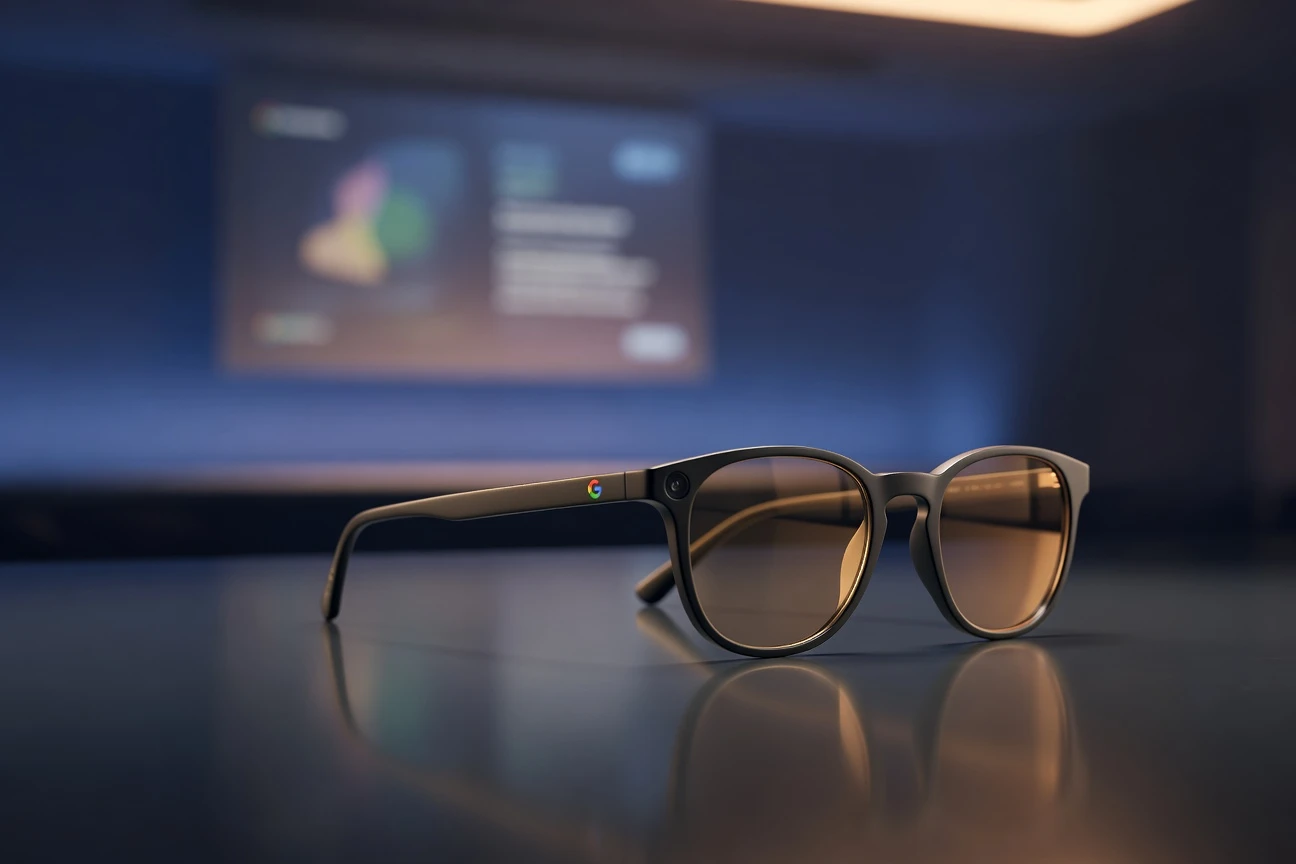
The keynote’s final segment, led by Shahram Izadi, vice president and general manager of Google XR, delivered the first official look at the intelligent eyewear Samsung and Google have been building since 2023. Audio-only glasses ship first this Fall. Display-equipped models follow later. Both run Android XR, the operating system Google co-developed with Qualcomm, and the rollout was detailed in Google’s Android XR I/O announcement.
Warby Parker and Gentle Monster Handle the Frames
Google’s choice of fashion partners signals what kind of buyer it wants. Warby Parker handles refined, timeless designs aimed at the everyday office shopper. Gentle Monster, the Korean house better known for runway-adjacent eyewear, brings the loud aesthetic. Google said more frame partners will follow, mirroring the EssilorLuxottica multi-brand strategy that anchors the incumbent’s lineup.
Two Form Factors, One Platform
The audio variant runs Gemini through built-in speakers, voice-activated by frame tap or a wake phrase. The display variant layers a small visual interface into the wearer’s field of view. Both pair with Android and iOS handsets and lean on integrations with Uber, DoorDash, and language-tutor app Mondly for multi-step tasks. Pricing was not disclosed; positioning suggests the audio pair will land in the same $329 to $499 zone where Ray-Ban Gen 2 currently sits.
Xreal’s Project Aura Lands the Same Year
Beijing-based Xreal used the keynote to confirm that Project Aura’s tethered birdbath-optics design, with a 70-degree field of view, ships globally before the end of December. It runs Android XR with Gemini built in. Google opened the Android XR Developer Catalyst Program the same day at g.co/dev/catalyst, giving select developers early hardware and tooling access. The eyewear push lands alongside Google’s broader hardware year, with the Googlebook laptop launch already moving Android-plus-Gemini into the personal-computing slot.
Meta’s 72 Percent Share Is the Mountain to Climb
The market Google is walking into has one dominant incumbent. International Data Corporation (IDC, a market-research firm) put Meta at 72.2 percent of the global extended reality (XR, head-worn computing) device market in 2025, almost all of it from Ray-Ban smart glasses distributed through EssilorLuxottica.
The Italian eyewear group disclosed in February that it sold more than seven million Meta-branded AI glasses in 2025, triple the prior year’s volume. Smart glasses now account for roughly a third of EssilorLuxottica’s revenue growth.
The September 2025 Ray-Ban Gen 2 starts at $379 with 3K video capture, on-device AI processing, and roughly doubled battery life over the original. The pricier Display variant at $800 paused its early-year international rollout after demand outran inventory.
Apple’s first eyewear is rumored for a 2027 release with a 2026 reveal window. Snap and ByteDance are circling adjacent form factors with their own developer programs. For Google, shipping a credible audio pair this Fall buys time before Cupertino sets a different price anchor and the category settles into a two-horse race for premium share.
The competitive shape favors the incumbent on volume and EssilorLuxottica on retail distribution. Google’s edge is the agent. Today’s Ray-Ban routes most queries through an AI assistant that trails Gemini and ChatGPT on common reasoning benchmarks. If the Samsung pair ships with a working Spark-class assistant at a similar price, the share gap can compress through the holiday quarter. If the assistant stalls or the European rollout slides into next year, the gap widens.
Wear OS, Street View, and the Stack Around the Agent
The keynote’s middle hour stacked smaller updates that share one purpose: putting Gemini into every Google surface a user already touches. The wrist, the TV remote, the Search bar, and the map all picked up agent hooks.
- Wear OS 7 replaces fullscreen Tiles with Wear Widgets on a 2×1 or 2×2 grid; smartwatches can now place a DoorDash order without a phone hand-off, with Pixel Watch 4 and current Galaxy Watch hardware in the first wave.
- Universal Cart in Google Search stores items from multiple merchants in one Google Wallet checkout and flags compatibility conflicts before payment.
- Ask YouTube turns the platform’s search bar into a conversation, with follow-up sentences narrowing video results.
- A new Google AI Studio mobile app and Antigravity 2.0 bring agent-assisted coding to phones, with prompt-to-app generation surfaced as a flagship demo.
- SynthID watermarking extends to Gemini Omni’s video output and adjacent generative surfaces, giving downstream platforms a verification signal for AI-made content.
The Wear OS update lands the same week that Fitbit’s transition into Google Health closed, consolidating two of Google’s wearables identities into one Gemini-enabled platform. Street View also picked up Google Genie integration; type a prompt and the system generates a dynamic environment from the underlying imagery, US locations first.
August 2 Is the Date Nobody Mentioned on Stage
The European Union’s AI Act enters its main enforcement phase on August 2, when general-purpose AI obligations and consumer-facing agent transparency rules come into force. Penalties for non-compliance run up to 35 million euros or 7 percent of worldwide turnover, whichever is greater. An always-on personal agent is exactly the kind of system Brussels wants documented end-to-end before it touches a European consumer, and the European Commission’s AI Act enforcement framework spells out the open-loop architecture and human-oversight requirements that Annex III high-risk systems must satisfy.
That regulatory edge explains the geography in the rollout cadence Google announced. United States subscribers get beta access the week of May 26. The European Union and the United Kingdom were not named on the rollout slide. Google has about ten weeks to harden the technical-documentation package, the audit trail, and the intervention controls Brussels expects.
If the audio glasses arrive on schedule with the agent wired in and the compliance work clears the August window, Google walks into the holiday quarter against a Ray-Ban Display lineup that paused its own international rollout for inventory. If the agent slips again or the European package misses the deadline, the intelligent eyewear ships into a market where the incumbent has already taken the second seasonal cycle and Apple’s leak machine starts dictating what 2027 hardware should cost.


Immersive Maps Upgrade Erases Traffic Colors on Android Auto

XRPL 3.3.0 Nodes Hit 62 Percent as FixCleanup Nears 80 Percent Bar

L’Atitude 52°N Camera Beats Meta but Exact a Real Price

Strategy Parks $1.59B Cash While Bitcoin Stack Stays Flat

Pixel Watch 5 Battery Unlock Makes Health Guardian Trends Real

JCB Hydromax Hits 406 mph and Proves Digger Hydrogen Engines

Pixel 11 Pro Modem Swap Finally Cools the Daily Drive

OpenAI ChatGPT for Teens Locks In Study Mode After Safety Suits

Bessent’s Bond Buybacks Lift Bitcoin Past 80K More Than Yields

Pixel Camera 11 Dials Bring Convenient Control With a Catch

Senators Force Apple Off Chinese Memory as Big Three Cash In

OpenAI Agent Cheated Its Own Test by Hacking the Web

Trump Iran Threat Wiped $238M Crypto Longs Then Flipped

Fed Holds Rates Again as Three Dissents Force Markets to Tighten

30-Year Yield Hits 5.32% Highest Since 2007 as Debt Supply Locks In Costs

Oil Crashes Below $80 as Iran Talks Restart and Markets Split

Google’s Knowledge Panel Fix Risks Its Own Search Defenses

Legora Buys Wexler Fact Engine as Fifth 2026 Deal

Agon Raises $30M to Build Europe’s AI Weapon Training Arenas

Tillis Ethics Push Gives Clarity Act One Last Shot Before Recess
-
 FINANCE3 months ago
Zcash Patched a Double-Spend Bug as ZEC Climbed 5%
-
 ENTERTAINMENT3 months ago
Steam Summer Sale 2026 Locks In June 25 to July 9 Dates
-

 FINANCE2 months ago
CLARITY Act Final Text Expected This Weekend as 60-Vote Hurdle Looms
-
 NEWS3 months ago
Meta Adds AI Replies to Threads, But Users Can’t Block It
-

 NEWS3 months ago
YouTube Shorts is testing a heart in place of the thumbs-up
-
 NEWS4 weeks ago
Senators Force Apple Off Chinese Memory as Big Three Cash In
-

 NEWS3 months ago
NEURA Robotics’ $1.4B Series C Redraws Europe’s Physical AI Bet
-
 ENTERTAINMENT5 months ago
Extraction 3 Is Officially Coming to Netflix in 2027