
NEWS
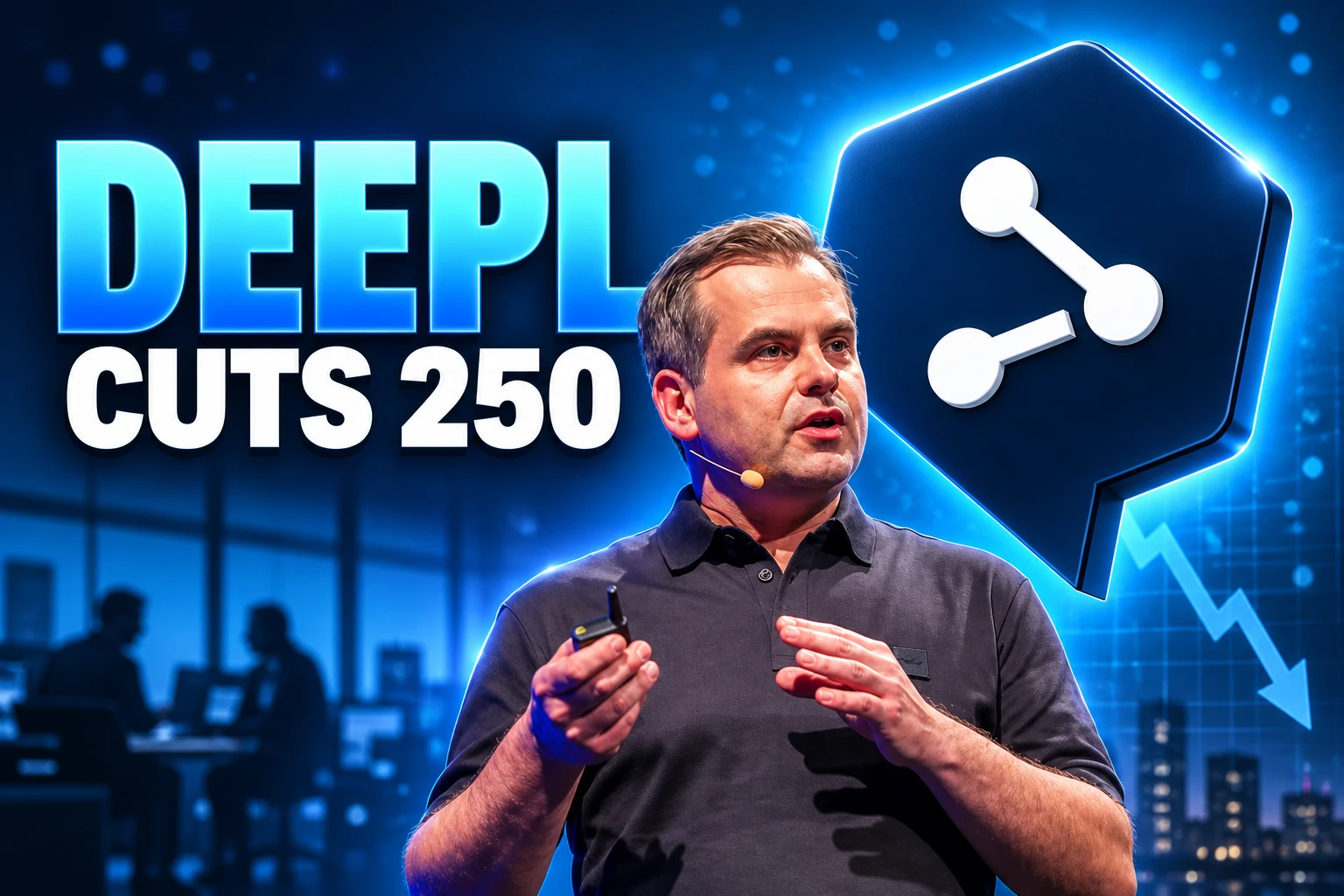
DeepL Cuts 250 Jobs as Mixhalo Takes the Voice Work
DeepL’s May letter cut about 250 roles as German staff neared a first works council vote, then brought Mixhalo in to run a San Francisco voice bet.

About 250 DeepL roles were put on the block on May 7, 2026, in a letter that already named Mixhalo and a San Francisco office. Founder Jarek Kutylowski called it a structural choice, not a rescue, and said it was the hardest of his career.
The people with the most at stake were not in that sentence. They were German staff heading into a first works council vote, and a small Bay Area audio team whose live-event stack would become DeepL’s voice bet.
The Same Letter Cut 250 Jobs and Hired Mixhalo
Kutylowski wrote that DeepL was reducing headcount by approximately 250 roles at DeepL, subject to local legal processes. The company employed more than 1,000 people at the time, so the cut was about a quarter of the payroll.
He framed the move as how an AI company has to run now. Smaller groups, he wrote, and sometimes one person, can do work that once took whole teams. AI would take the routine. People would keep judgment, new ideas, and the job of seeing a project through.
The same letter said DeepL would bring on Mixhalo, which he called a pioneer in audio streaming, and open a San Francisco office to push real-time voice translation. The May plan to cut 250 jobs and the Mixhalo hire were never two separate stories inside the company. They were one sequence.
He also said he would go deeper into founder mode and lead a small taskforce on how DeepL builds products, finds customers, and partners with them, with AI at the center. The phrases match a 2026 job-cut script used across tech: fewer layers, high-agency teams, founder mode. DeepL is an AI firm, so the script lands closer to home than it does at a bank.
THE SWAP ON THE CALENDAR
- May 7, 2026: Kutylowski posts the letter cutting about 250 roles and naming Mixhalo plus a San Francisco office.
- May 22, 2026: The German Startup Awards name him Founder of the Year in Berlin. He is not in the room.
- June 17, 2026: DeepL says the Mixhalo team and technology have joined and that its first San Francisco office is open.
Six weeks separate the cut and the close. Mixhalo was already in the May text. The June event was the public handshake, not the first mention.
German Staff Were About to Elect a Works Council
Verdi and IG Metall said the 250 roles were a large share of about 620 DeepL people in Germany. That is a different count from the global payroll of more than 1,000. If the cuts landed heavily in Cologne, the German office would shrink far more than the headline quarter.
The unions also said DeepL had slowed a first works council election. Lists were in by late May, they said, and a vote could still happen at the end of that month, after the company delayed staff data and missed deadlines. Jan Brauburger of IG Metall Berlin put the timing in one line.
That immediately before the first-ever election of a works council a substantial part of the German workforce is to be dismissed is a slap in the face for the employees who made the company what it is.
Jan Brauburger, IG Metall Berlin
Markus Frings of Verdi in Cologne, Bonn and Leverkusen told a local paper staff still felt some fear about standing for the council, even with legal shields. Anyone who issues hundreds of notices and slows a council vote, he said, sends a clear signal. He also called the AI-team story a pretext.
WHAT THE UNIONS PUT ON THE RECORD
- German headcount: About 620 DeepL staff in Germany, with 250 roles described as a substantial part of that group.
- First council: DeepL had never had a German works council; nominations were finally filed in May.
- Process fight: Verdi and IG Metall said staff data was held back and legal deadlines were missed.
- New posts elsewhere: The unions said new jobs were due at other European sites as San Francisco opened.
DeepL rejected the charge. It said it supports the right of staff to organize and form works councils, that the dismissals had no link to the election, and that it had followed German law. Kutylowski’s letter had already said the cuts were subject to local legal processes, which in Germany can mean hearings, a social plan, and months of procedure.
By early September 2026 the company had not published a closing tally of who left. LinkedIn-style headcounts still bounce around third-party databases. The number that remains on the record is the one in the letter: about 250 roles.
What Mixhalo Brings to DeepL Voice
On June 17 DeepL said the Mixhalo team and technology have joined. Mixhalo, founded in 2016 in San Francisco by guitarist Mike Einziger of Incubus, violinist Ann Marie Simpson-Einziger, and technologist Vik Singh, built a way to send high-quality sound to thousands of phones at once, with almost no lag.
Singh said the product was built to hit live audiences of any size all within 20 milliseconds. When Mixhalo moved into live translation, he said, the hard part was finding a language engine that could keep up without wrecking quality. After testing almost every major provider, he said, DeepL was the only one that was both accurate and fast enough.
The team has solved one of the hardest problems in live audio, which is delivering high-fidelity sound to thousands of people at once with basically zero latency.
Jarek Kutylowski, Founder and CEO, DeepL press release, June 17, 2026
Mixhalo listings put the firm in the 11 to 50 staff range, with about 25 people on its company page, against DeepL’s more than 1,000. CB Insights records that Mixhalo raised a total of $34.7 million before the sale, including a $24 million Series B in December 2021. Terms of the DeepL deal were not disclosed. Mixhalo had already been a DeepL customer; Singh has said talks started when he sat next to DeepL chief technology officer Sebastian Enderlein at a customer dinner.
TWO FIRMS, ONE JUNE DEAL
| Attribute | DeepL in May 2026 | Mixhalo at the deal |
|---|---|---|
| Base | Cologne, Germany | San Francisco, United States |
| Founded | 2017 | 2016 |
| Staff | More than 1,000 | A few dozen |
| Last disclosed capital | $300 million round at a $2 billion value, May 2024 | $34.7 million raised in total |
| Core product | Language AI, including DeepL Voice | Ultra-low lag live audio to phones |
The audio stack is the asset. Mixhalo’s own site and DeepL’s release list a run of rooms where lag is fatal.
WHERE MIXHALO ALREADY RAN LIVE SOUND
- Sport: MLB, NASCAR, the Sacramento Kings, and other league and venue work.
- Telecom and brand: Verizon, T-Mobile, Equinox, and TSX.
- Conferences: CES, Mobile World Congress, Salesforce events, the Databricks AI Summit, and Microsoft AI Tour Paris.
- Music: Metallica, Aerosmith, Sting, Charlie Puth, and Red Rocks.
DeepL’s AI Labs page on the real-time audio layer for voice translation describes Mixhalo as streaming a snare hit to a stadium faster than the sound wave itself. DeepL’s models, it says, then translate that stream end to end with no extra API hop. Head of Voice Leo Doin and Singh are named as the pair on latency.
At least one person who had owned Voice API work was among those let go in May, even as Mixhalo was being hired to speed Voice. The company never published a department breakdown, so that remains one named case, not a map of the 250. It still shows the swap was not cleanly “support out, voice in.”
Today we announced an important addition to DeepL. We’re bringing the team from @Mixhalo and their high-fidelity, ultra-low latency, audio streaming technology onto the DeepL platform. It’s going to rapidly accelerate our roadmap for DeepL Voice: human, nuanced spoken… pic.twitter.com/7WKrXvGKc4
— DeepL (@DeepLcom) June 17, 2026
San Francisco Is the Market the Cuts Help Fund
The Mixhalo close was also DeepL’s first San Francisco office. Kutylowski’s letter called the United States an important market. The June release went further: it is DeepL’s fastest-growing market, nearly 50% of the Fortune 500 are DeepL users, and US accounts already include NVIDIA, Cisco, and Nasdaq.
Index Ventures led a $300 million round on May 22, 2024, that valued DeepL at $2 billion. Benchmark and IVP sit on the backer list DeepL still cites. That money was raised to hire and to expand. Twenty-four months later the same founder was taking about a quarter of the company out and planting a flag in the Bay Area through Mixhalo’s home base.
Enderlein called Voice AI a fight for latency, quality, and real-world reliability. Mixhalo, he said, knows how to put APIs and audio gear into live rooms where delay is failure, and San Francisco puts DeepL closer to the customers and developers shaping the next products. For Cologne staff, that is a map of where the next headcount is allowed to grow.
Unions said new posts were also planned at other European sites. DeepL did not list those cities in the Mixhalo release. The office it did name is San Francisco.
Kutylowski Missed the Night He Was Named Founder of the Year
Fifteen days after the letter, the German Startup Awards in Berlin named Kutylowski Founder of the Year. The jury cited DeepL’s language tools. He did not collect the prize in person. Chancellor Friedrich Merz did attend, and told about 600 people in the startup scene that Germany should roll out a red carpet for young firms.
Verdi and IG Metall issued their works council statement the next day. Frings granted that Kutylowski had earned a prize for the business idea, then drew a line under how the staff were treated.
He will not, however, receive the prize for the best treatment of employees. I hope he took the award with the thought that property entails obligation.
Markus Frings, Verdi Köln-Bonn-Leverkusen
Frings also said people still in the building like the work and are paid well, and that the mood is mixed. That tracks the letter’s own split. Kutylowski thanked those leaving, then told those staying they would have to stop being pure specialists and start thinking like builders who own what happens next. He compared that shift to his own move from engineer to founder.
DeepL still sells the same mission he opened with: language should not cap how far a business can go. The argument inside the firm is who gets to stay on that mission, and from which city.
Stadiums and Call Centers Are the New Translation Desk
Text translation is no longer a moat you staff like a 2021 startup. General chat models now do a passable job for casual use. DeepL’s counter is spoken language in rooms where a delay of a beat breaks the night: a stand-up, a support call, a keynote, a race.
DeepL cites a 2026 Slator review that scored DeepL Voice 96.4 out of 100 on quality for spoken conversations, ahead of Microsoft Teams, Zoom, and Google Meet, with a 4% fail rate against a 17% market average. Those figures come from DeepL’s own Mixhalo release, which points to Slator’s assessment of AI-translated captions.
VOICE FIGURES DEEPL IS USING
- Quality score: 96.4 out of 100 in Slator’s 2026 review of real-time voice translation.
- Fail rate: 4% for DeepL Voice, against a 17% market average in that review.
- Audio budget: Mixhalo’s target of 20 milliseconds for live sound to a phone.
- Reach: More than 200,000 business teams on DeepL’s platform, per the June release.
A June 10 product note said the Voice API can transcribe and translate speech into up to five languages at once, from a set of 45. Speech-to-text is generally available for paid API customers; speech-to-speech sat in a beta program. Mixhalo Translate already ran on the DeepL Voice API. The firms are also testing support use cases on Amazon Connect, where a translated agent has to feel present, not dubbed.
DeepL said audiences would see the stack at GITEX Europe at the end of June 2026, with live German-to-English captions on the main stage, and later at the Databricks summit, Esri’s user conference, and Salesforce Dreamforce. On August 24 it was still posting from AI Labs about Singh and Doin on the audio layer, including live sport in any language.
Two days after the Mixhalo release, Kutylowski was at VivaTech in Paris describing a meeting in which each person speaks their own language and hears everyone else in theirs. If you run a French firm, he said, you should be able to sell in Germany tomorrow without wasting a moment on the German language. He still told the same audience that learning a language is worth it, because you learn the culture with it, and that he has his eye on Japanese.
Cologne remains the legal home. San Francisco is where the new audio team sits. About 250 people were told they no longer fit the firm that wants to own that gap. The works council vote the unions were pushing for in May was the first formal way those staff could answer him, and DeepL says that fight and the cuts are not connected.

UPI MDR Delay Hands Traders the Calendar After Paytm Falls

Google Messages Builds Nine In-Chat Games After Samsung’s Exit

Anthropic’s $100 Million Academy Trains the Firms That Bill Both Sides

Toyota’s Electric C-HR Leaves the Cheap Twin to Subaru

Markets Bet the Fed Skips October After Hawkish Minutes

The Orchard Bug Forced Zcash to Open an Empty Pool

The $5.99 Game That Won Steam’s 2026 Summer Sale

Don Lee Joins Hemsworth as Extraction 3 Starts Shooting

YouTube Shorts Retires Dislikes and Swaps Likes for Hearts

NEURA Robotics Is Spending Its $1.4B on a Machine Stack
-
 NEWS4 months ago
The Orchard Bug Forced Zcash to Open an Empty Pool
-
 GAMING4 months ago
The $5.99 Game That Won Steam’s 2026 Summer Sale
-
 ENTERTAINMENT6 months ago
Don Lee Joins Hemsworth as Extraction 3 Starts Shooting
-
 NEWS4 months ago
YouTube Shorts Retires Dislikes and Swaps Likes for Hearts
-
 NEWS4 months ago
NEURA Robotics Is Spending Its $1.4B on a Machine Stack
-

 AUTO6 months ago
Kawasaki Bets the New Z1100 Against Its Own Supercharger
-

 BUSINESS5 months ago
Norway’s Export Bank Backs Nscale’s $790 Million Narvik Loan
-

 GAMING4 months ago
Game of Thrones Dragonfire Follows Boston’s Conquest Playbook