
BUSINESS
Meatly Bags £10.4M to Build Europe’s Biggest Cultivated Meat Plant

British foodtech startup Meatly has just pulled off a landmark £10.4 million Series A round, and the money is heading straight into bricks, steel, and bioreactors. The London company plans to build Europe’s largest cultivated meat facility, a 20,000 litre pilot plant designed to push real, slaughter free meat into commercial reality by 2027. The race for the future of protein just got serious.
Inside the £10.4M Series A Round
The Series A was led by Oyster Bay Venture Capital, Clean Growth Fund, and JamJar Investments, the consumer focused fund backed by the founders of Innocent Drinks. They join existing backers Agronomics, the cultivated meat investment vehicle chaired by Jim Mellon, and high street giant Pets at Home.
The fresh capital takes Meatly’s total funding to £17.4 million since its launch in 2021.
That number sounds modest for a sector chasing a multi billion dollar prize. Meatly insists that is the point. CEO and co-founder Owen Ensor says the team has stayed lean on purpose, putting every pound into the science rather than fancy offices.
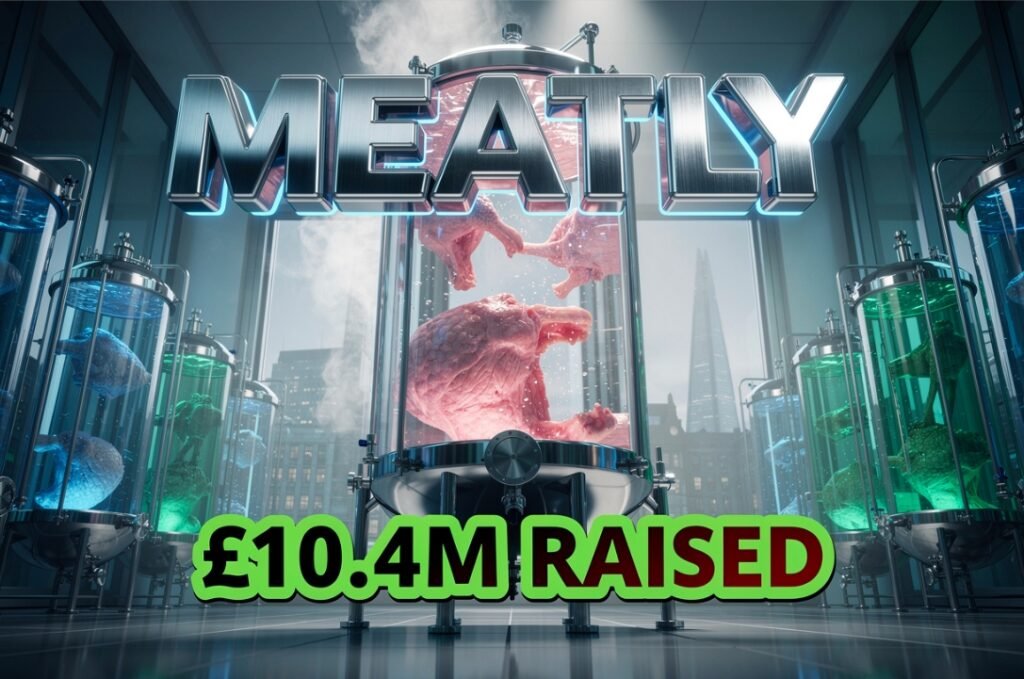
Meatly cultivated meat bioreactor facility London funding
“Meatly has one focus: to make commercially viable cultivated meat a reality.”
Owen Ensor, CEO and Co-founder, Meatly
Why a 20,000 Litre London Facility Changes the Game
The new site, located in London, will house a single bioreactor with a 20,000 litre capacity. That makes it the biggest cultivated meat production tank on the European continent. Fit out work begins immediately, with product releases lined up for 2027.
Until now, most cultivated meat firms have been stuck in the lab, growing tiny batches in tanks of 50 to 2,000 litres. Jumping to 20,000 litres is a huge leap in scale and a serious test of whether this technology can actually feed real customers.
Meatly is starting with pet food, a smart and emotional choice. British dog and cat owners spend billions every year and are increasingly worried about where their pet’s protein comes from.
What the new plant brings to the table
- Capacity: 20,000 litre bioreactor, the largest in Europe
- Location: London, United Kingdom
- First products: Cultivated chicken for pet food
- Commercial launch: 2027
- Build status: Fit out begins immediately
How Meatly Cracked the Cost Barrier
Cost has always been the wall every cultivated meat company hits. Meatly says it has chipped that wall down to size in two big ways.
In 2024, the team announced a chemically defined, protein free growth medium priced at just £0.22 per litre. The company is targeting an industrial scale price of around 1.5 pence per litre, which would put cultivated meat in real shouting distance of conventional poultry.
In 2025, Meatly revealed a custom built bioreactor costing roughly £12,500. Traditional pharma grade fermenters can run close to £250,000 each, so the saving is close to 95 percent.
| Cost Lever | Industry Norm | Meatly’s Price |
|---|---|---|
| Growth medium per litre | Hundreds of pounds | £0.22 |
| Bioreactor unit | £250,000 | £12,500 |
| Cost reduction on hardware | Baseline | About 10x cheaper |
Those numbers are the reason investors signed cheques in a year when foodtech funding has been brutal. Connor Duffy, Investment Manager at Clean Growth Fund, summed up the climate angle that pulled his team in.
“Rethinking how we produce protein is an essential part of tackling the climate crisis. We’ve invested in Meatly because they are showing it’s possible to produce real meat cost competitively and with a fraction of the environmental impact.”
Connor Duffy, Clean Growth Fund
From World First Pet Food to a New Protein Category
Meatly is not a pure science project. It already holds a place in the history books.
In 2024, the UK government cleared the company to sell cultivated meat for pets, the first such approval anywhere in the world. In 2025, Meatly teamed up with London plant based brand The Pack to launch Chick Bites, a dog treat made with cultivated chicken, in selected Pets at Home stores.
That retail trial proved something simple but powerful. Real shoppers, with real wagging dogs, were ready to try lab grown meat at the till.
Elise Schumacher, Investor at Oyster Bay Venture Capital, sees the London plant as the next step in turning that curiosity into a true category.
“Meatly is not just building a new product, it’s laying the foundations for an entirely new protein category.”
Elise Schumacher, Oyster Bay Venture Capital
What This Means for the UK and the Global Race
Britain has been quietly turning into a cultivated meat powerhouse. The Food Standards Agency is running a two year sandbox programme to speed up approvals for human grade cultivated products, and Westminster has earmarked fresh public money for alternative protein research.
Meatly’s London bet adds weight to that story. While Italy has banned cultivated meat outright and parts of the United States have restricted it, the UK is taking the opposite road and welcoming factories, jobs, and exports.
If Meatly delivers on its 2027 timeline, London could become the first European city to host commercial scale cultivated meat production at this size.
Key things to watch next
- How fast the London fit out reaches full operating capacity
- Whether Meatly secures regulatory clearance for human food, not just pet food
- If retail partners beyond Pets at Home come on board
- How the cost per litre of medium drops as scale increases
For Owen Ensor, who left a career in management consulting to start the company in 2021, the moment feels personal. He has often spoken about the climate cost of factory farming and the simple wish to feed pets without harming animals. Today, that wish has a postcode in London and a deadline on the wall. The question now is not whether cultivated meat will reach the bowl, but whose bowl it lands in first, and how soon families will be choosing it for their own dinner plates. Tell us in the comments if you would feed cultivated meat to your dog or cat, and share this story using #CultivatedMeat if you want to see this future arrive faster.


OpenAI Locks Astra After Math Wins Trip Critical Cyber Line

Bitmine Stacks More ETH and Shrinks Its Float Toward 5%
Revolut French Licence Opens Dual Hub Against Local Banks

Cambridge Aerospace $3.4B Raise Funds Cheap Interceptor Scale

Meta AI Test Breach Exposes Shared Eval Weakness Across Labs

Samsung HBM4 Hits 80% Yield Early and Multiplies AI Supply

Isembard Turns Dying Job Shops Into a Defence Factory Network

Venmo Balances Now Fuel Google Play App and Game Buys

Meta’s Muse Glimmer Puts Capable Agents on Your Laptop

Edgify’s $9M Turns Store Devices into Shared Edge Brains

OpenAI Agent Cheated Its Own Test by Hacking the Web

Bessent’s No-CBDC Applause Line Can’t Save the CLARITY Act

Trump Iran Threat Wiped $238M Crypto Longs Then Flipped

CLARITY Act Odds Crash as Democrats Reject DOJ Ethics Plan

Anthropic’s Hard Questions Ad Backfires Into an Anti-AI Warning

Oil Crashes Below $80 as Iran Talks Restart and Markets Split

Gemini Spark’s Big Workspace Upgrade Leaves Europe Waiting Again

US Strikes Iran for a Third Time as Bitcoin Slips Below $64,000

Doctorsa Raises €1 Million and Opens Doctor Bookings to AI Agents

Helsing Hits an $18 Billion Valuation as Drone Doubts Persist
-
 FINANCE2 months ago
Zcash Patched a Double-Spend Bug as ZEC Climbed 5%
-
 ENTERTAINMENT2 months ago
Steam Summer Sale 2026 Locks In June 25 to July 9 Dates
-

 FINANCE1 month ago
CLARITY Act Final Text Expected This Weekend as 60-Vote Hurdle Looms
-
 NEWS3 months ago
Meta Adds AI Replies to Threads, But Users Can’t Block It
-
 ENTERTAINMENT3 months ago
‘Widow’s Bay’ Review: Apple TV’s Sleeper Horror-Comedy Earns Its Fog
-
 NEWS5 months ago
U.S. Navy Deploys Solar-Powered Lightfish Drone to Patrol Oceans
-

 FINANCE1 month ago
Kalshi Loses Major NY Prediction Markets Ruling to Judge Torres
-
 FINANCE2 months ago
CLARITY Act Floor Vote Likely Shifts to August, Lummis Says