
BUSINESS
Fleek Lands $25M to Build the AI Plumbing Behind Secondhand Fashion
London startup Fleek raised a $25M Series B led by Burda to scale its AI marketplace and Fleek Sort model for the global secondhand clothing trade.

Fleek, the London startup building AI plumbing for the global secondhand clothing trade, has closed a $25 million Series B led by Burda Principal Investments, the German media group that was an early backer of Vinted. The round, announced on July 8, brings Fleek’s total funding to $45 million and adds eBay, FJ Labs and H14 to a cap table that already includes Andreessen Horowitz, HV Capital and Y Combinator. The company declined to disclose its valuation following the funding. The new capital will fund an AI-native marketplace, expand engineering teams and grow the supplier and buyer network behind a platform that says it now connects more than 2,000 verified wholesale suppliers and graders with over 50,000 retailers, resellers and boutiques across more than 100 countries.
This is not another consumer resale app chasing thrifting shoppers. The bet Burda is underwriting is the B2B rail beneath them.
The $25M Round, and What Burda Is Buying
Burda Principal Investments led the round, and the firm’s managing director for Europe framed the wager in terms that lean on the firm’s own history.
We backed Vinted when secondhand fashion was still considered niche. We know what it takes to build a platform that scales in this market. From its growing supplier network to the technology behind it, Fleek is building the infrastructure the next generation of fashion will rely on.
Julian von Eckartsberg, Burda’s managing director for Europe, said the German media group’s venture arm had led the Series B.
Vinted, the Lithuania-headquartered resale marketplace, raised capital from Burda in its early rounds and has since grown into a public company with a multibillion-euro market capitalisation. The pitch at Fleek is that the next wave of secondhand-fashion value will not be captured by another consumer marketplace, but by the software layer that moves inventory between wholesale suppliers and the retailers who stock vintage shelves. Vinted is, in effect, a customer of that layer. Fleek’s platform sits upstream of it.
Of the new $25M, Fleek says it will be spent on three priorities: developing Fleek Sort, the company’s in-house computer vision model; expanding the engineering team; and broadening the network of buyers and sellers. The company is also extending Fleek Sort from still images to video and is studying how the model could eventually sit on conveyor belts in large sorting facilities, though co-founder and CTO Sanket Agarwal cautioned in Fortune’s reporting that robots sorting garments at human speed remain a way off.
A Hand-Sorted Industry Meets a Computer-Vision Model
The infrastructure Fleek wants to replace is, by any reasonable standard, analogue. Every year, up to 24 billion secondhand items travel from donation bins in cities such as London, Paris and New York to sorting and grading centres scattered across the world. Inside a $200bn-plus industry, garments are still assessed by hand, graded to inconsistent standards, and traded through disconnected networks with little pricing transparency.
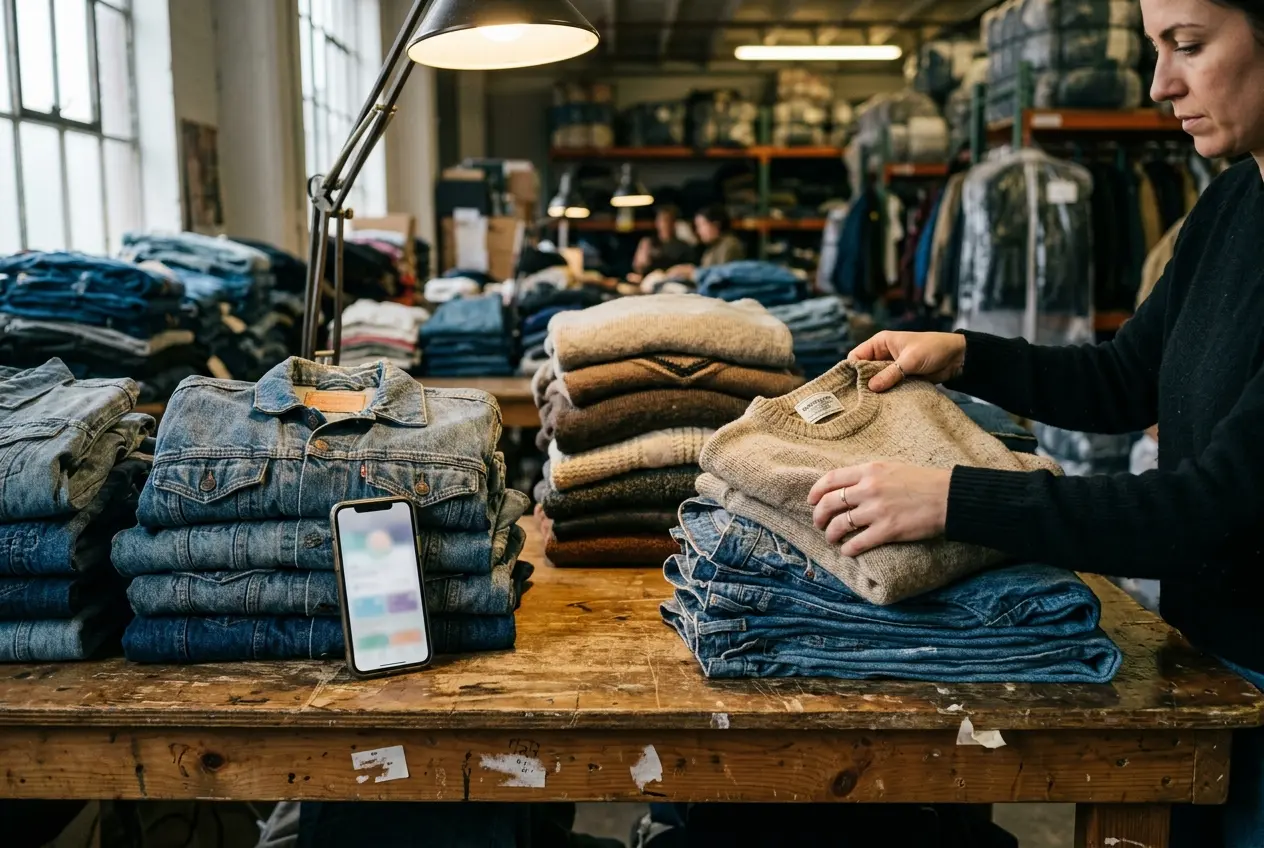
Fleek Sort is the wedge. The model is trained on millions of secondhand transactions gathered from the company’s own marketplace over four years. A grader photographs a garment with a smartphone, and the model identifies its brand, style and category, flags defects such as rips or faulty seams, and produces both a price estimate and a time-to-sale forecast. Fleek says its largest wholesale partner moves some 600,000 pounds of clothing a day, a volume that pushed Fleek to build the model in-house rather than rely on third-party APIs, which would have been too expensive at that throughput.
Deployment has already moved beyond pilots. Fleek Sort is in use by graders in sorting hubs in Pakistan, India and Dubai, with additional pilots launching in the UK, Europe and the US. Quality-check centres in Karachi and Delhi inspect items from brands and categories the data has flagged as frequently counterfeited, addressing an authenticity gap that pure computer vision cannot yet close.
Once Fleek Sort has categorised a batch, inventory is listed on Fleek’s marketplace, where AI-powered pricing, search, recommendation and matching tools connect suppliers with buyers globally. Every transaction generates new data, which the company describes as a proprietary intelligence layer for an industry that has captured very little of its own.
There’s more data locked inside the global secondhand supply chain than almost any other market, yet historically very little of it has been captured.
Sanket Agarwal, Fleek’s co-founder and CTO, said the company had built the first AI trained specifically to read used inventory, its worth and the demand behind it.
Why Burda Sees a Repeat of Vinted
Burda’s investment thesis is straightforward: it is the same fund, the same sector, one cycle later. The German firm first backed Vinted when secondhand fashion was still considered niche. Vinted has since grown into one of Europe’s most valuable consumer resale companies, and Burda has institutional memory of what scaled.
The argument now is that the second-hand market is hitting the same kind of wall Vinted once faced: demand is running ahead of supply. Secondhand fashion is growing about three times faster than traditional apparel, and the bottleneck is no longer consumer demand. It is upstream inventory. Arora told Fortune that supply is the biggest constraint in the industry.
That constraint is what Fleek’s B2B play is designed to relieve. Fleek does not compete with Vinted, Depop or eBay for end shoppers. The company sells tools and a marketplace to the wholesale suppliers and graders who feed those consumer platforms. If Burda’s Vinted bet was about owning the consumer interface, this bet is about owning the rail that interface depends on.
The participant list in the Series B is built for that argument. eBay’s involvement gives Fleek a foothold with one of the largest secondhand marketplaces in the world. FJ Labs, an investor known for backing marketplace businesses, brings operator experience. H14, Andreessen Horowitz, HV Capital and Y Combinator are all repeat backers, which signals continuity rather than a fresh speculative bet.
A Supply Squeeze Reshapes the Whole Stack
The investment lands inside a sector that is being pulled in two directions at once. Consumer demand for resale is rising, while supply is being squeezed by new regulations and by the cost economics of the brokers who sit between donation bins and shelves.
EU rules that went into effect last year require member states to collect textiles separately for recycling, and additional regulations about to come into force prohibit retailers from junking unsold inventory. Both shifts are designed to push more clothing into the channels Fleek serves. Comparable policy pressure is reshaping adjacent infrastructure plays, with Berlin-based reverse.fashion closing a seven-figure HTGF extension to scale its own AI textile sorting platform as the same mandates reshape fashion.
The cost of acquiring supply is also rising. Fleek’s origin story is anchored in one of those costs: the owner of a Brick Lane vintage shop in London’s East End told Arora she was closing her store after being scammed out of more than $15,000 by an online broker, having lost the buying trips to Asia and the Middle East that had once fed her shelves. That conversation is what put Arora and Agarwal on the path to founding Fleek in 2021.
Arora frames the company in larger terms.


NFL Preseason Week 2 Quietly Tests the Schemes That Matter

Alonso’s Towering Drive Stands Foul and Flips Orioles Momentum

US Debt Crosses $40 Trillion as Interest Crowds the Budget

Trevon Diggs Joins Seahawks on One-Year Deal After Cowboys Exit

Pixel Watch 5 Turns Passive Trends Into Early Health Alerts

Pixel 11 Pro Fold Sleek Build Undercuts Its Own Unfolding Appeal

Tugboat Wilkinson’s Scoreless Debut Pays Off Giants’ Bailey Trade

Brown Shines for Pats as Love for Eagles Meets Trade Reality

Pixel Watch 5 Turns Wrist Data Into Early Metabolic Alerts

Resistance Stars Pay the Price in Democratic Primaries

Senators Force Apple Off Chinese Memory as Big Three Cash In

OpenAI Agent Cheated Its Own Test by Hacking the Web

Trump Iran Threat Wiped $238M Crypto Longs Then Flipped

30-Year Yield Hits 5.32% Highest Since 2007 as Debt Supply Locks In Costs

Fed Holds Rates Again as Three Dissents Force Markets to Tighten

Oil Crashes Below $80 as Iran Talks Restart and Markets Split

Google’s Knowledge Panel Fix Risks Its Own Search Defenses

Agon Raises $30M to Build Europe’s AI Weapon Training Arenas

Legora Buys Wexler Fact Engine as Fifth 2026 Deal

Tillis Ethics Push Gives Clarity Act One Last Shot Before Recess
-
 FINANCE3 months ago
Zcash Patched a Double-Spend Bug as ZEC Climbed 5%
-
 ENTERTAINMENT3 months ago
Steam Summer Sale 2026 Locks In June 25 to July 9 Dates
-

 FINANCE2 months ago
CLARITY Act Final Text Expected This Weekend as 60-Vote Hurdle Looms
-
 NEWS3 months ago
Meta Adds AI Replies to Threads, But Users Can’t Block It
-

 NEWS2 months ago
YouTube Shorts is testing a heart in place of the thumbs-up
-

 NEWS2 months ago
NEURA Robotics’ $1.4B Series C Redraws Europe’s Physical AI Bet
-
 NEWS3 weeks ago
Senators Force Apple Off Chinese Memory as Big Three Cash In
-

 FINANCE2 months ago
Kalshi Loses Major NY Prediction Markets Ruling to Judge Torres