
NEWS
NEURA Robotics Is Spending Its $1.4B on a Machine Stack
NEURA’s up to $1.4 billion Series C is already buying Tether wallets, Italian compute boards, and other robots for one shared physical AI stack.

NEURA Robotics announced a Series C of up to $1.4 billion on June 10, 2026, led by Tether, to scale its physical AI platform from Metzingen.
The cheque is already buying more than a humanoid line. Tether is putting wallet software and on-device AI inside the machines, and since June the German firm has been folding other robots onto that same stack.
Tether Is Wiring Wallets Into the Robots
Tether Investments said it led one of the largest private rounds in humanoid robotics and will also ship its own tools into the Neuraverse, NEURA’s software layer that is meant to connect robots, models, data and services. The stablecoin issuer wants machines that can think on the device and settle a job without a human in the payment chain.
NEURA’s robots are expected to take Tether’s open-source Wallet Development Kit, so a unit can hold a self-custodial wallet and take pay for a finished task inside set limits. Settlement, Tether wrote, becomes part of the workflow rather than a separate office process. The same package adds QVAC, Tether’s edge-first AI runtime, so models can run on the robot instead of waiting on a distant cloud.
Autonomous machines need the ability to process information locally, make decisions, and transact without relying on centralized intermediaries. QVAC brings that edge-first intelligence to the platform while WDK handles the secure financial layer, together enabling machines to execute tasks, account for outcomes, and operate independently.
Paolo Ardoino, CEO of Tether, Series C announcement
David Reger, NEURA’s founder and CEO, backed that pitch on Tether’s own release, talking about machines that “coordinate, transact, and create value” in what he called the machine economy. That is a different product than a walking demo. It is also a product that only works if the robot finishes real work, invoices it, and stays up.
Tether published the same claim on its account the day the round landed.
Tether is leading a landmark Series C financing round of up to $1.4 billion for NEURA Robotics, @NEURARobotics , representing one of the largest private investment rounds in humanoid robotics history.
As robotics moves into true autonomy, payment and compute systems must evolve.… pic.twitter.com/NF3hO5hnke
— Tether (@tether) June 10, 2026
The louder test is whether this capital becomes robots that keep working on a factory floor. A wallet in a machine that cannot complete a shift is just software on a stand.
Italian Boards for a German Humanoid
On September 7, 2026, NEURA and SECO S.p.A. of Arezzo said they would design, engineer and manufacture compute modules for cognitive robots, including the 4NE1 humanoid. The boards carry Qualcomm Dragonwing processors and are meant to be developed and produced in Europe.
NEURA describes a Brain and Nervous System layout it calls Smart Limbs. Sensing and compute sit near the joints so an arm can react without a round trip to a single central box. Qualcomm Technologies is already an investor in the Series C, so the chip in the limb and the name on the cap table are the same firm. A German company still designs the robot. An Italian firm now builds the board. An American company still designs the chip. That is the European physical AI stack as it actually exists.
The two firms also said they would gather factory data as NEURA robots go into plants, with a first target in semiconductor and electronics making, and they sketched a NEURA Gym in Italy as the first training hub in Southern Europe. That gym is a plan, not an open hall. Reger said physical AI “will not be built by a single company” and that it needs sensing, compute, cloud and factory skill in the same chain.
A new step forward in scaling Physical AI from Europe. We are glad to welcome a new partner to our ecosystem.
We're joining forces with SECO, an Italian company with deep expertise in embedded and edge AI computing, to help bring our cognitive robots, including our humanoid… pic.twitter.com/YJe96ZbVNi
— NEURA Robotics (@NEURARobotics) September 7, 2026
Boards in series are the unglamorous half of a humanoid. They are also the half a $1.4 billion story has to clear before anyone should talk about millions of units.
Cleaning Robots and Factory Shuttles Join One Stack
The September boards sit on a summer of purchases that make the same point. NEURA is not only trying to stamp out 4NE1 bodies. It is buying machines that already roll through plants and hallways, then promising to hang them on Neuraverse.
HOW THE ROUND HAS BEEN SPENT SO FAR
- July 22, 2026: Announces a new NEURA Gym with RWTH Aachen, expanding the real-world training network it said the Series C would fund.
- August 13, 2026: Agrees to take Bosch Rexroth’s ACTIVE Shuttle automated guided vehicle, with the handover set for October 1, 2026, including hardware, software and service.
- August 24, 2026: NEURA Mobile Robots acquires 100 percent of ADLATUS Robotics of Ulm, a cleaning-robot maker with hundreds of systems already installed, 11 days after the Shuttle deal.
- September 7, 2026: Signs SECO to put Dragonwing compute modules into series production for cognitive robots, including 4NE1, and flags an Italian Gym.
On the ADLATUS release, NEURA said the aim was to bring different robots and jobs onto shared physical AI infrastructure, “turning intelligence from individual machines into a scalable platform.” Cleaning floors and hauling totes are not as photogenic as a humanoid bow. They are jobs with installed bases, service contracts and maps of real buildings. If Neuraverse is real, those fleets are how it gets data. If it is not, they are a roll-up with a new label.
The $1.4 Billion Figure Is a Ceiling
NEURA’s own newsroom called the round an up to $1.4 billion Series C and “the largest of a full-stack robotics company ever.” “Up to” is doing work. People familiar with the terms have said part of the package depends on performance targets the firm has not published. The company also did not put a valuation in the release. People familiar with the terms have put that mark at about $7 billion.
That still dwarfs NEURA’s own last round, a €120 million Series B in January 2025, 17 months earlier. It does not, on its own, put millions of walking machines on the floor. The firm said its order book and strategic deployment pipeline already exceed $1 billion. It has not said how many robots it has shipped against that book.
THE FIGURES NEURA HAS PUT ON THE RECORD
- Round ceiling: Up to $1.4 billion Series C, dated June 10, 2026, with Tether as lead.
- Booked work: Order book and deployment pipeline above $1 billion, a company figure.
- Output target: Serial production aimed at several million robots by 2030.
- Prior round: €120 million Series B in January 2025, before this ceiling.
When the company first set out the round that put it into Europe’s physical AI funding race, it listed a claim about global rank next to a production goal. Rank is a press line. Output is a factory problem. Those are not the same test.
What the 4NE1 Is Built to Carry
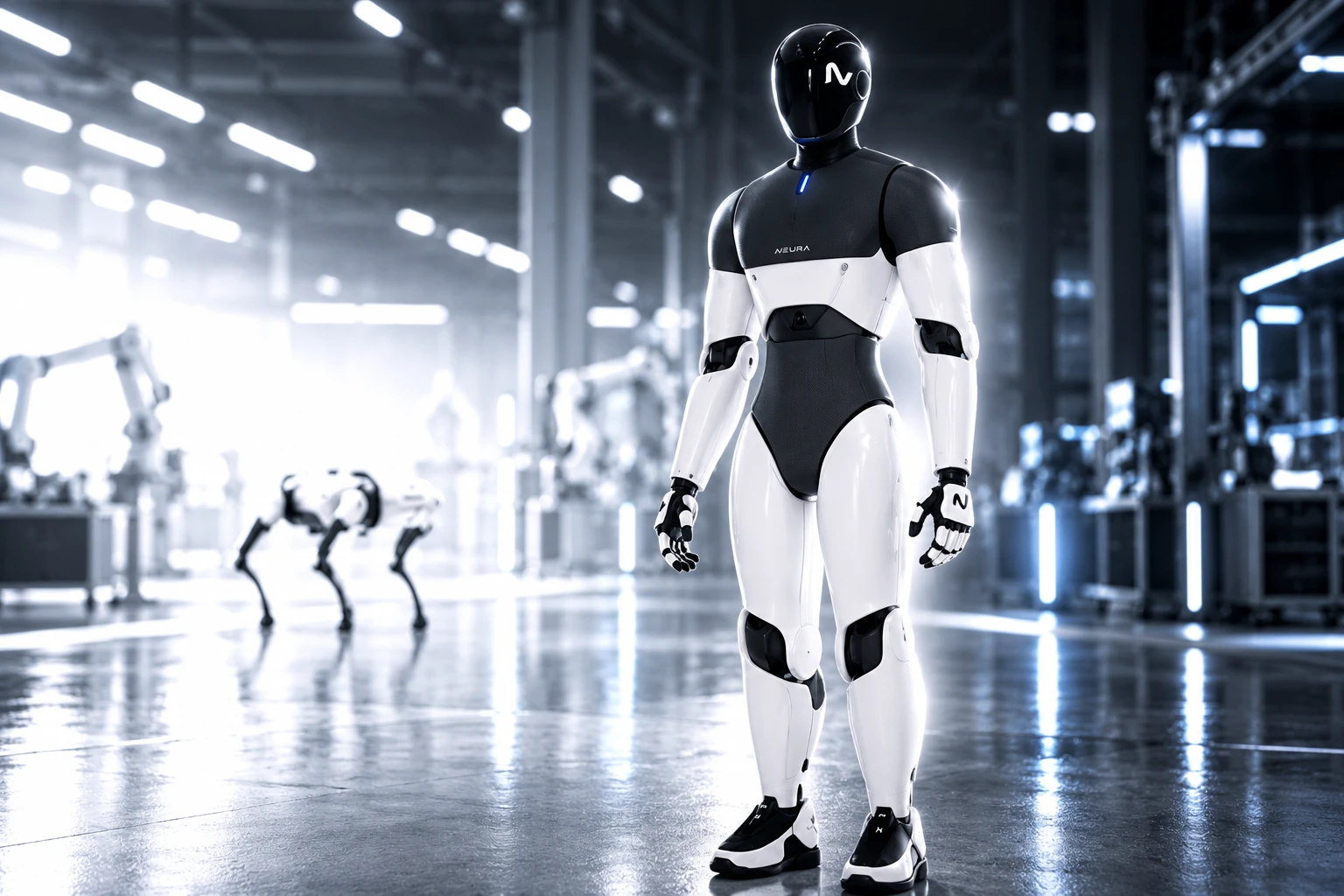
The humanoid that keeps showing up in the releases is 4NE1, which NEURA calls Europe’s first fully cognitive humanoid and sells as a teammate for plants, logistics and the home. A June 2026 datasheet is more specific than the slogans. Arm payload and a leg-supported load are different numbers, and the sheet treats them as such.
4NE1 FIGURES FROM THE JUNE DATASHEET
| Spec | Figure |
|---|---|
| Height | 180 cm |
| Weight | 80 kg |
| Top speed | 5 km/h |
| Arm payload | 20 kg |
| Leg-supported load | up to 100 kg |
| Degrees of freedom | 55 total, 12 per hand |
Those numbers describe a body. They do not describe a shipped fleet. NEURA also makes collaborative arms, mobile platforms and service robots, and Tether’s note listed humanoids, precision arms, autonomous mobile robots and service machines in the same portfolio. The 4NE1 is the poster. The stack is the business the new money is underwriting.
Bosch and the Public Bank Sit on the Cap Table
The investor list is doing more than decorating a graphic. Several names already sell NEURA parts, cloud or chips, and the European Investment Bank put public capital behind what Vice-President Nicola Beer called “European technological autonomy” through TechEU. Tether was advised on the deal by Skadden, Porsche Consulting, and Deloitte, a diligence trail that treats the round as industrial, not a crypto stunt.
WHO IS IN THE ROUND, AND WHAT THEY BRING
| Name | Role in the round | What else they put in |
|---|---|---|
| Tether | Lead | Wallet kit and QVAC on-device runtime, plus self-custodial wallet functionality described as native to the robots |
| Qualcomm Technologies | Investor | Dragonwing edge chips for Smart Limbs, via Nakul Duggal’s robotics group |
| Amazon | Investor | Cloud and training stack that Nafea Bshara named as Bedrock, SageMaker and Trainium |
| NVIDIA | Investor | Named as a compute partner in the release, without a separate product list in that note |
| Bosch | Investor and partner | Sensors, software and “conversion of electrical energy into motion,” Stefan Hartung said |
| Schaeffler | Investor and partner | Actuators and factory skill; Klaus Rosenfeld pointed at eight product families |
| European Investment Bank | Investor | Public TechEU capital aimed at products and jobs in Europe |
| imec.xpand, Lingotto Horizon, InterAlpen Partners | Investors | Chip-fund, early backer and growth capital around the same table |
Hartung said Bosch wants to make greater use of humanoid robotics through the partnership. Rosenfeld said Schaeffler is treating the field as a new growth area on top of its core. Those are supplier speeches. They also read as offtake speeches. A parts group that invests and then fits its actuators into the same robot has two reasons to see the line run.
Other humanoid names still sit on larger private marks. Figure AI is widely marked at about $39 billion after its 2025 round. Apptronik has raised nearly $1 billion. NEURA’s own claim is that this ceiling is the largest cheque a full-stack robotics company has drawn. Full-stack is doing work there too. It lets a Metzingen firm put arms, carts, cleaners and a humanoid on one slide and still sit next to specialists that only walk.
Several Million Units by 2030 Still Need a Line
NEURA’s Series C page says the next steps are ramping making, growing from Europe into the US, China and Japan, expanding Gyms and Neuraverse, and putting 4NE1 into industrial clients. The production line in that plan is “several million robots by 2030.” That is a target, and it is the one the company chose to print. It is also four years away from a firm that has not published a shipped-unit count against a $1 billion-plus book.
WHAT STILL HAS TO SHOW UP IN HARDWARE
- A public fleet number: Order book and pipeline are company figures; delivered units are not on the same page.
- Gyms that train, not just open: Aachen is announced, Italy is planned, and the data flywheel only starts when robots work in messy rooms.
- Wallets that settle a job: Tether’s kit is specified; a robot taking micropayments on a live shift is not.
- Boards at volume: SECO is signed to industrialize modules, which is a contract, not a crate count.
Reger said people will not only ask what AI can say, they will ask what it can physically do. He also said globally relevant AI firms can come from places that are not Silicon Valley, and that with this round NEURA sits “among the global leaders in the robotics race, alongside the best in the US and China.” The second sentence is a ranking. The first is a job description for the stack Tether, SECO, Bosch Rexroth and ADLATUS are now being asked to feed.
On October 1, 2026, NEURA Mobile Robots is due to take over ACTIVE Shuttle, the Bosch Rexroth cart that already moves totes in live plants. That is the next date on the calendar, and it is a more useful one than another funding graphic. If those shuttles, the Ulm cleaners and the Arezzo boards all learn on one platform, the machine-economy talk has somewhere to live. If they do not, the ceiling is still just a ceiling.
Disclaimer: This article is news reporting and analysis of a private funding round and related industrial deals. It is informational only and is not investment, financial or legal advice, and it is not a recommendation to buy, sell or hold any security, token or private-company interest. Readers who are weighing an investment in NEURA Robotics, SECO, Tether or any related name should consult a qualified financial adviser and, where needed, legal counsel licensed in their jurisdiction. Figures, valuations, order-book claims, production targets and deal closings reflect company statements and other sources dated June through September 2026 and may change as milestones are met, missed or restated.

UPI MDR Delay Hands Traders the Calendar After Paytm Falls

Google Messages Builds Nine In-Chat Games After Samsung’s Exit

Anthropic’s $100 Million Academy Trains the Firms That Bill Both Sides

Toyota’s Electric C-HR Leaves the Cheap Twin to Subaru

Markets Bet the Fed Skips October After Hawkish Minutes

The Orchard Bug Forced Zcash to Open an Empty Pool

The $5.99 Game That Won Steam’s 2026 Summer Sale

Don Lee Joins Hemsworth as Extraction 3 Starts Shooting

YouTube Shorts Retires Dislikes and Swaps Likes for Hearts

Atlantic City Turned WWE’s Return Into a Civic Night
-
 NEWS5 months ago
The Orchard Bug Forced Zcash to Open an Empty Pool
-
 GAMING5 months ago
The $5.99 Game That Won Steam’s 2026 Summer Sale
-
 ENTERTAINMENT7 months ago
Don Lee Joins Hemsworth as Extraction 3 Starts Shooting
-
 NEWS5 months ago
YouTube Shorts Retires Dislikes and Swaps Likes for Hearts
-
 NEWS5 months ago
Atlantic City Turned WWE’s Return Into a Civic Night
-
 BUSINESS6 months ago
Norway’s Export Bank Backs Nscale’s $790 Million Narvik Loan
-

 GAMING5 months ago
Game of Thrones Dragonfire Follows Boston’s Conquest Playbook
-

 AUTO7 months ago
The Kawasaki Z1100 Awakens Sugomi With Less Peak Power