
BUSINESS
Brands Win the World Cup Marketing Boom, Cities Pay the Bill
While Ferrero and FIFA’s sponsors cash in on World Cup fan zones, clean zone rules and city contracts leave host taxpayers footing the tournament’s bill.

Ferrero is spending about $100 million on its Go All In World Cup campaign, the largest marketing bet the candy maker has ever placed. A few miles from the fan zones that money is building, the city hosting the games is often writing a check of similar size, and economists say it may never see that money back.
Brands without a sponsorship deal see the tournament as an open invitation to throw a party and cash in on the mood. FIFA’s contracts, its sponsorship price tags and its clean zone enforcement around stadiums narrow that invitation considerably, and the fine print falls hardest on people who never signed anything.
A Sponsorship Ladder That Starts at $35 Million
Official sponsorship spots for the 2026 World Cup run from an estimated $35 million to more than $200 million depending on category and exclusivity, according to law firm Burges Salmon. Ferrero’s $100 million sits in the middle of that range, not the top.
Lenovo bought its way in as the tournament’s Official Technology Partner. Qatar Airways holds the Global Airline Partner title. Category exclusivity is the entire product: once a brand owns a slot, FIFA works to keep rivals from muscling into the same space for free.
Some brands went further and put an actual product behind the badge. Motorola struck a licensing deal for special edition World Cup phones, the kind of arrangement a small business cannot replicate without writing FIFA a check first.
Clean Zones Turn Advertising Into Fenced Property
Around every stadium, FIFA and local authorities draw what the industry calls a clean zone, a perimeter where unauthorized logos, ads and pop-up activity get stripped out for the tournament’s run. In Toronto and Vancouver, that perimeter stretches 2 kilometers from the stadium on match days, restricting non-sponsor outdoor advertising and activations inside the ring.
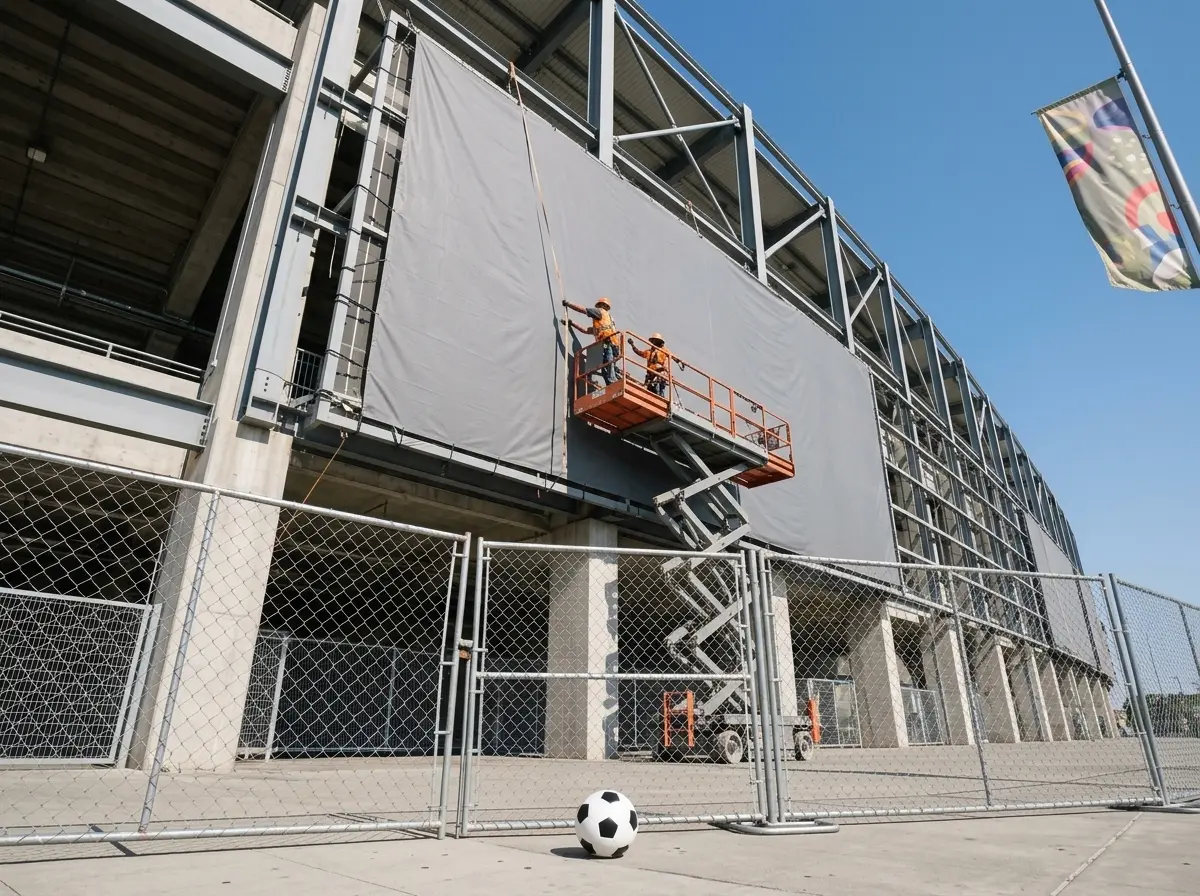
The enforcement got physical at the venues themselves. FIFA required host stadiums to strip their existing corporate names entirely:
- Gillette Stadium in Foxborough, Massachusetts became Boston Stadium
- Levi’s Stadium in Santa Clara, California became San Francisco Bay Area Stadium
- SoFi Stadium in Inglewood, California became Los Angeles Stadium
Thousands of logos across the venues were physically covered, protecting the exclusivity official partners had already paid for.
Unlike Qatar, which passed dedicated anti-ambush legislation ahead of its 2022 tournament, none of the three 2026 host countries wrote a special World Cup law. FIFA is leaning instead on existing trademark law, mainly the Lanham Act in the United States, plus venue contracts and municipal rules to police the zones.
There is a carve-out. FIFA calls it the business as usual principle, and it protects permanent, established local businesses that keep operating normally inside the perimeter, according to law firm Dickinson Wright. “You can absolutely throw a packed watch party,” the firm wrote. “Just don’t market it like you are affiliated with FIFA.”
Host Cities Signed Up to Pay, Not to Profit
Eleven U.S. host cities, plus three in Mexico and two in Canada, signed lengthy contracts with FIFA covering office space, security, transportation support and no-cost fan festivals, all largely at local expense. In return, FIFA granted host committees a limited number of tickets and commercial opportunities, always with its own sponsors holding first right of refusal, according to The Sports Examiner.
Andrew Zimbalist, a sports economist and Robert A. Woods Professor Emeritus of Economics at Smith College, put the imbalance in blunt terms. “There are very, very significant costs to host cities, which host anywhere from four to eight games,” he said. Those costs, he added, can top $100 million a city, and hosts rarely see it back as revenue since FIFA keeps the take.
New York offers a case study. Comptroller Mark Levine’s office ran the numbers using FIFA’s own forecast of 1.2 million regional visitors and still could not make the added tax revenue cover the city’s costs, per reporting on the city’s budget review.
Federal money has been just as shaky. The Federal Emergency Management Agency (FEMA) built a $625 million security grant program for the 11 U.S. host cities, but almost $900 million in related funding sat frozen earlier this year amid a partial government shutdown. Miami’s host committee warned it might have to cancel programming without fast relief. “We have to start making some really tough decisions and it starts with our fan festival,” said Ray Martinez, chief operating officer of the Miami World Cup Host Committee.
| Cost Item | Amount | What It Covers |
|---|---|---|
| FEMA World Cup security program (11 U.S. cities) | $625 million | Federal reimbursement for policing, screening and emergency response |
| Houston security grant | $64.7 million | Public safety preparedness for Houston’s host committee |
| Dallas / North Texas security grant | $51.6 million | Public safety preparedness around AT&T Stadium |
| Foxborough, Massachusetts dispute | About $8 million | Policing costs around the stadium renamed Boston Stadium |
| Georgia sales tax exemption | Up to $25 million | Foregone state and local tax on Atlanta ticket sales |
| Florida sales tax exemption | About $7.4 million | Foregone state tax on Miami ticket sales |
Those figures leave out stadium leases and overtime pay that several host committees negotiated separately and kept confidential, according to a joint records review by the Houston Chronicle and ProPublica that found most cities refused to release full FIFA contracts.
Where FIFA’s Numbers and Independent Economists Split
FIFA and the World Trade Organization project the tournament will generate $30.5 billion in gross U.S. output, add $17.2 billion to GDP and support roughly 185,000 jobs, plus close to $10 billion in advertising value. FIFA’s own financial projections separately put its tournament revenue at more than $11 billion, a sum host cities never touch. “These studies are invariably overstated,” Zimbalist told KXAN, arguing the groups commissioning them have a financial stake in the outcome.
Michael Edwards, a sport management professor at North Carolina State University, has studied why the estimates run so hot. “Many economic impact studies are structured in ways that predictably produce large numbers,” he said, pointing to standard multipliers that rarely subtract the public cost of hosting.
- FIFA and host committees point to the $30.5 billion gross output and 185,000 supported jobs as proof the tournament pays for itself many times over.
- Robert Baade, an economics professor at Lake Forest College, says it is too early to call the tournament a “rousing success” by any rigorous measure.
- Washington state officials expect to spend $24 million more hosting matches than they will recover in tax revenue, a pattern Baade and fellow economist Victor Matheson traced to the 1994 World Cup, which fell $5.5 billion to $9.3 billion short of its own pre-tournament projections.
That gap shows up as a real line item in a city’s budget long after the marketing campaigns wrap and the sponsors move on to the next event.
Can a Small Business Copy FIFA’s Own Playbook?
Yes, outside FIFA’s guarded perimeter and without implying a tournament tie. A watch party or themed pop-up built around World Cup excitement is legal almost anywhere. Trouble starts the moment a business borrows FIFA’s name, logos or protected phrases like World Cup 2026 to promote it, or operates inside a stadium’s clean zone.
The clearest protection is that business as usual principle, which shields permanent, established businesses that keep operating normally. Restricted terms flagged by FIFA’s own guidelines include FIFA WORLD CUP 2026, WORLD CUP 26, USA 2026, MEXICO 2026 and CANADA 2026, all off-limits without a license.
Partnership softens the cost either way. Two complementary local businesses splitting one activation halve the spend and double the reach, and neither needs FIFA’s name anywhere on the flyer to pull it off.
Los Angeles Is Already Carrying the Bill Twice
Los Angeles is managing World Cup preparations at the same time it builds toward the 2028 Summer Olympics, a dual event burden city planners have called both an opportunity and a scheduling challenge. Zimbalist has tracked this exact sequence for years, from London and Barcelona to Rio de Janeiro, cities that absorbed the costs of hosting while the promised windfall failed to fully arrive, according to his own published research on Olympic and World Cup economics.
The 2028 Games land in Los Angeles before most 2026 host cities finish auditing what this tournament actually cost them.
Frequently Asked Questions
What Counts as Ambush Marketing at the World Cup?
Ambush marketing means creating the false impression of an official tie to the tournament without paying for sponsorship rights. FIFA’s guidelines flag imitation logos, football-themed campaigns that mimic official branding, and misleading hashtags or influencer posts suggesting a partnership that does not exist.
Can I Throw a World Cup Watch Party Without FIFA’s Permission?
Yes. Hospitality events are allowed under the business as usual principle as long as the marketing does not suggest an official tie. Risk climbs once an operator charges admission, sells VIP tables, brings in sponsors or hands out branded promotional items near a clean zone.
Do Host Cities Get a Cut of FIFA’s Ticket Revenue?
Not much of one. FIFA grants host committees a limited allotment of tickets and commercial opportunities, but its own sponsors get first right of refusal on anything valuable. Most ticket and broadcast revenue flows back to FIFA itself rather than the cities providing security and venues.
Has a Sports Mega Event Missed Its Projections Before?
Yes, repeatedly. Texas dedicated $22 million to help host the 2017 Super Bowl expecting a return, but a state analysis afterward found Texas came up $14 million short. The 1994 World Cup fell $5.5 billion to $9.3 billion short of its own pre-tournament projections, according to research from economists Robert Baade and Victor Matheson.


Veridue Raises $4 Million to Speed Energy Deal Diligence

Healey Adds a £150m Rung for Northern Scale-Ups

Ten Deals Took Most of Europe’s August Tech Money

Holmes Hired Fielder to Film Her Last Days

Molten Bets £100m of Plc Cash on Late-Stage Tech

Garlinghouse Cited Dutch Gold, and London Got the Bars

byFounders Bets $4.3 Million on Fluencify After $2M ARR

Alpha Gang Puts A-List Stars on a Zellner Wager

Angel Bets a Recut PG-13 Chase on Ritchson and Wilson

Flex IT and T1A Combine to Own Corporate Device Supply

Walter’s TWG Insists No Fraud as Insurer Probes Force Cleanup

30-Year Yield Hits 5.32% Highest Since 2007 as Debt Supply Locks In Costs

PCE Stays at 3.7% as Gas and Tariffs Outrun Coming Revisions

Evernorth S-4 Clears Path for Active XRP Treasury on Nasdaq

Astute’s $1.2M bet makes B2B creator deals feed AI discovery

Strategy Parks $1.59B Cash While Bitcoin Stack Stays Flat

Instinct Hits $2.5 Billion as AI Agent Access Sparks Trust Fights

Oracle’s 2.8 GW Bloom Deal Exposes the AI Power Bypass

CLARITY Act Cloture Opens a Door Ethics Still Blocks

Amber’s €7M locks Mittelstand knowledge inside Europe
-
 FINANCE3 months ago
Zcash Patched a Double-Spend Bug as ZEC Climbed 5%
-
 ENTERTAINMENT3 months ago
Steam Summer Sale 2026 Locks In June 25 to July 9 Dates
-

 FINANCE2 months ago
CLARITY Act Final Text Expected This Weekend as 60-Vote Hurdle Looms
-
 NEWS4 months ago
Meta Adds AI Replies to Threads, But Users Can’t Block It
-
 ENTERTAINMENT5 months ago
Extraction 3 Is Officially Coming to Netflix in 2027
-

 NEWS3 months ago
YouTube Shorts is testing a heart in place of the thumbs-up
-

 NEWS1 month ago
Senators Force Apple Off Chinese Memory as Big Three Cash In
-

 NEWS3 months ago
NEURA Robotics’ $1.4B Series C Redraws Europe’s Physical AI Bet