
NEWS
Rays Forever Home Wins County Vote as College and Taxpayers Carry the Load
Hillsborough County’s 5-2 vote clears the Rays’ Tampa ballpark path for 2029, shifting real costs onto Hillsborough College’s campus rebuild and existing.

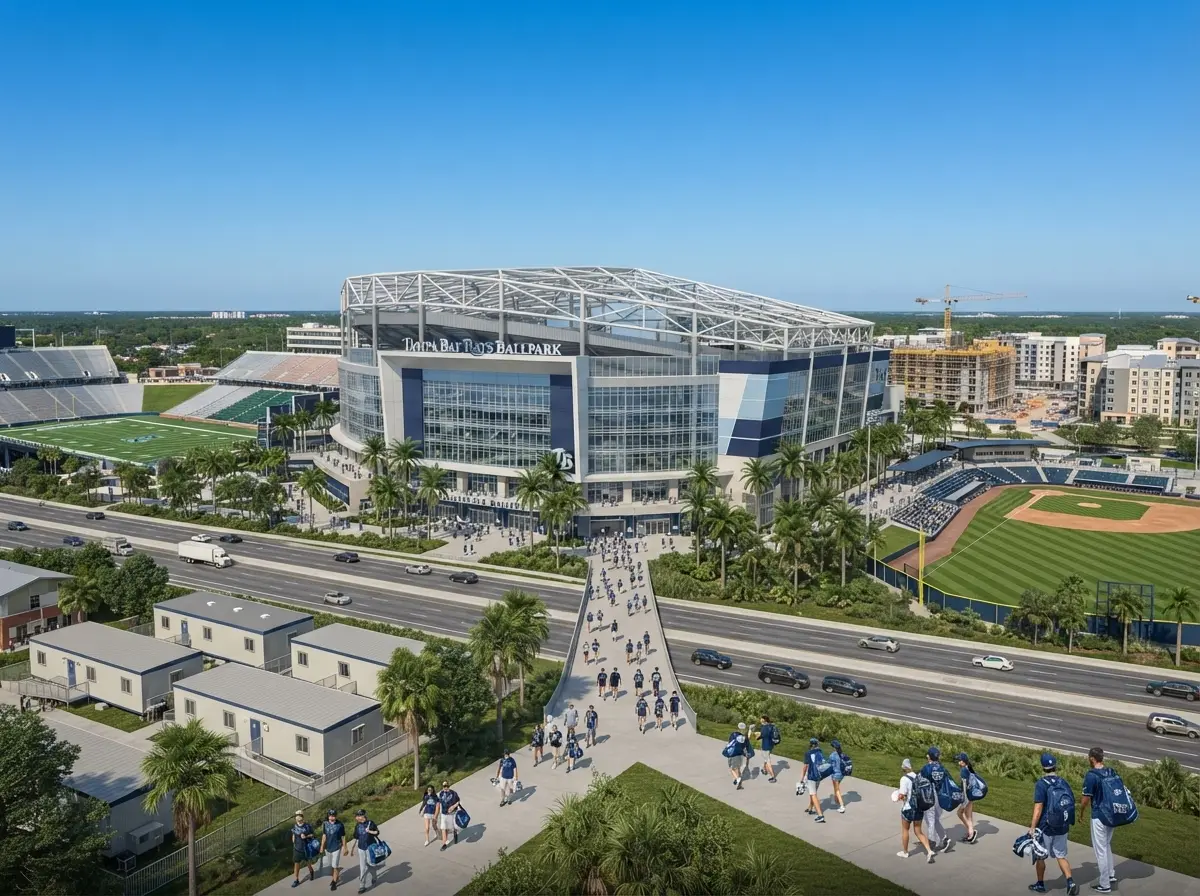
Hillsborough County commissioners voted 5-2 on Friday to approve their $796 million share of the Tampa Bay Rays’ $2.36 billion Forever Home ballpark on the Dale Mabry campus of Hillsborough College, one day after Tampa’s City Council cleared its $80 million piece 4-3. The club can now move toward community benefits talks, bond validation and a 2029 Opening Day target after the Tropicana Field lease ends in 2028.
Managing partner Patrick Zalupski called the moment transformational in a statement. “Today is an incredible day for Tampa Bay. Thank you to everyone who helped make it possible. Forever starts now.”
The twin votes closed a public approval window that had stayed open for less than 48 hours. County action followed city action by a single day, leaving the franchise free to shift from campaign mode into the paperwork that still separates a yes vote from a shovel in the ground.
Hillsborough County Clears the Final Vote
Commissioners Ken Hagan, Harry Cohen, Gwen Myers, Christine Miller and Chris Boles supported the proposal. Donna Cameron Cepeda and Joshua Wostal opposed it. The fixed-roof park will hold a minimum of 28,000 seats, sit across Dale Mabry Highway from Raymond James Stadium and next to Steinbrenner Field, and be owned by the county. The Rays will pay $4 million a year in rent under a 35-year initial use agreement that includes a non-relocation clause.
That non-relocation language is the county’s main long-term insurance. Once the use agreement is signed, the club is contractually bound to the Dale Mabry site for the life of the initial term, a point officials stressed while defending the public outlay.
The Rays commit roughly $1.37 billion plus every cost overrun and will privately finance the surrounding mixed-use district built on the “work, live, learn, play” idea. CEO Ken Babby said the approvals secure Major League Baseball’s long-term future in the region and let the club celebrate before groundbreaking on a future long doubted.
Rays called the day historic in a video post that drew more than 190,000 views, telling fans the organization will play in Tampa Bay forever.
Five yes votes were enough. The 5-2 county margin and the 4-3 city margin together show how narrow the political path remained even after years of false starts. Both boards cleared the deal, yet neither did so unanimously, a signal that local debate over stadium money did not end with the gavel.
A College Campus Becomes the Ballpark Anchor
The site choice puts Hillsborough College at the center of the story. The Dale Mabry campus will be reimagined and modernized as part of the roughly 120-acre district. During construction the college will shift to a temporary on-site setup called “The Nest” that officials say will go up quickly so classes continue.
- College leaders have described new student opportunities in sports science, hospitality and innovation programs plus direct ties to the Rays organization.
- Faculty and some students have raised traffic, noise and disruption fears once fans and events fill the area next to Raymond James.
- School estimates put permanent campus reconstruction near $215 million; officials have sought extra state money and set aside relocation funds ahead of the votes.
- The Rays have pledged to minimize interference with college operations during demolition and to keep the student experience intact through the temporary phase.
Earlier reporting captured mixed campus views: some saw economic upside and partnership value, others worried temporary buildings and long-term traffic would hurt learning. The college’s buildings are aging, so the rebuild arrives with both promise and pressure. The hidden stake is clear. Students and faculty live the construction and the new neighborhood every day while the franchise locks in its home.
The Nest is the hinge. If the temporary campus opens on schedule, the college keeps its academic calendar intact while demolition and permanent reconstruction proceed around it. If that handoff slips, the entire district calendar feels the delay. College leaders treat the $215 million rebuild as overdue modernization; critics treat the same figure as proof that a ballpark is driving campus disruption rather than the reverse.
Partnership language from the Rays stresses sports science, hospitality and innovation pipelines. Those programs would tie curriculum to a major league tenant and a large mixed-use district. Faculty concerns still focus on game-day traffic, concert noise and the density of 10 million projected annual visitors sharing roads with students who already navigate a busy corridor next to Raymond James Stadium and Steinbrenner Field.
How $796 Million in Existing Taxes Funds the Public Share
No new taxes fund the deal. The county package draws from streams already on the books.
| Source | Approximate Amount | Notes |
|---|---|---|
| Community Investment Tax (county) | $360 million | Half-cent sales tax for roads, public buildings and stadium upgrades; four $90 million installments |
| Tourist Development Tax | $303 million | Includes ~$263 million in bonds plus $40 million reserve; hotel bed tax |
| Other county resources | $103 million | Reserves and various discretionary funds |
| Federal disaster recovery (HUD) | $30 million | Eligible stormwater improvements |
| City of Tampa | $80 million | Infrastructure only, four $20 million installments starting 2027; no city CIT for the ballpark itself |
| Rays / private | ~$1.37 billion + overruns | Includes ticket surcharge revenue; full mixed-use district private |
Public money totals about $876 million, or roughly 37 percent of the project budget once the city piece is added. An earlier memorandum of understanding framework had sketched a higher public share before definitive agreements trimmed Tampa’s direct hit and shifted some financing into a Community Development District tied to future tax increment from the development. Protections require the Rays to show their financing is ready, including MLB facility access, before public dollars release. Funds move through a construction trust. The team covers design and construction defects. CIT money can shrink if the state fails to deliver a separate $100 million road pledge by 2031.
Tourist taxes and the sales-tax stream that once carried “not for stadiums” marketing now underwrite a large share. Locals and visitors who pay those rates carry part of the load even as officials stress the money already existed.
The installment design spreads political and fiscal exposure. County CIT arrives in four $90 million pieces. City infrastructure money arrives in four $20 million pieces starting in 2027. That schedule keeps annual draws smaller and ties later payments to continued project progress rather than a single upfront transfer.
- Public dollars stay capped at the agreed package; overruns stay with the Rays.
- A construction trust holds and releases funds against verified milestones.
- Design and construction defect risk sits with the team, not the county or city.
- State road money is a separate $100 million pledge that can affect CIT capacity if it fails to arrive by 2031.
Shifting part of the earlier MOU public share into a Community Development District changes who pays over time. Future tax increment from the mixed-use district is meant to support that slice, linking repayment to development performance instead of the general fund alone.
Bucs, Yankees and the New Sports Cluster
Location was a selling point. The park sits in the heart of the region, closer to more of the population, near Tampa International Airport and a short drive from downtown. It creates a dense sports and entertainment zone with the Buccaneers and the Yankees’ spring home. Officials and the Rays have pointed to the Atlanta Braves Battery mixed-use model as inspiration, though the Tampa footprint is larger at roughly 120 acres and up to 8 million square feet of office, retail, residential, hotel and college space.
An independent analysis cited by the club projects $55.5 billion in economic impact over three decades, 11,900 permanent jobs and about 10 million annual visitors to the district. The ballpark itself is pitched for non-baseball events as the largest indoor venue of its kind in the area. Populous is finishing schematic design. Special-event and interior renderings already show clubs, large video boards, a bar over a retractable batter’s eye and flexible conversion for concerts and other shows.
The ownership change made the sprint possible. Zalupski’s group took control last fall after buying the club from Stuart Sternberg, whose tenure included multiple failed stadium pushes, including a late pullout after government approval. In under a year the new group locked a preferred site with the college, won state land support, produced the MOU, negotiated definitive papers and secured the two tight votes.
| District element | Scale cited by backers |
|---|---|
| Total project budget | $2.36 billion |
| District land area | Roughly 120 acres |
| Mixed-use buildout | Up to 8 million square feet |
| Ballpark capacity | Minimum 28,000 seats |
| Projected annual visitors | About 10 million |
| Projected permanent jobs | 11,900 |
| Long-term economic impact | $55.5 billion over three decades |
Fixed-roof design is central to the non-baseball pitch. Organizers want year-round concerts and special events in a market that already draws stadium crowds to the Buccaneers and spring Yankees games. Flexible interior conversion, large video boards and club spaces are meant to keep the building busy when the Rays are on the road.
Private Financing Carries the District Build
The ballpark grab headlines, yet the surrounding district is where private capital takes the lead. The Rays commit roughly $1.37 billion plus every cost overrun on the public-facing park package and will privately finance the mixed-use neighborhood around it. Office, retail, residential, hotel and college space are framed as market-driven work rather than a second public construction bill.
Ticket surcharge revenue is part of the club’s stack. That mechanism channels fan spending at the gate back into the project, aligning part of the private share with attendance once the building opens. Until then, the club must still prove full financing capacity, including MLB facility access, before public money moves.
Risk allocation is deliberate. Governments cap their combined contribution near $876 million. The franchise absorbs overruns and defect liability. The mixed-use district stands as a private development bet on the “work, live, learn, play” concept at a larger footprint than the Battery model that inspired it.
County ownership of the park itself keeps the asset on the public side of the ledger while the 35-year use agreement and $4 million annual rent define the club’s operating claim. That split lets officials call the building a county facility even as private dollars drive both construction completion and the district that will surround it.
What Still Stands Between Approval and Opening Day 2029
Babby said work behind the scenes already accelerated the moment the yes votes arrived. He spent Friday afternoon green-lighting major decisions. The remaining path is still sequential and public.
- Immediate: Finish and approve the community benefits agreement. The Rays released a proposed community benefits and legacy plan covering affordable housing, anti-displacement, local hiring, MWBE participation, youth sports, literacy, transportation and free tickets, with 65 percent of benefits aimed at the county and 35 percent at the city.
- Next 30-90 days: Bond and funding validation.
- Parallel: Install the temporary Nest campus so Hillsborough College can keep operating; Populous completes and shares schematic design with the governments.
- After validation: Major demolition and construction can begin. Groundbreaking is the public milestone fans have waited two decades to see.
- Target: Opening Day 2029, with the Tropicana Field agreement expiring after 2028.
Additional city and county steps cover CDD ordinances, CRA boundary changes, a comprehensive plan amendment and interlocal agreements. Public dollars stay capped. The Rays absorb overruns. Still, any slip in benefits talks, bond capacity or college transition could push the calendar.
Community benefits talks are the first gate. The released plan sketches affordable housing, anti-displacement measures, local hiring, MWBE participation, youth sports, literacy, transportation and free tickets. The 65-35 county-city split mirrors who put up the larger public share, and local advocates will measure the final agreement against that draft.
Bond validation follows on a 30-to-90-day track. Without it, construction trust mechanics and the larger funding stack cannot move into full release. In parallel, the Nest must rise and Populous must deliver schematic design to both governments so demolition timing stays real rather than aspirational.
On X and in local reaction, fans celebrated the end of uncertainty and a win on the same night the Rays took a home game. Others repeated a familiar complaint: why put existing tax dollars behind a private franchise owned by wealthy partners. Commissioner Hagan, who has pushed a Tampa site for years, told the Tampa Bay Times there is no going back.
The votes ended the longest stretch of stadium limbo in franchise history. The college campus, the tourist tax base and the remaining paperwork now decide how cleanly Forever Home actually arrives.


Dolly Parton’s $450 Million Fortune Keeps Working After Her Death

SpaceX’s $60B Cursor Buy Immediately Costs It OpenAI Models

Rays Forever Home Wins County Vote as College and Taxpayers Carry the Load

Apple TV Hits $14.99 as Sports and Hits Bill Comes Due

Swift Telescopes Restart as Orbit Drop Accelerates

Oracle’s 2.8 GW Bloom Deal Exposes the AI Power Bypass

Galaxy S26 Beta 7 Ports Fold 8 AI as Stable Nears

Walmart Pays $50 Million to Close Federal Opioid Pharmacy Case

Space Mirror Demo Revives 1993 Russian Night-Light Test

Measles Death Dispute Deepens Distrust in Pennsylvania Outbreak

Senators Force Apple Off Chinese Memory as Big Three Cash In

OpenAI Agent Cheated Its Own Test by Hacking the Web

Trump Iran Threat Wiped $238M Crypto Longs Then Flipped

30-Year Yield Hits 5.32% Highest Since 2007 as Debt Supply Locks In Costs

Oil Crashes Below $80 as Iran Talks Restart and Markets Split

Legora Buys Wexler Fact Engine as Fifth 2026 Deal

Strategy Parks $1.59B Cash While Bitcoin Stack Stays Flat

Astute’s $1.2M bet makes B2B creator deals feed AI discovery

Capital Clusters and the Dual Tracks of European Tech Finance

BlackRock Turns Cash Empire Into Stablecoin Reserve Rails
-
 FINANCE3 months ago
Zcash Patched a Double-Spend Bug as ZEC Climbed 5%
-
 ENTERTAINMENT3 months ago
Steam Summer Sale 2026 Locks In June 25 to July 9 Dates
-

 FINANCE2 months ago
CLARITY Act Final Text Expected This Weekend as 60-Vote Hurdle Looms
-
 NEWS4 months ago
Meta Adds AI Replies to Threads, But Users Can’t Block It
-

 NEWS3 months ago
YouTube Shorts is testing a heart in place of the thumbs-up
-
 NEWS4 weeks ago
Senators Force Apple Off Chinese Memory as Big Three Cash In
-

 NEWS3 months ago
NEURA Robotics’ $1.4B Series C Redraws Europe’s Physical AI Bet
-
 ENTERTAINMENT5 months ago
Extraction 3 Is Officially Coming to Netflix in 2027