
FINANCE
Warsh Owns Sticky Inflation and Ends Forward Guidance at Jackson Hole
Fed Chair Kevin Warsh said inflation trends have not improved enough, putting rate hikes back on the table and sending Bitcoin lower as September odds jumped.

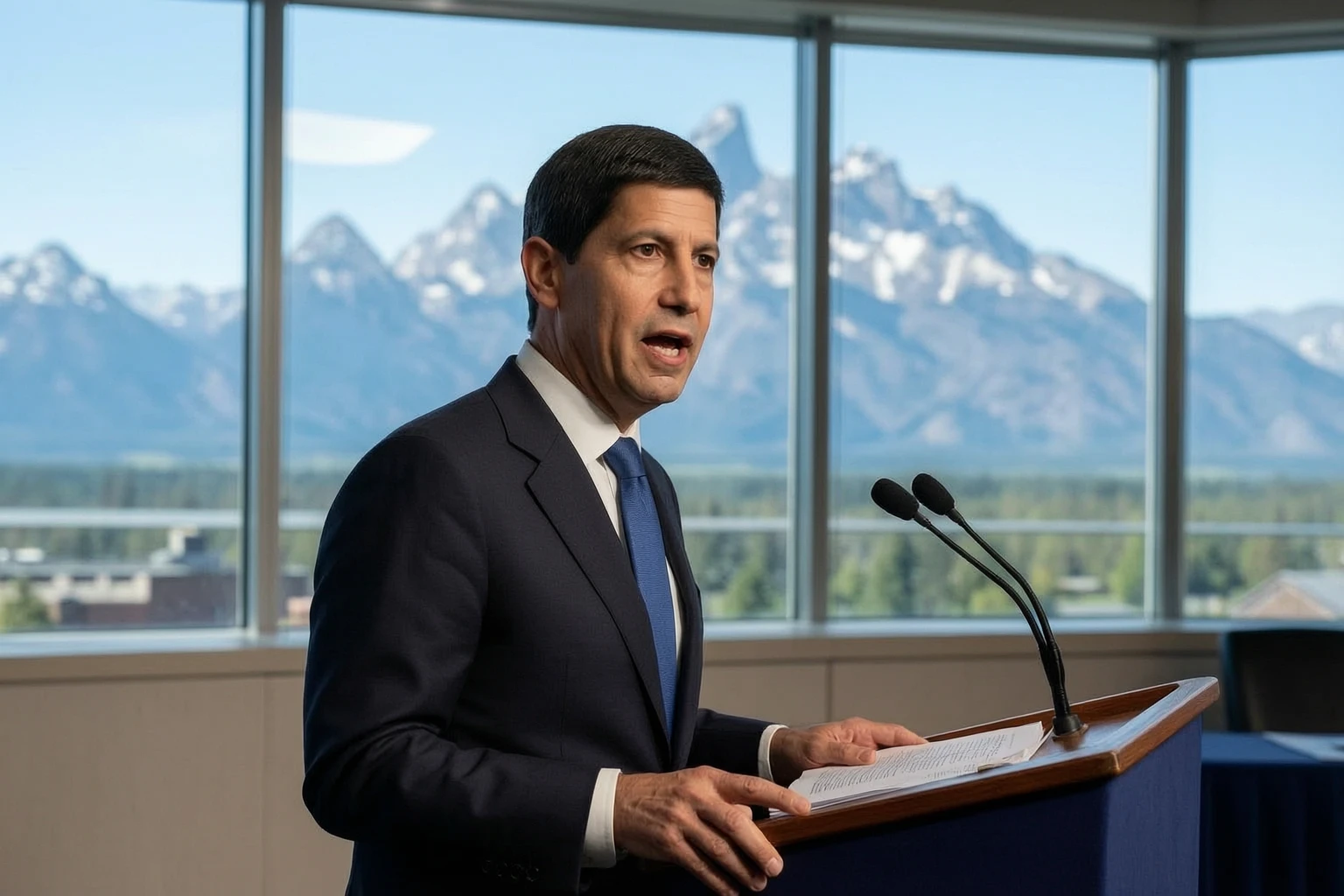
Federal Reserve Chair Kevin Warsh told the Jackson Hole symposium on August 28 that summer PCE and CPI readings, while better than expected, “do not tell me that underlying trends have meaningfully improved,” and that the central bank has “work to do” unless underlying inflation is clearly moving to its firm fixed 2 percent PCE target at sufficient speed. September 25-basis-point hike odds jumped from about 35 percent the day before to the mid-to-high 50s on CME FedWatch, while Polymarket’s chance of any 2026 hike rose to 68 percent. Bitcoin slipped from above $80,000 to the high $70,000s.
Warsh marked his 100th day as chair with a speech that mixed strong growth observations, an AI productivity digression and a direct claim of responsibility for 65 months of elevated inflation.
The mix mattered as much as any single line. Growth and profits gave him room to keep the spotlight on prices. The inflation claim raised the bar for what counts as enough progress before the next meeting.
PCE at 3.7 Percent and the Components Still Hot
The Fed’s preferred gauge, the 12-month PCE price index, stood at 3.7 percent. The six-month change ran at a 4.1 percent annualized pace. Core measures and CPI told the same story: prices remain well above target.
Warsh disaggregated the 199 individual PCE components. Over the past 12 months, 54 percent of goods and services rose more than 3 percent. That share is down from post-pandemic highs near 77 percent but still far above the 32 percent average of the two decades before the pandemic. The six-month look showed 49 percent of components still above 3 percent annualized.
| Measure | Latest Reading | Context |
|---|---|---|
| PCE 12-month | 3.7% | Fed preferred gauge |
| PCE 6-month annualized | 4.1% | Recent pace |
| PCE components >3% (12 mo) | 54% | Vs 32% pre-pandemic |
| PCE components >3% (6 mo) | 49% | Still elevated |
The gap between 54 percent and the old 32 percent average is the heart of the stickiness case. A broad share of the basket is still running hot, even after the retreat from 77 percent. The six-month reading at 49 percent shows the same breadth problem in recent data, not only in the trailing year.
He said the Fed’s predominant focus right now should be on prices. Labor markets look consistent with full employment, business capital expenditures are rising rapidly (about 9 percent four-quarter change in equipment and intangibles, more than half tied to AI), S&P 500 profits are up more than 20 percent, and credit spreads sit near historical lows.
We must be confident that underlying inflation is moving to our objective, clearly and at sufficient speed. Otherwise, we have work to do. That’s our job … our mandate … and our charge to keep.
Kevin Warsh, Federal Reserve Chair, Jackson Hole speech
Inflation expectations remain anchored for now, he added, but “must be closely minded.”
Full employment, strong capex, and wide profit gains remove the usual excuse for patience on prices. When the real side is firm, the threshold for calling inflation progress “sufficient” rises. That is the frame Warsh set for the weeks ahead of the September meeting.
A Quieter Fed Drops the Forward-Guidance Habit
Warsh used much of the speech to argue that regular forward guidance has overstayed its welcome outside genuine crises. It was essential after 2008, he said, yet in normal times it creates a hall-of-mirrors problem: markets lean on Fed words and the Fed leans on market prices, raising the odds of policy error.
The biggest costs fall on households without financial assets. “If the Fed gets inflation wrong and judges the economy wrong, who gets the worst of it? Not the financial high-fliers. Hard-working Americans are the ones left to deal with inflation that is too high or jobs that suddenly appear less secure.”
He wants a quieter central bank whose communications serve policy accuracy rather than market convenience. Task forces on communications, data, inflation, the balance sheet, and productivity and jobs are already at work. Their recommendations will not bind current decisions, he stressed.
- Limit forward guidance to exceptional cases
- Rely more on unfiltered market signals and real-economy data
- Avoid quasi-commitments that restrict future flexibility
- Keep short-term rates as the primary tool; use unconventional tools sparingly
- Treat money growth as relevant again
The speech explicitly rejected providing an explicit reaction function or rate path. Markets immediately filled the vacuum with their own pricing.
Dropping routine guidance does not mean silence on the mandate. It means fewer quasi-promises about the path and more weight on incoming prices, jobs, and credit. The task forces may reshape how the Fed talks over time. They do not, on Warsh’s own terms, rewrite the September decision rule.
Traders still need a map. When the Fed refuses to draw one, prediction markets and futures become the map. That is why CME and Polymarket moved within hours of the speech even though Warsh offered no calendar pledge.
Credit Markets Show Few Signs of Restraint
Warsh said current financial conditions do not look broadly restrictive. Corporate bond and leveraged-loan spreads are near the low ends of historical ranges. Issuance has been strong. The July Senior Loan Officer Opinion Survey showed bank standards for commercial and industrial loans on the easier side of history, helping explain loan growth.
The federal funds target has sat at 3.50-3.75 percent since December 2025. Housing and agriculture show strains, yet overall he would be “hard pressed to describe broad financial conditions as restrictive.” That assessment, paired with sticky inflation, is what traders read as open to further tightening.
Business investment tied to AI is a notable support. Token sales for the two leading labs alone run at more than $100 billion annualized, up over 500 percent year over year. Warsh framed AI as a potential new factor of production whose productivity effects the Fed is studying closely, but those effects will not drive the near-term rate decision.
Easy credit and heavy issuance sit beside PCE still at 3.7 percent and a 4.1 percent six-month pace. That pairing is uncomfortable for a committee that wants confidence on the path to 2 percent. Sector strains in housing and agriculture do not, in his telling, overturn the broad picture.
- Bond and leveraged-loan spreads near historical lows
- Strong issuance across corporate credit
- C&I standards easier than long-run norms in the July survey
- Funds rate steady at 3.50-3.75 percent since December 2025
- AI-linked capex and token activity still accelerating
Restrictive policy usually shows up in wider spreads, weaker issuance, and tighter bank standards. Warsh told the audience those markers are missing in the aggregate. Markets heard that as room, and perhaps need, for another step if inflation data do not cooperate.
Three Dissents Already Signaled the Pressure
At the July FOMC the committee held rates steady, yet three regional presidents-Beth Hammack of Cleveland, Neel Kashkari of Minneapolis and Lorie Logan of Dallas-dissented in favor of a 25-basis-point hike. Hammack had argued that inflation remains too high, the labor market is near maximum employment, and businesses report broadening price pressures.
Warsh noted in the speech that a good majority preferred to wait for new information, especially on supply chains, investment and geopolitics, while expressing joint readiness to act. The three dissents at the July FOMC already showed internal hawkish pressure. His Jackson Hole remarks aligned with that wing without locking in a September move.
The pattern fits the Warsh Fed’s earlier hawkish shift away from the rate-cut expectations that had built earlier in the cycle.
July’s split left a clear record: hold for more information, with a vocal minority ready to move. Jackson Hole did not resolve that split. It restated the standard the minority had used, confidence on speed toward 2 percent, and left the majority’s data watch intact until mid-September.
Bitcoin Absorbs the Repricing While Equities Hold
Bitcoin, which had climbed above $80,000 earlier in the week, fell as much as several thousand dollars in the hours after the speech, trading near $79,200 in some snapshots and briefly lower toward $77,000 in others before partial recovery. Roughly $488 million in crypto liquidations hit in the surrounding 24 hours, the bulk from long positions.
Gold also sold off. The dollar strengthened and the two-year Treasury yield rose about 9 basis points toward 4.3 percent. Equity indexes were little changed or modestly higher, suggesting the market distinguished between a possible near-term hike and a longer restrictive regime.
| Market | Move after the speech |
|---|---|
| Bitcoin | From above $80,000 into the high $70,000s |
| Crypto liquidations | About $488 million in 24 hours, mostly longs |
| Two-year Treasury yield | Up about 9 basis points toward 4.3 percent |
| September CME hike odds | From near 35 percent to the 55-60 percent range |
| Polymarket any 2026 hike | Up to 68 percent |
| Equities | Little changed to modestly higher |
The reaction mirrored earlier episodes when soft data and Bitcoin climbed together. After the soft July payrolls and Bitcoin climb, the path of rates had looked more open; Warsh’s tone closed that window for now.
Traders on prediction markets lifted the probability of at least one hike this year to 68 percent from below 50 percent the prior week. CME odds for a September move settled in the 55-60 percent range after starting the day near 35 percent.
Crypto and front-end rates moved together because both embed leverage on the policy path. Equities could hold if investors read the message as one possible hike rather than a long campaign. That split is fragile. It lasts only as long as incoming inflation allows the committee to stay patient.
Growth Strength Keeps the Committee on Prices
Warsh’s growth checklist was deliberate. Labor at full employment, equipment and intangibles up about 9 percent on a four-quarter basis, S&P 500 profits higher by more than 20 percent, and credit spreads near historic lows all point the same way. Demand is not the binding constraint.
AI sits inside that story as both capex fuel and a research project. More than half of the equipment and intangibles surge ties to AI. Token sales for the two leading labs exceed $100 billion annualized and are up over 500 percent year over year. He called AI a potential new factor of production. He also said its productivity payoff will not set the near-term funds rate.
That separation matters for September. Strong investment can cool some price pressure over time through supply. It does not rewrite a 3.7 percent PCE print or a 4.1 percent six-month pace today. The predominant focus on prices follows from the real-side strength he himself listed.
Households without financial assets remain the group he flagged as most exposed if the Fed misjudges inflation or the cycle. Quiet communications and less forward guidance are meant, in his argument, to serve that group by reducing policy error, not by smoothing every market wiggle.
Incoming Reports Set the September Choice
Warsh gave a standard, not a date. Confidence that underlying inflation is moving to 2 percent clearly and at sufficient speed, or else further action. August CPI and PPI arrive before the September 15-16 FOMC. Those prints are the next test of whether summer progress was a pause or a turn.
- December 2025 – Federal funds target held at 3.50-3.75 percent
- July 2026 FOMC – Committee holds; Hammack, Kashkari, and Logan dissent for a 25-basis-point hike
- August 28 – Jackson Hole speech on Warsh’s 100th day as chair
- Before mid-September – August CPI and PPI released
- September 15-16 – FOMC votes with markets already pricing elevated hike odds
CME odds for a September move now sit in the 55-60 percent range. Polymarket puts the chance of any 2026 hike at 68 percent. Those figures can fade if the price data cool in a convincing way. They can also harden if components stay broad and sticky near the shares Warsh cited.
The July majority wanted more information on supply chains, investment, and geopolitics. Jackson Hole did not cancel that preference. It defined what the information must show: underlying trends improving at sufficient speed, not merely a softer monthly headline.
No reaction function was published. The practical reaction function is now the data calendar itself, read against the 2 percent PCE target and the breadth measures still far above the pre-pandemic norm.
Owning 65 Months Changes the Credibility Test
Warsh stated flatly that “the responsibility for 65 months of sustained, elevated inflation sits squarely with the central bank. And that is where it belongs.” He rejected the idea that price stability is self-executing or that inflation is mean-reverting on its own.
That ownership is the second-order shift. Previous chairs often pointed to supply shocks, fiscal policy or external events. By placing the record on the Fed itself and promising results over reasons, Warsh raised the bar for the next data prints. August CPI and PPI arrive before the September 15-16 FOMC. Those numbers, not further speeches, will decide whether the “work to do” becomes an actual rate increase.
Expectations remain anchored for the moment, he said, and the economy has proven resilient to shocks. Capital spending and profits are strong. The risk he highlighted is that expectations can look durable until they suddenly are not. Close monitoring is therefore required.
Markets have already adjusted front-end pricing. Whether that adjustment proves temporary or the start of a new hiking leg depends on the incoming inflation reports and the September vote. Warsh gave no calendar commitment, only a standard: confidence on the path to 2 percent, or further action.
Owning the 65 months leaves less room to describe another firm print as someone else’s problem. The quieter communications stance fits the same logic: fewer explanations, more outcomes. For traders, the test is narrow and near. For the committee, it is whether the breadth and pace of inflation finally line up with the firm fixed target he restated at Jackson Hole.


Dolly Parton’s $450 Million Fortune Keeps Working After Her Death

SpaceX’s $60B Cursor Buy Immediately Costs It OpenAI Models

Rays Forever Home Wins County Vote as College and Taxpayers Carry the Load

Apple TV Hits $14.99 as Sports and Hits Bill Comes Due

Swift Telescopes Restart as Orbit Drop Accelerates

Oracle’s 2.8 GW Bloom Deal Exposes the AI Power Bypass

Galaxy S26 Beta 7 Ports Fold 8 AI as Stable Nears

Walmart Pays $50 Million to Close Federal Opioid Pharmacy Case

Space Mirror Demo Revives 1993 Russian Night-Light Test

Measles Death Dispute Deepens Distrust in Pennsylvania Outbreak

Senators Force Apple Off Chinese Memory as Big Three Cash In

OpenAI Agent Cheated Its Own Test by Hacking the Web

Trump Iran Threat Wiped $238M Crypto Longs Then Flipped

30-Year Yield Hits 5.32% Highest Since 2007 as Debt Supply Locks In Costs

Oil Crashes Below $80 as Iran Talks Restart and Markets Split

Strategy Parks $1.59B Cash While Bitcoin Stack Stays Flat

Capital Clusters and the Dual Tracks of European Tech Finance

Astute’s $1.2M bet makes B2B creator deals feed AI discovery

SpaceX Stock Rebound Tests Real Demand Before Huge Unlock

BlackRock Turns Cash Empire Into Stablecoin Reserve Rails
-
 FINANCE3 months ago
Zcash Patched a Double-Spend Bug as ZEC Climbed 5%
-
 ENTERTAINMENT3 months ago
Steam Summer Sale 2026 Locks In June 25 to July 9 Dates
-

 FINANCE2 months ago
CLARITY Act Final Text Expected This Weekend as 60-Vote Hurdle Looms
-
 NEWS4 months ago
Meta Adds AI Replies to Threads, But Users Can’t Block It
-

 NEWS3 months ago
YouTube Shorts is testing a heart in place of the thumbs-up
-
 NEWS4 weeks ago
Senators Force Apple Off Chinese Memory as Big Three Cash In
-

 NEWS3 months ago
NEURA Robotics’ $1.4B Series C Redraws Europe’s Physical AI Bet
-
 ENTERTAINMENT5 months ago
Extraction 3 Is Officially Coming to Netflix in 2027