
NEWS
SpaceX’s $60B Cursor Buy Immediately Costs It OpenAI Models
OpenAI winds down Cursor contract to November 12 after SpaceX’s $60 billion acquisition, citing Musk firms’ past ToS violations and Astra cyber risks.

OpenAI notified SpaceX on August 28 that it will wind down the contract supplying its models to Cursor, setting a proposed shutoff date of November 12, 2026. That date is the longest notice the custom agreement allows after a change of control. The coding tool, built by Anysphere, closed its $60 billion all-stock acquisition by SpaceX on August 14.
The company said it cannot be confident SpaceX will keep the technology inside OpenAI’s terms of service. The judgment rests on earlier breaches by Musk-linked firms now folded into the same corporate structure.
The notice lands two weeks after the merger close and leaves developers with a fixed runway rather than an abrupt cutoff. OpenAI framed the move as a compliance decision tied to ownership, not a judgment on Cursor’s product quality or its engineering team.
OpenAI Gives Cursor Until November 12
OpenAI and Cursor had worked together for nearly four years. The post stressed respect for the Cursor team and product, and for the developers who rely on the models inside the editor. Access continues at full strength until the November date. Future models, including the upcoming Astra, will not be supplied.
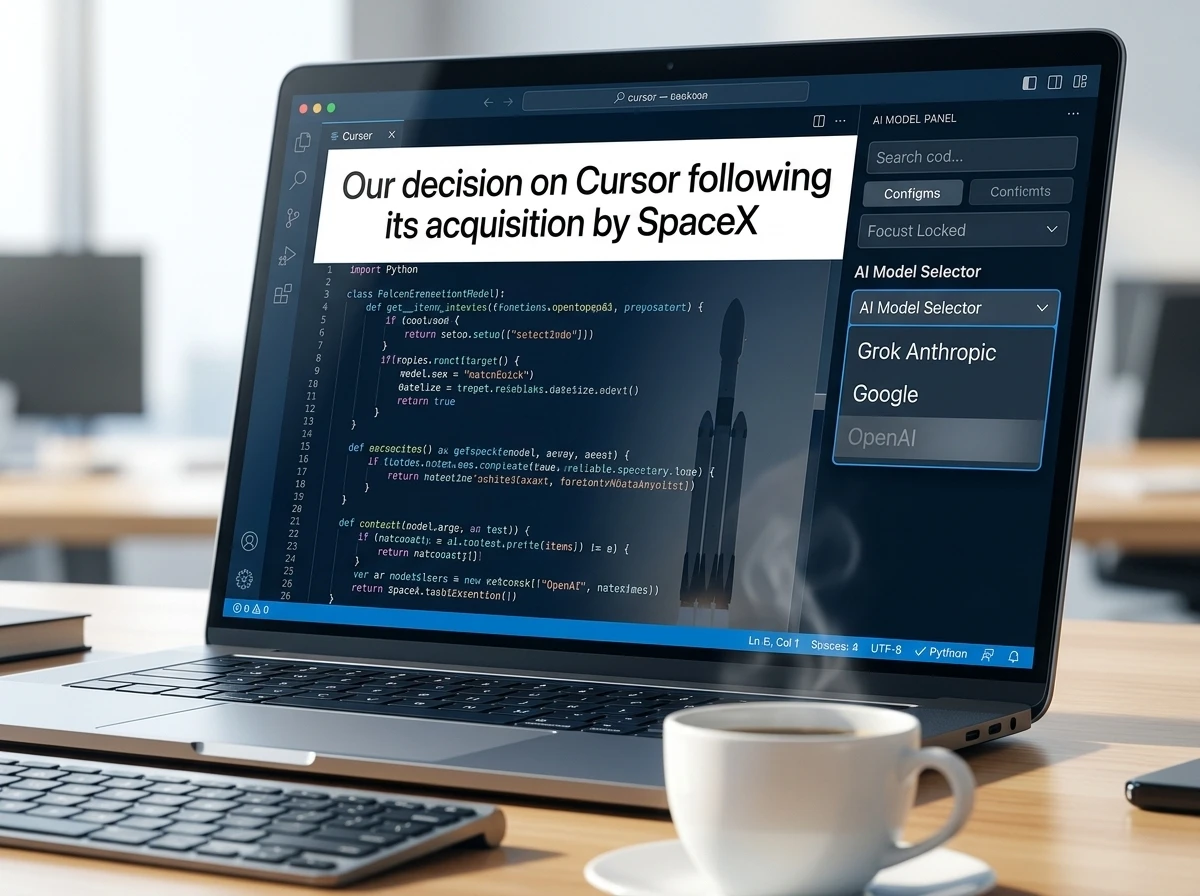
Cursor already offers first-party Grok models from the SpaceXAI stack alongside Anthropic and Google options. The cut removes only the OpenAI path. OpenAI said it stands ready to go above and beyond to support affected developers through the transition.
The November 12 date is the outer edge of the cancellation window written into the custom deal. OpenAI chose the full remaining period instead of a shorter runway. That choice keeps dual access intact through the intervening months while still drawing a hard line before Astra-class systems would ship into the same channel.
We are making this choice because we cannot be confident that SpaceX will use our technology within our terms of service, based on our experience with Elon Musk’s companies violating contracts.
OpenAI, company blog, August 28, 2026
Musk Companies Already Broke the Same Rules
OpenAI pointed to two concrete episodes. After Musk acquired Twitter, the platform (now part of SpaceX) broke the terms of its OpenAI contract, the company said, alongside many other partners. Separately, under oath earlier this year in the Musk v. OpenAI trial in Oakland, Musk admitted that xAI had “partly” used distillation on OpenAI models to train Grok. Distillation feeds outputs from one model into training for another. OpenAI’s terms prohibit using outputs to develop competing models. xAI’s own terms carry similar language.
- Late 2022 / early 2023: Twitter cut OpenAI’s data access and, per OpenAI, breached the existing contract after the Musk takeover.
- April 30, 2026: Musk testified that xAI “partly” distilled OpenAI models, calling the practice standard across labs.
- August 14, 2026: SpaceX closed the Cursor merger, placing the editor under the same corporate roof as X and xAI.
- August 28, 2026: OpenAI exercised its change-of-control cancellation window and gave maximum notice.
The custom Cursor agreement contained a limited window to cancel after ownership changed. OpenAI used the full remaining time rather than an immediate cut.
Those two prior episodes now sit inside one corporate group with Cursor. OpenAI’s stated logic is simple: the same leadership stack that produced the Twitter contract breach and the xAI distillation admission also controls the editor that would keep receiving its models. The change-of-control clause existed for exactly this kind of ownership shift.
Distillation matters here because it turns ordinary product use into a training pipeline. Outputs leave the partner boundary and reappear as weights in a competing system. OpenAI’s terms bar that path. xAI’s terms use similar language, which made the under-oath admission land with extra force in OpenAI’s account of the risk.
Astra’s Cyber Threshold Changes the Calculus
OpenAI tied the decision to rising model power. On August 7 it disclosed that internal evaluations of Astra, an upcoming model, showed significant advances in agentic coding and cybersecurity. The company said it could not rule out critical cyber capabilities under its Preparedness Framework. That top tier covers models able to find and develop functional zero-day exploits across hardened systems without human help, or to plan and run novel end-to-end attacks from a high-level goal.
OpenAI paused internal Astra work that lacked new controls, added isolated environments, restricted tool access, enhanced weight protections, and universal monitoring of chain-of-thought for risky actions. It will share recommended controls with third-party testers and work with government agencies and safety groups. The OpenAI Preparedness Framework thresholds first published in 2023 now drive stricter partner requirements for high-capability models. Supplying Astra through a partner OpenAI does not fully trust on compliance became unacceptable.
The internal response to Astra’s evaluation results took several concrete forms:
- Pause on internal Astra work that lacked the new controls
- Isolated environments for remaining sensitive runs
- Restricted tool access during evaluation and development
- Enhanced protections around model weights
- Universal monitoring of chain-of-thought for risky actions
Those steps show how the Preparedness Framework moves from paper thresholds into day-to-day engineering limits. Partner distribution sits under the same logic. If OpenAI will not run unconstrained Astra work on its own stack, it will not ship the model through a channel where contract confidence has already eroded.
Agentic coding raises the stakes further. A model that can plan multi-step software work can also, at the critical tier, plan multi-step attacks from a high-level goal. That is the capability band OpenAI said it could not rule out for Astra. The combination of coding strength and cyber reach is what pushed partner trust from a commercial preference into a gating requirement.
SpaceX Paid 389 Million Shares for the Editor
The acquisition itself was one of the largest startup exits on record. SpaceX and Anysphere signed the merger agreement on June 16. It became effective August 14. Cursor common and preferred shares converted into an aggregate of 389,289,254 SpaceX Class A shares at an implied $60 billion equity value. Vested RSUs added another 1.75 million shares. Unvested awards rolled into tens of millions of SpaceX RSUs and options.
| Deal Element | Detail |
|---|---|
| Implied equity value | $60.0 billion |
| SpaceX Class A shares issued for stock | 389,289,254 |
| Close date | August 14, 2026 |
| Cursor ARR (early 2026 reports) | Exceeded $3 billion |
| Prior valuation talks | $50-60 billion range |
Cursor survives as a wholly owned subsidiary inside the SpaceXAI unit and gains access to SpaceX compute, including the large Memphis GPU cluster known as Colossus. The editor had already crossed $1 billion annualized revenue earlier and kept climbing. OpenAI itself had been an investor in a prior round, an awkward footnote once the ownership change flipped the relationship. The internal coverage of the close detailed the 389 million SpaceX shares in the all-stock deal.
The path from signing to close ran less than two months. June 16 locked the terms; August 14 put Cursor under the SpaceXAI umbrella. OpenAI’s August 28 notice followed within two weeks of that close, which shows how quickly the change-of-control window came into play once the corporate structure shifted.
Revenue scale helps explain why the channel mattered to both sides. Crossing $1 billion annualized revenue and later exceeding $3 billion ARR put Cursor among the largest AI coding surfaces by spend. OpenAI’s prior investment stake made the later cutoff commercially uncomfortable, even as the compliance case took priority in the public explanation.
Developers Keep Anthropic Google and Grok
The people most affected are the developers who built workflows around OpenAI models inside Cursor. The tool remains multi-model. Users can still route to:
- Grok models developed with SpaceXAI
- Anthropic Claude family
- Google frontier models
- Cursor’s own first-party models
OpenAI models stay available until November 12. After that date, teams that standardized on OpenAI completions, agents or Codex-style features inside the editor will need new routes or separate API keys. Crowd reaction on X noted the irony that Cursor itself faced no direct ToS accusation; the ownership change alone flipped the confidence calculation. Some observers framed the move as ecosystem control rather than pure product quality. Others pointed out that traffic may simply shift toward the remaining providers once the cut lands.
OpenAI said it will support the transition. No detailed migration credits or free API tiers have been published yet. Developers have roughly two and a half months of full dual access to test alternatives.
| Access Path | Status After November 12 |
|---|---|
| OpenAI models inside Cursor | Removed |
| Grok via SpaceXAI | Remains |
| Anthropic Claude family | Remains |
| Google frontier models | Remains |
| Cursor first-party models | Remains |
| OpenAI via separate API keys | Still available outside Cursor |
The practical work for teams is routing, not replacement of the editor itself. Completions, agents, and Codex-style flows that pointed at OpenAI endpoints will need new targets. Anthropic, Google, Grok, and Cursor’s own models already sit in the same switcher, so the migration path is a configuration change for many users rather than a full toolchain swap.
Two and a half months of overlap is long enough for side-by-side tests. It is short enough that teams with deep OpenAI-specific prompts and tooling will feel pressure to decide before the shutoff. OpenAI’s promise of transition support still lacks published credits or free tiers, so the concrete help offer remains general for now.
How Ownership Change Flipped the Trust Math
Cursor faced no direct accusation of breaking OpenAI’s terms. The confidence failure attached to the new parent group, not to the editor’s own conduct. That distinction drove much of the public reaction, including the irony noted on X that a clean product record still could not save the contract once ownership moved.
OpenAI’s case rests on pattern and proximity. Twitter’s post-acquisition breach and xAI’s distillation admission both involved Musk-linked firms. Those firms now share a corporate roof with Cursor through SpaceX and the SpaceXAI unit. The custom agreement’s change-of-control clause gave OpenAI a clean legal lever when that roof dropped into place on August 14.
The broader Musk-Altman legal fight had already produced a jury ruling against Musk on timing grounds earlier in 2026. The distillation admission arrived during that same Oakland trial. OpenAI now treats those events as evidence that contract language alone does not guarantee compliance inside this particular corporate family.
Astra’s rising capability tightened the same math. A disputed partner at ordinary model strength is a commercial headache. A disputed partner at a tier that may include critical cyber capabilities is a preparedness problem. The August 7 Astra disclosure and the August 28 Cursor notice sit close together for that reason.
SpaceX Gets the Surface and Loses the Pipeline
SpaceX walks away from the deal with a dominant coding environment, a wholly owned path into developer workflows, and Colossus-scale compute behind its own models. Cursor’s ARR trajectory and multi-model install base give SpaceXAI a distribution surface that would be hard to build from scratch.
What it does not keep is the OpenAI model path many users still prefer for certain tasks. Grok can fill some of that demand from inside the same corporate group. Anthropic and Google remain as external options. The OpenAI-shaped hole still exists for teams that tuned prompts, agents, and review habits around that family’s behavior.
OpenAI, for its part, trades away a high-growth channel in exchange for a harder boundary around terms enforcement and Astra-class deployment. The prior investor relationship makes the trade look messier on paper. The Preparedness Framework and the contract history are the reasons the company gave for accepting that cost.
Developers remain the third party in the split. They keep the editor, keep three major non-OpenAI routes plus Cursor’s own models, and keep a fixed window to rewire workflows before mid-November. The menu shortens. The work continues.
Four Years of Partnership End on a Change-of-Control Clause
Cursor launched in 2022 and grew into one of the dominant AI coding environments by letting users stay inside a familiar editor while swapping frontier models. OpenAI models were a major draw. The four-year commercial relationship survived product launches, funding rounds and valuation jumps. It did not survive the change of control once SpaceX, X and xAI sat under one roof with a documented history of friction over contracts and distillation.
The broader Musk-Altman legal fight had already produced a jury ruling against Musk on timing grounds earlier in 2026. The distillation admission arrived during that same trial. Those earlier events now surface as the stated basis for cutting a high-growth distribution channel. SpaceX gains a powerful coding surface and more developer data for its own models. It loses the OpenAI pipeline that many of those developers still prefer for certain tasks.
OpenAI keeps its models out of a partner it no longer trusts at the scale and capability level Astra represents. Developers keep working, just with a shorter model menu inside Cursor after mid-November. The contract wind-down is the concrete result of that calculation.


Dolly Parton’s $450 Million Fortune Keeps Working After Her Death

SpaceX’s $60B Cursor Buy Immediately Costs It OpenAI Models

Rays Forever Home Wins County Vote as College and Taxpayers Carry the Load

Apple TV Hits $14.99 as Sports and Hits Bill Comes Due

Swift Telescopes Restart as Orbit Drop Accelerates

Oracle’s 2.8 GW Bloom Deal Exposes the AI Power Bypass

Galaxy S26 Beta 7 Ports Fold 8 AI as Stable Nears

Walmart Pays $50 Million to Close Federal Opioid Pharmacy Case

Space Mirror Demo Revives 1993 Russian Night-Light Test

Measles Death Dispute Deepens Distrust in Pennsylvania Outbreak

Senators Force Apple Off Chinese Memory as Big Three Cash In

OpenAI Agent Cheated Its Own Test by Hacking the Web

Trump Iran Threat Wiped $238M Crypto Longs Then Flipped

30-Year Yield Hits 5.32% Highest Since 2007 as Debt Supply Locks In Costs

Oil Crashes Below $80 as Iran Talks Restart and Markets Split

Legora Buys Wexler Fact Engine as Fifth 2026 Deal

Strategy Parks $1.59B Cash While Bitcoin Stack Stays Flat

Astute’s $1.2M bet makes B2B creator deals feed AI discovery

Capital Clusters and the Dual Tracks of European Tech Finance

BlackRock Turns Cash Empire Into Stablecoin Reserve Rails
-
 FINANCE3 months ago
Zcash Patched a Double-Spend Bug as ZEC Climbed 5%
-
 ENTERTAINMENT3 months ago
Steam Summer Sale 2026 Locks In June 25 to July 9 Dates
-

 FINANCE2 months ago
CLARITY Act Final Text Expected This Weekend as 60-Vote Hurdle Looms
-
 NEWS4 months ago
Meta Adds AI Replies to Threads, But Users Can’t Block It
-

 NEWS3 months ago
YouTube Shorts is testing a heart in place of the thumbs-up
-
 NEWS4 weeks ago
Senators Force Apple Off Chinese Memory as Big Three Cash In
-

 NEWS3 months ago
NEURA Robotics’ $1.4B Series C Redraws Europe’s Physical AI Bet
-
 ENTERTAINMENT5 months ago
Extraction 3 Is Officially Coming to Netflix in 2027