
HEALTH
TidalSense Breaks Spirometry’s Grip With a 75-Second COPD Test
Cambridge medtech TidalSense’s CE-marked N-Tidal device uses normal breathing and AI to diagnose COPD in five minutes, easing the UK’s 600,000-patient backlog.

At least 600,000 people in the UK sit on waiting lists for a formal COPD diagnosis while the standard test still demands forced exhalation, specialist staff and half an hour or more. Cambridge company TidalSense has put a CE-marked alternative into NHS clinics that needs only 75 seconds of ordinary breathing and returns a result inside five minutes.
The device, N-Tidal Diagnose, captures a high-resolution CO₂ waveform and runs it through regulated AI models. Early deployments and a fresh $19 million raise now test whether the technology can finally shrink a diagnosis gap that leaves many patients identified only after hospital admission. The stakes are practical as much as clinical: every month on a waiting list is another month in which airflow limitation can worsen without a label, a treatment plan or even basic inhaler technique coaching.
Why Forced Exhalation Still Dominates and Still Fails
Spirometry remains the reference standard for COPD. A patient must seal their lips around a tube and blast air out as hard and fast as possible, repeating the manoeuvre until the numbers stabilise. The test measures volume and flow, then a trained operator interprets the curve against predicted values.
Many people simply cannot complete it. Older or frail patients, those with facial weakness or paralysis, children, and anyone already severely breathless struggle to form the seal or generate the required effort. Patel, both a doctor and engineer who founded the company after her own delayed asthma diagnosis, has watched patients fail the test in clinic.
Even when the manoeuvre succeeds, the picture can be nonspecific. Asthma and COPD sometimes look identical on spirometry. By the time airflow obstruction is obvious, disease has often advanced. The practical barriers compound the clinical ones.
- Specialist training and accreditation are required; the UK has only around 2,600 ARTP-certified practitioners.
- Equipment needs regular calibration and consumables, and the full encounter frequently runs 30 minutes or longer.
- Results remain highly operator-dependent, with different countries applying different standards.
- Over half of NHS regions report insufficient capacity to meet current demand.
Those four constraints interact. Sparse certified staff, long slots and operator variability mean lists grow even when clinics run at full stretch. COPD is the UK’s third-biggest killer and the second-leading cause of emergency admissions. A quarter of patients receive their first diagnosis only after that admission. Globally the disease ranks as the third leading cause of death worldwide, yet respiratory care still trails cancer and heart disease on most policy agendas.
Seventy-Five Seconds of Normal Breathing Captures the Waveform
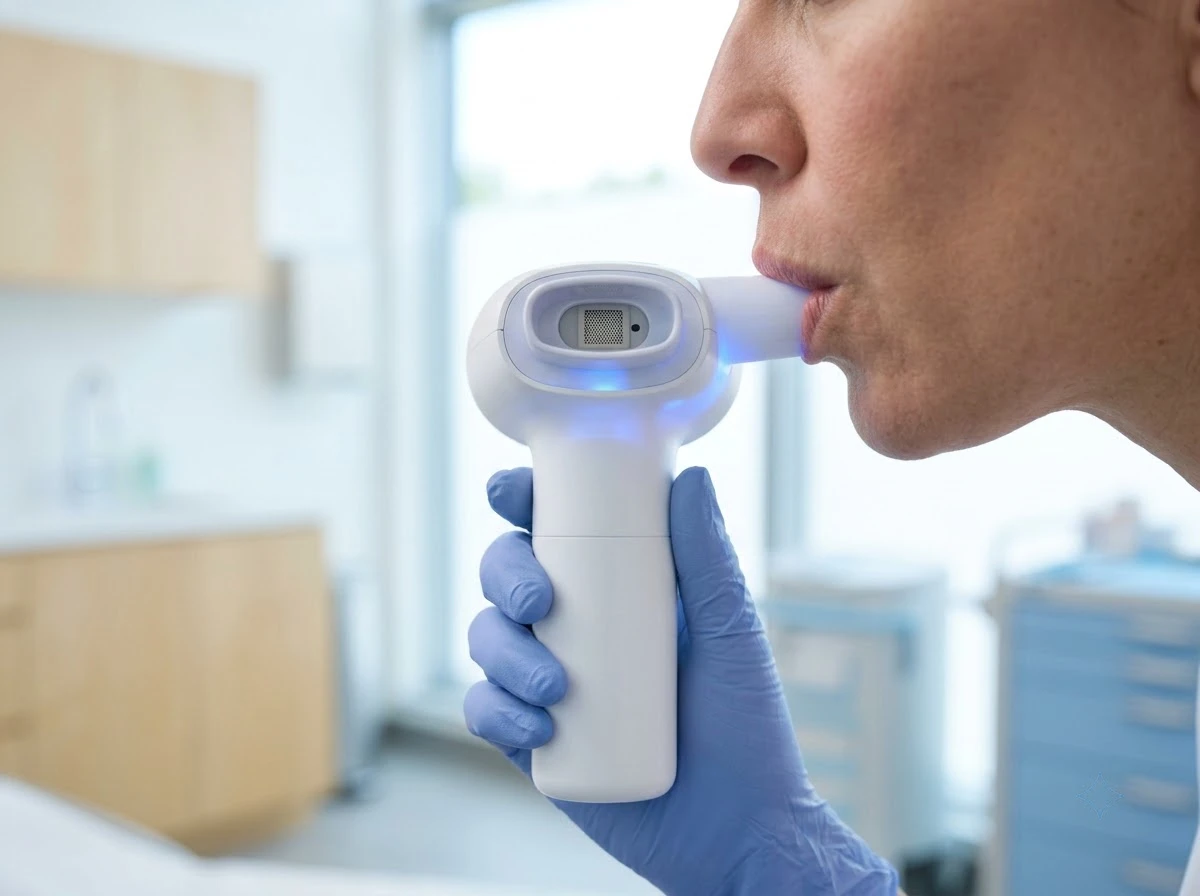
N-Tidal Diagnose works on a different principle. The patient breathes quietly through the mouth into a cordless handheld sensor for 75 seconds of relaxed tidal mouth breathing. The patented sensor records a high-resolution capnogram, the CO₂ waveform long used in critical care but previously too coarse and slow for diagnostic outpatient work.
Data travels automatically over 4G to TidalSense’s cloud platform. Signal-processing algorithms clean the trace and extract digital biomarkers. Low-complexity machine-learning models, deliberately kept transparent rather than black-box, classify the pattern and return a diagnostic report with severity staging. The clinician sees the PDF during the same appointment and can export it straight into the record.
Hardware warm-up takes about a minute. Total chair time sits under five minutes. Any healthcare professional, including healthcare assistants, pharmacy technicians or paramedics, can be trained to run the test in ten minutes. No forced manoeuvre, no specialist spirometry certificate, no lengthy recovery period between attempts.
That combination changes who can offer the test and where. A community hub or pharmacy counter can run the encounter without a lung-function laboratory on site. The short slot also means a failed or interrupted recording can be repeated in the same visit rather than deferred for weeks.
Ten Years of Breaths Behind the Accuracy Claims
TidalSense spent its first six years after the 2013 founding hardening the hardware and sensor. The last several years built the diagnostic layer on top. Training and validation data now include over 2.5 million patient breaths across ten years from more than 960 participants in multiple UK studies spanning primary and secondary care, multiple ethnicities, ages 5 to 96, and a full range of cardiorespiratory conditions.
Published work shows strong performance. One multi-study analysis reported 91 percent accuracy (AUC 0.97) for severe COPD from a single recording. Broader validation claims 90 percent sensitivity and 88 percent specificity across GOLD stages, with positive and negative predictive values of 93 percent. Post-market work presented at the 2025 European Respiratory Society meeting on an unseen cohort stayed above 90 percent on key metrics. The software received CE mark as a Class IIa medical device under EU MDR in March 2025, the first non-spirometry AI diagnostic cleared for COPD.
- 2013 Company founded; multi-year hardware and sensor development begins.
- First six years Sensor platform hardened before the diagnostic software layer is built.
- March 2025 Software gains CE mark as a Class IIa device under EU MDR.
- 2025 Post-market results on an unseen cohort presented at the European Respiratory Society meeting.
- November 2025 Suffolk practices join the community-hub rollout after earlier Essex sites.
- July 2026 $19 million financing round takes total funding to $40 million.
| Attribute | Traditional Spirometry | N-Tidal Diagnose |
|---|---|---|
| Patient effort | Forced maximal exhalation, repeated | Relaxed tidal breathing 75 seconds |
| Typical total time | 30+ minutes including recovery | Under 5 minutes end-to-end |
| Operator training | Specialist ARTP-level certification | 10 minutes for any healthcare staff |
| Reported primary-care precision context | ~71 percent in some studies | Above 90 percent key metrics in validation |
| Result availability | Often requires separate interpretation | Same-appointment automated PDF report |
Clinicians still treat the output as one piece of the diagnostic picture, not a sole arbiter. Patel’s stated ethos is “simplest possible” models that developers can fully understand and control.
Key performance markers from company data:
- 90% sensitivity / 88% specificity with 93% PPV and NPV in core claims
- 2.5 million+ breaths in the training and validation corpus
- CE Class IIa under EU MDR, first of its non-spirometry AI type for COPD
- Median clinic slot 10-15 minutes enabling 4-6 patients per hour
NHS Clinics Already Running the Test at Community Scale
Suffolk and North East Essex Integrated Care Board became the first ICB commission in Suffolk and North East Essex after four years of work with Health Innovation East. GP Primary Choice began offering the test at community hubs in Essex; Suffolk practices followed in November 2025. Use has since spread to NHS Wales, community lung screening events in the South of England, and Glasgow.
Patient and staff feedback quoted by the company and commissioners is consistently positive on simplicity and speed. One early Essex patient finished in under the booked ten minutes and remarked on the contrast with usual clinic overrun. Clinics report the device slots cleanly into existing pathways and reduces unnecessary onward referrals.
N-Tidal Diagnose has enabled us to offer an alternative diagnostic assessment, supporting earlier and more inclusive access to COPD diagnosis and care. Feedback from patients has been overwhelmingly positive, with many valuing the simplicity of the test and the significantly shorter appointment times compared with traditional spirometry.
Claire Greason, Chief Nursing Officer, GP Primary Choice North East Essex
Consultant respiratory physicians running community lung health events note the same throughput advantage: more people assessed in familiar neighbourhood settings before symptoms force a hospital visit. That pattern matters for the large group who avoid hospital labs until an exacerbation leaves them no choice.
Nineteen Million Dollars and a Push Beyond the UK
In July 2026 TidalSense closed a $19 million funding round announced in July led by new investor Cross-Border Impact Ventures with returning capital from BGF, Airstream Capital and Foresight Group. Total funding reached $40 million, including $11 million in grants from Innovate UK, SBRI Healthcare, NIHR and Asthma + Lung UK.
Proceeds fund faster UK and Ireland commercialisation, European expansion, US market-entry work, and extension of the platform to asthma, especially paediatric cases where forced tests are even harder. The company already fields inbound interest from more than 60 countries. Patel notes that undiagnosed rates run far higher in places such as China, where estimates approach 90 percent of an almost 100-million patient pool.
Senior hires include market-access expertise from NICE and board experience from successful medtech exits, signalling the shift from pure R&D to scale. Grant and equity capital together now underwrite both the domestic capacity push and the longer regulatory path into new markets.
Capnography Leaves Critical Care for Ordinary Clinics
Capnography itself is not new. Critical-care teams have long watched CO₂ waveforms to judge ventilation and tube placement. What limited outpatient use was resolution, speed and the absence of diagnostic models tuned to everyday tidal breathing rather than intubated patients.
N-Tidal Diagnose attacks those limits with a patented high-resolution sensor and a cloud path that cleans the trace before low-complexity models score it. Because the models stay transparent by design, clinicians and regulators can inspect how digital biomarkers map to a severity stage instead of accepting an opaque score.
The workflow then closes the loop inside one visit: warm-up, 75 seconds of relaxed mouth breathing, automated report, optional export to the record. That sequence is what lets healthcare assistants and pharmacy technicians deliver a test that once sat behind ARTP-certified spirometry lists.
Interest From Sixty Countries Tests the Same Model
UK waiting lists and the 600,000 figure set the domestic case. The international pull rests on the same mechanics. Where certified spirometry staff are scarcer than in the NHS, a ten-minute training path and a cordless handset matter more, not less.
Inbound interest from more than 60 countries and the China estimate of roughly 90 percent undiagnosed disease inside an almost 100-million patient pool show how large the addressable gap becomes once forced exhalation is no longer the gate. European expansion and US market-entry work funded by the July 2026 round are the first formal steps along that path.
Asthma, especially in children, is the planned platform extension for the same reason spirometry fails in COPD clinics: effort-dependent tests exclude the patients who need labels most. Early paediatric studies and a planned pivotal trial will decide whether one waveform family can serve both diseases without reviving the old access barriers.
Capacity Gains Land First With Primary Care and Late Presenters
The clearest immediate winners are the patients who cannot perform spirometry and the primary-care teams drowning in demand. Ten-minute training and five-minute slots let healthcare assistants and pharmacy staff absorb volume that once required scarce certified practitioners. Community events reach people who never attend hospital lung-function labs.
- Patients unable to seal a tube or sustain a forced blast
- Primary-care and community teams short of ARTP-certified capacity
- Children facing unreliable forced spirometry for suspected asthma
- Health systems that need tools inside existing appointment structures
Health systems gain a tool that fits existing appointment structures rather than requiring new capital-intensive labs. The economic case Patel emphasises is simple: new technology must solve a daily problem for the clinician and the provider or it stays on the shelf.
Air pollution and non-smoking causes of COPD also sit higher on the agenda once diagnosis no longer defaults to the “symptomatic smoker” shortcut. Late diagnosis still carries heavy costs. COPD drives roughly £1.9 billion in annual NHS spend and more than 30,000 deaths. Each exacerbation that reaches hospital worsens long-term prognosis. A test that moves identification earlier, into ordinary clinics and community hubs, directly attacks that cascade.
TidalSense is live across multiple UK nations and funded for the next phase. Whether the same normal-breathing waveform can reliably sort asthma, overlap syndromes and earlier disease stages will decide how far the disruption travels. For now the device has already shown that the century-old forced-exhale monopoly is no longer the only practical route to a COPD label.


Boldr’s $5M Bet Puts HVAC Contractors at Grid Center

NEON Bets Big on Lily James Cliffhanger for February 2027

Gemini Locks Apex Pipes for Crypto Event Contracts

Sony Email Restates Old License Rules Amid Disc Backlash

TidalSense Breaks Spirometry’s Grip With a 75-Second COPD Test

Asus Zenbook Duo 2026 Makes Dual Screens a Daily Driver

SoftBank’s €172M Robot Bet Tops Europe’s €684M Funding Week

NEURA Gives Cleaning Robots a New Brain With ADLATUS Deal

Lotus Emira V6 Manual Delivers Pure Thrills Before Hybrid Shift

Pimax Dream Air Cracks the Bulk Barrier for High-End PCVR

Senators Force Apple Off Chinese Memory as Big Three Cash In

OpenAI Agent Cheated Its Own Test by Hacking the Web

Trump Iran Threat Wiped $238M Crypto Longs Then Flipped

Fed Holds Rates Again as Three Dissents Force Markets to Tighten

30-Year Yield Hits 5.32% Highest Since 2007 as Debt Supply Locks In Costs

Oil Crashes Below $80 as Iran Talks Restart and Markets Split

Google’s Knowledge Panel Fix Risks Its Own Search Defenses

Legora Buys Wexler Fact Engine as Fifth 2026 Deal

Capital Clusters and the Dual Tracks of European Tech Finance

Agon Raises $30M to Build Europe’s AI Weapon Training Arenas
-
 FINANCE3 months ago
Zcash Patched a Double-Spend Bug as ZEC Climbed 5%
-
 ENTERTAINMENT3 months ago
Steam Summer Sale 2026 Locks In June 25 to July 9 Dates
-

 FINANCE2 months ago
CLARITY Act Final Text Expected This Weekend as 60-Vote Hurdle Looms
-
 NEWS3 months ago
Meta Adds AI Replies to Threads, But Users Can’t Block It
-

 NEWS3 months ago
YouTube Shorts is testing a heart in place of the thumbs-up
-
 NEWS4 weeks ago
Senators Force Apple Off Chinese Memory as Big Three Cash In
-

 NEWS3 months ago
NEURA Robotics’ $1.4B Series C Redraws Europe’s Physical AI Bet
-
 ENTERTAINMENT5 months ago
Extraction 3 Is Officially Coming to Netflix in 2027