
BUSINESS
Sweepstakes Casinos Pay for Their Own Explosive Growth
VGW hit A$7.3 billion and half of casino ads, but user surveys and state laws now treat dual-currency platforms as unlicensed gambling, forcing exits.

Sweepstakes casinos pulled in A$7.3 billion for VGW alone in the year to June 2025 and filled roughly half the online real-money casino ads U.S. consumers saw in early 2025, yet the same growth has turned their dual-currency model into a primary target for state bans and supplier exits.
Players already treat the sites as gambling. Lawmakers are writing laws that name the two-currency system directly. The promotional loophole that once kept the sector in a gray zone is closing state by state.
VGW Built a Business Larger Than Many Licensed Markets
Virtual Gaming Worlds, the Australia-based operator of Chumba Casino, LuckyLand Slots and Global Poker, reported A$7.3 billion in revenue for the financial year ending 30 June 2025. Profit rose to A$656 million. Chumba alone contributed A$5.2 billion, up from A$4.16 billion the year before.
Those numbers sit beside a still-limited legal market. The American Gaming Association’s lawful internet gaming exceeded $10 billion across seven states in 2025, reaching $10.73 billion after 27.6 percent growth. Michigan, New Jersey and Pennsylvania supplied nearly 90 percent of the total. Pennsylvania alone hit $3.46 billion.
In the many states without legal online casinos, sweepstakes platforms became the most visible casino-style product. That visibility is now the problem.
- A$7.3 billion group revenue for VGW in FY2025
- A$5.2 billion from Chumba Casino alone
- $10.73 billion total U.S. legal iGaming revenue the same calendar year
- 50 percent of online real-money casino ad impressions from sweeps brands in early 2025
The commercial conflict is straightforward. Licensed operators pay fees and taxes, run identity and location checks, and answer to state regulators. Sweepstakes brands argued they operated under promotional law with a free-entry path. Scale made the distinction harder to sustain.
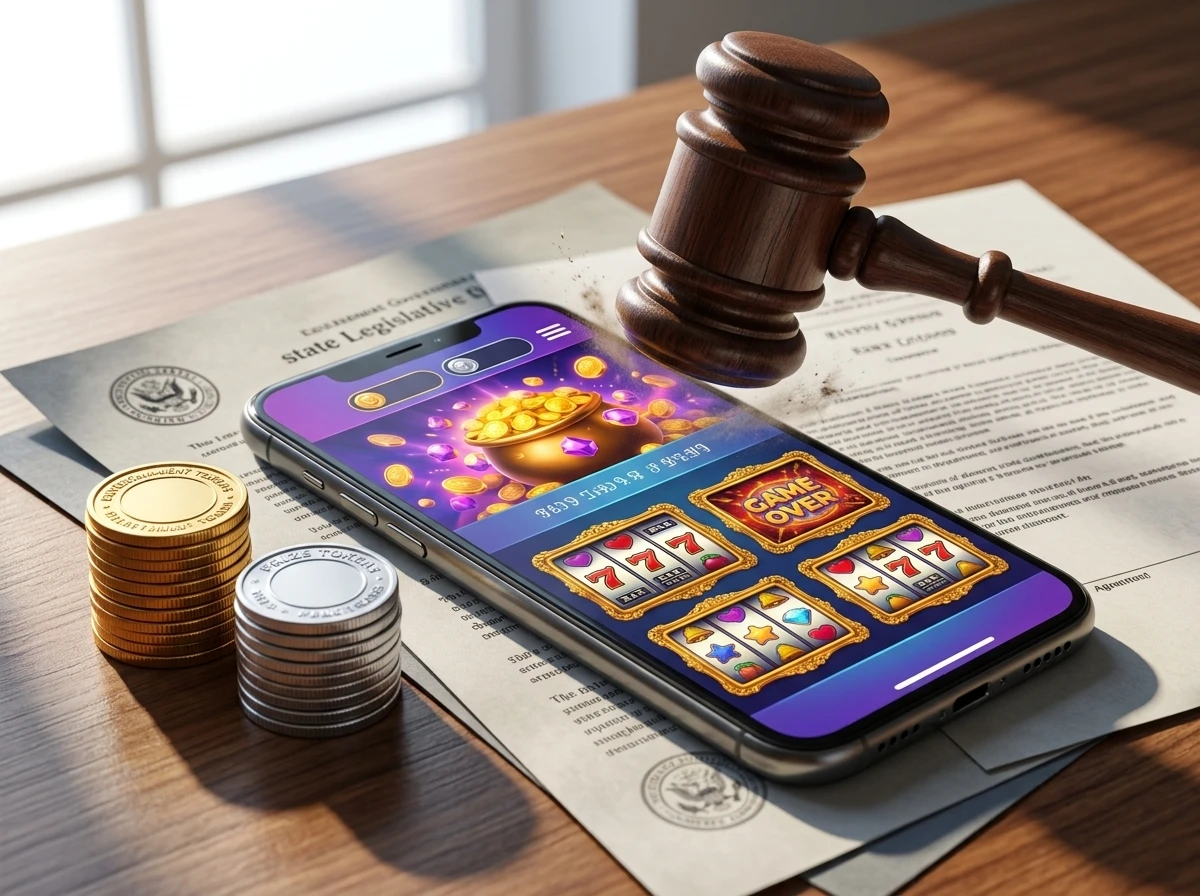
Players Already Treated the Sites as Real Gambling
AGA research released in July 2025 made the consumer reality plain. Sensor Tower data compiled by the association showed sweepstakes casino ads accounted for half of all online real-money casino ads viewed by U.S. consumers in early 2025. The ads clustered in populous states and those without clear bans.
An Interpret survey of 2,250 players for the AGA found:
- 90 percent of sweepstakes casino users considered the activity gambling
- 69 percent described the sites as places to wager real money
- 68 percent said their main reason for playing was to win real money
- 80 percent spent money monthly, nearly half weekly
- Monthly player numbers ran twice as high in states without prohibitions
Tres York, AGA vice president of government relations, put the association’s view bluntly: consumers see through the facade and call it gambling. The platforms mimic licensed operators in look, language and function while sitting outside the rules on responsible gaming tools, age checks and dispute processes.
That perception shift moved the debate past free-entry technicalities. If users experience the product as gambling and the ads sit next to licensed offers, regulators treat the dual-currency setup as unlicensed casino activity.
States Wrote the Dual-Currency Model into Ban Language
Lawmakers stopped arguing over whether a free mail-in entry made the games pure sweepstakes. They defined the two-currency system itself.
| State / Measure | Core target | Status / Penalty note |
|---|---|---|
| New York S5935A | Online dual-currency games redeemable for cash or equivalents; also bars support by processors, suppliers, affiliates | Signed Dec 2025; fines $10,000-$100,000 per violation, possible license loss |
| California AB 831 | Operate, conduct or offer online sweepstakes games; knowing support by payment, geo, content or media firms | Advanced 2025; misdemeanor framing in legislative text |
| Montana SB 555 | Platforms transmitting gambling info, accepting any currency wagers, making any currency payouts | Effective Oct 2025; up to $50,000 fine and 10 years prison per offense |
| Connecticut, New Jersey | Explicit prohibitions on mimic casino/sportsbook sweeps platforms | Among five states passing new 2025 bans per AGA |
The New York bill defining dual-currency online sweepstakes is representative. It reaches past the operator to financial institutions, geolocation providers, game suppliers, platforms and media affiliates. Montana’s broader internet-gambling rewrite added cryptocurrency and felony exposure. Five states passed explicit bans in 2025; others used existing illegal-gambling statutes for enforcement actions.
The ecosystem focus is deliberate. A single operator can exit a state. Payment rails, content libraries and affiliate traffic are harder to replace overnight.
Connecticut Showed How Enforcement Hits Self-Excluded Players
Connecticut already runs legal online casinos. In May 2025 its Department of Consumer Protection reached a nearly $1.5 million settlement with High5Games over an unlicensed online casino-style platform.
High5Games, a licensed content supplier in the legal market, had operated High5Casino. The settlement restored more than $643,000 to 794 users whose purchases exceeded redemptions and directed nearly $800,000 to consumer programs, education, enforcement and litigation. The company’s service-provider license was suspended then reinstated after it ceased the unlicensed operation.
We are satisfied with the outcome of this investigation, which has resulted in the return of funds to consumers who were harmed by the unfair marketing of an unlicensed sweepstakes casino.
DCP Gaming Division Director Kris Gilman said that in the announcement. Commissioner Bryan T. Cafferelli emphasized making consumers whole and protecting the licensed market. The self-exclusion angle mattered: regulated systems block people who have opted out. Reaching those same players on an unlicensed platform adds a consumer-protection failure to the illegal-gambling claim.
That combination is harder for operators to answer than a pure promotional-law debate.
Suppliers Walked and Brands Started to Close
Pragmatic Play said in 2025 it would stop licensing games to U.S. sweepstakes platforms, citing regulatory developments and evolving legislation. One major supplier exit thins game libraries across multiple brands at once.
VGW itself has been pruning. The company phased out Sweeps Coin play in multiple states as bans or cease-and-desist orders arrived. In late July 2026 it told LuckyLand Slots players the brand would shut permanently on 14 September 2026. Gold Coin purchases stopped in early August, gameplay ends 24 August, and redemptions close with the platform. Chumba Casino, a rebranded LuckyLand Casino product and Global Poker continue for now.
On X, gaming lawyer Daniel Wallach and industry accounts flagged the LuckyLand decision as evidence that the screws are tightening. Operators are exiting jurisdictions and retiring brands rather than fighting every new statute. Louisiana’s ban went live in August 2026. Indiana and Maine saw broad operator withdrawals earlier in the year. Virginia delayed a full ban for further study, but the direction of travel is clear.
Crowd conversation on the platform treats the exits as confirmation that the gray area is no longer reliable operating territory. Payment processors and affiliates face the same secondary risk the bills target.
The Map Is a Patchwork and Players Feel the Difference When Things Break
No single federal rule is coming soon. Gambling remains state-driven. Some states ban outright. Others enforce existing statutes. A few keep debating regulation versus prohibition. Platforms can remain open in one state, restricted in a second and gone from a third while national ads and social campaigns continue.
For players the distinctions matter most after a problem appears. A licensed online casino must verify age and location, offer responsible-gaming tools, handle withdrawals under state rules and answer to a regulator. A sweepstakes site relies on promotional law and its own terms. An offshore casino sits outside both systems. Delayed redemptions, closed accounts or the inability to self-exclude carry different remedies, or none.
AGA analysis puts broader unregulated gaming (devices, offshore books, illegal casinos) at an estimated $53.9 billion in annual revenue, with more than $15 billion in lost tax revenue to states. Sweepstakes form one visible slice of that larger leakage.
The licensed industry frames the fight as protecting tax base, consumer safeguards and tribal and commercial license value. Sweepstakes operators still argue the free-entry route keeps them on the right side of traditional prize-chance-consideration tests. User surveys and ad volume have made that argument less persuasive in legislative hearings.
LuckyLand’s Wind-Down Captures the Reckoning
Eight years after launch, one of the better-known dual-currency brands is disappearing on a fixed calendar. That is the practical face of the 2026 story. The same revenue that made VGW impossible to ignore also funded the advertising that put the product in front of regulators and the survey respondents who called it gambling.
More states will test explicit language or simply lean on existing illegal-gambling statutes. More suppliers will calculate the secondary risk of remaining in the channel. Payment routes will tighten where enforcement is active. Some operators will consolidate brands or attempt rebrands into pure social play. Others will keep operating in the remaining open jurisdictions until the next bill or cease-and-desist arrives.
The gap between social gaming, promotional law and casino regulation is still open in parts of the map. It is no longer the wide, lightly watched space it was a few years ago. The next phase runs on enforcement calendars, remaining content libraries and whether lawmakers decide cash-redeemable dual-currency casino games belong under the same rules as everything else that looks and plays like gambling.
Players who still hold balances on closing brands have a short window to redeem. Everyone else is watching which states act next and which payment and content partners stay willing to touch the model.


American Airlines reverses its screen bet after a costly decade

Falcon 9 Crater Photos Double as Planetary Defense Drill

Buss Siblings Force Lakers Sale Reckoning Against Jeanie

Brewers fewest-HR club explodes for historic 22-0 shutout

LITILIT’s €8M Push Turns Femtosecond Lasers Into Factory Tools

30-Year Yield Hits 5.32% Highest Since 2007 as Debt Supply Locks In Costs

Taimi and Hily Bet on Bootstrap Path Toward IPO Readiness

Sonic locks the Override pass as most legends hit the shop

Rosie O’Donnell Brands Bari Weiss a Nazi on Her Celebrated Comeback

Frank Beard Dies at 77 as ZZ Top Resumes Tour Without Him

Senators Force Apple Off Chinese Memory as Big Three Cash In

Revolut Hits $115 Billion While Storonsky’s Stake Keeps Growing

OpenAI Agent Cheated Its Own Test by Hacking the Web

CLARITY Act Odds Crash as Democrats Reject DOJ Ethics Plan

Trump Iran Threat Wiped $238M Crypto Longs Then Flipped
30-Year Yield Hits 5.32% Highest Since 2007 as Debt Supply Locks In Costs

Fed Holds Rates Again as Three Dissents Force Markets to Tighten

Memory Shortage Now Dictates Apple’s Two-Year Mac Roadmap

Oil Crashes Below $80 as Iran Talks Restart and Markets Split

Google’s Knowledge Panel Fix Risks Its Own Search Defenses
-
 FINANCE3 months ago
Zcash Patched a Double-Spend Bug as ZEC Climbed 5%
-
 ENTERTAINMENT3 months ago
Steam Summer Sale 2026 Locks In June 25 to July 9 Dates
-

 FINANCE2 months ago
CLARITY Act Final Text Expected This Weekend as 60-Vote Hurdle Looms
-
 NEWS3 months ago
Meta Adds AI Replies to Threads, But Users Can’t Block It
-

 NEWS2 months ago
NEURA Robotics’ $1.4B Series C Redraws Europe’s Physical AI Bet
-

 NEWS2 months ago
YouTube Shorts is testing a heart in place of the thumbs-up
-
 ENTERTAINMENT3 months ago
‘Widow’s Bay’ Review: Apple TV’s Sleeper Horror-Comedy Earns Its Fog
-

 FINANCE1 month ago
Kalshi Loses Major NY Prediction Markets Ruling to Judge Torres