
NEWS
United Flight to Spain Turned Around by a Bluetooth Named Bomb
A United flight to Spain turned around over the Atlantic after a teen’s Fitbit broadcast the Bluetooth name BOMB. Here is the law, the cost, and the pattern.

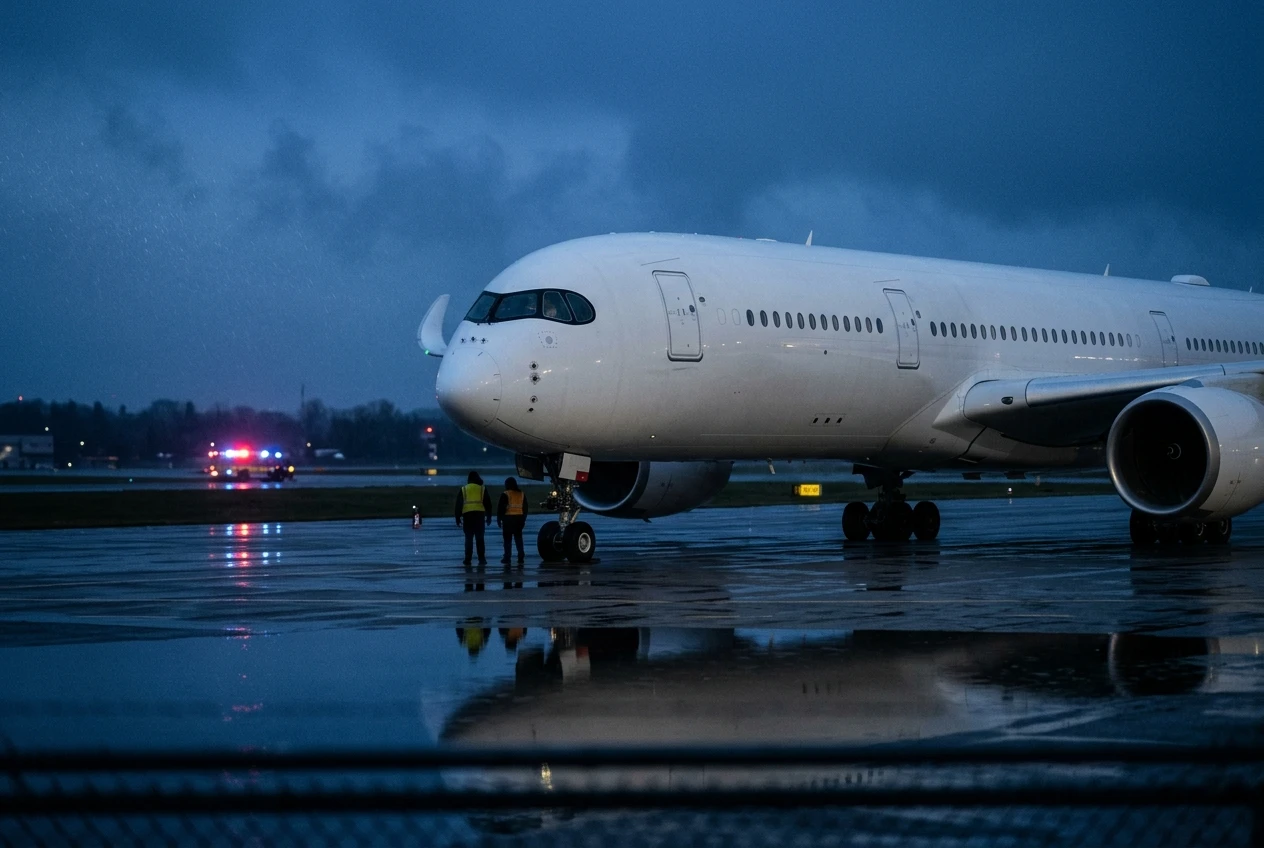
A United Airlines flight to Spain turned around mid-flight on Saturday, May 30, after a passenger’s Bluetooth device appeared on the cabin network under the name BOMB. The Boeing 767, carrying 190 people, returned to Newark Liberty International Airport about three and a half hours after takeoff, where local and federal police re-screened everyone on board. The device turned out to be a 16-year-old’s Fitbit, and no explosives were found.
What sounds like a one-off teenage prank is something airlines have seen on a loop. The detail that changed here was the technology; the response, the protocol, and the legal trap waiting at the end of it have all played out before.
How a Fitbit Named BOMB Sent Flight 236 Back to Newark
United Flight 236 pushed back from Newark at 6:08 PM bound for Palma de Mallorca, the Mediterranean island that fills with northern European holidaymakers every summer. Roughly an hour into the crossing, with the 767 already out over the Atlantic, crew members spotted a discoverable Bluetooth device broadcasting a name that no flight attendant can wave off.
The cabin crew worked the public-address system, asking everyone to switch Bluetooth off. The name stayed live. So the crew set a hard deadline, one minute, and warned that the aircraft would turn back if devices stayed active. At least two were still broadcasting when the clock ran out. The pilots squawked 7700, the transponder code for a general in-flight emergency, and pointed the jet back toward New Jersey.
Here is how the night ran:
- 6:08 PM: Flight 236 departs Newark for Palma de Mallorca with 190 passengers and 12 crew.
- About 60 minutes in: crew notice the BOMB device name and issue repeated PA warnings.
- The one-minute ultimatum passes with two devices still active; the pilots declare an emergency.
- 8:50 PM: the 767 lands back at Newark and taxis to be met by police.
- Passengers deplane around 9:00 PM, carrying only passports and phones, and clear airport security a second time.
- A replacement service leaves in the small hours and reaches Palma at 3:41 PM the next day, more than nine hours late.
The captain’s account, caught on air-traffic audio that circulated widely after the flight, was blunt.
We’re returning back to Newark because we have one passenger that seems to be making a funny joke that isn’t so funny. It’s going to be compromising the safety of this flight.
He went on to call the passenger foolish. The Fitbit’s owner, a teenager, was later deemed no threat by authorities.
Why Crews Cannot Treat the Name as a Joke
To a passenger, the word on a pairing screen is obviously a dumb gag. To a crew 60 minutes out over deep ocean, it is an unknown they cannot close. They have no way to inspect a sealed device in flight, no bomb dog, and nowhere to divert quickly once the coastline is behind them. Federal rules give them one safe move: treat the threat as real until trained people on the ground prove otherwise.
That is why the response looks heavy. A discoverable name is enough to trigger a turnaround because the alternative, pressing on across the Atlantic with an uncleared bomb reference active in the cabin, is the one outcome the system refuses to risk. The transponder code tells every controller in the sector to clear airspace and give the aircraft priority. Police and federal agents stage at the gate before the wheels touch.
Once on the ground, the aircraft and bags get swept, and passengers pass back through the Transportation Security Administration (TSA, the federal agency that screens U.S. airport passengers) a second time. Modern wearables only complicate the picture. A Fitbit, like any device with a lithium cell, travels in the cabin under the FAA’s guidance on portable electronic devices with batteries, so there was never a question of the hardware being banned. The problem was four letters of text, not the gadget itself.
Where the Bomb-Hoax Law Leaves a 16-Year-Old
Saying or writing the word bomb on a plane is not itself a crime. Convincing an aircraft to treat it as a threat can be. The statute that matters is Title 18 of the U.S. Code, Section 35, the federal bomb-hoax law, and it splits sharply depending on intent.
The Felony Line
Under the criminal half of the law, anyone who willfully and maliciously, or with reckless disregard for human safety, conveys false information about an attempt to damage an aircraft faces up to $5,000 or five years in prison, or both. The Justice Department’s own guidance on the federal bomb-hoax provisions under Section 35 spells out steeper penalties when things go wrong: up to 20 years if serious injury results, and the possibility of life if someone dies. There is also a civil track for non-malicious false reports, where prosecutors do not even need to prove intent, and a penalty can be recovered even when the report was just a bad attempt at humor.
A Passive Name Is the Gray Zone
The teenager’s case sits in an awkward spot. The criminal statute turns on whether someone conveyed or imparted false information. A device name that simply sits on a network, never sent to anyone and never claiming a bomb is actually present, is not a clean match for that language, which you can read in the full text of Title 18 Section 35. Earlier prosecutions leaned on active messages: a man who said he had a bomb in his luggage, a threat scrawled on a vomit bag. A Fitbit label is more passive than any of those. The FBI has opened an investigation, and as of this writing the 16-year-old has not been charged.
The Same Script Has Played Out Before
Strip away the Bluetooth twist and this is a rerun. For the past few years, Apple’s AirDrop has been the favorite tool for the same prank, letting a passenger push a message or image to nearby phones without giving up a name. Crews reacted the same way every time: divert, sweep, re-screen.
| Incident | Route | What happened | Outcome |
|---|---|---|---|
| Southwest, July 2023 | Las Vegas to Maui | Photos suggesting a bomb were AirDropped to a flight attendant | Diverted to Oakland, searched, no explosives, continued to Hawaii |
| American, February 2023 | El Paso to Chicago | AirDropped message read “I have a bomb would like to share a photo” | A high-school student on a field trip was identified as responsible |
| American, October 2022 | Domestic U.S. | A passenger AirDropped a threat to blow up the plane | Emergency landing; the man was arrested by police |
The pattern is older than smartphones. Bomb threats against aircraft date to the 1930s, and the overwhelming majority are hoaxes. That is exactly why none can be ignored. A single real device would be catastrophic, so the system is built to absorb a thousand false alarms rather than miss one genuine one. The Fitbit on Flight 236 is just the newest delivery method for a very old problem.
What a Mid-Atlantic Turnaround Costs
None of this is cheap, and the bill lands on the airline first. Aviation analysts put the cost of a diversion at roughly $15,000 to $20,000 an hour for a domestic flight, with long international trips running three to five times that. A widebody an hour into a transatlantic crossing is close to the worst case.
The line items stack up fast:
- Fuel. A 767 cannot land at takeoff weight, so a quick return often means burning off or jettisoning fuel; the mechanics of overweight returns are detailed in the FAA’s report to Congress on aircraft fuel dumping.
- Crew limits. By the time the jet was back on the ground near 9:00 PM, the original crew was out of legal duty hours, forcing the overnight delay and a fresh crew.
- Re-accommodation. Meals, the early-morning replacement flight, and a knock-on hit to the airline’s schedule that feeds into the kind of downstream flight delays airlines now spend millions trying to predict.
For perspective on the distance involved, Newark to Palma is a multi-hour ocean leg, the kind of long-haul flying that has pushed carriers toward ever longer non-stop international routes where a diversion is most expensive to unwind. Flight 236’s passengers reached Palma the next afternoon, more than nine hours late. The FBI investigation is open, no charges have been filed, and the most expensive joke of the weekend cost a teenager nothing yet and an airline a great deal.


Veridue Raises $4 Million to Speed Energy Deal Diligence

Healey Adds a £150m Rung for Northern Scale-Ups

Ten Deals Took Most of Europe’s August Tech Money

Holmes Hired Fielder to Film Her Last Days

Molten Bets £100m of Plc Cash on Late-Stage Tech

Garlinghouse Cited Dutch Gold, and London Got the Bars

byFounders Bets $4.3 Million on Fluencify After $2M ARR

Alpha Gang Puts A-List Stars on a Zellner Wager

Angel Bets a Recut PG-13 Chase on Ritchson and Wilson

Flex IT and T1A Combine to Own Corporate Device Supply

Walter’s TWG Insists No Fraud as Insurer Probes Force Cleanup

30-Year Yield Hits 5.32% Highest Since 2007 as Debt Supply Locks In Costs

PCE Stays at 3.7% as Gas and Tariffs Outrun Coming Revisions

Evernorth S-4 Clears Path for Active XRP Treasury on Nasdaq

Astute’s $1.2M bet makes B2B creator deals feed AI discovery

Strategy Parks $1.59B Cash While Bitcoin Stack Stays Flat

Instinct Hits $2.5 Billion as AI Agent Access Sparks Trust Fights

CLARITY Act Cloture Opens a Door Ethics Still Blocks

Oracle’s 2.8 GW Bloom Deal Exposes the AI Power Bypass

Amber’s €7M locks Mittelstand knowledge inside Europe
-
 FINANCE3 months ago
Zcash Patched a Double-Spend Bug as ZEC Climbed 5%
-
 ENTERTAINMENT3 months ago
Steam Summer Sale 2026 Locks In June 25 to July 9 Dates
-

 FINANCE2 months ago
CLARITY Act Final Text Expected This Weekend as 60-Vote Hurdle Looms
-
 NEWS4 months ago
Meta Adds AI Replies to Threads, But Users Can’t Block It
-
 ENTERTAINMENT5 months ago
Extraction 3 Is Officially Coming to Netflix in 2027
-

 NEWS3 months ago
YouTube Shorts is testing a heart in place of the thumbs-up
-

 NEWS1 month ago
Senators Force Apple Off Chinese Memory as Big Three Cash In
-

 NEWS3 months ago
NEURA Robotics’ $1.4B Series C Redraws Europe’s Physical AI Bet