
HEALTH
Samsung Just Wired a Galaxy Watch Into Workplace Safety
Samsung upgraded its SmartThings Pro heat stress system with South Korea’s labor ministry. The Galaxy Watch-based solution uses biometrics and three temperature thresholds to predict heat-related risks.

Samsung upgraded a heat-stress management system on July 6, 2026 that turns its LTE Galaxy Watch into a workplace safety tool for outdoor workers, built with South Korea’s Ministry of Employment and Labor and running on the company’s own semiconductor construction site. The upgrade layers South Korea’s three-tier heat-wave response guidelines onto biometric data streamed from a worker’s wrist. Alerts go to a manager’s dashboard first, then to the watch itself, with rest recommendations pushed at perceived on-site temperatures of 33°C, 35°C, and 38°C.
The system is the next step for the SmartThings Pro Safety Management Solution, which Samsung launched in September 2025 for B2B deployments. This version sharpens the prediction algorithm through a research partnership with Incheon National University and adds clinical validation from Samsung Medical Center’s Data Science Research Institute. The workplace using it today is a single construction site at Samsung Electronics’ Pyeongtaek Campus, the crews building a new semiconductor production line. Every other outdoor worker in South Korea is still waiting.
What Samsung and MOEL Just Upgraded
Samsung Electronics has upgraded its Heat Stress Management System in partnership with South Korea’s Ministry of Employment and Labor, also known as MOEL. The system runs on Samsung’s SmartThings Pro AI platform and uses LTE-equipped Galaxy Watches to monitor outdoor workers in a cloud environment. It bakes MOEL’s step-by-step heat-wave response criteria into the alerts a site manager sees and the rest recommendations that flow back down to each worker’s wrist.
The upgrade sits inside the SmartThings Pro Safety Management Solution, which Samsung first introduced in September 2025. The stack pulls together environmental data like on-site temperature and humidity with worker biometrics like heart rate and activity level to predict heat-stress risk before it becomes heatstroke. When a worker’s metrics cross one of MOEL’s three temperature thresholds, the manager’s dashboard flags the event. Managers can then push heat warnings and rest advisories directly to the worker’s watch face.
We upgraded the solution to enable proactive management of heat stress by reflecting the MOEL’s guidelines and the demand for heat stress management at industrial sites.
Park Chan-woo, Executive Vice President of Samsung Electronics’ B2B Integrated Offering Center, framed the upgrade as a step from one-size-fits-all heat responses to per-worker monitoring. He said Samsung would keep developing the safety solution on top of an information security management system that meets international standards. Samsung’s upgrade of the heat stress management system was first reported by Seoul Economic Daily.
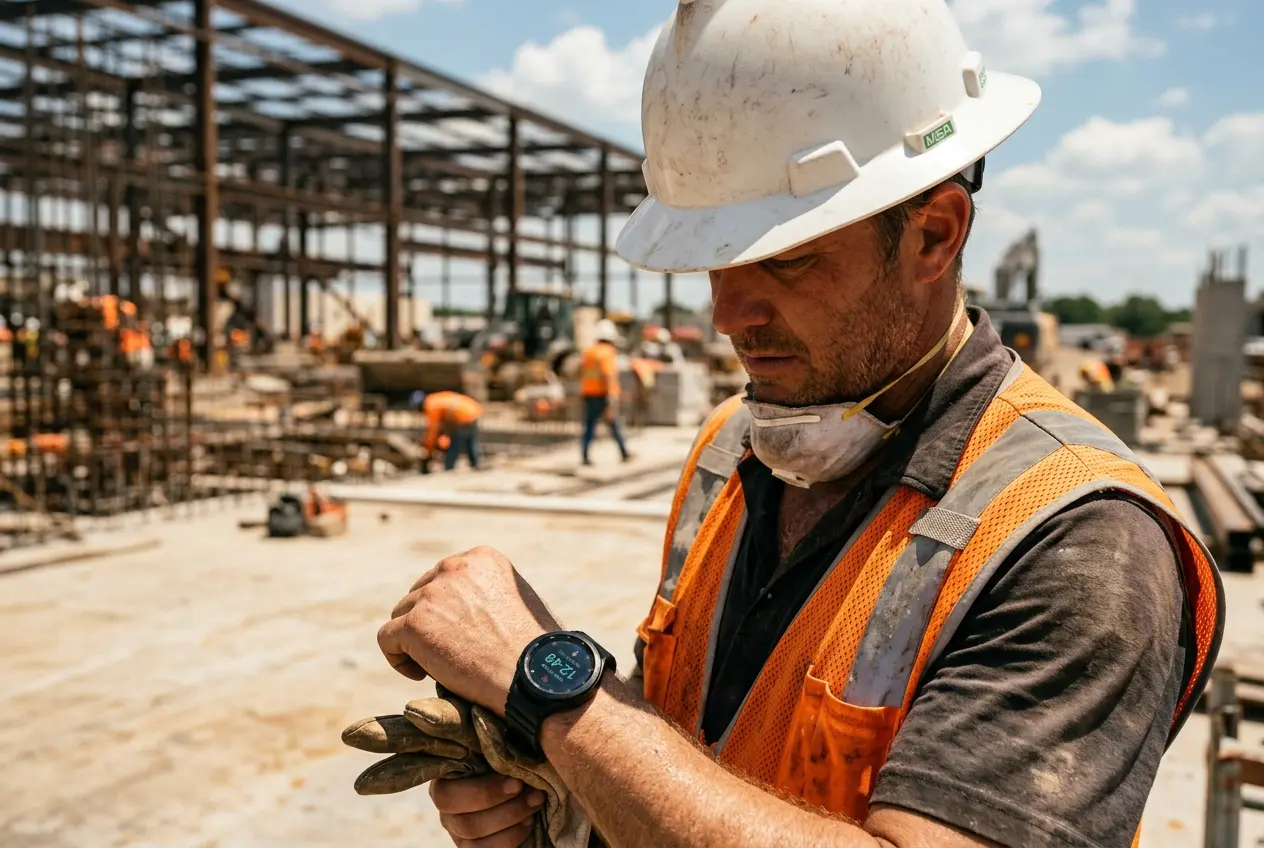
How the SmartThings Pro Stack Reads Heat Stress
The system reads a worker’s body the way most consumer wearables track fitness, then turns the same signals into an industrial safety answer. An LTE Galaxy Watch streams heart rate and activity level into the SmartThings Pro cloud. On-site temperature and humidity feed the same model from the other side. The platform then estimates each worker’s core body temperature in real time and assigns a risk level. When that risk crosses a threshold, the system alerts the manager, who can push a rest recommendation back to the watch. The watch becomes the final link between environmental monitoring, health data, and the person who decides whether a worker steps away.
The key shift is personalization. The system no longer waits for a single site-wide reading before acting; it tries to forecast which worker is most at risk under the day’s actual mix of temperature, workload, and biology. The algorithm weighs that combination rather than reacting to ambient readings alone. Two workers standing under the same sky can produce different alerts because their personal data tells different stories.
Inputs to the algorithm include a worker’s height, weight, age, and sex, alongside their real-time heart rate pattern and the local environment. Samsung says this combination lets the platform forecast core body temperature rather than just register it, which matters because heat illness can set in before the body itself signals a problem. The research team at Incheon National University helped Samsung sharpen the model. The Data Science Research Institute at Samsung Medical Center cross-checked the predictions against actual physiological responses under stress. What SmartThings Pro does for safety management is laid out on Samsung’s B2B product page.
- Real-time heart rate from the LTE Galaxy Watch
- Worker activity level from the same watch
- On-site temperature and humidity from site sensors
- Personal physical data, namely height, weight, age, and sex
The Three Temperature Thresholds Driving Every Alert
The thresholds themselves come straight from South Korea’s labor ministry, not from Samsung’s engineers. When the perceived on-site temperature reaches 33°C, the platform labels the conditions a heat-wave advisory. At 35°C, the label steps up to a heat-wave warning. At 38°C, the system treats the situation as a serious heat-wave warning. Each crossing fires an automatic alert on the manager’s dashboard, where the response is dictated by MOEL’s pause-work guidance.
Managers see the alert, then act. They can issue a heat-illness warning to the worker’s Galaxy Watch, a rest recommendation, or both. The system does not stop work on its own; the human in the loop decides what happens next. That is the point of personalizing the alert rather than automating the shutdown.
Workers facing the same high-heat shift have always dealt with the same MOEL thresholds; what is new is that the threshold now fires at the wrist and on the dashboard at the same moment. Managers can see which worker is in trouble and not just which site. The escalation logic mirrors how South Korea’s industrial safety policy already handles extreme heat. The technology adds visibility around the framework rather than rewriting the rules.
Outside contractors and shift supervisors still carry the legal duty of care. The watch surfaces a signal earlier than a worker might speak up, but the call to pull someone off a job still goes through a person. That handoff matters as much as the algorithm that triggered it.
- 33°C perceived on-site temperature triggers a heat-wave advisory on the manager dashboard and unlocks the option to send a heat-illness warning to the worker’s watch.
- 35°C perceived on-site temperature triggers a heat-wave warning, with the rest-recommendation option added to the manager’s tools.
- 38°C perceived on-site temperature triggers a serious heat-wave warning and is treated as the escalation point in MOEL’s response guidelines.
Pyeongtaek Is the Only Site Wearing the Watch Right Now
The construction site of a new semiconductor production line at Samsung Electronics’ Pyeongtaek Campus is the only place the upgraded system is live today. There, the wearable layer of SmartThings Pro is being tested on the outdoor crews whose working conditions often trigger the very alerts the system is built to fire. The site’s location matters, because Samsung’s manufacturing operations push workers through long summer shifts when South Korea’s heat index climbs. The Pyeongtaek deployment acts as a real-world lab and a way to protect the people building the company’s next chip line.
Outside that campus, no other Samsung facility, contractor, or industry is currently running the upgraded heat-stress version. Samsung frames the partnership with MOEL as work toward a “wearable industrial safety model” other organizations could adopt. That language is aspirational, not a confirmed rollout. Construction crews at South Korea’s other semiconductor sites, and the broader pool of outdoor laborers, are still waiting for a version that reaches them.
The Two Research Partners Behind the Algorithm
Samsung did not run the upgrade in isolation. Two outside institutions had to sign off before workers could wear the watch. The first is Incheon National University, which contributed research that sharpened the algorithm predicting each worker’s core body temperature. The second is Samsung Medical Center’s Data Science Research Institute, which validated those predictions against real physiological responses under heat stress.
The Incheon team deepened the algorithm’s inputs. A worker’s height, weight, age, and sex joined real-time heart rate patterns and site environment data inside the same model. The team at Samsung Medical Center then checked the output: did the predicted body temperature match what bodies actually did during heat exposure? Together the two partnerships turned a B2B safety feature into a clinically checked one.
Samsung frames this pairing as a public-private collaboration, with MOEL setting the rules and academic plus medical teams auditing the science. That structure could matter if the system expands outside South Korea, where regulators may want the same kind of validation. The validation is also why a single temperature threshold can be trusted to trigger a real intervention rather than another false alarm. For now, the academic credit lives in research papers; the practical credit belongs to the workers who wore the watch during testing at Samsung Medical Center-validated conditions.
Where Samsung and the Ministry Want This to Land Next
Samsung and MOEL have framed the upgrade as the starting point for a wearable-first industrial safety model other organizations can adopt. Park Chan-woo’s division, B2B Integrated Offering Center, is the unit tasked with pushing that rollout. SmartThings Pro also recently picked up ISO 27001 certification, the international standard for information security management, which Samsung presents as a precondition for handling worker biometrics at scale.
Any wider deployment will still require clear rules on worker consent, data access, and how employers may use health information, the choice of partners signals that. The current reach is one campus, one set of outdoor crews, and one set of Korean government thresholds. Workers at Pyeongtaek are the first to wear the upgraded technology. Everyone else waits for the rollout.
- SmartThings Pro Safety Management Solution original launch: September 2025
- Heat-wave advisory trigger: 33°C perceived on-site temperature
- Heat-wave warning trigger: 35°C perceived on-site temperature
- Serious heat-wave warning trigger: 38°C perceived on-site temperature
- Live deployment today: Samsung Electronics’ Pyeongtaek Campus
Frequently Asked Questions
Can a regular Galaxy Watch owner use this heat stress feature?
No. The system is currently a B2B workplace deployment inside Samsung’s SmartThings Pro Safety Management Solution, not a consumer feature you can download from the Galaxy Store. Even workers using a personal Galaxy Watch outside a registered industrial deployment would not get the same alerts, because the manager dashboard and MOEL threshold logic live behind the enterprise layer.
Is the heat stress system available outside South Korea?
No confirmed international rollout exists. The upgraded system runs against South Korea’s Ministry of Employment and Labor thresholds and is currently deployed only at Samsung Electronics’ Pyeongtaek Campus. Samsung has said it wants to grow this into a wearable industrial safety model other organizations can adopt, but no other country or company is running it yet.
What temperature triggers each manager-dashboard alert?
A perceived on-site temperature of 33°C or higher triggers a heat-wave advisory, 35°C or higher triggers a heat-wave warning, and 38°C or higher triggers a serious heat-wave warning. Each level fires an automatic alert on the manager’s dashboard and unlocks the matching rest-recommendation options on a worker’s LTE Galaxy Watch.
How accurate is the core body temperature prediction?
Samsung ran the upgraded algorithm through validation work with Incheon National University and clinical checks with the Data Science Research Institute at Samsung Medical Center. The partnership compared algorithm predictions against actual physiological responses under heat stress. Samsung has not published a single accuracy percentage for the general public.
Will other companies or industries adopt this safety model?
Samsung has framed the partnership with South Korea’s labor ministry as work toward a wearable industrial safety model that other organizations can adopt. The current deployment at Samsung’s own campus is the only active site, and no external employer has been named as a launch customer.


NFL Preseason Week 2 Quietly Tests the Schemes That Matter

Alonso’s Towering Drive Stands Foul and Flips Orioles Momentum

US Debt Crosses $40 Trillion as Interest Crowds the Budget

Trevon Diggs Joins Seahawks on One-Year Deal After Cowboys Exit

Pixel Watch 5 Turns Passive Trends Into Early Health Alerts

Pixel 11 Pro Fold Sleek Build Undercuts Its Own Unfolding Appeal

Tugboat Wilkinson’s Scoreless Debut Pays Off Giants’ Bailey Trade

Brown Shines for Pats as Love for Eagles Meets Trade Reality

Pixel Watch 5 Turns Wrist Data Into Early Metabolic Alerts

Resistance Stars Pay the Price in Democratic Primaries

Senators Force Apple Off Chinese Memory as Big Three Cash In

OpenAI Agent Cheated Its Own Test by Hacking the Web

Trump Iran Threat Wiped $238M Crypto Longs Then Flipped

30-Year Yield Hits 5.32% Highest Since 2007 as Debt Supply Locks In Costs

Fed Holds Rates Again as Three Dissents Force Markets to Tighten

Oil Crashes Below $80 as Iran Talks Restart and Markets Split

Google’s Knowledge Panel Fix Risks Its Own Search Defenses

Agon Raises $30M to Build Europe’s AI Weapon Training Arenas

Legora Buys Wexler Fact Engine as Fifth 2026 Deal

Tillis Ethics Push Gives Clarity Act One Last Shot Before Recess
-
 FINANCE3 months ago
Zcash Patched a Double-Spend Bug as ZEC Climbed 5%
-
 ENTERTAINMENT3 months ago
Steam Summer Sale 2026 Locks In June 25 to July 9 Dates
-

 FINANCE2 months ago
CLARITY Act Final Text Expected This Weekend as 60-Vote Hurdle Looms
-
 NEWS3 months ago
Meta Adds AI Replies to Threads, But Users Can’t Block It
-

 NEWS2 months ago
YouTube Shorts is testing a heart in place of the thumbs-up
-

 NEWS2 months ago
NEURA Robotics’ $1.4B Series C Redraws Europe’s Physical AI Bet
-
 NEWS3 weeks ago
Senators Force Apple Off Chinese Memory as Big Three Cash In
-
 ENTERTAINMENT3 months ago
‘Widow’s Bay’ Review: Apple TV’s Sleeper Horror-Comedy Earns Its Fog