
FINANCE
India Dearness Allowance July 2026: Where the 3% Estimate Stands
India’s central government employees await the July 2026 Dearness Allowance revision. The May AICPI-IW reading of 150.8 puts a 3% hike firmly in view.

India’s central government employees are weeks away from the next Dearness Allowance revision, and the latest inflation print has put a specific number at the front of the estimate range. The All India Consumer Price Index for Industrial Workers, or AICPI-IW, rose to 150.8 in May 2026, up 0.9 points from April. Working through the standard formula with that print points to a 3 percentage point hike in Dearness Allowance, taking the rate from 60 per cent to 63 per cent of basic pay from July 1, 2026.
The exact figure depends on the June index reading, which the Ministry of Labour and Employment is expected to release in the first week of July. A larger 4 per cent move, taking DA to 64 per cent, would require the June AICPI-IW to climb well above the recent trend.
Where the Index Stands Now
The current Dearness Allowance rate of 60 per cent took effect on January 1, 2026, after the Union Cabinet approved a 2 per cent increase on April 18, 2026. That decision raised DA from 58 per cent to 60 per cent and Dearness Relief for pensioners by the same margin. India revises DA twice a year, with the January and July cycles tied to six-month averages of the AICPI-IW. The midpoint between cycles usually falls in March and September, with the formal Cabinet approval often trailing the effective date by weeks.
Index prints over the last twelve months have climbed steadily, with the May 2026 figure of 150.8 marking a fresh high. The April reading was 149.9, the March reading 149.1, and January 2026 came in at 148.6. Year-on-year inflation based on the index stood at 4.72 per cent in May 2026, up from 2.93 per cent in May 2025. Food, fuel, and housing categories carried the bulk of the May move, mirroring the trend in retail inflation. The steady climb rather than a single jump is what the formula reads as it sets the next revision.
The Numbers That Matter
- 60 per cent: current Dearness Allowance rate, effective January 1, 2026
- 150.8: AICPI-IW reading for May 2026
- 4.72 per cent: year-on-year inflation based on AICPI-IW in May 2026
How the DA Formula Reads the Print
Dearness Allowance is calculated under the 7th Central Pay Commission using a 12-month average of the AICPI-IW. The formula multiplies that average by a linking factor of 2.88, which converts the 2016 base series to the older 2001 base, and applies a fixed adjustment of 261.41.
For the July 2026 calculation, the 12-month window runs from July 2025 to June 2026. The Economic Times, using the AICPI-IW rise to 150.8 in May 2026 data from the Labour Bureau, put the average of the eleven confirmed prints from June 2025 to May 2026 at 148.075. The June print, once released, will close that window. Each confirmed print is published by the Labour Bureau, with year-on-year inflation reported alongside the index level.
If June lands near 151, the calculated DA works out to 63.7 per cent, which rounds down to 63 per cent under the government’s usual convention, a 3 percentage point increase from 60 per cent. The formula turns the 12-month average into a DA percentage mechanically, with each tenth of a point moving the final figure in step. The calculation behind a possible 63% DA walks through each line of the arithmetic, with the 2.88 factor and the 261.41 adjustment applied to the 148.58 estimate.
AICPI-IW Monthly Trail
| Month | Reading |
|---|---|
| January 2026 | 148.6 |
| February 2026 | 148.5 |
| March 2026 | 149.1 |
| April 2026 | 149.9 |
| May 2026 | 150.8 |
Three Percent Looks Likely, Four Would Take a Jump
Most estimates built off the May data converge on a 3 per cent hike as the central case. Both Moneycontrol and Livemint calculate a 3.7 per cent rise from the current 60 per cent rate using the average of recent prints, which rounds down to a 3 percentage point increase.
Reaching 64 per cent would require a meaningfully hotter June print. The Economic Times calculates that the 12-month average would need to reach 148.86, which in turn requires the June 2026 AICPI-IW to come in at 154.5, per the threshold for a 4% hike to 64%. Recent monthly gains have run closer to half a point than four points, putting that level out of immediate reach.
A second scenario sits in between. A June print of around 151.7, in line with the May to June trend extrapolation shown in Livemint’s table, still rounds to a 63 per cent hike. The Union Cabinet, not the index formula, sets the final percentage. Rounding conventions and political precedent usually keep the announced figure close to the calculated value.
Moneycontrol lays out the calculation step by step. A 12-month average of 148.58, multiplied by 2.88 and run through the standard formula, produces a 63.7 per cent DA rate. Subtracting the existing 60 per cent leaves a 3.7 per cent rise that rounds down to 3 per cent. The same formula works in reverse when the index cools, leaving DA flat or trimming it at the next revision. The other inputs in the formula are fixed by the 7th Central Pay Commission.
What a 63 per cent DA Means for Paychecks
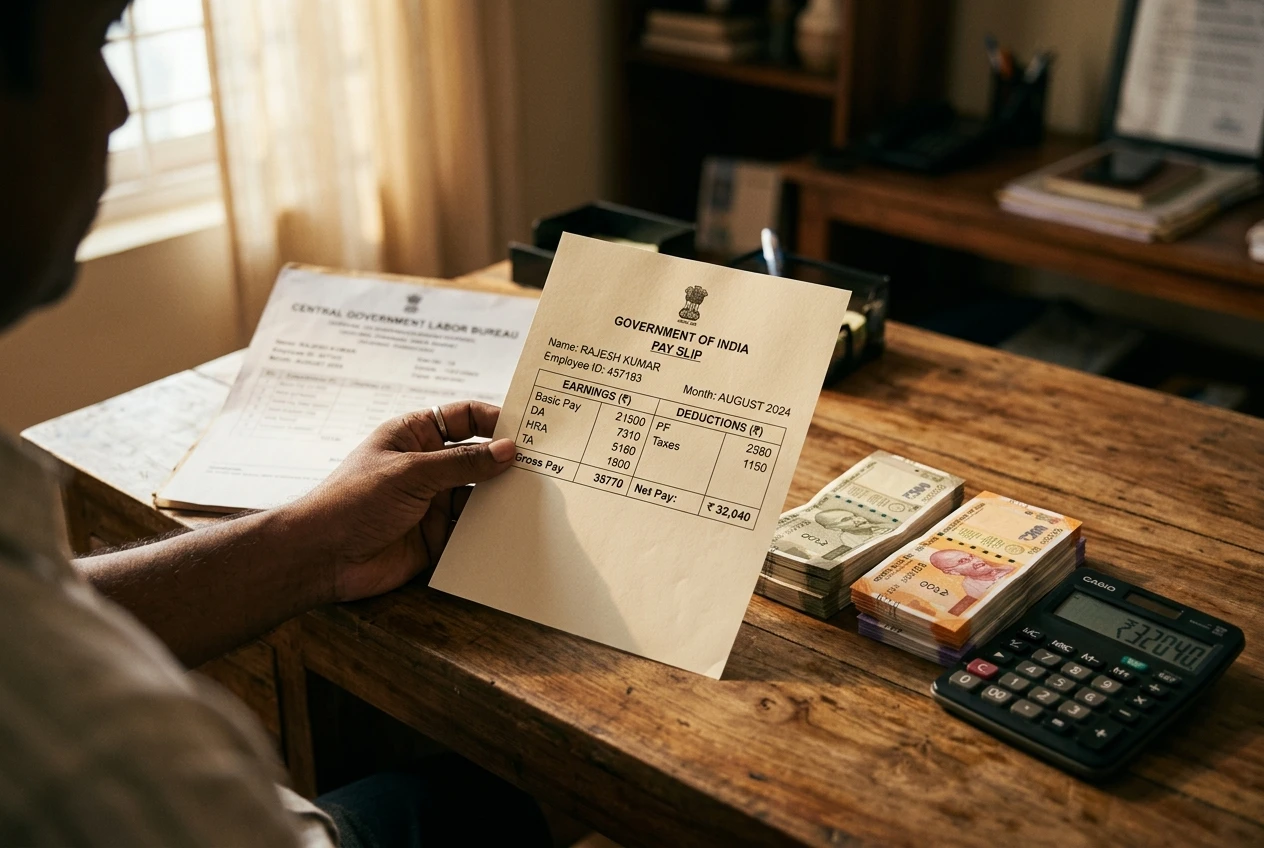
The hike flows through to take-home pay, transport allowance, and any pay-component that sits on top of basic pay. The Economic Times illustrates the effect with a Level 6 central government employee whose minimum basic pay is Rs 35,400 a month. In the paper’s worked example, gross pay at 50 per cent DA works out to Rs 53,100, with a 3 percentage point rise to 53 per cent lifting the gross to Rs 54,162, a Rs 1,062 monthly increase.
Transport allowance moves in step. Moneycontrol works through a Y-category city example at Pay Level 5 with a base transport allowance of Rs 1,800 a month. At the current 60 per cent DA, the component totals Rs 2,880. Under a 63 per cent DA, the figure rises to Rs 2,934.
Pensioners on Dearness Relief see the same percentage revision, with the increase applied to basic pension. The 7th Pay Commission structure means the change is mechanical: every percentage point on DA flows one-for-one into retirement income for those covered. HRA, where applicable, sits on a separate revision track tied to the pay commission’s city classification.
Transport Allowance at Different DA Levels
| Component | At 60% DA | At 63% DA |
|---|---|---|
| Base transport allowance (Pay Level 5, Y city) | Rs 1,800 | Rs 1,800 |
| Total transport allowance with DA | Rs 2,880 | Rs 2,934 |
The Fiscal Side of the Decision
Every percentage point added to DA feeds straight into the central wage bill and pension outgo. The October 2025 Cabinet decision, which raised DA from 55 per cent to 58 per cent, carried an annual exchequer impact of Rs 10,083.96 crore. That revision was sized to reach 49.19 lakh central government employees and 68.72 lakh pensioners. The fiscal hit scales with both the percentage increase and the size of the covered workforce.
States often follow the Centre’s lead, which spreads the fiscal load across multiple state budgets in subsequent quarters. Madhya Pradesh, for example, approved a parallel 3 per cent DA rise to 58 per cent effective July 1, 2025, per the April 18 cabinet approval of the 2% DA hike report. Pensioners, who receive the parallel Dearness Relief, see the same percentage revision under current rules.
What Drives the Final Call
- The June 2026 AICPI-IW print, due in the first week of July, closes the 12-month calculation window.
- Food, fuel, and housing sub-indices, the largest weights inside AICPI-IW, shape whether the print drifts higher or softer.
- Cabinet sign-off on the calculated rate, with the second instalment typically announced in September, sometimes delayed into October.
- State-level adoption, with state governments usually mirroring the central revision within one or two cycles.
June Print Closes the Calculation Window
The single most important data point still missing is the June 2026 AICPI-IW reading. The Labour Bureau typically releases the figure during the first week of the following month, putting the print in the public domain by the first week of July.
Once the Cabinet approves a rate, the revision is retroactive to July 1, 2026. Arrears are paid from that effective date even if the official notification arrives weeks later. Employees should plan on a moderate increase in monthly income from August or September onward, with the exact percentage locked in by the announcement.
Until that announcement, the 3 per cent figure sits at the front of the estimate range. The 4 per cent threshold sits further out, requiring a June reading that the recent monthly trend does not support. The Cabinet retains discretion to round up or down within the calculated band, but past practice usually tracks the formula closely. Once the Labour Bureau drops the June print, the calculation closes, and the political decision becomes a matter of weeks.
Frequently Asked Questions
What is the current Dearness Allowance rate for central government employees?
Dearness Allowance for central government employees and Dearness Relief for pensioners stand at 60 per cent of basic pay or basic pension, effective January 1, 2026. The Union Cabinet approved the 2 per cent hike from the previous 58 per cent on April 18, 2026.
When will the next DA revision be announced?
The revision takes effect from July 1, 2026, and the government typically announces the second instalment in September, sometimes delayed into October. Once notified, the increase applies from the start of the six-month cycle, with arrears paid for any lag.
How is the DA percentage calculated?
Under the 7th Central Pay Commission, the formula takes the 12-month average AICPI-IW, multiplies it by a linking factor of 2.88, subtracts a fixed adjustment of 261.41, and divides by the same adjustment to reach a percentage. The increment over the existing DA gives the hike in percentage points.
Will the July 2026 DA hike be 3 per cent or 4 per cent?
Estimates built on the May 2026 AICPI-IW reading point to a 3 per cent hike, taking DA from 60 per cent to 63 per cent. A 4 per cent hike to 64 per cent would require the June 2026 index to reach 154.5, well above the recent monthly trend.
How much more will employees earn after the hike?
A Level 6 employee with a Rs 35,400 basic pay sees monthly gross pay rise by Rs 1,062 in the Economic Times worked example. Transport allowance moves up in step, with a Pay Level 5 employee in a Y-category city moving from Rs 2,880 a month at the current 60 per cent DA to Rs 2,934 a month under a 63 per cent DA.
Disclaimer: This article is for informational purposes only and does not constitute financial, tax, or investment advice. Figures are accurate as of publication and reflect data published by the Labour Bureau and Indian press outlets in early July 2026. Consult a qualified professional before making financial decisions based on the figures cited here.


xTool M2 Hands-On: A 3-in-1 Laser Cutter for Creators

Senate’s August 7 Deadline Caps the CLARITY Act’s 2026 Path

Strategy’s $216 Million Bitcoin Sale Funds STRC Preferred Dividends

Byron Donalds Pitched Trump’s Tax Bill on Varney. It’s Now Law.

Night Falls on Manhattan Turns 30, Lumet’s Crime Drama Returns to Blu-ray

India Dearness Allowance July 2026: Where the 3% Estimate Stands

The Bet Parents Are Making on College Students’ Credit Cards

Average Refinance Rates Hit a Seven-Week Low on the Friday Update

Aylight Closes €4.5M Pre-Seed Round for AI Optical Interconnects

BBC’s Personal Finance Push Is Bigger Than One Week

Coinbase for Agents Lets AI Trade and Spend From Your Account

NEURA Robotics’ $1.4B Series C Redraws Europe’s Physical AI Bet

SpaceX IPO Tests Retail Appetite With a Record $75B Raise

Kalshi’s CFTC-Approved HYPE Perpetuals Go Live in the US

Theker’s $85M Series A Bets on Robots That Rethink the Factory Floor

Coinbase and Ripple Push CLARITY Act Vote as Time Tightens

OpenAI Confidentially Files S-1, A Week Behind Anthropic

Ripple CEO Agrees Wall Street Is Copying XRP’s Banker Coin Model

DOJ’s Live Nation Antitrust Suit Closes In on a Ticketmaster Breakup

CLARITY Act’s Senate Path Now Runs Through Law Enforcement Buy-In
-
 FINANCE1 month ago
Zcash Patched a Double-Spend Bug as ZEC Climbed 5%
-
 ENTERTAINMENT1 month ago
Steam Summer Sale 2026 Locks In June 25 to July 9 Dates
-
 NEWS2 months ago
Meta Adds AI Replies to Threads, But Users Can’t Block It
-
 ENTERTAINMENT2 months ago
‘Widow’s Bay’ Review: Apple TV’s Sleeper Horror-Comedy Earns Its Fog
-
 ENTERTAINMENT1 month ago
Amazon Scraps Its Stargate Revival After a 20-Week Writers Room
-
 FINANCE1 month ago
Citigroup Says ETF Outflows Drove Bitcoin’s Crash, Not Strategy’s Sale
-
 FINANCE1 month ago
CLARITY Act Floor Vote Likely Shifts to August, Lummis Says
-
 FINANCE1 month ago
Coinbase Invests in Ethena, ENA Jumps 10% on Open-Market Buy