
NEWS
Aylight Closes €4.5M Pre-Seed Round for AI Optical Interconnects
Zurich-based Aylight closed a €4.5M pre-seed round to build chip-scale multiwavelength lasers for AI data-centre interconnects. Elaia and Swisscom Ventures co-led.

Zurich-based photonics startup Aylight has closed a €4.5 million pre-seed round to develop chip-scale multiwavelength lasers for AI data-centre optical interconnects. The round was co-led by Elaia and Swisscom Ventures, with participation from Verve Ventures and Plug and Play. Founded in 2025 by Bahareh Marzban and Dmitry Kazakov following research at ETH Zürich, Aylight says its technology targets the laser at each end of every optical link between chips, a constraint that has been hiding inside AI infrastructure.
Each optical interconnect needs its own laser; as more accelerators are packed into a system, the lasers stack with them, driving up cost, power and integration complexity. Aylight’s answer is a single chip built around a frequency-modulated comb, generating many precisely spaced wavelengths from one device. The company frames the architecture as a way to replace dozens of lasers per optical link with one source. The €4.5 million funds the move from research results to first foundry-made prototypes and the expansion of its research and development team.
The Round and Its Investors
The size of the round is small in absolute terms: €4.5 million is the kind of capital a chip startup raises to put the first wafers through a foundry. The company plans to use the cash to build its first semiconductor-foundry prototypes and to expand its research and development team, per the primary announcement of the pre-seed round.
Elaia co-led the round with Swisscom Ventures, the company and the lead investors confirmed. Verve Ventures and Plug and Play also participated. The two leads are betting on the same thesis, articulated differently: that optical links inside AI data centres are constrained not by fibre but by the discrete lasers stacked behind them.
- Elaia: co-lead.
- Swisscom Ventures: co-lead.
- Verve Ventures: participant.
- Plug and Play: participant.
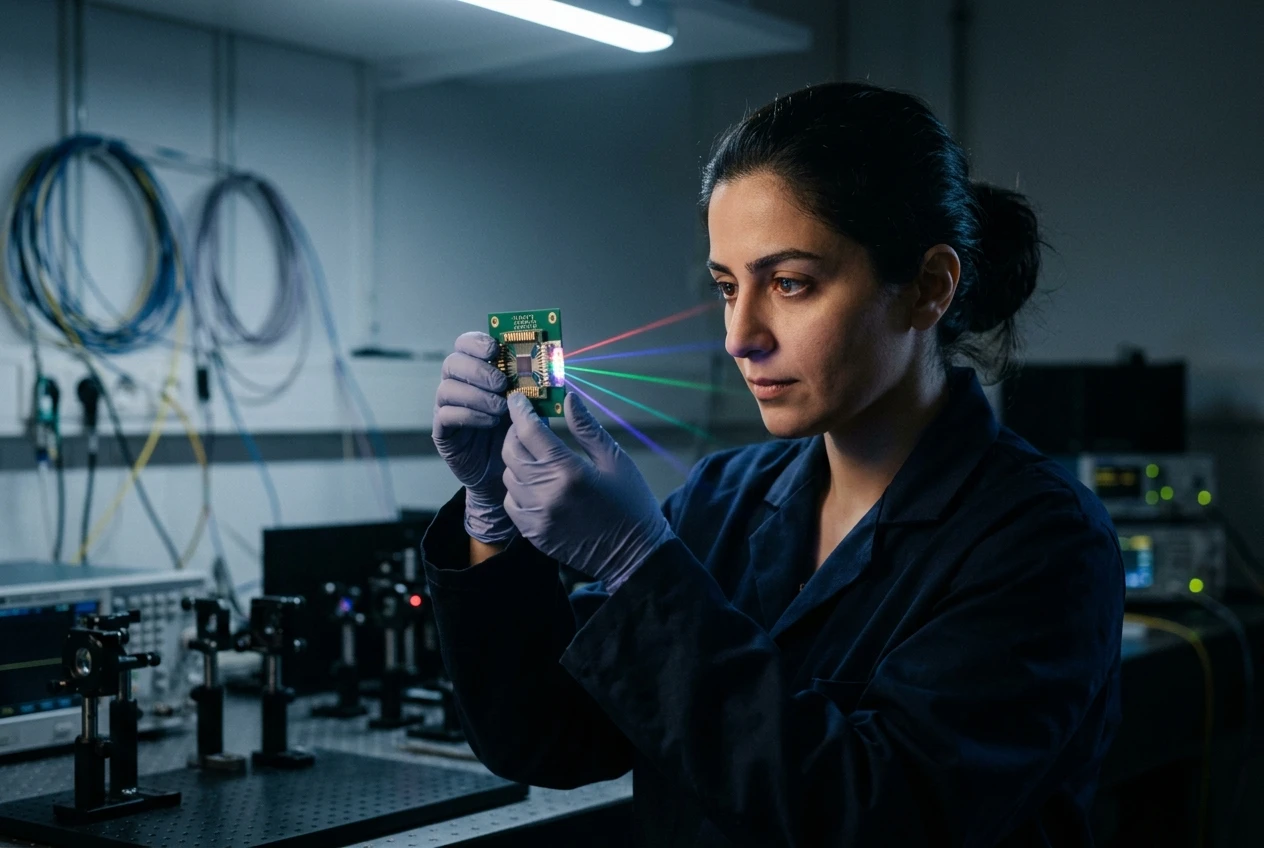
How a Frequency-Modulated Comb Replaces Dozens of Lasers
Aylight’s chip is built around a frequency-modulated comb. The architecture turns a single semiconductor laser into many precisely spaced optical channels on one device, each acting as its own data lane. An optical link that would conventionally need an array of discrete lasers can in principle draw on a single Aylight source. The chip is designed to be manufactured on existing semiconductor photonics foundries rather than on a custom process line, the company said.
Co-founder and CEO Marzban framed the choice as a problem-first decision rather than a technology in search of a market. She pointed the company’s first products at the link between two processing chips inside a data-centre rack, not at the long-haul fibre outside it.
That positioning puts Aylight into a small but crowded corner of photonics. Chip-scale comb lasers are an active area of research; comparable architectures have been pursued by Ayar Labs and Lumentum in the United States, and by the multi-colour laser rival Enlightra, which raised $15 million from Y Combinator, Runa Capital and others to build its own multi-colour sources for AI data centres. Enlightra’s chips generate more than 50 distinct colours of light from a single specialised laser, the company has said, on a standard silicon manufacturing line rather than a custom fab.
From the ETH Zürich Lab Bench to Foundry Prototypes
Both Aylight founders came through the photonics group at ETH Zürich. Marzban’s research has centred on semiconductor laser design and silicon photonics, including peer-reviewed work on quantum walk comb lasers. Kazakov holds an earlier degree from Harvard University and is listed as co-founder and CTO at Aylight.
The spin-out’s research roots are showing through to industry. Aylight researchers presented on ultrafast frequency-modulated continuous-wave LiDAR at OFC Conference 2026, reporting multi-harmonic modulation enabling linear chirps up to 1.2THz bandwidth at micrometer range resolution, with a stated path to sub-150 micrometer resolution. The LiDAR work runs in parallel to the data-centre interconnect roadmap but draws on the same comb-laser hardware, and sensing has been flagged as a second commercial direction once optical links for AI land.
Beyond Optical Interconnects
Aylight’s pitch does not stop at networking. The company has named four adjacent markets for the same laser hardware, including ones with much smaller unit volumes but higher tolerance for new suppliers. Three of those four ride on the frequency-modulated continuous-wave sensing capability, where the same comb that drives data lanes can drive precision depth imaging.
The four applications set out by Aylight are:
- Semiconductor inspection: linewidth and overlay metrology tools that need single-chip multiwavelength sources.
- Metrology: precision measurement instruments, including atomic clocks and frequency references.
- Industrial automation: short-range 3D sensing for robot arms and quality-control vision.
- Precision robotics: high-resolution depth maps for autonomous systems in unstructured environments.
The application list was set out in Aylight’s own announcement of the round. Of the four, semiconductor inspection is the most natural adjacent market, since it operates with similar volume curves to optical components and tolerates the kind of price points Aylight’s foundry route can reach. The other three depend on the same comb-laser hardware being functional for precision sensing, an application the company’s research group has already published on. None of the four is generating revenue for Aylight today; the company is pre-seed-stage and still building prototypes.
What the Round Says About AI’s Next Constraint
The round was built on a single pitch: that AI infrastructure’s bind is shifting from chips to connections. Aylight said in its own announcement of the round that the bottleneck is moving from compute to data movement between chips. Every additional GPU in a system needs more bandwidth, more fibre, and more lasers to drive the light sources at each end of an optical link.
We started from a problem rather than a technology: the laser had become one of the constraints on scaling AI infrastructure. This funding will help us bring our technology from research to our first products.
That is CEO Bahareh Marzban, speaking in the statement announcing the round. Aylight’s framing is that one chip emitting a frequency-modulated comb can replace the dozens of lasers a multi-link interconnect currently requires.
Investors are buying the idea that AI infrastructure is going to bind at the laser before it binds elsewhere, and that the next-generation optical link will be identified by how few lasers it uses rather than by how many. The same framing has been adopted by Enlightra, Ayar Labs and the optical-component incumbents, each pursuing a different version of the multiwavelength-on-a-chip concept. Where this round’s backers have placed their chips is on Aylight’s specific bet: a frequency-modulated comb laser that can be manufactured in existing foundries rather than a custom process line.
The work is unfinished. Aylight remains a small team, with the first foundry prototypes still to ship and the chip-scale multiwavelength laser pitch still unproven in production silicon at data-centre scale. The €4.5 million funds the move from research to first products, per Marzban. McKinsey projects the AI optical interconnect market to reach $24 billion by 2030, a figure both Aylight and Enlightra cite as the wider context for bets that are still pre-revenue.
Frequently Asked Questions
What does Aylight actually make?
Aylight makes chip-scale multiwavelength lasers built on a frequency-modulated comb architecture. A single chip emits many precisely spaced optical wavelengths, replacing the stacks of discrete lasers that conventional optical interconnects rely on. The architecture is built to be manufactured on existing semiconductor photonics foundries, the company said, and aims first at the link between two processing chips inside a data-centre rack.
Who backed Aylight’s €4.5 million pre-seed round?
The round was co-led by Elaia and Swisscom Ventures, with Verve Ventures and Plug and Play participating.
Why does AI infrastructure need a new kind of laser?
Aylight’s pitch is that the laser is now the binding constraint inside AI clusters, not the compute. As more accelerators are packed into a rack, more optical links are needed between them, and each link today needs its own discrete laser. Stacking more accelerators means stacking more lasers, with the cost, power and integration complexity that follows. Aylight’s bet is that one chip emitting many wavelengths can replace dozens of discrete lasers per link.
What will Aylight do with the funding?
The pre-seed funds Aylight’s first semiconductor-foundry prototypes and the expansion of its research and development team. The stated aim, per co-founder and CEO Bahareh Marzban, is to bring the technology from research results to first products. The research group’s prior work, including peer-reviewed quantum walk comb laser papers and an OFC Conference 2026 presentation on ultrafast LiDAR, is the base the prototypes build on.
Where is Aylight based, and who founded it?
Aylight is based in Zurich, Switzerland, and was founded in 2025. Its co-founders are Bahareh Marzban, who serves as CEO, and Dmitry Kazakov, listed as CTO. Both came through the photonics group at ETH Zürich. The company is small: Aylight’s public profile lists its workforce at between two and ten employees, focused on chip-scale quantum walk comb laser R&D.


xTool M2 Hands-On: A 3-in-1 Laser Cutter for Creators

Senate’s August 7 Deadline Caps the CLARITY Act’s 2026 Path

Strategy’s $216 Million Bitcoin Sale Funds STRC Preferred Dividends

Byron Donalds Pitched Trump’s Tax Bill on Varney. It’s Now Law.

Night Falls on Manhattan Turns 30, Lumet’s Crime Drama Returns to Blu-ray

India Dearness Allowance July 2026: Where the 3% Estimate Stands

The Bet Parents Are Making on College Students’ Credit Cards

Average Refinance Rates Hit a Seven-Week Low on the Friday Update

Aylight Closes €4.5M Pre-Seed Round for AI Optical Interconnects

BBC’s Personal Finance Push Is Bigger Than One Week

Coinbase for Agents Lets AI Trade and Spend From Your Account

NEURA Robotics’ $1.4B Series C Redraws Europe’s Physical AI Bet

SpaceX IPO Tests Retail Appetite With a Record $75B Raise

Kalshi’s CFTC-Approved HYPE Perpetuals Go Live in the US

Theker’s $85M Series A Bets on Robots That Rethink the Factory Floor

Coinbase and Ripple Push CLARITY Act Vote as Time Tightens

OpenAI Confidentially Files S-1, A Week Behind Anthropic

Ripple CEO Agrees Wall Street Is Copying XRP’s Banker Coin Model

DOJ’s Live Nation Antitrust Suit Closes In on a Ticketmaster Breakup

CLARITY Act’s Senate Path Now Runs Through Law Enforcement Buy-In
-
 FINANCE1 month ago
Zcash Patched a Double-Spend Bug as ZEC Climbed 5%
-
 ENTERTAINMENT1 month ago
Steam Summer Sale 2026 Locks In June 25 to July 9 Dates
-
 NEWS2 months ago
Meta Adds AI Replies to Threads, But Users Can’t Block It
-
 ENTERTAINMENT2 months ago
‘Widow’s Bay’ Review: Apple TV’s Sleeper Horror-Comedy Earns Its Fog
-
 ENTERTAINMENT1 month ago
Amazon Scraps Its Stargate Revival After a 20-Week Writers Room
-
 FINANCE1 month ago
Citigroup Says ETF Outflows Drove Bitcoin’s Crash, Not Strategy’s Sale
-
 FINANCE1 month ago
CLARITY Act Floor Vote Likely Shifts to August, Lummis Says
-
 FINANCE1 month ago
Coinbase Invests in Ethena, ENA Jumps 10% on Open-Market Buy