
NEWS
Honda’s Electric Trial Bike Lands in the Top Five at TrialGP Japan
Miquel Gelabert piloted Honda’s RTL Electric to sixth and fifth at the 2026 TrialGP of Japan, the first time an electric bike raced the premier class.

The 2026 TrialGP of Japan opened with a result the sport had never recorded. Spain’s Miquel Gelabert piloted Honda’s RTL Electric to sixth overall on day one at Mobility Resort Motegi, then climbed to fifth the next day, the first time an electric motorcycle has ever raced in motorcycle trial’s premier class. The debut is Honda Montesa’s first data point at the level the bike was built for.
Honda brought the project up through trial’s lower ranks on purpose. The RTL Electric ran three rounds of Japan’s national JTR series in 2024, a full year in the Trial2 support class in 2025, and reached the X-Trial Barcelona indoor event in February 2026 before this season’s promotion to the top flight. The team’s stated target for 2026 is to fight for podiums, a step up from the runner-up Gelabert delivered in Trial2 last year.
What Happened at Motegi
Spain’s Miquel Gelabert opened the 2026 Hertz FIM Trial World Championship at Motegi with a sixth overall on day one, then improved to fifth on day two across the rocks, climbs and giant logs that define a TrialGP course. The FIM, motorcycle sport’s world governing body, put the message in its own post-race report from the 2026 TrialGP of Japan: electric machines can compete on an equal footing against petrol-powered motorcycles over the toughest, most challenging sections. Honda has framed the result as the first data point at the level the bike was built to race at.
The 2026 season also overhauled the event format, with a new Super Pole session the day before competition and a Super Final reserved for the top five riders after Race 1. Gelabert qualified fifth in the first-ever Super Pole, then made the cut for the Super Final on both days of racing. Honda Montesa Team Manager Carles Barneda described the debut as a positive experience and said the team sees real potential for the bike to fight for a podium. Round two, the TrialGP of Andorra, is scheduled for 12-14 June at Sant Julià de Lòria.
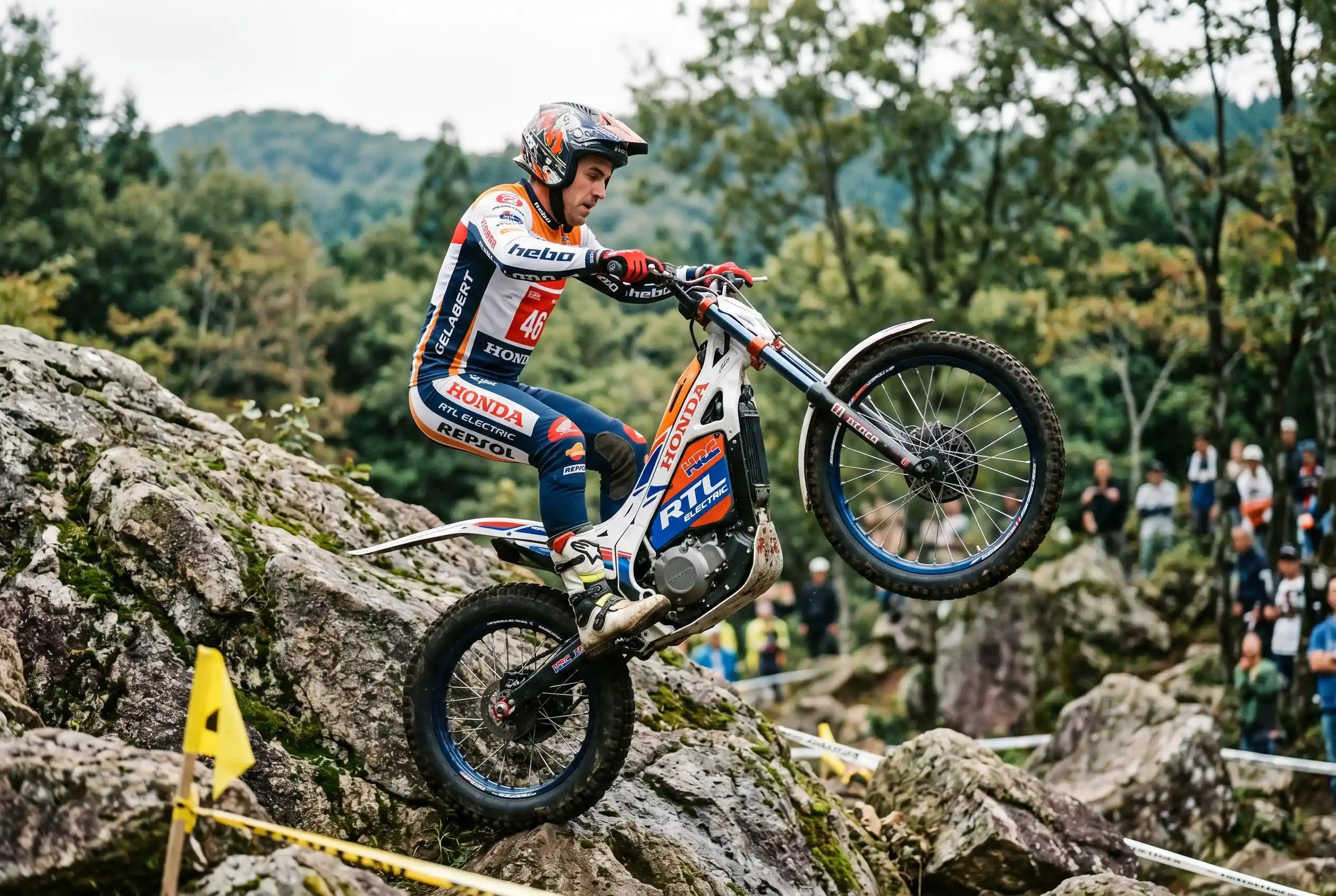
The First Electric Premier-Class Trial Bike
Honda’s electric trials project climbed the sport’s ladder on a deliberate schedule. The RTL Electric ran three rounds of Japan’s national JTR series in 2024, then a full year in the Trial2 support class in 2025, then the X-Trial Barcelona indoor event in February 2026 before this season’s promotion to the top flight, as set out in Honda Montesa’s pre-season announcement of the RTL Electric’s TrialGP debut.
The X-Trial Barcelona debut was the first time the bike lined up at the sport’s highest level, even though Gelabert did not make the Final that night. The May weekend in Japan was the first time the machine faced a full outdoor TrialGP course, complete with the rocks, climbs and giant logs the FIM catalogue describes as making up much of the Mobility Resort Motegi layout. Honda designed the project as an electric trial bike superior to its own Montesa COTA 4RT factory bike, the standard Honda measures every prototype against. The team has been open about the development work still required, conceding that the Super Final sections were more demanding and that the bike struggled at that level.
Gelabert’s own path mirrors the bike’s. He was a regular in the TrialGP class from 2016 to 2024, then dropped to Trial2 last season specifically to help Honda develop the RTL Electric. His 2025 Trial2 record of five victories and nine podium finishes was good enough for runner-up in the series, and good enough to earn promotion back to the top flight for 2026 on the electric machine.
By the numbers
- Day 1, Motegi: 6th overall (Gelabert, Honda RTL Electric)
- Day 2, Motegi: 5th overall (Gelabert, Honda RTL Electric)
- 2025 Trial2 record: 5 wins, 9 podiums, runner-up
- First-ever Super Pole: qualified 5th
- Voltage class: FIM Type A, 60 V or below
What the RTL Electric Is Made Of
The RTL Electric is built around a lithium-ion battery developed with know-how from Honda’s CR Electric Proto electric motocross project, paired with an AC synchronous motor integrated with its own inverter. The package targets high output and a low, central mass, with a wet hydraulic multi-plate clutch, flywheel and constant-mesh transmission sitting behind it.
Honda picked a Type A classification under FIM rules, which means the bike operates at 60 volts or below. Higher-voltage Type B machines can deliver more power but require stricter safety measures, and some European manufacturers build Type A bikes for the commercial market and Type B machines for World Championship competition. Honda’s electrification team has described the choice as the optimal balance for a trial bike, worked out through PC simulation rather than engine-build experience. The aluminium twin-tube frame, newly developed swing arm and telescopic front end are tuned for the impacts the underguard is expected to absorb in competition.
Honda has published the dimensions but not the weight or battery capacity. The RTL Electric is 2,010 mm long, 830 mm wide and 1,130 mm tall, with a 1,320 mm wheelbase and 335 mm of ground clearance, riding on Michelin COMP tires with a four-pot front brake and a two-pot rear. For reference, the Stark VARG MX 1.2 electric motocross bike is listed at 118 kg (260 pounds), and most sporty petrol motorcycles come in between 300 and 500 pounds.
The chassis is a deliberate echo of Honda’s petrol Montesa COTA 4RT, the four-stroke factory bike the RTL Electric is being developed to replace, with shared suspension and brake architecture, as the prototype that became the RTL Electric showed when it first entered the All-Japan Trial Championship.
Why Trials Plays to an Electric Bike’s Strengths
Trials riding is the unusual motorcycle discipline where battery power may already hold a structural edge. The format scores riders on precise turning, slow balance over extreme obstacles, and the ability to hold a motorcycle on a steep climb without putting a foot down, exactly the kind of work where instant torque and the absence of a clutch bite point matter more than top speed. Honda’s RTL Electric development team, in a published interview with the project’s electrification engineers, said it is “becoming clear that EVs have advantages in trial competition,” and pointed to the way a swappable battery lets engineers tune the weight of smaller bikes for children.
Off-road riding also blunts the two usual objections to electric motorcycles. Quiet operation is a feature on trails with wildlife and noise restrictions, not a drawback, and trial events are held indoors in the X-Trial version of the sport. The shorter range that discourages road buyers is irrelevant on a course that lasts a handful of sections. Less obvious is the operational benefit: trial courses are short, intense and easy on batteries, and the absence of fuel vapour inside transporters is the kind of small thing development teams flag when they list the case for going electric. Motegi is the first time that case has been put to a real-world test at top-class level under the eyes of the wider motorcycle industry.
Where Honda Says the Bike Still Has to Improve
Honda is being unusually candid about the gaps. Barneda pointed to the Super Final sections as the area that needs the most work, describing the level of the course as more demanding and the bike as having struggled a bit more there.
After last season in Trial2, where we saw that the bike could compete for top positions in every race, we felt that the next step was to move up to TrialGP to keep developing the project. During the winter, we worked intensively to further develop the bike and the goal for the 2026 season is to be able to fight for the podium.
The 2025 Trial2 season showed the same pattern from a different angle. Honda’s RTL Electric scored a runner-up finish in the class, but the team also recorded zero-point results caused by mid-race issues that could not be repaired in the paddock, including a USA round disqualification triggered by a battery change in the wrong location. One of Honda’s developers described those problems as areas that were not fully refined during the prototype stage, and noted that an EV battery is harder to patch in the field than a fuel leak.
The shorter term targets are clearer. Honda’s stated goal for 2026 is to fight for podiums, a step up from the runner-up Gelabert delivered in Trial2 last year. Gelabert’s own read after Motegi was measured. He told the FIM: “That’s the first weekend of the season done. We know that we have to keep improving little by little, race after race, so I’m happy. I’m very grateful to the team for all the hard work and in Andorra we will look to make a step forward.” Barneda’s framing of the same picture is the one Honda will be judged by at the end of the season: podium fights, not top-fives.
The 2026 calendar after Motegi:
- Round 2, 12-14 June: Sant Julià de Lòria, Andorra
- Round 3: Camerino, Italy
- Round 4: Trac Môn Circuit, Great Britain
- Round 5: Cahors, France
- Round 6: Zelhem, Netherlands
- Round 7: Pobladura de las Regueras, Spain
The Off-Road Electric Field Honda Just Entered
Honda is not the only company building serious electric off-roaders. Stark Future’s Stark VARG has been the headline electric motocross machine for years, with the MX 1.2 version claimed at 118 kg (260 pounds) and as much as 80 hp in its top configuration. The trial category has its own smaller, slower electric entrants, including Yamaha’s TY-E 2.1, in development since 2018, and Oset, now part of Triumph, which has been making electric trials machines for years. Honda’s choice to keep the RTL Electric at 60 volts or below, with all the trade-offs that brings, is a design philosophy, not a budget cut.
The RTL Electric is a niche competition project, not a commercial fix, but it is the first Honda EV programme to put a measurable premier-class result on the board. The 2026 TrialGP calendar is the first season in which that comparison can be made in public, on the same courses, against the same petrol-powered works riders. The FIM sells a season pass covering all seven rounds and the Trial des Nations for €49.90, putting every weekend of that comparison behind a single paywall, against a wider backdrop that includes Honda’s first-ever annual net loss as an EV bet and solid-state battery tech that charges in five minutes already reaching production motorcycles.
Frequently Asked Questions
Who is Miquel Gelabert?
Miquel Gelabert is a 28-year-old Spanish trial rider from Barcelona who races for Honda Montesa. He is the rider Honda chose to debut the RTL Electric in the top flight, after a 2025 Trial2 runner-up result with five wins and nine podiums and a 2016-2024 run in the premier class.
When did the Honda RTL Electric first race at top-class level?
The RTL Electric’s first appearance in the premier class was at the X-Trial Barcelona indoor event in February 2026, although Gelabert did not make the Final that night. The 2026 TrialGP of Japan in May was the first time the bike raced the full outdoor premier-class course, and the first time an electric motorcycle was used in the premier TrialGP category at all.
What is the Honda RTL Electric and when was it revealed?
The RTL Electric is Honda’s first competition electric trial bike, designed to be superior to the long-running Montesa COTA 4RT four-stroke. Honda first teased the project in 2024, ran it in three rounds of the Japanese JTR series that year, and then put it through a full year in the Trial2 support class in 2025 before promoting it to the top flight for 2026. The bike uses a lithium-ion battery developed with know-how from Honda’s CR Electric Proto electric motocross project, paired with an AC synchronous motor, a wet hydraulic multi-plate clutch and a constant-mesh transmission, all in a 2,010 mm-long aluminium twin-tube frame.
What is the next TrialGP round in 2026?
Round two of the 2026 Hertz FIM Trial World Championship, the TrialGP of Andorra, is scheduled for 12-14 June at Sant Julià de Lòria. The rest of the season visits Italy, Great Britain, France and the Netherlands before finishing in Spain, with the FIM Trial des Nations held in addition to the seven regular rounds.
How does the Honda RTL Electric compare to petrol-powered trial bikes on weight?
Honda has not yet published the RTL Electric’s weight. For reference, the Stark VARG MX 1.2 electric motocross bike is listed at 118 kg (260 pounds), and most sporty petrol motorcycles come in between 300 and 500 pounds. Trial bikes are built around low-speed balance rather than outright power, which is one reason the category is a credible proving ground for electric powertrains.


Capital Clusters and the Dual Tracks of European Tech Finance

Microsoft Shrinks Windows 11 Memory for 8GB PCs

XRP Ledger Brings Back Bugged Features Fixed for Institutions

The Shards Trailer Turns Ellis Nightmare Into Murphy Glamour

WhatsApp Folder Hides Business Messages After Hours

Mova LiDAX Ultra 3000 AWD Cracks the Robot Mower Moat

Urban Arrow FamilyNext Turns Costco Runs Into Bike Trips

Reddit Builds Spoken Video Layer to Reclaim Its Own Viral Stories

Nuggit £5m Fund Treats YouTube Channels as Real Businesses

Galaxy Z Fold 8 Makes Foldables Daily Drivers but Drops Flex Mode

CLARITY Act Final Text Expected This Weekend as 60-Vote Hurdle Looms

Kalshi Loses Major NY Prediction Markets Ruling to Judge Torres

Fed Minutes Cite AI Demand as Inflation Risk, Put a 2026 Hike Back on the Map

Marker AI Writing Startup Lands $13M Seed Led by Index Ventures

Dota 2 Esports World Cup 2026: Spirit Defends $2M Title In Paris

Meta’s Muse Spark 1.1 Beats Rivals on Price, Trails on Coding

Backrooms Returns to Theaters as the Everything Must Go Edition

CS2 Premier Season 5 Lands With Cache and a C4 Damage Rework

Finto Picks Munich Over Silicon Valley After YC, Raises $3.4M

ARC Intelligence Closes €4M Seed Round in Roughly a Week
-
 FINANCE2 months ago
Zcash Patched a Double-Spend Bug as ZEC Climbed 5%
-
 ENTERTAINMENT2 months ago
Steam Summer Sale 2026 Locks In June 25 to July 9 Dates
-
 FINANCE4 weeks ago
CLARITY Act Final Text Expected This Weekend as 60-Vote Hurdle Looms
-
 NEWS3 months ago
Meta Adds AI Replies to Threads, But Users Can’t Block It
-
 ENTERTAINMENT2 months ago
‘Widow’s Bay’ Review: Apple TV’s Sleeper Horror-Comedy Earns Its Fog
-
 NEWS5 months ago
U.S. Navy Deploys Solar-Powered Lightfish Drone to Patrol Oceans
-
 NEWS8 months ago
FolderFresh Review: This Free Tool Automates Windows File Organizing
-
 FINANCE4 weeks ago
Kalshi Loses Major NY Prediction Markets Ruling to Judge Torres