
NEWS
Urban Arrow FamilyNext Turns Costco Runs Into Bike Trips
A $9,000 cargo ebike hauled a full Costco load with ease. Stacked against $11,577 yearly car costs, the FamilyNext math looks different for second-car households.

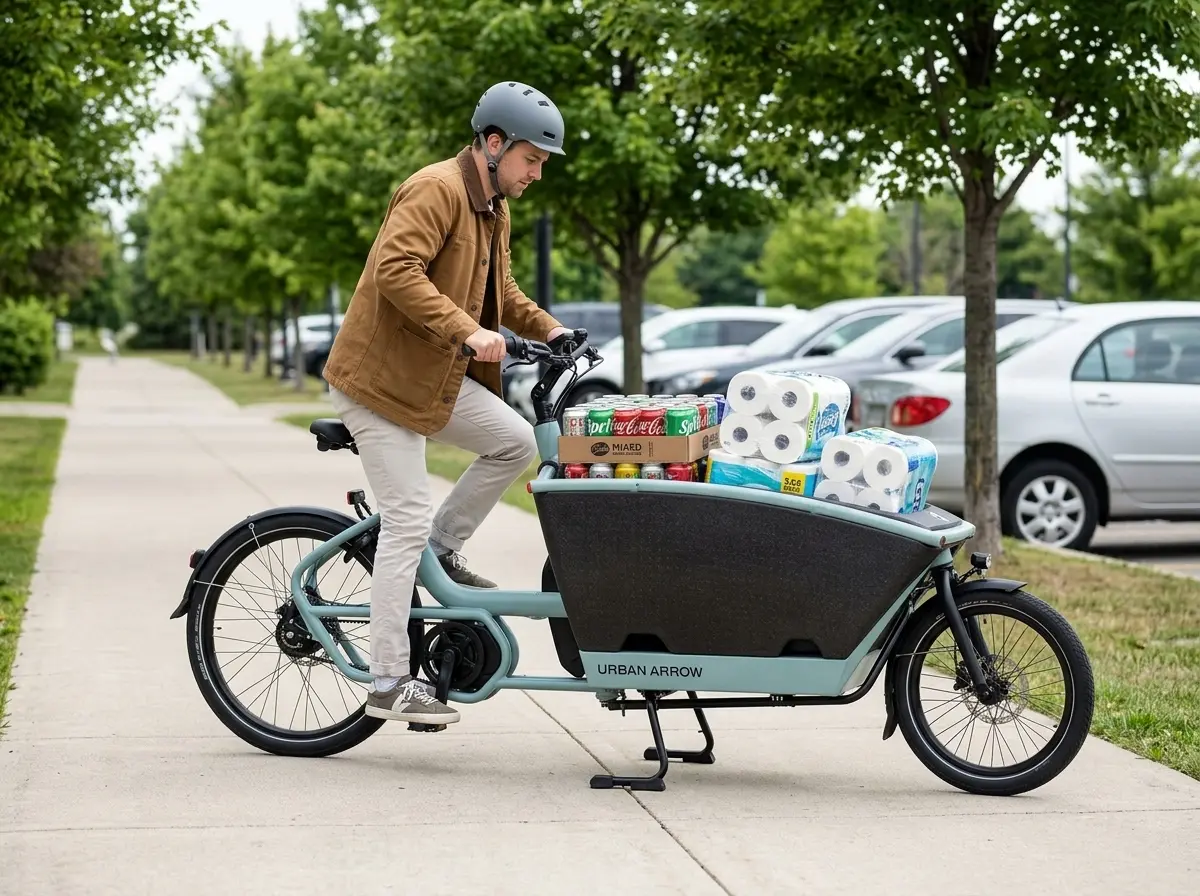
Adam Doud rode an eight-foot Urban Arrow FamilyNext cargo ebike to his local Costco, filled the front box with roughly $200 in bulk goods, and rode home in about 45 minutes. The trip worked. The bike swallowed a 35-can case of Coke Zero, a 45-pack of toilet paper, a 90-pack of fruit snacks, 400 band-aids, a dozen mac-and-cheese packs and more without drama.
That single run is the cleanest recent proof that a premium Dutch cargo ebike can handle American warehouse-club shopping. The remaining fight is money: the bike sits one penny under $9,000.
A Warehouse Haul That Fit in the Front Box
Doud, writing for SlashGear, borrowed the FamilyNext from a downtown Chicago shop and staged the 37-mile journey home in two rides with an overnight charge. Once the bike was local he chose the nearest Costco with the friendliest mix of side streets and bike lanes.
Costco even had a bike rack. He loaded the front compartment and rode back in Cargo mode. The return felt no harder than the outbound leg in Auto. Both directions took roughly 45 minutes.
- Soda: 35-can case of Coke Zero
- Paper goods: 45-pack of toilet paper
- Snacks and household: 90-pack fruit snacks, 400 band-aids, 12 mac-and-cheese packs, a new t-shirt and assorted large items
The front box held everything securely. Steering comes through steel rods that run under the cargo bay to the front wheel, so the rider never sees the tire. Doud called the bike a “land kayak” and a bit of a whale when stopped, yet smooth once moving.
Payload Numbers That Rival a Small Car
Official specs put the FamilyNext in serious utility territory. North American pricing lists the Pro at $8,999 MSRP and 545Wh battery. Weight is about 112 pounds (51 kg). Total permissible load reaches 550 pounds (250 kg).
| Spec | FamilyNext Pro | Typical compact car note |
|---|---|---|
| Total load capacity | 550 lbs (250 kg) | Passenger + cargo often similar for small hatch |
| Front box / bench | Up to 275 lbs box; 100 kg bench | Rear seats folded or trunk only |
| Assist motor | Bosch Cargo Line, 85 Nm (100 Nm on some green builds) | N/A |
| Drivetrain | Enviolo hub + Gates carbon belt | Multi-speed transmission |
| Class / top assist | Class 1, 20 mph | Highway capable |
| Quoted range | ~31 miles average; battery options higher | Hundreds of miles |
Urban Arrow rates the bench at 100 kg bench capacity and suspension fork. The 36 kg sticker is only the seat-belt test limit, not structural capacity. Kids ideally two, possible five with accessories. The box uses EPP foam and a one-handed harness system. An integrated suspension fork and redesigned entry step aim at comfort for both rider and cargo.
Power comes from a Bosch Cargo Line 85 Nm mid-drive with no throttle. Modes such as Eco, Normal, Auto and Cargo replace stepped assist levels. The continuous Enviolo “gear” system shifts only when not pedaling, a habit that takes practice. Doud liked the motor after earlier Bosch experience in Paris but felt he found power levels more than he chose them.
Why Nine Thousand Dollars Still Stings
Doud’s verdict was honest. The bike is well built and capable. The seat is not especially comfortable. The whole machine is unwieldy at a stop. And the price equals roughly four and a half cheaper commuter ebikes he has tested. For occasional Costco runs while a car still sits in the driveway, the ratio favors the car.
That is the consensus take. It is incomplete.
AAA’s 2025 Your Driving Costs study puts the average $11,577 annual new-vehicle ownership cost at roughly $965 per month. That figure covers depreciation, finance, fuel, insurance, maintenance, license and taxes for a new vehicle driven 15,000 miles a year. Dropping a second car therefore frees more than the entire purchase price of a FamilyNext in a single year of avoided ownership.
Even if the cargo bike only erases half those trips, fuel, parking, wear and insurance still move. Electricity for the Bosch pack is pennies per charge. Maintenance is mainly tires, brake pads and annual dealer checks. Urban Arrow claims more than 100,000 bikes sold globally and positions the FamilyNext as a second-car replacement for urban and suburban households.
Dutch Design Hits American Suburbs
Urban Arrow began in Amsterdam in 2011 when two fathers wanted better family transport. Pon Bike later acquired the brand. Front-loaders with low centers of gravity became common across the Netherlands and much of northern Europe. Dense streets, short distances and strong cycling culture make a $6,000-$9,000 cargo bike feel ordinary.
American suburbs are different. Distances stretch. Zoning and parking favor cars. Bike lanes appear in patches. Doud still found enough infrastructure for a comfortable Costco loop, and the warehouse even offered a rack. That small detail hints at slow change: more people are arriving on two wheels, so retailers respond.
- 2011, Urban Arrow founded in Amsterdam by two fathers seeking practical family cargo solutions.
- 2019, Pon Bike acquires the brand, expanding manufacturing and distribution reach.
- 2025, FamilyNext Pro launches with suspension fork, larger box, one-hand harness and updated Bosch Smart System; MSRP $8,999 in the US.
- January 2026, Gazelle USA (distribution partner) issues a limited buckle recall.
- July 2026, SlashGear publishes the Costco real-world test that brought the model fresh US attention.
The bike is longer than a normal ebike and heavier. Learning the steering rods and the no-pedal shift rule takes rides. Once under way the low center of gravity and Bosch torque make hills and loads feel manageable. Reviewers consistently praise stability with kids or cargo aboard.
A Limited Buckle Fix and What Buyers Should Check
In late January 2026 the U.S. Consumer Product Safety Commission announced a CPSC recall of about 320 bikes. The Fidlock buckles on certain FamilyNext Pro units could fail to fully latch, creating an injury hazard for children in the cargo area. The remedy is a free replacement buckle. Owners are told to stop using the cargo seating until the new hardware is installed.
What we know
- About 320 units sold March-December 2025 are affected.
- Hazard is incomplete latch of the child harness buckle.
- Free repair or replacement buckle through dealers; stop cargo-area child use until fixed.
What remains open for shoppers
- Whether a specific serial number is in the batch (dealers and CPSC site confirm).
- Local dealer stock of the updated hardware and turnaround time.
- Any residual market effect on used or demo inventory pricing.
The mechanical core of the bike (frame, motor, belt, suspension) was not part of the recall. For new buyers the issue is largely historical once the buckle is swapped. Still, any family considering the model should verify the fix is complete before loading children.
When the Ownership Math Turns Positive
Doud is right that the FamilyNext is not a casual impulse buy. If the household already owns a reliable car and only needs occasional bulk shopping, the car stays cheaper on pure trip cost. The contrarian case appears when the cargo bike lets a family sell or avoid a second vehicle.
At $11,577 per year of avoided ownership, the $8,999 bike is paid for in under ten months of full second-car replacement. Even partial replacement (school runs, grocery loops, sports gear) compounds. Add the health benefit of regular pedaling, the absence of parking fees in many urban cores, and the simple fact that two kids in a box are often happier looking forward than strapped in a back seat.
Accessories stretch utility further: rain cover (sometimes bundled in promotions), extra bench, rear carrier, Connected module for tracking. The steel construction and belt drive are built for years of daily use. Urban Arrow and dealers emphasize service networks that match the premium price.
The SlashGear experiment did not claim the car is obsolete. It showed one concrete American errand that no longer requires four wheels. For households already paying the full freight of a second car, that demonstration changes the calculator. The FamilyNext is expensive until the alternative is an entire automobile. Then the numbers reverse.
Suburban Costco parking lots still fill with SUVs. A growing minority of those trips can leave the car at home. The Dutch cargo bike that looks oversized on a Chicago side street is simply doing the job it was designed for.


Capital Clusters and the Dual Tracks of European Tech Finance

Microsoft Shrinks Windows 11 Memory for 8GB PCs

XRP Ledger Brings Back Bugged Features Fixed for Institutions

The Shards Trailer Turns Ellis Nightmare Into Murphy Glamour

WhatsApp Folder Hides Business Messages After Hours

Mova LiDAX Ultra 3000 AWD Cracks the Robot Mower Moat

Urban Arrow FamilyNext Turns Costco Runs Into Bike Trips

Reddit Builds Spoken Video Layer to Reclaim Its Own Viral Stories

Nuggit £5m Fund Treats YouTube Channels as Real Businesses

Galaxy Z Fold 8 Makes Foldables Daily Drivers but Drops Flex Mode

CLARITY Act Final Text Expected This Weekend as 60-Vote Hurdle Looms

Kalshi Loses Major NY Prediction Markets Ruling to Judge Torres

Fed Minutes Cite AI Demand as Inflation Risk, Put a 2026 Hike Back on the Map

Marker AI Writing Startup Lands $13M Seed Led by Index Ventures

Dota 2 Esports World Cup 2026: Spirit Defends $2M Title In Paris

Meta’s Muse Spark 1.1 Beats Rivals on Price, Trails on Coding

CS2 Premier Season 5 Lands With Cache and a C4 Damage Rework

Finto Picks Munich Over Silicon Valley After YC, Raises $3.4M

Backrooms Returns to Theaters as the Everything Must Go Edition

ARC Intelligence Closes €4M Seed Round in Roughly a Week
-
 FINANCE2 months ago
Zcash Patched a Double-Spend Bug as ZEC Climbed 5%
-
 ENTERTAINMENT2 months ago
Steam Summer Sale 2026 Locks In June 25 to July 9 Dates
-
 NEWS3 months ago
Meta Adds AI Replies to Threads, But Users Can’t Block It
-
 FINANCE4 weeks ago
CLARITY Act Final Text Expected This Weekend as 60-Vote Hurdle Looms
-
 ENTERTAINMENT2 months ago
‘Widow’s Bay’ Review: Apple TV’s Sleeper Horror-Comedy Earns Its Fog
-
 NEWS5 months ago
U.S. Navy Deploys Solar-Powered Lightfish Drone to Patrol Oceans
-
 NEWS8 months ago
FolderFresh Review: This Free Tool Automates Windows File Organizing
-
 FINANCE3 weeks ago
Kalshi Loses Major NY Prediction Markets Ruling to Judge Torres