
FINANCE
Grayscale Letter Presses Senate on CLARITY Act Before Recess
Grayscale presses for a CLARITY Act floor vote before August recess, framing clear SEC-CFTC rules as the difference between US leadership and offshore capital.

Grayscale Investments sent a letter to Senate leaders on July 31 urging a floor vote on the CLARITY Act before the August recess, arguing that hundreds of thousands of Americans who hold its digital asset products need clear rules now. The firm framed the bill as essential market structure that would split oversight between the SEC and CFTC and stop capital from drifting to places with finished frameworks.
The timing lands in the final days before lawmakers leave Washington. Ethics language still divides the chamber and floor time is scarce.
The Letter That Named Hundreds of Thousands of Holders
Grayscale described itself as the world’s largest digital asset-focused investment platform and said its products give the firm a direct stake. In Grayscale’s July 31 letter announcement the company wrote that senators and staff “across the aisle have spent months addressing hard questions about jurisdiction, investor protections, and developer safeguards.”
The framework that emerged protects investors, shields legitimate developers from overreach, and provides the certainty Americans deserve.
The firm added that crypto firms, developers and investors need predictable rules after years of uneven enforcement and shifting agency guidance. Clear statutes would also support growth in ETFs, ETPs and other regulated vehicles that now sit inside ordinary portfolios.
By naming the scale of its own holder base, Grayscale turned an industry talking point into a concrete constituency argument. The letter treats those holders as people already inside regulated products who still lack durable secondary-market rules. That framing links product adoption directly to the calendar pressure of the final week before recess.
The company also stressed that bipartisan staff work had already answered the hard jurisdictional questions. In its view the remaining task is political, not technical: schedule the floor time so the drafted framework can move.
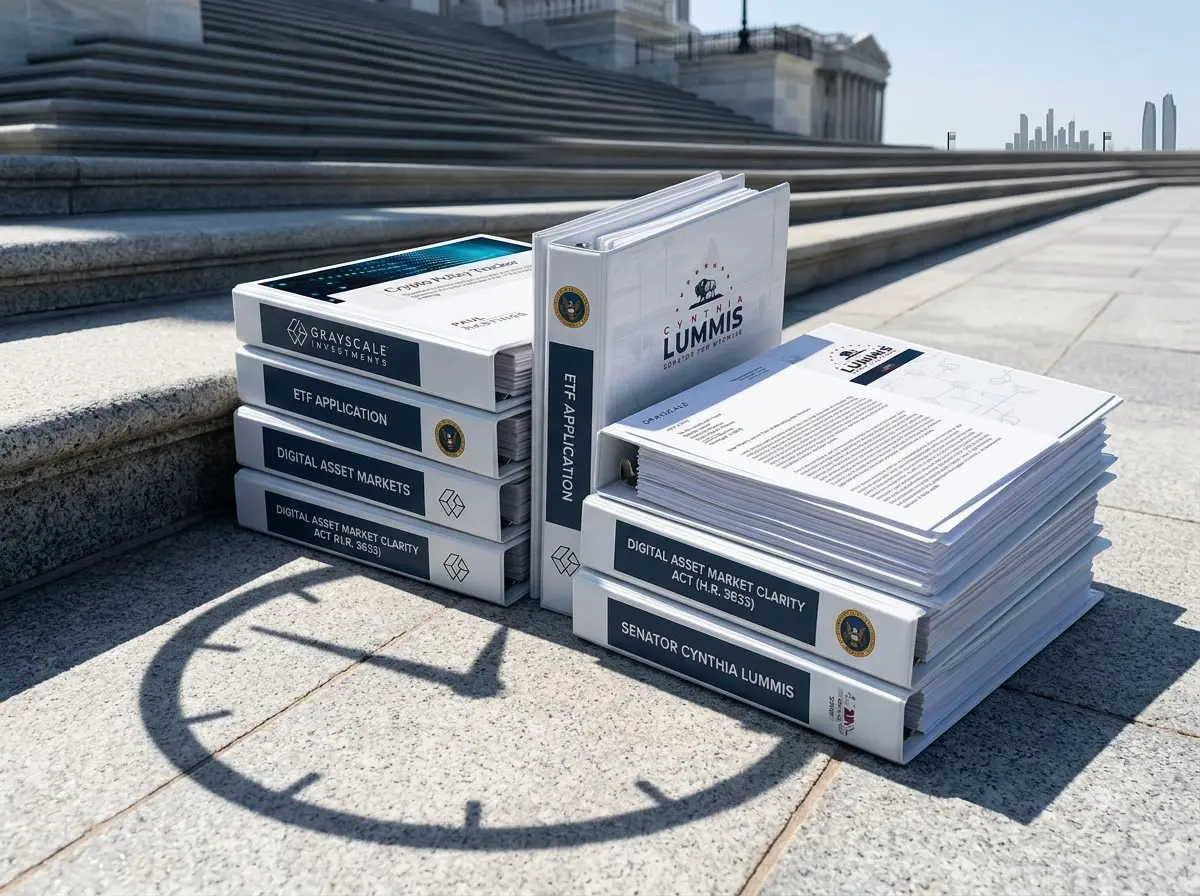
How H.R. 3633 Reached the Senate Calendar
The bill began as House legislation. It passed the House on July 17, 2025 by a bipartisan 294-134 vote. The Senate Banking Committee advanced it 15-9 in May 2026. On June 1 it was placed on the Senate Legislative Calendar under General Orders as Calendar No. 423.
- May 29, 2025, Introduced in the House by Rep. French Hill.
- July 17, 2025, House passes the bill 294-134.
- May 2026, Senate Banking Committee reports it 15-9 bipartisan.
- June 1, 2026, Placed on Senate Legislative Calendar No. 423.
- July 22, 2026, Sen. Cynthia Lummis releases the updated 616-page merged Senate text combining Banking and Agriculture work.
The core of H.R. 3633 Digital Asset Market Clarity Act defines digital commodities and assigns primary trading oversight of mature blockchain systems to the CFTC while leaving investment-contract assets with the SEC. It adds registration paths for exchanges, brokers and dealers, AML obligations, and carve-outs for non-custodial developers.
| Agency | Main Role Under CLARITY | Key Trigger |
|---|---|---|
| CFTC | Digital commodity exchanges, brokers, dealers | Mature or maturing blockchain systems |
| SEC | Investment contract assets, certain ATS activity | Assets still tied to investment contracts |
| Both | Dual-registered entities, anti-fraud | Overlapping intermediary activity |
That split is the part industry groups have sought for years. The July 22 merge finally put a single floor-ready package in front of leadership.
The path from House passage to a merged Senate text took nearly a year of committee work. Each step narrowed the gap between Banking and Agriculture drafts until Lummis released the single 616-page package. Once that text landed on the calendar, the procedural obstacle shifted from drafting to floor time and the unresolved ethics language.
Ethics Language Still Blocks the Clock
The remaining fight sits on ethics limits for public officials who issue or sponsor digital assets while in office. Democrats have pressed for stronger language covering family members. Republicans included provisions in the draft but have not closed the gap.
Senate Majority Leader John Thune has repeatedly noted limited bandwidth. Competing bills and Russia-related measures have taken priority. Prediction markets reflected the squeeze: Polymarket odds of 2026 enactment fell into the high-20s to mid-30s percent range in late July after peaking above 80 percent earlier in the year. Kalshi showed higher odds of a simple vote at points, but floor time never locked in.
- Recess start: around August 7-8, leaving roughly one working week after Grayscale’s letter.
- Passage odds (late July): roughly 28-37 percent on major prediction markets.
- House vote: 294-134 bipartisan in 2025.
- Banking markup: 15-9 in May 2026.
Senator Cynthia Lummis said the chamber still hoped to secure a vote with “one more week here in Washington.” Treasury Secretary Scott Bessent went further. In Treasury Secretary Bessent’s call to vote NOW he wrote that Democrats were delaying under pressure from Senator Elizabeth Warren and her “Anti-Crypto Army.” He defended the Blockchain Regulatory Certainty Act language as simply codifying long-standing Treasury policy on non-custodial developers and noted recent law-enforcement endorsements, including the Fraternal Order of Police. That tracks with the police endorsement as passage odds sank reported earlier.
The same pressure appeared in earlier Bessent demand and developer risks coverage, showing the administration’s consistent line.
The ethics dispute therefore functions as the last substantive hold-up even after the jurisdictional titles reached floor-ready form. Bandwidth limits and competing priorities compound that hold-up, turning a largely drafted bill into a calendar race measured in days rather than months.
Capital and Talent Already Have Clearer Addresses
Grayscale’s second-order point is straightforward. Once retail money sits inside regulated US products, the managers of those products need stable secondary-market rules. Without them, new capital and engineering talent can simply choose jurisdictions that finished the job first.
- Singapore has operated a licensing regime for digital-payment token services for years and continues to refine staking and custody rules.
- Abu Dhabi Global Market finalized a virtual-asset staking framework in 2026 and markets itself as a regulated innovation hub.
- Other centers have moved faster on exchange registration and stablecoin clarity than the US Congress.
The firm warned that firms cannot plan multi-year product roadmaps under shifting guidance. That risk compounds for the ETFs and ETPs Grayscale and peers already run. Clear rules would let those vehicles scale; prolonged uncertainty keeps them constrained and pushes activity offshore.
A Grayscale research note on the two-week window by head of research Zach Pandl put the same clock in market terms in late July: miss the recess and midterm politics likely drown the bill for the rest of 2026.
The comparison is practical rather than abstract. Jurisdictions that already finished licensing, staking and custody frameworks give managers a place to build while the US debate continues. Each month of delay widens that gap for the next product cycle.
The Oversight Split Matches Long-Sought Boundaries
Industry groups have pressed for years for the precise division the bill now writes into statute. Mature blockchain systems would fall primarily to the CFTC for trading oversight. Assets still tied to investment contracts would remain with the SEC. Dual-registered entities and anti-fraud work would sit with both agencies where intermediary activity overlaps.
Registration paths for exchanges, brokers and dealers sit alongside AML obligations and carve-outs for non-custodial developers. Those developer provisions drew law-enforcement support, including the Fraternal Order of Police endorsement Bessent highlighted. The structure therefore pairs market-structure clarity with the compliance tools enforcement agencies already favor.
| Element | What the Bill Supplies |
|---|---|
| Digital commodities | Defined and assigned mainly to CFTC trading oversight |
| Investment-contract assets | Left with the SEC |
| Intermediaries | Registration paths for exchanges, brokers, dealers |
| Developers | Carve-outs for non-custodial activity |
| Compliance | AML obligations across covered entities |
Once the July 22 merge combined Banking and Agriculture work into one 616-page text, that package became the vehicle leadership could move if the ethics gap closed and floor time opened. The substance of the split is no longer the open question; the calendar is.
What the Voices on X Emphasized
Bessent’s post drew more than two million views and framed the choice as American exceptionalism versus ceding a global industry. Grayscale’s own announcement emphasized bipartisan staff work already completed and the readiness of the industry for rules. Crowd replies mixed urgency with skepticism. Some users treated the letter as confirmation that institutional product flows now create political weight. Others pointed to the ethics deadlock and low odds as proof the window had already closed. A recurring observation was that developer carve-outs and AML titles had won law-enforcement support, yet the ethics fight still blocked the floor.
That split tracks the real constraint: the policy substance is largely drafted, but the politics of ethics and calendar remain unresolved.
The volume around Bessent’s call and Grayscale’s letter shows how the debate has moved from pure industry advocacy into a broader argument about whether the United States keeps the institutional path opened by ETFs. Holders already inside regulated products give that argument a domestic constituency that earlier crypto bills lacked.
The Recess Deadline Shapes the Remaining Options
Grayscale’s July 31 letter arrived with roughly one working week left before the recess start around August 7-8. Lummis still spoke of securing a vote in that final week. Prediction markets, however, had already priced enactment odds into the high-20s to mid-30s percent range after earlier peaks above 80 percent.
- A procedural vote or full debate before recess would keep conference with the House version alive.
- A slip past recess would hand the bill to midterm politics and likely reset comprehensive market-structure work to the next Congress.
- Stablecoin rules under the GENIUS Act and continuing agency guidance would remain, yet they would not supply the full SEC-CFTC boundary the industry has sought.
The narrow window therefore turns every day of ethics negotiation into a binary choice. Either leadership finds floor time and closes the family-member language gap, or the merged text waits while capital and talent continue to test jurisdictions that already finished their frameworks.
Products, Holders and the Next Window
If the Senate schedules a procedural vote or full debate before recess, the bill advances and conference with the House version becomes possible. If it slips, comprehensive market-structure legislation resets to the next Congress. In the meantime stablecoin rules under the GENIUS Act and agency guidance continue, but they do not deliver the full SEC-CFTC boundary the industry has sought.
Grayscale’s letter makes the second-order stake explicit. The same Americans who bought regulated crypto products now sit inside a system that still lacks durable secondary-market rules. The firm is telling the Senate that delay no longer costs only startups. It costs the holders already on the books and the next wave of capital that can choose Singapore or Abu Dhabi instead. Whether that argument produces a vote in the final days before August will decide if the US keeps the institutionalization path it opened with ETFs or watches the next chapter write itself elsewhere.
The holders Grayscale cited are already exposed to the outcome. Their products operate under existing registrations, yet the secondary-market rules that would let those vehicles scale remain unfinished. That gap is what the letter asks the Senate to close before the recess clock runs out.


Capital Clusters and the Dual Tracks of European Tech Finance

Microsoft Shrinks Windows 11 Memory for 8GB PCs

XRP Ledger Brings Back Bugged Features Fixed for Institutions

The Shards Trailer Turns Ellis Nightmare Into Murphy Glamour

WhatsApp Folder Hides Business Messages After Hours

Mova LiDAX Ultra 3000 AWD Cracks the Robot Mower Moat

Urban Arrow FamilyNext Turns Costco Runs Into Bike Trips

Reddit Builds Spoken Video Layer to Reclaim Its Own Viral Stories

Nuggit £5m Fund Treats YouTube Channels as Real Businesses

Galaxy Z Fold 8 Makes Foldables Daily Drivers but Drops Flex Mode

CLARITY Act Final Text Expected This Weekend as 60-Vote Hurdle Looms

Kalshi Loses Major NY Prediction Markets Ruling to Judge Torres

Fed Minutes Cite AI Demand as Inflation Risk, Put a 2026 Hike Back on the Map

Marker AI Writing Startup Lands $13M Seed Led by Index Ventures

Dota 2 Esports World Cup 2026: Spirit Defends $2M Title In Paris

Meta’s Muse Spark 1.1 Beats Rivals on Price, Trails on Coding

CS2 Premier Season 5 Lands With Cache and a C4 Damage Rework

Finto Picks Munich Over Silicon Valley After YC, Raises $3.4M

Backrooms Returns to Theaters as the Everything Must Go Edition

ARC Intelligence Closes €4M Seed Round in Roughly a Week
-
 FINANCE2 months ago
Zcash Patched a Double-Spend Bug as ZEC Climbed 5%
-
 ENTERTAINMENT2 months ago
Steam Summer Sale 2026 Locks In June 25 to July 9 Dates
-
 NEWS3 months ago
Meta Adds AI Replies to Threads, But Users Can’t Block It
-
 FINANCE4 weeks ago
CLARITY Act Final Text Expected This Weekend as 60-Vote Hurdle Looms
-
 ENTERTAINMENT2 months ago
‘Widow’s Bay’ Review: Apple TV’s Sleeper Horror-Comedy Earns Its Fog
-
 NEWS5 months ago
U.S. Navy Deploys Solar-Powered Lightfish Drone to Patrol Oceans
-
 NEWS8 months ago
FolderFresh Review: This Free Tool Automates Windows File Organizing
-
 FINANCE3 weeks ago
Kalshi Loses Major NY Prediction Markets Ruling to Judge Torres