
BUSINESS
Uber’s €13 Billion Delivery Hero Bid Echoes a Deal Regulators Killed
Uber’s €13 billion Delivery Hero takeover follows an 80% stock collapse and a $950 million Taiwan deal antitrust regulators blocked in 2024.

Uber will pay €41.50 a share, in cash, for Delivery Hero. The deal values the Berlin food delivery group at €13 billion ($14.8 billion) and stitches together a combined platform spanning 99 countries, the companies confirmed this week.
It is not the first time Uber has tried to own a piece of Delivery Hero. A little over a year ago, Uber walked away from a much smaller version of this same bet, a $950 million deal for Delivery Hero’s Taiwan business that antitrust regulators killed. This time Uber is buying the whole company.
The Fine Print Behind the €13 Billion Headline
The offer works out to a fully diluted equity value of €13.0 billion, or $13.7 billion once Uber’s existing stake in Delivery Hero is stripped out. Uber says the price is €41.50 in cash for every Delivery Hero share, a premium of roughly 34% to the stock’s three-month average price before the announcement leaked.
A second, smaller deal rides alongside it. SSW Partners, a New York investment firm, has separately agreed to buy Delivery Hero’s operations in 14 markets where Uber Eats and Delivery Hero already compete head to head, for about €1.4 billion. That carve-out clears the most obvious overlap before regulators even look at the file.
| Buyer | What Changes Hands | Price | Scope |
|---|---|---|---|
| Uber | Delivery Hero’s remaining global business | €41.50 per share, €13.0 billion equity value | Roughly 50 markets, extending Uber to 99 countries in total |
| SSW Partners | Delivery Hero assets that overlap with Uber Eats | About €1.4 billion | 14 markets, including several in Europe and the Middle East |
Delivery Hero’s biggest shareholder, Prosus, has irrevocably committed to tender a stake described as just under 17%, which would push Uber’s total economic interest in the company to about 53% once the offer closes. The Management Board and Supervisory Board have both backed the takeover.
Uber chief executive Dara Khosrowshahi said bringing the two platforms together would help “extend affordable, reliable delivery to many millions more people in some of the world’s most dynamic economies, while creating more opportunities for merchants and couriers.” Delivery Hero’s brands, including Foodpanda, Glovo, Talabat, HungerStation and PedidosYa, all come with the deal.
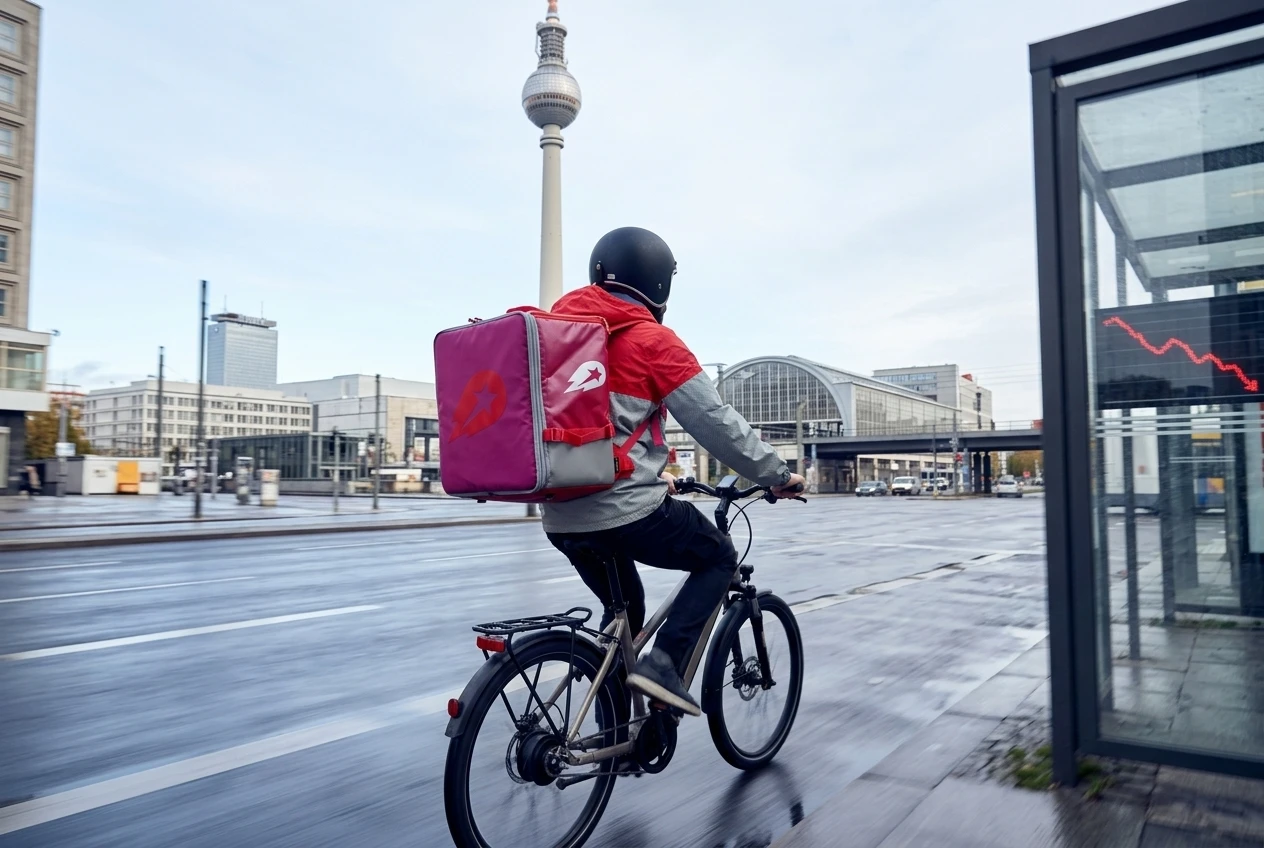
Delivery Hero’s Long Fall From a €145 Peak
Delivery Hero listed in 2017 and rode the pandemic delivery boom to a record close of €145.40 in January 2021, according to the stock’s all-time high hit in January 2021. From there it was mostly downhill. Shares eventually bottomed at €14.80 in March 2026, nearly 90% below that peak, as years of cash-burning global expansion caught up with the company.
By May 2026, Bloomberg reported shares had plunged almost 80% since their 2021 peak, even after a partial rebound. That same month, Hong Kong hedge fund Aspex Management bought a 5% stake from Prosus and kept building, reportedly reaching 15% and pushing for a breakup of the group. Days later, co-founder and chief executive Niklas Östberg said he would step down by the end of March 2027. Shares jumped 48% in a single week, their best run since the 2017 listing.
“The gradual removal of the founder from the equation means a rising likelihood of a group dismantlement,” Stifel analyst Clément Genelot wrote in a note at the time, adding that the surge in the share price reflected exactly that expectation. Delivery Hero had already sold its Taiwan Foodpanda unit to rival Grab Holdings that March, and South Korea, its single biggest market, was rumored to be next on the block.
Hasn’t Uber Tried This Exact Deal Before?
Yes. In May 2024, Uber agreed to pay $950 million for Delivery Hero’s Foodpanda business in Taiwan, alongside a separate $300 million purchase of newly issued Delivery Hero shares. Taiwan’s antitrust regulator blocked the Foodpanda deal that December, warning the combined company would control 90% of the island’s food delivery market, and Uber walked away in March 2025.
Taiwan’s regulator cited that 90% combined market share as its core objection, noting Foodpanda and Uber Eats already ran the island as a duopoly. Uber chose not to appeal. Its own a $236 million charge tied to the collapsed deal later showed up in its quarterly filings as a fourth-quarter 2024 expense, settled in cash that April.
None of that stopped Uber from coming back for more. Regulatory filings tracked by GuruFocus show Uber had already built a roughly 4.5% stake in Delivery Hero for about $318 million in the weeks before the full takeover offer, buying in even as Prosus was heading for the exits.
- January 2021: Delivery Hero shares hit an all-time high of €145.40 in Frankfurt.
- May 2024: Uber agrees to buy Delivery Hero’s Foodpanda business in Taiwan for $950 million.
- December 2024: Taiwan’s Fair Trade Commission blocks the deal over market share concerns.
- March 2025: Uber terminates the Taiwan deal without appeal and later books a termination charge.
- March 2026: Delivery Hero’s stock bottoms at €14.80, and the Taiwan unit is sold to Grab Holdings instead.
- May 2026: Activist investor Aspex Management builds its stake as CEO Niklas Östberg announces plans to step down; shares surge 48% in a week.
- July 2026: Uber agrees to buy all of Delivery Hero for €13 billion in cash.
Seen against that run of events, the Taiwan collapse looks less like a one-off and more like a dress rehearsal, at a fraction of the scale, for the regulatory fight now waiting across 99 countries.
Berlin Keeps Its Headquarters, For Now
Delivery Hero was founded in Berlin in 2011 and has stayed headquartered there ever since. Uber has built specific promises into the deal to keep it that way, at least for a few years.
- Headquarters lock-in – Delivery Hero’s Berlin head office stays in place through at least 2029.
- No workforce cuts – Uber has committed not to reduce the Berlin workforce during that same window.
- €2 billion investment – Uber plans to put that sum into Germany’s economy through 2031.
- Autonomous vehicle push – part of that spending targets self-driving pilots and partnerships with German carmakers.
Östberg framed the commitment as a vote of confidence in the region, saying the deal and Uber’s planned investment “demonstrate the attractiveness of the European tech ecosystem,” adding that Delivery Hero intends “to keep contributing to its growth.” Uber also expects the acquisition to be accretive to earnings, with high single digit EPS accretion by year three laid out in its own filing on the transaction.
Couriers and Rivals Wait on the Regulators
The takeover offer needs at least 50% plus one share to succeed, and completion is not expected until the second half of 2027, a full regulatory cycle away. Delivery Hero’s roughly 60-plus markets and Uber’s own footprint will each need clearance from national competition authorities, some of which have shown they are willing to block food delivery mergers outright.
Uber has leaned on consolidation before to relieve pressure from DoorDash at home, and this deal builds the same logic on a global scale, creating the largest food delivery operator outside China. For Delivery Hero’s couriers, merchants and remaining shareholders, the near-term terms are set. For competition regulators from Seoul to Riyadh to Buenos Aires, the file is only just landing on the desk.
Delivery Hero shares traded at €37.90 in Frankfurt after the announcement, down slightly on the day and still about 9% below Uber’s €41.50 cash offer, with the deal’s close not expected until the second half of 2027.


Flower Labs Puts Endeavor 1.0 on Customer Servers

Cummins Bets on Emerald to Scout the Next Power Shift

Holifya Raises €2 Million to Wrap Italy’s GLP-1 Care

INLEAP Photonics Places a Factory Bet on Laser Defences

Instarc Takes €1.25 Million After a Quiet July Recap

nordIX Bets €21 Million on ID Finance’s Spanish Loans

Space Cargo Buys Into France’s Zero-G Flight Company

The $399 Omni Walks Away, Then Asks for a Dock

TECNO’s 0mm Bezelless Phone Still Needs a Rim

The Ryobi Tools That Unblocked a Garage Workbench

30-Year Yield Hits 5.32% Highest Since 2007 as Debt Supply Locks In Costs

Walter’s TWG Insists No Fraud as Insurer Probes Force Cleanup

Astute’s $1.2M bet makes B2B creator deals feed AI discovery

Strategy Parks $1.59B Cash While Bitcoin Stack Stays Flat

PCE Stays at 3.7% as Gas and Tariffs Outrun Coming Revisions

SpaceX Stock Rebound Tests Real Demand Before Huge Unlock

The 20% Savings Ideal Meets a 2.7% Reality Check

Amber’s €7M locks Mittelstand knowledge inside Europe

Monzo chair Gary Hoffman exits after board revolt fallout

Nvidia’s $16,000 RTX Pro 6000 Turns Local AI Into a Luxury
-
 FINANCE3 months ago
Zcash Patched a Double-Spend Bug as ZEC Climbed 5%
-
 ENTERTAINMENT3 months ago
Steam Summer Sale 2026 Locks In June 25 to July 9 Dates
-

 FINANCE2 months ago
CLARITY Act Final Text Expected This Weekend as 60-Vote Hurdle Looms
-
 NEWS4 months ago
Meta Adds AI Replies to Threads, But Users Can’t Block It
-

 NEWS3 months ago
YouTube Shorts is testing a heart in place of the thumbs-up
-

 NEWS1 month ago
Senators Force Apple Off Chinese Memory as Big Three Cash In
-

 NEWS3 months ago
NEURA Robotics’ $1.4B Series C Redraws Europe’s Physical AI Bet
-
 ENTERTAINMENT5 months ago
Extraction 3 Is Officially Coming to Netflix in 2027