
FINANCE
SpaceX Stock Hits a Post-IPO Low as Float and Leverage Risks Build
SpaceX stock hit a post-IPO low after Starship’s abort, but a 4% float, an August lockup and new 25x leverage trades are the bigger risk.

SpaceX shares sank to $124.68 on Friday, a fresh post-IPO low, hours after the company scrubbed its 13th Starship test flight seconds before liftoff. The stock is down about 35% over the past month and roughly 8% below its $135 initial public offering (IPO) price, extending a losing streak that started well before the rocket ever reached the pad.
A thin public float, a lockup deadline arriving within weeks, and a new 25-times leverage trading product going live the same day as the next launch attempt are all stacking up around SpaceX’s stock right now. None of the three has anything to do with rocket engines.
Four Raptor Engines Balk at T-Zero
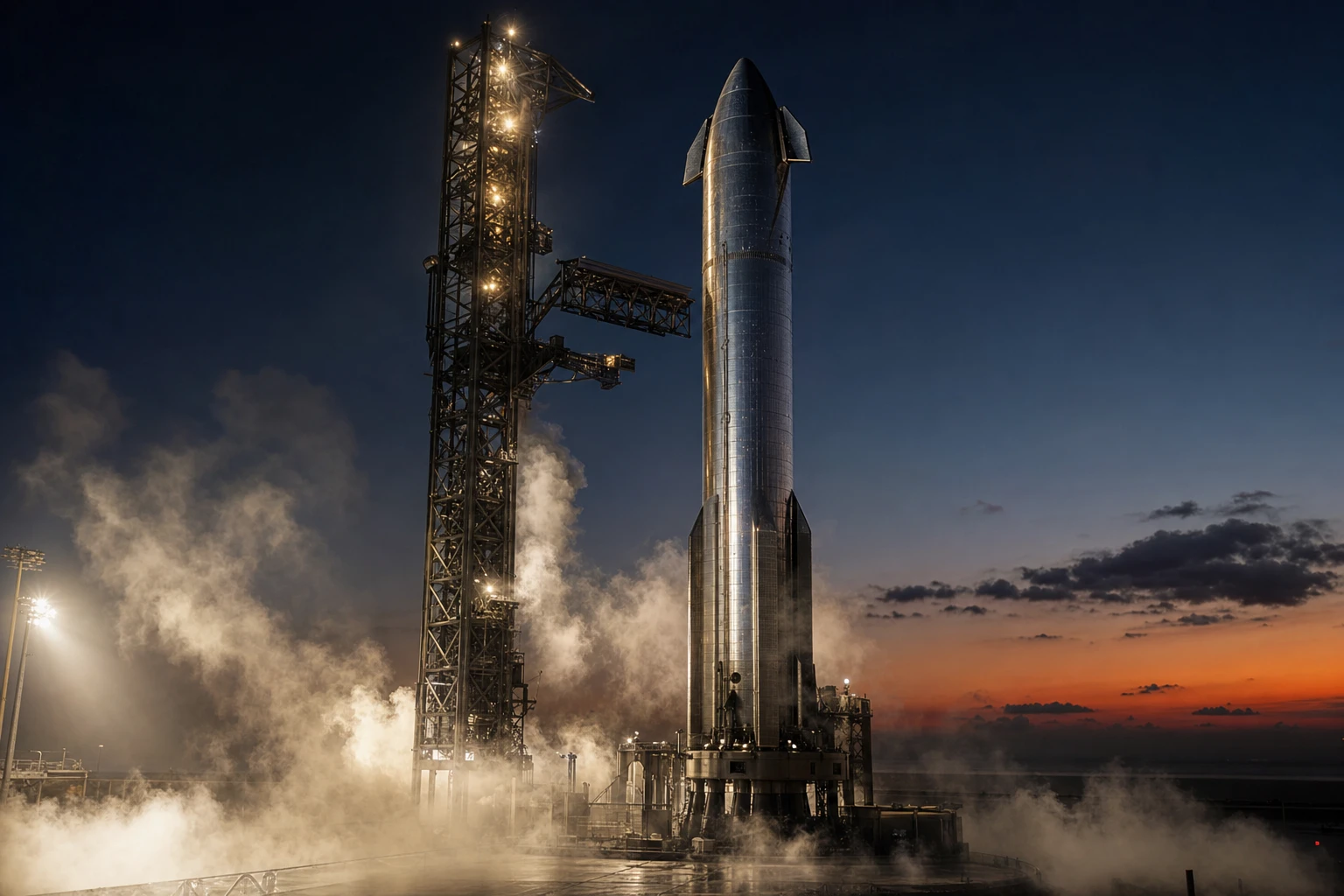
SpaceX loaded more than 11.5 million pounds of methane and liquid oxygen into Starship on Thursday without incident. Then, as the Super Heavy booster’s 33 Raptor 3 engines began their ignition sequence, four of them never lit. The automated flight computer shut the whole sequence down before the vehicle left the mount.
Elon Musk confirmed the cause within hours. Some of the engines didn’t start, triggering an automatic launch abort,
he wrote on X. He said two of the four non-igniting Raptors would be swapped out and that a new attempt was most likely early the following week. SpaceX later firmed that up to Monday, July 20, at 6:45 p.m. Eastern time, a 90-minute window at Starbase in Boca Chica, Texas.
Nothing about the abort itself was unusual by Starship standards. The vehicle stayed upright and intact, no hardware was lost, and engine swaps on the pad are a routine part of the program. Flight 12 in May, the first outing for this Starship V3 design, had its own rough patch: the booster failed to stick its splashdown, and the upper stage lost an engine before it could attempt an in-space relight. Flight 13 was built specifically to fix both problems, and it also carries the program’s first real operational payload, 20 Starlink V3 satellites that are physically too large for SpaceX’s older Falcon 9 rocket to carry.
That detail matters for the balance sheet as much as the launch manifest. Starlink generated roughly $3.26 billion in revenue in the first quarter of 2026, close to 69% of SpaceX’s total quarterly sales, and Starship is the only vehicle capable of putting the newer, bigger satellites into orbit.
- Thursday, July 16: Starship Flight 13 aborts at T-zero after four Raptor 3 engines fail to ignite; SPCX closes at $131, its fifth straight red session, then drops further after hours.
- Friday, July 17: Musk confirms two engines will be replaced; SPCX slides to a post-IPO low of $124.68; Cathie Wood’s ARK Invest buys roughly $18.3 million of shares into the drop.
- Monday, July 20: SpaceX targets 6:45 p.m. Eastern for Starship’s rescheduled 13th flight; hours earlier, at 09:00 UTC, Binance’s new 25-times leverage SPCX contract goes live.
Cathie Wood Buys the Dip Wall Street Is Debating
The scrub split market commentary almost immediately. Gary Marcus, a cognitive scientist and outspoken critic of Musk’s public claims, predicted trouble ahead of Friday’s session. Sawyer Merritt, an investor and prominent Tesla shareholder on X, took the opposite view and dismissed the reaction as noise over a routine scrub and a few-day delay.
A third party simply bought. Cathie Wood’s ARK Invest, which has purchased SpaceX stock on nearly every trading day this month, added roughly $18.3 million of shares on Friday alone, according to the firm’s own daily trading disclosures, as the price touched its lowest point since listing.
Where the reactions split:
- Gary Marcus, cognitive scientist and AI critic: wrote that SpaceX “is likely going to crash hard Friday, as people come to realize that Elon isn’t magic,” then walked that back to expect only a fresh record low rather than a collapse.
- Sawyer Merritt, investor and Tesla shareholder: called the selloff an overreaction, writing that traders selling over a short delay “shouldn’t have been in the stock in the first place.”
- Cathie Wood, ARK Invest founder: bought into the exact session that produced the post-IPO low, extending a month of near-daily SPCX purchases across several ARK funds.
Wall Street’s analyst community leans closer to Wood than to Marcus. Of the analysts tracked by data provider LSEG, 27 out of 32 currently recommend buying the stock, four are neutral, and one recommends selling, according to Yahoo Finance’s review of coverage on the stock. That split of opinion, bullish analysts and a bullish fund manager against a bearish social-media voice, is fairly normal for a young, volatile stock. What is less normal is the mechanical setup underneath it.
Why Does a 5% Drop Hit SpaceX So Hard?
A single-digit percentage move looks large mainly because SpaceX has almost nothing available to trade. Of roughly 13.08 billion total shares outstanding, only about 555.6 million, somewhere between 4% and 5% of the company, were sold in the June IPO and are free to change hands. Nearly everything else sits behind lockup agreements.
That scarcity cuts in both directions. It is a big part of why the stock rocketed from its $135 offering price to a peak above $225 within days of its Nasdaq debut, a run that briefly valued the company near $2.66 trillion. The same mechanic works in reverse once sentiment turns, which is exactly what has happened since. The record-breaking IPO that made Musk the world’s first trillionaire priced the company at roughly 95 times sales, a valuation that leaves little room for a rocket program to have an ordinary bad week.
The numbers behind the float:
- 13.08 billion total shares outstanding, versus roughly 555.6 million actually tradable today
- $75 billion raised in the June 11 offering, the largest IPO on record
- Shares ran from a $135 IPO price to above $225, then back to $124.68 in five weeks
A float this small means ordinary trading volume, in either direction, moves the price more than it would for a company with a normal shareholder base. It also means the market has not yet actually tested what SpaceX is worth once real supply shows up.
August Brings the Supply Overhang Into View
That test has a calendar. SpaceX’s second-quarter earnings report, expected in early August though not yet formally scheduled, triggers the first major lockup release. KeyBanc Capital Markets estimates that about 11% of total shares outstanding become eligible for sale two trading days after that report, with further tranches of roughly 4% apiece following on a fixed schedule regardless of where the stock is trading.
Short sellers are already positioning for it. Bearish bets against SpaceX have been building ahead of the unlock calendar, KeyBanc’s research on the float and unlock schedule shows, a bet that supply, not Starship, is the bigger risk to the share price over the next few months.
| Date or Window | What Unlocks | Detail |
|---|---|---|
| Early August 2026 | ~11% of shares outstanding | Two trading days after Q2 earnings, per KeyBanc |
| ~Day 70 to 135 after IPO | ~4% per tranche, several rounds | Fixed calendar dates, independent of share price |
| After Q3 2026 earnings | Additional block of shares | Second earnings-linked release, expected around November |
| December 8, 2026 | Remaining 180-day block | Standard lockup fully expires |
| June 12, 2027 | Musk’s stake, ~42% of shares | Single largest block; no early release provision |
Even after the standard lockup fully expires in December, Musk’s roughly 42% stake stays locked for another six months. That single block is bigger than the entire float trading today.
Binance Layers 25x Leverage Onto the Same Day
Retail traders already had a way to bet on SpaceX before the company even went public. Binance, the world’s largest crypto exchange, launched a pre-IPO perpetual futures contract on SPCX back in May, and it drew more than $9 billion in cumulative trading volume, briefly becoming Binance’s second-most-traded contract behind Bitcoin, capturing over 60% of all SpaceX derivatives trading across exchanges.
Now Binance is going further. A new contract, SPCXUSD1, launches July 20 at 09:00 UTC, the same calendar day as Starship’s rescheduled flight, and it lets eligible traders apply up to 25 times leverage on SpaceX’s share price around the clock. Funding payments settle every eight hours, capped at plus or minus 1%, and the minimum order size is just 0.01 SPCX. It is also the first equity-linked contract on Binance to settle in USD1, a stablecoin from World Liberty Financial that multiple crypto outlets describe as tied to the Trump family’s crypto venture, rather than the more common Tether-backed USDT.
The addition of SPCXUSD1 advances our strategy to develop a comprehensive range of tokenized assets that integrate traditional finance with the crypto derivatives ecosystem,
Binance said in its own announcement of the product. Traders on these contracts hold no actual equity, no voting rights and no dividend claim; they are purely synthetic bets on where the price goes next.
Layering 25-times leverage onto a stock with a float this thin, in the same week its lockup calendar starts moving, adds a second source of amplified swings that has nothing to do with whether Monday’s rocket flies cleanly. A liquidation cascade on a leveraged derivatives desk can move faster than any spot-market seller ever could.
What Monday’s Relaunch Still Has to Prove
SpaceX chose Nasdaq for its listing partly by securing an early path into the Nasdaq-100 index, a status the stock is still expected to gain in the coming weeks even though it remains out of the S&P 500 for now. That kind of index inclusion tends to force passive funds to buy shares regardless of sentiment, one of the few near-term catalysts that could offset the unlock calendar described above.
SpaceX is not the only company chasing a rocket-scale valuation while its hardware still has kinks to work out. Rocket Lab’s move to buy satellite operator Iridium, an $8 billion deal aimed at building a genuine SpaceX rival, shows how much capital is chasing an alternative to Musk’s company even as SpaceX’s own stock struggles to hold its offering price.
For now, the next test is simple and dated. SpaceX’s launch window opens Monday at 6:45 p.m. Eastern. Binance’s 25-times leverage contract goes live at 09:00 UTC that same morning, hours before the rocket even reaches the pad.
Frequently Asked Questions
Is SpaceX Stock Part of the Nasdaq-100 or the S&P 500?
SpaceX secured a rule change that put it on a path to early Nasdaq-100 inclusion as a condition of listing on that exchange, but it is not part of the S&P 500. The earliest an S&P 500 addition could realistically happen is December 2026, since index committees typically require a longer trading history first.
How Much Voting Control Does Elon Musk Have Over SpaceX?
Musk holds SpaceX’s Class B shares, which carry ten votes each versus one vote for the Class A stock sold in the IPO. That structure gives him control of roughly 82% to 85% of total voting power, making SpaceX a controlled company under Nasdaq rules, a status that exempts it from several standard governance requirements.
What Happens if a Trader Gets Liquidated on Binance’s SPCX Perpetual?
Perpetual futures let traders multiply a bet with borrowed exposure instead of owning shares outright. At 25 times leverage, roughly a 4% move against a position can wipe out the margin backing it, triggering an automatic liquidation and closing the trade at a loss regardless of where the underlying stock trades minutes later.
Can US Investors Buy Actual SpaceX Shares Instead of Derivatives?
Yes. SpaceX trades on Nasdaq under the ticker SPCX and can be bought through any standard brokerage account, which grants real equity, unlike Binance’s perpetual contracts or tokenized products that only track the price without conferring ownership or voting rights.
When Will SpaceX Report Second-Quarter Earnings?
SpaceX has not yet announced an official date. Analysts generally expect the report in early August 2026, and that date carries extra weight this year because it is the trigger for the company’s first major lockup release under the terms set in its IPO prospectus.
Disclaimer: This article is for informational purposes only and is not investment advice. SPCX shares and leveraged derivatives such as perpetual futures carry substantial volatility and loss risk, and all figures reflect trading data available at the time of publication.


Nvidia Buys Hugging Face, the Platform That Turned It Down

OpenAI Names GPT-6 Astra AGI, Then Locks It Down

Relay Q Bets a $150 Puck Can Beat Dictation Apps

Accel Backs Atira to Automate Industrial Sales Engineering

Beyerdynamic Hides a Spare Battery in the Aventho Y

Lummis Pushes the CLARITY Act to Export Wyoming’s Crypto Banks

AI Exposure Turns a Cloud Beat Into a Selloff

Citadel’s XRP ETF Filing Looks Like Dealer Inventory

Revolut’s OCC Nod Starts an 18-Month US Bank Clock

British Business Bank’s Zinc Fund Will Mint 80 Startups

Walter’s TWG Insists No Fraud as Insurer Probes Force Cleanup

30-Year Yield Hits 5.32% Highest Since 2007 as Debt Supply Locks In Costs

PCE Stays at 3.7% as Gas and Tariffs Outrun Coming Revisions

Astute’s $1.2M bet makes B2B creator deals feed AI discovery

Strategy Parks $1.59B Cash While Bitcoin Stack Stays Flat

SpaceX Stock Rebound Tests Real Demand Before Huge Unlock

The 20% Savings Ideal Meets a 2.7% Reality Check

Monzo chair Gary Hoffman exits after board revolt fallout

Amber’s €7M locks Mittelstand knowledge inside Europe

AI data centers win as RAM kits jump nearly 500 percent
-
 FINANCE3 months ago
Zcash Patched a Double-Spend Bug as ZEC Climbed 5%
-
 ENTERTAINMENT3 months ago
Steam Summer Sale 2026 Locks In June 25 to July 9 Dates
-

 FINANCE2 months ago
CLARITY Act Final Text Expected This Weekend as 60-Vote Hurdle Looms
-
 NEWS4 months ago
Meta Adds AI Replies to Threads, But Users Can’t Block It
-

 NEWS3 months ago
YouTube Shorts is testing a heart in place of the thumbs-up
-

 NEWS1 month ago
Senators Force Apple Off Chinese Memory as Big Three Cash In
-

 NEWS3 months ago
NEURA Robotics’ $1.4B Series C Redraws Europe’s Physical AI Bet
-
 ENTERTAINMENT5 months ago
Extraction 3 Is Officially Coming to Netflix in 2027