
NEWS
iPhone Loyalty Hits a Record 87% as Apple’s Android Pipeline Dries Up
CIRP finds US iPhone loyalty at a record 87%, but the milestone lands inside a US-only survey as global smartphone shipments post their steepest decline ever.

87% of Americans who bought a new iPhone this spring already owned one, the highest iPhone loyalty rate Consumer Intelligence Research Partners (CIRP) has logged in three years of quarterly tracking. Just 12% crossed over from Android, down from 14% a year earlier.
The number reads like proof that Apple’s ecosystem keeps tightening its hold. It also lands in the worst year for global phone sales in a decade, when few buyers of any brand are moving anywhere at all.
A Third Straight Quarter of Climbing Retention
Consumer Intelligence Research Partners estimates that 87% of U.S. iPhone buyers in the March 2026 quarter came from another iPhone, the highest level in the three years covered by the report, up from 84% in 2025 and 85% in 2024. Android supplied most of the rest.
Another 12% switched from an Android smartphone, down from 14% in 2025 and slightly below the 13% measured in 2024, while the remaining 1% came from a basic phone, a first smartphone purchase, or another category.
| Quarter | iPhone Loyalty Rate | Switched From Android | Feature Phone or First Smartphone |
|---|---|---|---|
| Q1 2024 | 85% | 13% | 2% |
| Q1 2025 | 84% | 14% | 2% |
| Q1 2026 | 87% | 12% | 1% |
CIRP builds that figure by asking buyers what phone they owned before their latest purchase, then repeating the question every quarter.
- iPhone loyalty rate – the share of a quarter’s iPhone buyers who owned an iPhone immediately before their new one, as CIRP defines and tracks it.
Early years saw significant platform switching as Apple introduced iPhones to US mobile carriers one by one, but in the past few years the rate of switching from Android has settled at 11 to 15% of new iPhone buyers. A quarter reading of 12% sits comfortably inside that band.
The numbers point to a smartphone market in which most buyers settled on a platform years ago. Apple can still attract Android owners, but the larger opportunity comes from convincing hundreds of millions of existing customers to replace an older iPhone with a newer model.
There is a catch in reading the percentage alone. The growing iPhone buyer pool makes CIRP’s percentage harder to interpret on its own, since the number of Android converts could hold steady or even increase while representing a smaller share of total iPhone purchases.
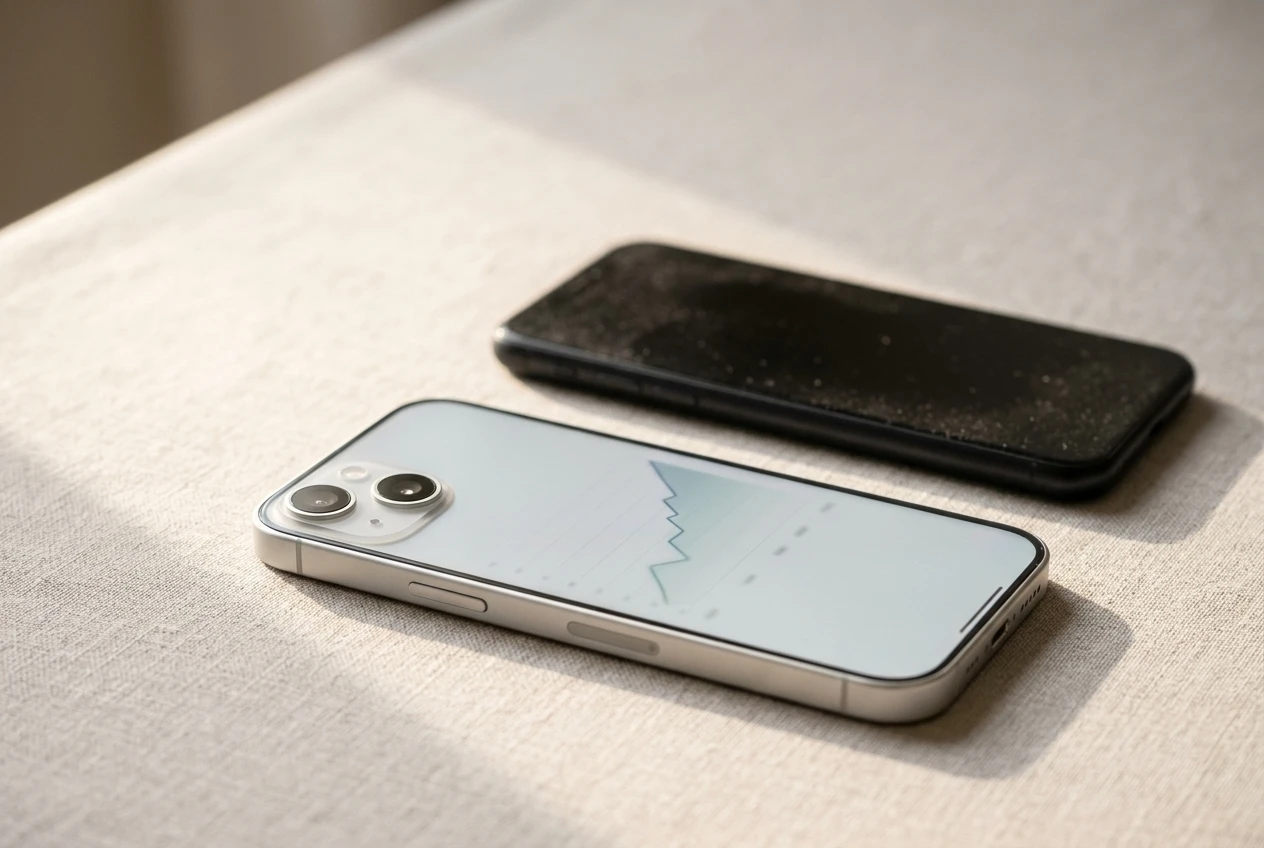
The Survey Only Covers the Market Apple Already Leads
CIRP samples American buyers exclusively. Zoom out to the rest of the planet and the picture flips hard. Android holds roughly 70.6% of global active devices to iOS’s 28.7%, though iOS captures 64.2% of consumer app spend. A separate tracker puts Android’s global active device lead at 68% to iOS’s 32%, but that headline masks sharp regional splits: iOS commands 59.8% in the United States and 68.2% in Japan, while Android holds 95.2% in India.
Counterpoint’s quarterly global tracker shows Apple and Samsung leading global growth amid strong demand in North America, Central America and Latin America, and emerging markets, yet the places where Android keeps adding the most new owners sit outside CIRP’s sample entirely. India alone shows 95.21% Android penetration. None of those buyers ever show up in a survey built around US iPhone purchases.
A Global Market That Has Stopped Growing
The backdrop matters. According to the International Data Corporation’s shipment tracker, global smartphone shipments decreased 2.9% year over year to 293.8 million units in the first quarter of 2026, breaking a ten consecutive quarter growth streak that had run since mid 2023.
The smartphone market has entered one of its most challenging periods, driven by acute memory supply constraints that are directly impacting both shipments and demand.
Nabila Popal, senior research director for Worldwide Consumer Devices at IDC, made that assessment as memory chip shortages ripple through the industry. In several emerging markets, prices have risen by as much as 40 to 50%, weighing heavily on demand in price sensitive regions, exactly where budget Android phones sell best.
Only two of the world’s five largest phone makers grew shipments that quarter. Apple took second place behind strong iPhone 17 sales, including growth of more than 30% in China, for a 4.4% year over year increase in global volume. Samsung reclaimed the top spot on strong demand for its new Galaxy S26 Ultra, a 2.9% year over year gain despite a later launch.
For the full year, IDC now forecasts shipments will sink 13.9% to 1.09 billion units. That is a further downward revision from IDC’s February forecast of a 12.9% decline, and would mark the steepest annual contraction in smartphone history.
Loyalty Is Getting More Expensive to Keep
Apple’s most loyal buyers are not just staying. They are trading up. CIRP’s analysis of iPhone model sales in the March 2026 quarter found that US iPhone sales shifted dramatically toward the iPhone 17 lineup, and further still toward the pricier Pro and Pro Max models.
That mix shift shows up directly in price. CIRP’s weighted average retail price tracker found the typical US iPhone sold for $1,042 in the March 2026 quarter, the highest March quarter CIRP has recorded since it began tracking Apple’s US business, up sharply from $971 in the March 2025 quarter.
The retention itself rests on factors that have little to do with any single new feature.
- Familiarity – existing owners already understand iOS, own compatible accessories, and may have years of purchases and personal data tied to Apple Services.
- Financial pull – carrier promotions and trade in offers can make another iPhone the easiest financial and technical choice.
- Cross device habit – repeat buyers often stay connected to Apple Watch, AirPods, Mac, iPad, and other Services.
- Sheer scale – Apple said on January 29, 2026, that its installed base had surpassed 2.5 billion active devices worldwide.
Each of those factors rewards a customer for staying. None require Apple to win a single new convert.
Carriers and Software Still Shape Who Switches
Platform loyalty runs through the carrier contract as much as the operating system. CIRP’s quarterly survey of all smartphone buyers, not just Apple’s, finds that about one quarter of buyers switch mobile carriers when they buy a new phone, with a slightly higher share of Android owners doing so than iPhone owners. CIRP’s carrier breakdown found iPhone carried an overall loyalty rate of 89% for the twelve months ending in June 2025, but that rate fell specifically among buyers who had changed carriers.
Apple has also chipped away at the software friction that once pushed people toward Android or kept them there. With the second beta of iOS 27, Apple added support for replying to a specific message inside an RCS conversation with an Android user, working the same way it already does in iMessage. An earlier update aimed even more directly at the other side. Apple’s software update built for Android switchers shipped months before this survey closed.
Android device makers are closing the same gap from their side. ColorOS 17’s redesign borrows Apple’s Liquid Glass look, part of a wider wave of Android skins converging on the visual language Apple popularized. The less the two platforms look and feel apart, the less reason a buyer has to leave either one.
A Foldable Test Waits for Apple’s Next Chief Executive
Apple’s next real attempt at outside converts arrives this fall. The company’s first foldable iPhone is expected as part of the fall 2026 lineup, introduced alongside the iPhone 18 Pro and iPhone 18 Pro Max in September. It will not be cheap: rumors put the starting price above $2,000, making it the most expensive iPhone Apple has ever sold.
The timing carries weight beyond hardware. Forbes reported the launch coincides with a leadership change, with John Ternus taking over as chief executive from Tim Cook in September. The foldable will be Ternus’s first major product moment in the role.
Attracting Android converts remains a separate challenge from retention, though the new form factor may appeal to some existing Android foldable owners. A device priced above $2,000 will test whether that appeal survives contact with the price tag. It arrives into a global phone market posting its worst year on record, with a loyalty number that, for now, keeps climbing only inside the one country Apple already owns.
Frequently Asked Questions
How does CIRP measure iPhone loyalty?
CIRP surveys people at the moment they buy a new iPhone and asks what device they owned right before it. The firm’s Apple analysis has been cited by the Wall Street Journal, the New York Times, Bloomberg, and CNBC. Because it only samples actual iPhone buyers, it cannot count Android owners who thought about switching and chose to stay put.
Is iPhone loyalty the same everywhere in the world?
No. India alone shows 95.21% Android penetration, and Android holds roughly a 68% global lead in active devices to iOS’s 32%. CIRP’s figures describe only the United States, where iOS already commands close to six in ten phones in use.
Why don’t more Android owners switch to iPhone?
Most simply are not weighing it. Among Android users who said they would be open to leaving, 31.8% cited better value elsewhere and 27.1% pointed to superior technology from a rival brand, according to one Android Authority breakdown. That is a minority of Android owners overall.
What will Apple’s foldable iPhone look like?
Apple’s rumored foldable phone may launch in September 2026 with a book style design, a roughly 7.7 to 7.8 inch internal display, and a 5.3 to 5.5 inch external screen. No official name or specs have been confirmed by Apple itself.
Will the foldable pull in more Android switchers?
It faces a head start problem as much as a price problem. Huawei and Samsung have been shipping foldables since 2019, a six year lead that let rivals work through most of the early design headaches, including the screen crease problem that plagued first generation models. Apple’s version will have to justify a premium price against habits Android foldable owners already have.


The House Cancels September Votes and Strands the CLARITY Act

Ascentiz Recruits Developers Around Its Modular Exoskeleton at IFA

Saylor’s Bitcoin Speech Claim Needs a Statute

Zeit AI Raises €5 Million for the Mid-Market Data Layer

Onwards and Sideways Turns Five Good Years Into a Joke

The Galaxy Watch 9 Splits Samsung’s Watch Update Path

Rightcharge Raises £500,000 as Fleets Drift Onto Public Chargers

Early Payment Discounts Hand Buyers a 37 Percent Return

AI Score Raises $5.4 Million as Security Alumni Watch Agents

Sony’s PlayStation Settlement Pays Users in Store Credit

Walter’s TWG Insists No Fraud as Insurer Probes Force Cleanup

30-Year Yield Hits 5.32% Highest Since 2007 as Debt Supply Locks In Costs

PCE Stays at 3.7% as Gas and Tariffs Outrun Coming Revisions

Evernorth S-4 Clears Path for Active XRP Treasury on Nasdaq

Astute’s $1.2M bet makes B2B creator deals feed AI discovery

Strategy Parks $1.59B Cash While Bitcoin Stack Stays Flat

Amber’s €7M locks Mittelstand knowledge inside Europe

SpaceX Stock Rebound Tests Real Demand Before Huge Unlock

The 20% Savings Ideal Meets a 2.7% Reality Check

CLARITY Act Cloture Opens a Door Ethics Still Blocks
-
 FINANCE3 months ago
Zcash Patched a Double-Spend Bug as ZEC Climbed 5%
-
 ENTERTAINMENT3 months ago
Steam Summer Sale 2026 Locks In June 25 to July 9 Dates
-

 FINANCE2 months ago
CLARITY Act Final Text Expected This Weekend as 60-Vote Hurdle Looms
-
 NEWS4 months ago
Meta Adds AI Replies to Threads, But Users Can’t Block It
-

 NEWS3 months ago
YouTube Shorts is testing a heart in place of the thumbs-up
-
 ENTERTAINMENT5 months ago
Extraction 3 Is Officially Coming to Netflix in 2027
-

 NEWS1 month ago
Senators Force Apple Off Chinese Memory as Big Three Cash In
-

 NEWS3 months ago
NEURA Robotics’ $1.4B Series C Redraws Europe’s Physical AI Bet