
NEWS
China’s Pontoon Rescue Saved Thousands as Guangxi’s Death Toll Stalls
China’s folding pontoon bridges rescued thousands from Guangxi’s floods, yet the region’s official death toll has stayed frozen at 39 since July 9.

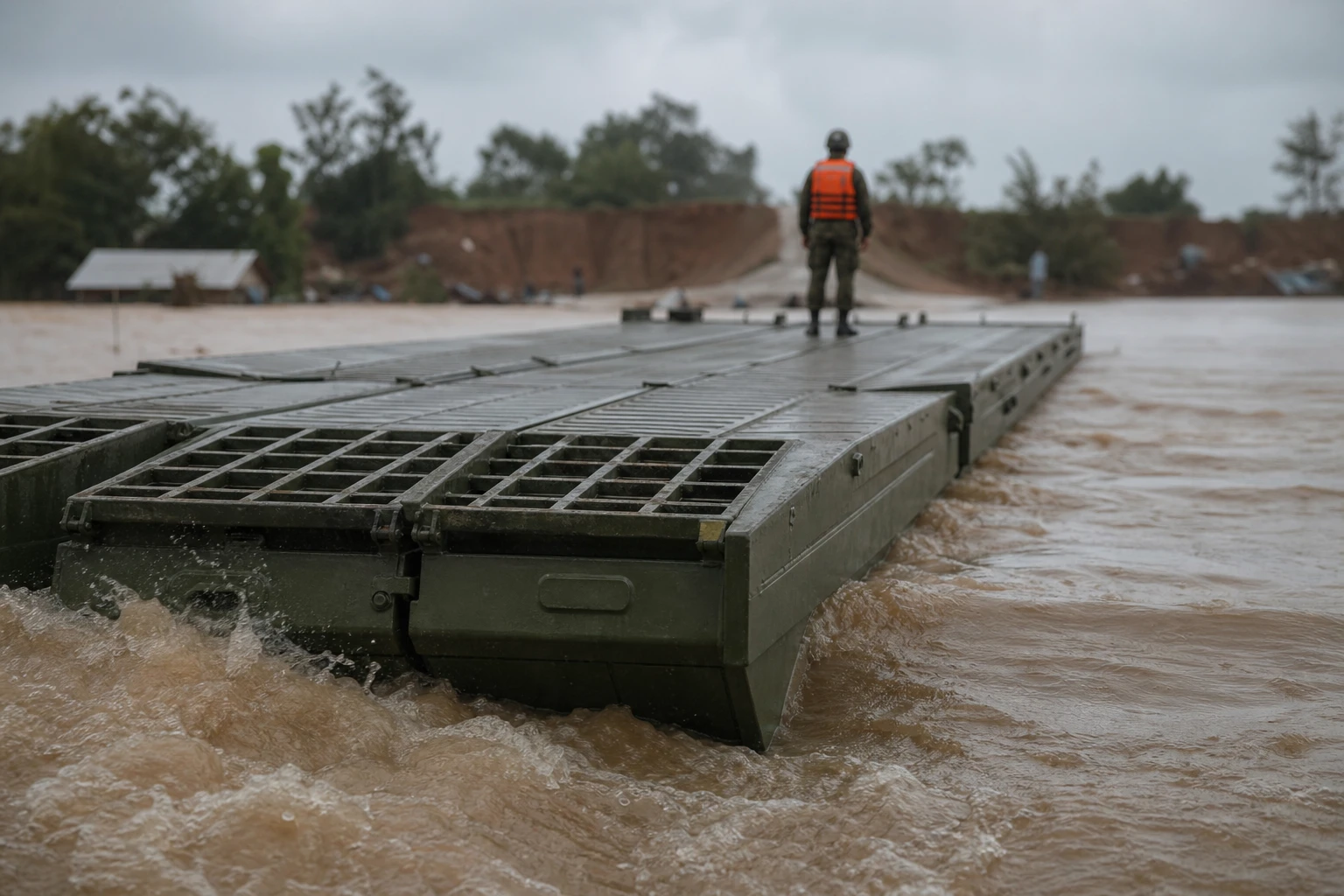
A 60-meter motorized pontoon platform pulled more than 6,000 students out of a flooded college campus in Guigang, China, gliding across water that had risen five meters overnight. Xinhua called it Noah’s Ark. Chinese embassies pushed the footage worldwide within a day.
The flood that made the rescue necessary has a death toll that has not moved in eleven days. Officials in Nanning, the regional capital, put it at 39 dead and nine missing on July 9. Residents in the hardest-hit villages say the real count is far higher, and Chinese censors keep deleting the posts that say so.
A Folding Barge Clears a Flooded Campus in Hours
Record rainfall from Typhoon Maysak trapped more than 6,000 students and staff at the Guangxi Logistics Vocational and Technical College on the night of July 7 into July 8, one of several schools inside Guigang’s Xijiang Education Park where the Associated Press (AP) reported more than 10,000 students and teachers were trapped in total.
China Anneng Construction Group, the state emergency rescue force that answered the call, rolled in modular pontoon hulls that unfold on the water and lock together into a continuous floating deck. Rescuers needed three of them, working the narrow, obstacle-choked lanes between flooded dormitories.
“We deployed three sets of these vessels. We did this because the terrain inside is complex and some areas are very narrow,” said Bian Fang, head of the emergency rescue department at China Anneng Group’s First Engineering Bureau. “Alternating the three sets allows us to stay agile, safe, and highly efficient.”
For the students who boarded, the machinery felt like more than transportation. “The first time I boarded the pontoon bridge, I truly felt the strength of the nation’s technology,” student Li Guizhao said, describing how the fear of being trapped gave way to a sense of safety.
Chinese embassies circulated clips of the platforms ferrying evacuees to dry ground within hours, branding the machine a real-life Transformer. By July 9, state broadcasters said every stranded student and teacher at the college had been evacuated.
- 60 meters long and 8 meters wide, with a load rating above 60 tonnes, per the South China Morning Post.
- Up to 500 people per trip at rated capacity, though CCTV, China Central Television, reported actual loads closer to 300 to 400 passengers a run.
- About ten minutes to unfold a single hull; the full span across the flooded courtyard went up in roughly half an hour.
- Three vessels rotated through the campus grounds to keep the operation moving without bottlenecks.
Before the barges arrived, crews had leaned on inflatable and assault boats that moved only a handful of people at a time. The pontoon platform turned that trickle into a continuous flow.
Typhoon Maysak Turns Nine Reservoirs Into a Countdown
The storm that set all of this in motion battered southern Guangxi for days. The national meteorological center recorded cumulative rainfall of 10 to 40 centimeters in some areas and more than 90 centimeters, roughly 35 inches, in the hardest-hit patches of the region.
Nanning’s emergency response was raised to Level I, the highest alert the system allows. It wasn’t enough to hold back the water. Nine reservoirs across Guangxi developed dangerous conditions between July 6 and July 7, four of them near Nanning and five near Guigang.
One of them failed outright. The Liulan Reservoir in Hengzhou, a 66-year-old structure holding more than 93 million cubic meters of water and irrigating close to 25,000 acres of farmland, gave way in two sections roughly 50 meters wide around 11 a.m. on July 6.
Not every rumor that followed held up. Local authorities in Guigang later said reports that the separate Dakai and Shiniu reservoirs had also collapsed were false, insisting both were operating normally.
- July 4: Torrential rain begins across Guangxi as Typhoon Maysak stalls over the region.
- July 6, around 11 a.m.: Two sections of the Liulan Reservoir dam in Hengzhou give way, sending water into low-lying communities.
- July 8: China Anneng deploys pontoon platforms to evacuate the Xijiang Education Park in Guigang.
- July 9: Nanning vice mayor Ding Wei announces 39 dead and nine missing region-wide, including 26 deaths tied to the Liulan breach.
- July 15 to 17: Residents and independent outlets report the toll is far higher; the official number has not changed since July 9.
Ding Wei said at the July 9 briefing that the dead and missing figures could overlap, since identification of some bodies was still ongoing. Rescue and cleanup crews were still clearing mud and restoring power to tens of thousands of homes days later.
From Dam Guards to Rescue Crews
China Anneng did not start out as a rescue company. It traces its roots to the People’s Armed Police (PAP) Hydropower Corps, a uniformed military unit whose job for decades was building, guarding, and repairing the same kind of levees, reservoirs, and hydropower stations that just failed in Guangxi.
Xi Jinping’s 2018 restructuring of the PAP stripped out its non-combat branches. The Hydropower Corps was disbanded that August and handed to civilian control the following year, reborn as China Anneng Construction Group at a ceremony in Beijing in May 2019. Its First Engineering Bureau, the unit that ran the Guigang rescue, is headquartered in Nanning, the very city the flooding hit hardest.
| Era | Command | Personnel | Core Mission |
|---|---|---|---|
| Before 2018 | Central Military Commission, via the PAP | Active-duty soldiers | Building, guarding, and repairing dams, levees, and hydropower stations |
| 2019 onward | State Council asset regulator | Civilian state employees | Construction contracts plus disaster and emergency rescue, including the Guigang deployment |
The irony sits close to the surface: the descendants of the corps once responsible for keeping reservoirs like Liulan intact are now the ones celebrated for cleaning up after one gave way. A Jamestown Foundation review of the PAP found gaps in training and cutting-edge equipment flagged by the corps’ own engineers years before the reform. A separate analysis from the International Institute for Strategic Studies (IISS) described the broader 2018 shakeup as leaving the PAP with a narrower focus on internal and maritime security, pushing functions like flood engineering out to state enterprises such as China Anneng.
Why Hasn’t Guangxi’s Death Toll Moved Since July 9?
China’s last official update came at that July 9 briefing: 39 dead, nine missing, including 26 deaths and seven missing tied specifically to the Liulan breach. More than a week later, residents in the worst-hit villages were telling foreign reporters the real number runs into the thousands, though no outlet has been able to confirm that independently.
On July 15, Guangxi residents filled Douyin comment sections with accusations that officials were hiding the true scale of the disaster. One commenter called the dam failure a man-made calamity. Others described neighbors who went out to pick tea the morning of the breach and never returned.
- 39 dead and 9 missing is the last official figure, given by Ding Wei on July 9 and unchanged since.
- Two dam sections failed at Liulan Reservoir around 11 a.m. on July 6, releasing water from a 93-million-cubic-meter reservoir.
- Nine reservoirs across Guangxi reported dangerous conditions between July 6 and July 7.
- Two rumored collapses, at the Dakai and Shiniu reservoirs, were officially debunked as false.
- A toll in the thousands, alleged by anonymous residents of Yunbiao township to The Epoch Times, which said it could not independently verify the claim.
- A delayed gate opening, blamed by an anonymous Douyin commenter on a fish farm operator’s request to haul in nets first, never confirmed by officials.
- A 2025 warning video of cracking in the dam structure, referenced in a since-censored WeChat post archived by China Digital Times.
Villagers in Yunbiao township, which sat directly in the floodwater’s path, described entire communities gone. One resident, speaking to The Epoch Times on condition of anonymity over fear of reprisal, said two people died in his own village while a neighboring village lost more than ten from a single production team.
Censors Moved Faster Than the Floodwaters Did
You can see from the footage that entire villages were swept away.
Li Linyi, a US-based commentator on Chinese current affairs, made that observation to The Epoch Times, adding that it’s hard to believe only a few dozen people died given the scale of destruction visible online.
China Digital Times, a US-based project that tracks Chinese internet censorship, archived a WeChat post asking questions that never got answered publicly. Among them:
- Why did the reservoir fail just a year after an expensive safety upgrade was completed?
- Did the economic interests of fish farmers delay the flood-control release?
- Why was a resident’s 2025 video documenting the dam’s cracking apparently ignored?
- What happened to a 2009 promise to make the dam withstand a hundred-year flood?
State media itself avoided blunt language. Xinhua’s Chinese-language reporting described the disaster with the phrase


Replit Opens Its London Office Inside an AI Crowd

Straight Circle Trailer Lands Without a U.S. Date

Anemo Labs Bets £700,000 on an AI Sense of Smell

Nintendo Prices the Zelda 40th Switch 2 at $519

Copilot Capital Buys the Autopilot Already Running 90 GW

Ground A Raises €9.1 Million for a Pallet Laser

Gibney’s Musk Film Opens in Venice Without Its Subject

Torvalds Blames AI for a Full-Fat Linux 7.3-rc2

Dexter Returns Sharper, Older, and Stuck Between Killers

Meta’s Muse Agent Can Spend Before the Privacy Lock

Walter’s TWG Insists No Fraud as Insurer Probes Force Cleanup

30-Year Yield Hits 5.32% Highest Since 2007 as Debt Supply Locks In Costs

PCE Stays at 3.7% as Gas and Tariffs Outrun Coming Revisions

Evernorth S-4 Clears Path for Active XRP Treasury on Nasdaq

Astute’s $1.2M bet makes B2B creator deals feed AI discovery

Strategy Parks $1.59B Cash While Bitcoin Stack Stays Flat

CLARITY Act Cloture Opens a Door Ethics Still Blocks

Instinct Hits $2.5 Billion as AI Agent Access Sparks Trust Fights

Oracle’s 2.8 GW Bloom Deal Exposes the AI Power Bypass

AI data centers win as RAM kits jump nearly 500 percent
-
 FINANCE3 months ago
Zcash Patched a Double-Spend Bug as ZEC Climbed 5%
-
 ENTERTAINMENT3 months ago
Steam Summer Sale 2026 Locks In June 25 to July 9 Dates
-

 FINANCE2 months ago
CLARITY Act Final Text Expected This Weekend as 60-Vote Hurdle Looms
-
 NEWS4 months ago
Meta Adds AI Replies to Threads, But Users Can’t Block It
-
 ENTERTAINMENT5 months ago
Extraction 3 Is Officially Coming to Netflix in 2027
-

 NEWS3 months ago
YouTube Shorts is testing a heart in place of the thumbs-up
-

 NEWS1 month ago
Senators Force Apple Off Chinese Memory as Big Three Cash In
-

 NEWS3 months ago
NEURA Robotics’ $1.4B Series C Redraws Europe’s Physical AI Bet