
BUSINESS
Rightcharge Raises £500,000 as Fleets Drift Onto Public Chargers
Rightcharge raised £500,000 to license home charging reimbursement after public plugs took 70 percent of fleet charging spend.

Rightcharge has raised £500,000 from existing investors to license its home charging payback tools to fleet suppliers across Europe. The London company, which puts home and public EV charging payments on one bill, took the cheque from Soulmates Ventures, with BlackWood Ventures and Purple Ventures joining.
The sum is modest beside a typical Series A. It arrives after Rightcharge’s own first-half data showed fleets moving more energy onto public chargers that now consume 70% of the charging bill.
A Second Cheque From the Same Investors
Charlie Cook, founder and chief executive, said the past year confirmed the company is solving a large problem for fleets. Rightcharge now supports more than 200 direct fleet customers in the UK. Over 99% of them were still on the platform after two years, and revenue from that existing base rose about 165% as those fleets added drivers.
Annual recurring revenue grew more than 20 times over the past year, Cook said. The new money is meant to buy customer acquisition, deepen supplier partnerships, and keep building the product as the firm prepares for a later Series A.
THE GROWTH CHEQUE
- The round: £500,000 led by Soulmates Ventures, with BlackWood Ventures and Purple Ventures, announced on 3 September 2026.
- The customers: More than 200 direct UK fleets, with over 99% still billed after two years.
- The licences: Five deals that let fleet suppliers embed Rightcharge’s home reimbursement technology in their own products.
- The next step: Europe expansion and a future Series A, after a £1.6 million seed in October 2025.
Michal Sikyta, managing partner at Soulmates Ventures, said the team had confirmed the fund’s conviction since that first cheque, citing growth, retention, and partnerships across energy and mobility. Soulmates had already led the October 2025 seed, which also included Unruly Capital.
Cook’s pitch has been consistent since that seed. “The home is the quiet giant of electrification. Over 70% of charging already happens there,” he said then. The company’s own 2026 numbers now show how fast that mix can slip if drivers default to the public plug.
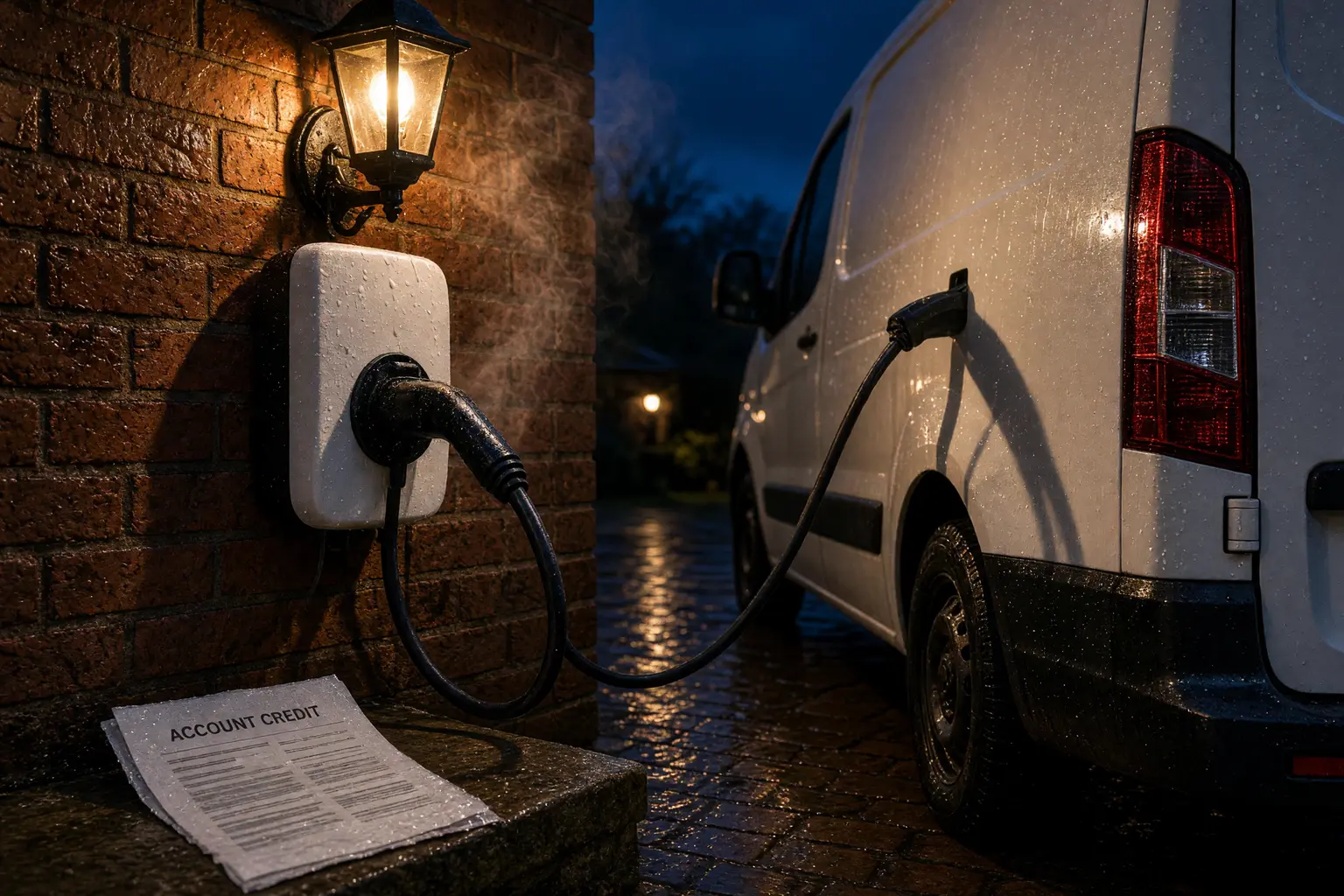
Public Charging Now Eats 70 Percent of the Bill
Rightcharge’s State of Fleet Charging report for the first half of 2026 drew on more than 1.5 million kWh used by fleets on its platform between January and June. Unit prices at both home and public sockets eased a little. The blended bill still went up, because a larger share of energy moved onto the road.
FLEET UNIT RATES ON THE RIGHTCHARGE NETWORK
| Setting | H1 2026 | 2025 |
|---|---|---|
| Home charging | 23.8p/kWh | 24.5p/kWh |
| Public charging | 80.9p/kWh | 81.5p/kWh |
| Blended fleet rate | 46.9p/kWh | 40.5p/kWh |
Public charging’s share of the energy those fleets used rose from 28% to 41%. That 41% of the electrons produced 70% of the spend. The report puts public sessions at 3.5 times the home rate on average. A driver on an EV tariff might pay 6p/kWh; the busiest rapid sockets on the same network hit 91.5p, 15 times more.
At 3.5 miles per kWh, the blended 46.9p rate works out at about 13p a mile. Across the busiest operators, rapid prices ran from 55p/kWh to 91.5p. For a 30 kWh top-up, that is £16.50 or £27.45 for the same energy. Advertised rates put 50 kW and above at 68.9p against 49.3p for 22 kW and below; sessions drivers actually ran cost 82.6p on DC and 68.5p on AC.
Some of that public use is forced. Drivers without a driveway cannot take the cheap overnight rate, and vans on long shifts need mid-day top-ups. Rightcharge’s own note is sharper on the rest of the mix: the person who picks the operator often does not pay the invoice.
The savings from electrification are real, but they’re the reward for managing charging well, not something that happens automatically. They slip away when nobody is watching the numbers.
Freddie Winterbotham, head of strategic partnerships, Rightcharge
Edmund King, president of the AA, put the same finding in plainer terms after the report landed in August: driver behaviour is the single biggest factor dictating a fleet’s operational EV costs. The AA is already a Rightcharge customer, so the warning comes from inside the book, not from a bystander.
How Rightcharge Credits a Driver’s Energy Bill
Cook built the company after watching businesses buy EVs and then stall on fairly reimbursing employees for home charging. Home bills do not split out the van. Flat mileage rates overpay some drivers and underpay others. Public charging then becomes the path of least paperwork, even when it is the expensive path.
The product is a payments layer, not a charger network. Drivers get one card and one app for public sockets. At home, they link the energy account and the charger. Software checks the session against the registered work vehicle, prices it on the live tariff, and sends the money to the supplier so the credit lands on the electricity bill rather than in a bank account.
WHAT THE HOME CREDIT ACTUALLY DOES
- The payee: Cash goes to the energy supplier, so the driver is not floating the bill on expenses.
- The tariff: API feeds keep the rate accurate when a driver switches supplier or sits on a variable EV tariff.
- The vehicle check: Sessions are matched to the work EV, which is how the firm tries to stop a family car riding on the company invoice.
- The fleet invoice: Home and public sessions land on one HMRC-compliant monthly bill, with carbon data attached.
Soulmates describes the same mechanism as direct integration with energy suppliers, including homes without smart meters. Rightcharge says it adds no margin to the unit rates. Plans can be mixed by driver, home only, public only, or both, billed monthly by Direct Debit, with separate enterprise pricing for large fleets.
On the AA account, 82% of charging happens at home. The fleet saves £12.90 on each full home charge and about £1,000 per driver per year. Michelle Tustain, the AA’s fleet manager, said the firm had delivered every feature requested and freed her time for other projects. Fisher & Paykel, the appliance maker, reports 88% of charging at home and a 63% cut in charging costs. WJ Group, the road-marking specialist, used the kWh log to record a 134 tCO2e cut for SBTi reporting.
Those case studies are the bull case. They also show why the H1 mix shift matters. If a large fleet can keep four fifths of its energy on a driveway, the EV bill holds. If public share climbs toward 41% of energy, the cheap electrons stop setting the price.
Five Supplier Licences Beat a Bigger Raise
Cook was explicit about where this £500,000 goes. He wants more fleet suppliers selling the home reimbursement product under their own names, not a bigger direct sales team as the only route into Europe.
Five such licence deals are already signed. The named partners sit in the pipes fleets already use. Octopus Electroverse white-labels the home payments stack. The Right Fuel Card, part of Edenred, bundles it with fuel for mixed fleets. Fuuse sits in the same group. POD, the UK charging arm owned by EDF, uses it inside Home Fleet. Andersen EV, a home charge-point maker, connected its sockets to the payback engine on 25 August 2026, so session data can price itself on the driver’s real tariff.
THE PATH TO THIS CHEQUE
- 2019: Charlie Cook founds Rightcharge in London, after EV charging work at Octopus Energy.
- 23 October 2025: Soulmates Ventures leads a £1.6 million seed with BlackWood Ventures, Unruly Capital and Purple Ventures.
- 16 April 2026: Rightcharge launches a Gold Card bolt-on, later piloted by the AA, with fixed public rates on partner networks.
- 7 August 2026: The H1 2026 fleet charging report is published from 1.5 million kWh of platform sessions.
- 25 August 2026: Andersen EV goes live as a home charger feed into the reimbursement engine.
- 3 September 2026: Existing investors add £500,000 and the firm flags a future Series A.
A company comparison dated 21 January 2026 put Rightcharge’s public network at 82,000 charge points, against 77,000 on Allstar and 58,000 on Paua. Soulmates says the card reaches over 38 networks and, through European roaming, more than a million sockets. The home credit is still the piece Cook is licensing. Public cards are crowded. Accurate payback to an energy bill is not.
That is also why a half-million-pound round can be the rational next step after 20-times revenue growth. The seed already funded the product and the first European localisation. This cheque is working capital to put that product inside other people’s contracts before a larger raise.
France and Germany Already Have Live Fleets
Through Octopus Electroverse, Rightcharge has started operating in France and Germany, with first fleet deployments and local partners in both markets. The seed-era plan also named the Netherlands, Belgium, Norway and Ireland as white-label targets.
Germany is the prize Hynek Sochor, founder and managing partner at Soulmates, flagged at the seed: 80% of new high-end cars there are company vehicles. From the start of 2026, German company-car home charging also needs actual kilowatt-hour records rather than a monthly lump sum. A payments firm that already prices sessions from charger, vehicle and tariff data is built for that kind of rulebook.
Visa recently certified Rightcharge as a home charging reimbursement partner in Europe, against the network’s tests for function, integration and security. For a company that wants fleet-card issuers to distribute its rail, that stamp is a sales document as much as a compliance one.
Cook’s background sits on both sides of the bill. He trained as a civil engineer, worked at CERN, took an Imperial MSc in climate change, management and finance, then ran EV charging work at Octopus Energy, including some of the early vehicle-to-grid projects. Kevin Ikelle is chief technology officer. The firm still has a small London team. The licence model is how a company that size tries to sit inside Edenred and EDF rather than out-spend them.
Drivers Still Decide Where the Fleet Pays
Even a perfect home credit cannot move a van that has nowhere to park. Rightcharge said as much in the H1 report: driveway access is not a policy lever. Mid-shift range is not either. The residual job is to stop discretionary public charging from setting the price for everyone else.
That is the point of the Gold Card bolt-on. It offers fixed public rates of 49p/kWh on fast sockets and 59p on rapid and ultra-rapid, against the 80.9p average in the first half. The first four partner networks were Sainsbury’s Smart Charge, Ionity, BP Pulse and BeEV, with four more due to join on the same fixed prices. At a blended 46.9p, home charging averaged 23.8p per kWh and still undercut those capped public rates.
THE PUBLIC SIDE OF THE SAME BILL
- Gold Card fast: 49p/kWh on partner AC, versus 68.5p on actual AC sessions in H1 2026.
- Gold Card rapid: 59p/kWh, versus 82.6p on actual DC sessions in the same half.
- HMRC split: From 1 June 2026 the department’s advisory electric rate of 7p a mile applies to home charging, with 15p a mile for public charging.
The HMRC split is the tax version of the same gap. Employers that still reimburse on a single mileage figure will overpay home charging and underpay the rapid-network miles. Actual-cost payback, which is what Rightcharge sells, sits under both rates at once when the tariff is cheap, and above the public advisory rate when a driver hits 91.5p/kWh.
Company claims of cost cuts up to 90% and carbon cuts around 30% describe the home-heavy outcome, not the H1 blended book. The AA and Fisher & Paykel figures are closer to that outcome because their drivers actually plug in on a driveway. The 41% public energy share is what happens when that habit does not stick.
The £500,000 does not build chargers and does not buy a European brand campaign. It pays to put a home-bill credit inside the fuel-card and energy firms that already own the fleet relationship, in markets where the company car is the default new car. If that rail holds, the public networks keep the miles that have to happen on the road, and lose the miles that were only ever an admin failure.
Frequently Asked Questions
How Does Rightcharge Reimburse Home Charging?
The driver links a home energy account and charger in the app; each session is checked against the registered work vehicle, priced on the live tariff, and paid to the energy supplier so a credit appears on the electricity bill. Rightcharge says it does not add a margin to those unit rates, bills the fleet a separate monthly energy invoice, and lets managers mix Home Only and Public Only plans by driver rather than forcing one product on the whole fleet.
What Is HMRC’s Advisory Electric Rate for Company EVs?
From 1 June 2026 HMRC’s advisory electric rate is 7p a mile for home charging and 15p a mile for public charging, reviewed on 1 March, 1 June, 1 September and 1 December. Employers may pay more than those figures if they can show a higher cost per mile, and plug-in hybrids are still treated as petrol or diesel cars for advisory fuel rates rather than under the electric split.
Who Founded Rightcharge and When?
Charlie Cook founded the company in London in 2019 and remains chief executive, with Kevin Ikelle as chief technology officer. Cook previously worked on EV charging and vehicle-to-grid projects at Octopus Energy, after a civil engineering degree, time at CERN in Geneva, and an Imperial Business School MSc; in 2018 he won Young Renewable Energy Professional and Young Energy Professional awards for that Octopus work.
How Much Did Rightcharge Raise Before This Round?
Soulmates Ventures led a £1.6 million seed on 23 October 2025, joined by BlackWood Ventures, Unruly Capital and Purple Ventures. Nine members of the S100 Angel Investment Club put in £83,000 inside that seed, which also funded the Octopus Electroverse white-label work that later put live fleets into France and Germany.


The House Cancels September Votes and Strands the CLARITY Act

Ascentiz Recruits Developers Around Its Modular Exoskeleton at IFA

Saylor’s Bitcoin Speech Claim Needs a Statute

Zeit AI Raises €5 Million for the Mid-Market Data Layer

Onwards and Sideways Turns Five Good Years Into a Joke

The Galaxy Watch 9 Splits Samsung’s Watch Update Path

Rightcharge Raises £500,000 as Fleets Drift Onto Public Chargers

Early Payment Discounts Hand Buyers a 37 Percent Return

AI Score Raises $5.4 Million as Security Alumni Watch Agents

Sony’s PlayStation Settlement Pays Users in Store Credit

Walter’s TWG Insists No Fraud as Insurer Probes Force Cleanup

30-Year Yield Hits 5.32% Highest Since 2007 as Debt Supply Locks In Costs

PCE Stays at 3.7% as Gas and Tariffs Outrun Coming Revisions

Astute’s $1.2M bet makes B2B creator deals feed AI discovery

Strategy Parks $1.59B Cash While Bitcoin Stack Stays Flat

Evernorth S-4 Clears Path for Active XRP Treasury on Nasdaq

Amber’s €7M locks Mittelstand knowledge inside Europe

SpaceX Stock Rebound Tests Real Demand Before Huge Unlock

The 20% Savings Ideal Meets a 2.7% Reality Check

AI data centers win as RAM kits jump nearly 500 percent
-
 FINANCE3 months ago
Zcash Patched a Double-Spend Bug as ZEC Climbed 5%
-
 ENTERTAINMENT3 months ago
Steam Summer Sale 2026 Locks In June 25 to July 9 Dates
-

 FINANCE2 months ago
CLARITY Act Final Text Expected This Weekend as 60-Vote Hurdle Looms
-
 NEWS4 months ago
Meta Adds AI Replies to Threads, But Users Can’t Block It
-

 NEWS3 months ago
YouTube Shorts is testing a heart in place of the thumbs-up
-
 ENTERTAINMENT5 months ago
Extraction 3 Is Officially Coming to Netflix in 2027
-

 NEWS1 month ago
Senators Force Apple Off Chinese Memory as Big Three Cash In
-

 NEWS3 months ago
NEURA Robotics’ $1.4B Series C Redraws Europe’s Physical AI Bet