
FINANCE
The House Cancels September Votes and Strands the CLARITY Act
House Republicans cut their last two September weeks, leaving the CLARITY Act stranded two days after a Senate vote and past the midterms.

Speaker Mike Johnson canceled the House’s last two weeks of September votes on Sept. 3, leaving the CLARITY Act two days after a Senate test.
Members return Sept. 14 through Sept. 17, then stay out through the Nov. 3 midterms. The Senate still votes Sept. 15 on whether to debate the crypto market bill. Even a yes cannot finish the job while the House is gone.
House GOP Cancels Eight September Voting Days
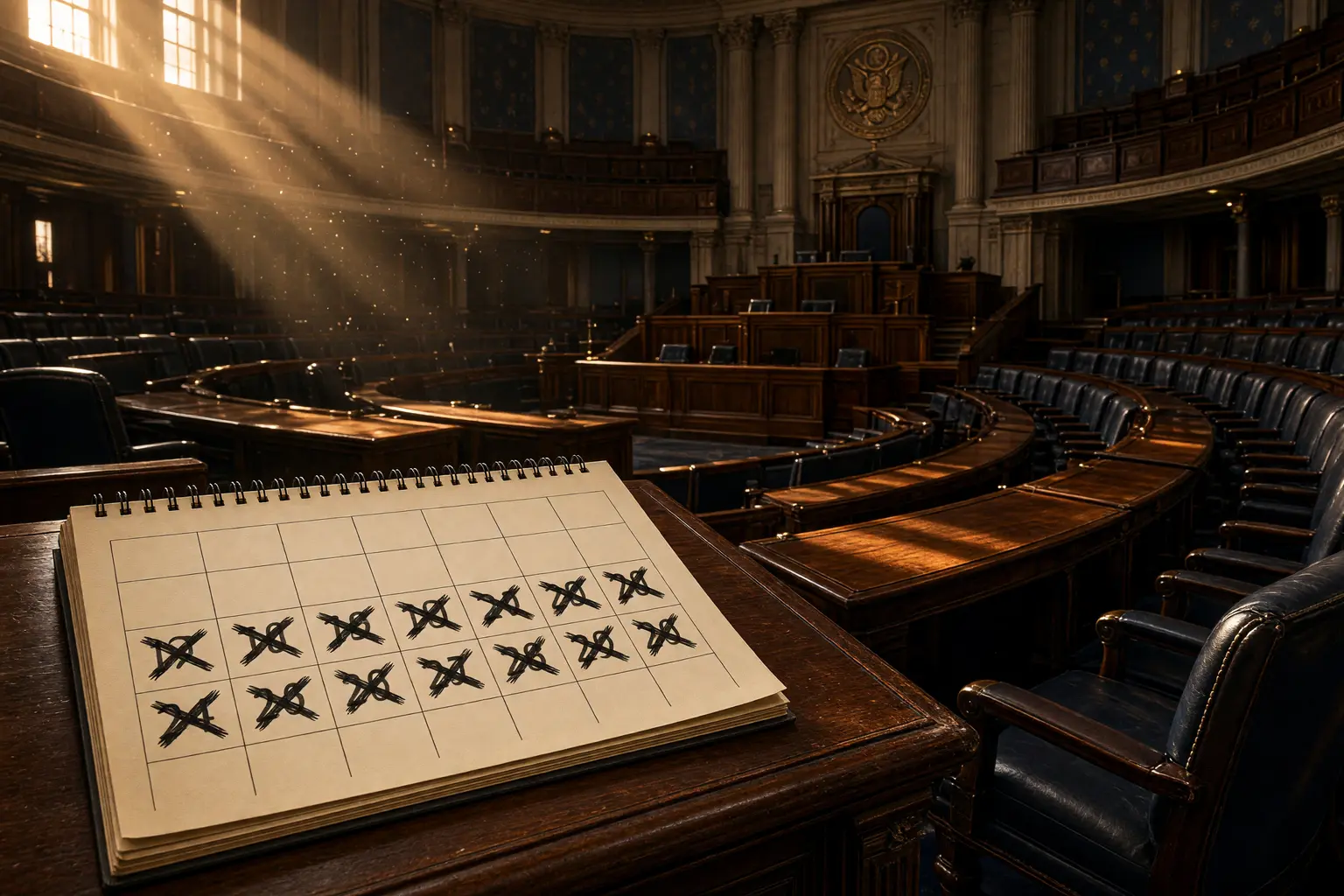
A notice from Majority Whip Tom Emmer’s office (R-Minn.) dropped the weeks of Sept. 21 and Sept. 28, which had held eight voting days. After the Labor Day break, the House now has four days on the floor, then the rest of September and all of October off.
Johnson, the Louisiana Republican, told reporters the Congress had done phenomenal work and that members were jostling a lot of different priorities. The same notice said members could be called back with 48 hours’ warning, but only if the Senate adopts a budget resolution that opens a party-line reconciliation bill. Crypto market structure is not that bill.
President Donald Trump had already signed a stopgap funding measure on Sept. 2 that runs through Dec. 11, so there is no shutdown clock holding anyone in town. Rep. Robert B. Aderholt (R-Ala.), a House appropriator, said he did not see a compelling reason to be there late in the month. Rep. Ralph Norman (R-S.C.), who sits on Rules, said nothing controversial would come up in the remaining week.
THE SEPTEMBER CALENDAR AFTER THE CUT
| Chamber | Days still on the books | What that window can hold |
|---|---|---|
| House | Sept. 14-17, then out until mid-November | Four days, then the midterm recess |
| Senate | Sept. 14-18, 22-25, and 28-Oct. 2 | Cloture on Sept. 15, then more floor weeks the House will miss |
Those Senate weeks still appear on the original September House and Senate calendars. The House column for the last two weeks is the part leadership just erased. Rep. Morgan Griffith (R-Va.), also on Rules, said the extra campaign time helps people who are running, and asked why the House should pass more bills for a Senate that does not finish them.
The Senate’s Sept. 15 Vote Meets an Empty Calendar
Senate Majority Leader John Thune (R-S.D.) filed cloture on the motion to proceed to H.R. 3633 at 4:52 a.m. ET on Aug. 8, just before the chamber left for its summer break. That filing ripens at 2:15 p.m. ET on Sept. 15, the day after senators return.
The vote is not passage. It is the 60-vote step that decides whether the Senate will even begin debate on the Digital Asset Market Clarity Act. Republicans hold 53 seats, so they need 7 Democratic votes if every Republican joins. The Banking Committee advanced the bill 15-9 on May 14, with Sens. Ruben Gallego (D-Ariz.) and Angela Alsobrooks (D-Md.) the only Democrats in that tally, and put it on the Senate calendar on June 1 as Calendar No. 423.
SEC Chair Paul Atkins has said he hopes the Senate will move the bill in that window and eventually send it to Trump. A yes on Sept. 15 still leaves text, amendments, a second 60-vote hurdle, and a final roll call. That sequence runs longer than the two days the House will still be in Washington.
Why the House Must Take the Bill Up Again
The House already passed this bill. On July 17, 2025, it cleared H.R. 3633 by 294 to 134, a wide bipartisan margin on a measure House Financial Services Chairman French Hill (R-Ark.) had introduced on May 29, 2025. The remaining House job is not to invent the bill. It is to accept, or rewrite, whatever the Senate changes.
Griffith’s complaint about bills dying in the Senate is the tell, because CLARITY is the inverse case: the House did its first job last year, and the second job is a return trip.
When we’ve passed so many bills and they’re just languishing in the sauna of the Senate, then you know, why would we pass more bills to go over there not to be done?
Rep. Morgan Griffith, R-Va., to reporters
Johnson had told an interviewer on Sept. 1 that the House would remain in Washington through September, calling an early recess a nonsensical idea. Two days later the whip’s office canceled those weeks. The chamber had already taken a monthlong August recess. Members now get the campaign time they wanted. The bill they already passed does not get a partner chamber that can take it back before the election.
FROM HOUSE PASSAGE TO A CANCELED SESSION
- July 17, 2025: House passes H.R. 3633, 294 to 134.
- May 14, 2026: Senate Banking Committee advances the bill, 15-9.
- June 1, 2026: The bill reaches the Senate calendar as Calendar No. 423.
- Aug. 8, 2026: Thune files cloture on the motion to proceed.
- Sept. 3, 2026: House leadership cancels the weeks of Sept. 21 and Sept. 28.
- Sept. 15, 2026: Senate cloture vote set for 2:15 p.m. ET.
- Sept. 17, 2026: House leaves until mid-November.
If the Senate rewrites yield, ethics, or DeFi language, the House has to vote again. That vote cannot happen in a chamber that has gone home, unless Johnson uses the 48-hour callback written for reconciliation, not for this bill.
The Stablecoin Yield Fight That Ate the Clock
The calendar is the immediate block. The reason there is no spare week is that the Senate spent the year on fights that still are not closed. The loudest money fight is whether payment stablecoins can pay anything that looks like bank interest.
Sens. Thom Tillis (R-N.C.) and Angela Alsobrooks released Section 404 on May 1, 2026. It bars crypto firms from paying interest or yield that is economically or functionally equivalent to a bank deposit, while leaving rewards tied to bona fide activity such as payments, transfers, and trading. Coinbase chief Brian Armstrong’s public reaction was three words: “Mark it up.” Banking trade groups did not treat that as the end.
The American Bankers Association, the Bank Policy Institute, and allied groups argued the text still leaves room for interest-like rewards. Their research warned that yield-earning stablecoins could cut consumer, small-business, and farm loans by one-fifth or more, and an ABA analysis put possible deposit flight as high as $6.6 trillion. Between May 9 and May 13, ABA members sent more than 8,000 letters to Senate offices. Tillis said the banks had had a seat at the table for months and that he respectfully agreed to disagree.
THE FIGHTS STILL OPEN
- Stablecoin rewards: Banks want Section 404 tightened so activity rewards cannot mimic deposit interest; crypto firms say the May compromise already closed that door.
- Officeholder ethics: Gallego has said he will not back a floor vote without ethics language, and Sen. Kirsten Gillibrand (D-N.Y.) has demanded an enforceable ban on presidents and senior officials issuing or profiting from crypto, the ethics fight still blocking Senate cloture.
- The 60-vote count: Committee Democrats are not the same as floor Democrats, and seven crossovers still have to exist on Sept. 15.
Those arguments burned spring markup, summer text, and the July window Galaxy Digital’s Alex Thorn had already flagged as a calendar problem rather than a substance problem. By the time Thune filed cloture, the House was weeks from an election recess. Johnson then shortened that recess’s front edge.
A 17% Chance of a Law This Year
Polymarket traders now price a 17% chance that Trump signs the CLARITY Act in 2026, down from a print above 20% in late August and from 82% in February. The same desks put Democrats at 90% to take the House and 52% to take the Senate. That is the political math behind Johnson’s “defy history in 63 days” line, which he delivered on Sept. 1, pointing at the Nov. 3 midterms.
THE MARKET’S READ ON 2026
- Year-end signing: 17% on Polymarket that the bill becomes law in 2026.
- House control: 90% that Democrats take the chamber.
- Senate control: 52% that Democrats take the chamber.
- February high: 82% that the bill would be signed this year.
The passage odds now in the teens are a timing price. They assume the Senate may still hold its test, and that a law still needs a House that will not be there to take amendments, then a lame-duck majority that may be on the way out. Miller Whitehouse-Levine, chief executive of the Solana Policy Institute, had already put the chance of a law before the midterms at 10%, citing the short floor and unfinished talks.
Going home to campaign is supposed to protect the majority that passed the bill. The market’s 90% House print says that majority is the thing most likely to vanish, which is why a Sept. 17 exit does not look like a pause. It looks like a bet that the bill can wait for a chamber the bettors do not think Republicans will still run.
Atkins Keeps Writing Rules Without a Statute
Congress can leave. The agencies have not. On Aug. 18 the SEC proposed Regulation Crypto Assets, with two new exemptions for crypto offerings: a one-time startup path of up to $5 million over four years, and a fundraising path of up to $75 million in each 12-month period. Issuers would give principles-based disclosures; the larger path would add financial statements and ongoing reports. The comment window runs 60 days after the proposal hits the Federal Register.
The same package includes a safe harbor once managerial work ends, so a token can be treated as no longer tied to an investment contract if the issuer certifies that it has ceased the essential efforts it promised. Atkins framed the project as a path to raise capital under the securities laws while Congress still tries to write a lasting statute. He has also said the commission plans separate Innovation Exemption guidance for tokenized securities.
As we continue the Commission’s efforts to provide clarity for crypto markets, and as Congress works to establish a lasting regulatory framework, Regulation Crypto Assets seeks to provide crypto asset entrepreneurs and market participants with clear pathways to raise capital under the federal securities laws.
Paul S. Atkins, SEC chairman, Aug. 18, 2026, Commission press release
CFTC Chair Michael Selig directed staff on Aug. 20 to explore rules under existing authority if Congress does not enact CLARITY. Agency action can cover offerings, custody, and some spot-market plumbing. It cannot, on its own, lock in the statutory split the bill writes between the SEC and the CFTC, or settle the bank fight over stablecoin rewards. That is why Atkins keeps asking for a signature even as his own shop writes around the wait, and why crypto market growth during the delay has not depended on a November signing ceremony.
Mid-November Is Now the First House Date
The Senate can still vote on Sept. 15. It can still spend the weeks of Sept. 22 and Sept. 28 on amendments the House will not be present to receive. If cloture fails, the 2026 statute path is effectively closed. If cloture succeeds and the Senate passes a rewritten text, the earliest regular House date is mid-November, after the Nov. 3 election, in a lame duck that runs until the 119th Congress ends on Jan. 3, 2027.
Norman said that after the midterms, members may see some consequential bills. A Democratic House at the 90% price would still let the outgoing GOP majority try to finish CLARITY in that lame duck, and it would also give the incoming majority a reason to wait and rewrite. Johnson can still call the House back in 48 hours for reconciliation. He has not claimed that tool for a crypto conference report.
The House already passed the CLARITY Act. It has now booked itself out of the room for the only September week in which the Senate’s first vote could have come back. Members will be in their districts. The bill will be on the Senate calendar. The next House date is after the election they left town to win.


The House Cancels September Votes and Strands the CLARITY Act

Ascentiz Recruits Developers Around Its Modular Exoskeleton at IFA

Saylor’s Bitcoin Speech Claim Needs a Statute

Zeit AI Raises €5 Million for the Mid-Market Data Layer

Onwards and Sideways Turns Five Good Years Into a Joke

The Galaxy Watch 9 Splits Samsung’s Watch Update Path

Rightcharge Raises £500,000 as Fleets Drift Onto Public Chargers

Early Payment Discounts Hand Buyers a 37 Percent Return

AI Score Raises $5.4 Million as Security Alumni Watch Agents

Sony’s PlayStation Settlement Pays Users in Store Credit

Walter’s TWG Insists No Fraud as Insurer Probes Force Cleanup

30-Year Yield Hits 5.32% Highest Since 2007 as Debt Supply Locks In Costs

PCE Stays at 3.7% as Gas and Tariffs Outrun Coming Revisions

Astute’s $1.2M bet makes B2B creator deals feed AI discovery

Strategy Parks $1.59B Cash While Bitcoin Stack Stays Flat

Evernorth S-4 Clears Path for Active XRP Treasury on Nasdaq

Amber’s €7M locks Mittelstand knowledge inside Europe

SpaceX Stock Rebound Tests Real Demand Before Huge Unlock

The 20% Savings Ideal Meets a 2.7% Reality Check

AI data centers win as RAM kits jump nearly 500 percent
-
 FINANCE3 months ago
Zcash Patched a Double-Spend Bug as ZEC Climbed 5%
-
 ENTERTAINMENT3 months ago
Steam Summer Sale 2026 Locks In June 25 to July 9 Dates
-

 FINANCE2 months ago
CLARITY Act Final Text Expected This Weekend as 60-Vote Hurdle Looms
-
 NEWS4 months ago
Meta Adds AI Replies to Threads, But Users Can’t Block It
-

 NEWS3 months ago
YouTube Shorts is testing a heart in place of the thumbs-up
-
 ENTERTAINMENT5 months ago
Extraction 3 Is Officially Coming to Netflix in 2027
-

 NEWS1 month ago
Senators Force Apple Off Chinese Memory as Big Three Cash In
-

 NEWS3 months ago
NEURA Robotics’ $1.4B Series C Redraws Europe’s Physical AI Bet