
NEWS
Ascentiz Bets IFA on a Modular Exoskeleton Platform
Ascentiz is betting IFA visitors on BodyOS, an open modular exoskeleton platform, while the knee module still has no ship date.

Ascentiz used IFA Berlin from September 4 to 8 to show a modular exoskeleton on one Exo-Belt with swappable hip and knee joints. Hip units are already on sale; the knee module still carries a price and no ship date.
Hall 12, Booth 109 put a developer kit beside those joints, because the 2023 startup is trying to turn a crowded hip-assist market into a platform other people will extend.
IFA Put the DevKit Ahead of the Hardware
The company release on September 3 called the setup the world’s first modular exoskeleton platform: one wearable base, interchangeable joint modules, and an open software layer underneath. Ascentiz-H is the hip unit for walking, climbing, running, and faster travel. Ascentiz-K is the knee unit, billed as Adaptive Knee Augmentation for flat ground, stairs, climbs, and descents. Both, the company said, use Adaptive Motion Intelligence to change assistance inside a user-selected mode.
That is the consumer pitch. The booth pitch was narrower. On September 7, while the show was still open, the company’s own account said the mission was to put the K modules and the DevKit in front of visitors.
Our mission at IFA 2026 was simple: Unveil the Unseen. We put our core K Modules and DevKit front and center, giving the world a hands-on look at the hidden technology powering the future and driving next-generation performance. Thank you to everyone who stopped by our booth! pic.twitter.com/cXInWNkQe1
— Ascentiz (@AscentizTalks) September 7, 2026
Cody Kou, Vice President of Ascentiz, framed the design as a refusal to freeze one gait into one machine.
We chose modularity because people do not move in one way or need the same assistance all the time. Different activities place different demands on the hips and knees. We believe wearable robotics should evolve with those needs, rather than lock every capability into one fixed device. Our goal is to build a platform that can keep gaining new capabilities over time, rather than asking users to start over with each new generation.
Cody Kou, Vice President of Ascentiz
A short show-floor walk in the hip setup was described as timed to the stride, with the clips coming off by hand after a few minutes on the floor and the stairs. That is a demo, not a season of trail use, and it is the hip module that visitors could actually buy when they left Berlin.
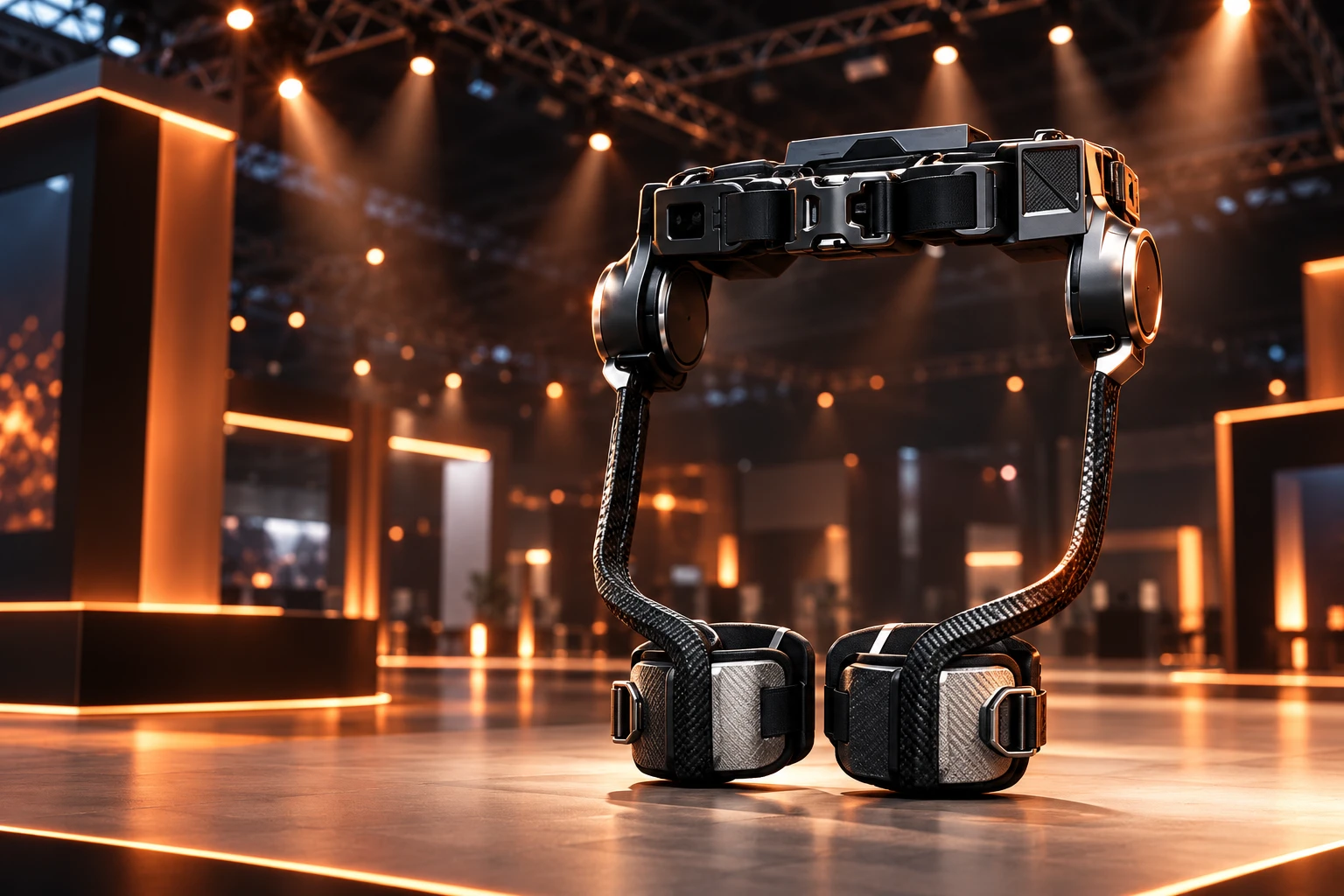
The Exo-Belt Is the Product
Every configuration hangs off the same hub. The Exo-Belt holds the battery, the controller, and the core code. It can run H, K, or both, with modules swapped by hand in seconds on a MOLLE quick-release the company brands AZ-Lock. H pushes the wearer forward and up. K adds support and controlled braking when knee load and impact rise.
The store kit for the flagship hip unit makes that physical. An H Ultra listed at $1,699 ships with one Exo-Belt, two H modules, two batteries, a carry case, and the straps, and the charger is sold separately. Fit is listed from 5.1 to 6.6 feet. Both Pro and Ultra hip sets are published at 2.5 kg, or 5.5 lb, with one battery, IP54 weather sealing, and noise at or under 35 dB.
On paper the belt is more than a battery pack. Three named interfaces are supposed to let a future module talk to today’s hardware without a new chassis.
THE THREE SHARED LAYERS
- AZ-Lock: A MOLLE-style clip so a joint module can go on or come off by hand in seconds.
- CAN-FD: The electrical and data link that lets H, K, and later hardware share the same belt.
- BodyOS: The common control software that is meant to run one joint, or coordinate hip and knee together.
Kickstarter still warns that you cannot mix H and K on different legs. Ultra hardware, the campaign said, is the path for that kind of open custom work. Until then, modularity means whole-module swaps, not a left-right mashup.
Why Ascentiz Is Opening BodyOS in Stages
BodyOS is the actual wager. The IFA release said the layer was open-sourced in 2026 so the system can grow through software updates, new Ascentiz modules, and hardware from researchers and outside builders. Kou has also said the opening is staged. DevKit hardware and firmware were on the stand in Berlin. SDK and API access is scheduled for mid-November, when people in the BodyOS Program are expected to start showing early apps. Workshops and hackathons are planned after that.
“Opening BodyOS is a process, not a switch,” Kou said, describing a path from DevKit hardware to SDK access, then to demonstrations and community programs. That is a different claim from a public GitHub dump. The campaign page promised SDKs and APIs in C, C++, Python, and Matlab, plus a future GitHub repository under an MIT license. The live invitation now sits on the company’s BodyOS developer program page, not on a finished public repo that independent builders can clone this week.
The calendar behind that pitch is short, and it is already a year of trade-show loops.
FROM CROWDFUND TO A STAGED OS
- September 25, 2025: A 45-day Kickstarter campaign opens on a HK$388,788 goal.
- November 9, 2025: The campaign closes with HK$20,626,726 from 2,301 backers, about 53 times the goal, and the company later called it the most funded exoskeleton project on the platform and eighth historically in wearable technology.
- January 4, 2026: Ascentiz stages a commercial debut at CES in Las Vegas with final H and K modules after that crowdfunding run.
- September 3, 2026: The IFA release sets Hall 12, Booth 109, lists euro prices for H, K, and combos, and says K and H+K availability will be announced soon.
- September 4 to 8, 2026: The Berlin stand shows H, K, and the DevKit. The H Series is later described as an IFA Innovation Award honoree in the Mobility category.
- Mid-November 2026: SDK and API access is scheduled for developers in the BodyOS Program.
Founded in 2023, the company is still converting a record crowdfunding week into a catalog. The hip units made that jump. The software tools and the second joint have not.
Hip Exoskeletons Already Fight Under $2,000
The H Series does not enter an empty aisle. Powered consumer hip units now cluster between about $800 and $2,000, and several of them already ship. Ascentiz sells two hip kits in that band: the H Pro at $1,299, down from a $1,499 list, with 1,000 W peak boost, 44 Nm, and one battery rated for 15.5 miles (25 km); and the H Ultra at $1,699, down from $1,999, with 1,100 W, 48 Nm, Toray T700 carbon-fiber legs, an AMS 4928 titanium belt, 16 motion modes, a 0.2-second mode switch, and two batteries that the company rates at 31 miles (50 km) when used one after the other, not at the same time.
The Ultra’s own page claims a 40% cut in effort, a 66 lb load taken off the hips, a 65-minute 0 to 100% charge on a 77.7 Wh pack, CSA certification, and shipping to the contiguous United States, Canada, Mexico, and the European Union. Ease, ACC, Train, and Boost are the four riding modes. Those are manufacturer figures, not a third-party lab card.
WHAT A BUYER CAN ACTUALLY ORDER
| Model | Joint | Public price | Status |
|---|---|---|---|
| Ascentiz H Pro | Hip | $1,299 | Shipping |
| Ascentiz H Ultra | Hip | $1,699 | Shipping |
| Hypershell X Pro S | Hip | $999 | Shipping |
| Hypershell X Max S | Hip | $1,499 | Shipping |
| Hypershell X Ultra S | Hip | $1,999 | Shipping |
| DNSYS X1 | Hip | From $829 | Shipping |
| Ascentiz-K Pro | Knee | €2,399 | No ship date |
Hypershell is the funded incumbent in that table. Dealroom records B-series capital of $120 million, including a $50 million B+ round in June 2026. Earlier show-floor trials of the Ascentiz hip module found the assist natural on stairs and short jogs, while some testers still judged a rival hip-only unit as more finished. Independent hiking roundups have made the same split: Hypershell as the mature premium pick, Ascentiz as the newer modular alternative with a thinner evidence base.
The IFA euro list sits beside those dollar tags, not on top of them. H Pro is €1,599 and H Ultra is €2,299 on the September 3 release. That is a Berlin price card, not the U.S. store.
The Knee Module Still Has No Ship Date
K is the half of the architecture you cannot add to a cart. The same release priced K Pro at €2,399, K Ultra at €2,999, the Pro Combo at €3,599, and the Ultra Combo at €3,999, then said availability for K and the combos will be announced soon. The live catalog is still two hip SKUs and accessories. Company buyer guides still say the knee module is in development and is not in the current H packages.
That gap matters because the knee is the job most hip-only units skip. Ascentiz says K can offload up to 216 pounds of impact across both knees on descent and feed some of that energy back into the pack. If those numbers hold on a shipping product, the belt stops being a second Hypershell and starts being a two-joint system. Until a date lands, they are a booth demo and a euro sticker.
WHAT WE KNOW
- H on sale: Pro and Ultra hip kits ship now through the company store in the listed dollar prices.
- K priced in euros: The September 3 release published four K and combo figures and no calendar.
- DevKit shown: Firmware and hardware for builders were on the IFA stand, with SDK and API access timed for mid-November.
WHAT IS UNCONFIRMED
- A K ship week: No public delivery window has replaced the “announced soon” line.
- A live public SDK: The MIT GitHub repository described on Kickstarter is still a plan, not a page builders can fork.
- Third-party joints in the wild: Partner hardware has been shown, not sold as a mixed catalog.
The euro combo prices also assume a buyer who wants both joints on day one. A Pro Combo at €3,599 is a different object from a $1,299 hip belt that might gain a knee later. Without a K date, that later never becomes a product page.
RoboCT Showed an Upper-Body Module on BodyOS
The Berlin exhibitor card is more revealing than the press release, because it names the parent and the next hardware. Ascentiz, founded in 2023, is incubated by RoboCT Group, a medical robotics firm. The same profile lists the H Series, the K Series, a RoboCT upper-body exoskeleton “developed by our ecosystem partner RoboCT around the BodyOS system,” and B-core Pi 1, a compute module built on a Raspberry Pi Compute Module 5 that “turn[s] every exoskeleton into a platform that keeps growing.” It also talks about swapping hip, knee, or arm modules, which is a wider map than the two SKUs on the store.
That pedigree cuts two ways. Medical-robotics roots help explain why the company talks about gait, impact, and a shared control layer instead of a single hiking motor. They also explain the caution in its own legal copy: the H Series is sold as consumer assistance, not as a certified medical device, and the store tells buyers not to treat it as treatment. Skip, the Arc’teryx-linked knee system, still sits on a $4,999 reservation path with 2027 delivery in public materials. Ascentiz is trying to occupy the space between a $999 hip belt and a five-figure apparel project, using an OS as the bridge.
Co-founder Feng Sha is described in the CES launch materials as chasing a problem he met in the death zone above 8,000 meters. The consumer product that followed is a 5.5 lb belt with magnetic covers and MOLLE mounts for a bottle or a camera, not a hospital frame. The IFA honoree badge in Mobility is the company asking a phone-and-TV fair to treat that belt as consumer electronics.
Testers Are Already Reversing the Belt
The first people to take the H Ultra off the show carpet have been using it like modular kit, not like a suit. In mid-September, walkers on Mount Takao ran the same route with the Exo-Belt turned front to back, which is a small, practical test of whether the hub is a fixed garment or a piece of hardware you restage. Other clips from the same stretch treat the assist as something that cleans up a stride rather than something that walks for you. That is a better reading of Kou’s line than a second press release, because it is the belt, not the slogan, getting flipped.
None of that settles the software bet. Mid-November is when the BodyOS Program is supposed to get SDK and API access. Until those tools exist in public, the open platform is a DevKit on a stand, a partner arm on an exhibitor card, and a hip motor you can order tonight. Rivals already sell that motor. The knee, the Pi compute pack, and the outside modules are the parts that would make the IFA booth look like a platform instead of a product launch with extra language.
Ascentiz left Berlin with an honoree badge, a hip catalog, and a date for developers. The knee module still does not have one.

UPI MDR Delay Hands Traders the Calendar After Paytm Falls

Google Messages Builds Nine In-Chat Games After Samsung’s Exit

Anthropic’s $100 Million Academy Trains the Firms That Bill Both Sides

Toyota’s Electric C-HR Leaves the Cheap Twin to Subaru

Markets Bet the Fed Skips October After Hawkish Minutes

The Orchard Bug Forced Zcash to Open an Empty Pool

The $5.99 Game That Won Steam’s 2026 Summer Sale

Don Lee Joins Hemsworth as Extraction 3 Starts Shooting

YouTube Shorts Retires Dislikes and Swaps Likes for Hearts

NEURA Robotics Is Spending Its $1.4B on a Machine Stack
-
 NEWS5 months ago
The Orchard Bug Forced Zcash to Open an Empty Pool
-
 GAMING5 months ago
The $5.99 Game That Won Steam’s 2026 Summer Sale
-
 ENTERTAINMENT6 months ago
Don Lee Joins Hemsworth as Extraction 3 Starts Shooting
-
 NEWS4 months ago
YouTube Shorts Retires Dislikes and Swaps Likes for Hearts
-
 NEWS4 months ago
NEURA Robotics Is Spending Its $1.4B on a Machine Stack
-

 NEWS5 months ago
Atlantic City Turned WWE’s Return Into a Civic Night
-

 AUTO6 months ago
Kawasaki Bets the New Z1100 Against Its Own Supercharger
-

 BUSINESS5 months ago
Norway’s Export Bank Backs Nscale’s $790 Million Narvik Loan