
NEWS
A 39-Year-Old Ferry Capsizes in the Java Sea
Virgo Transport 8, a 39-year-old Japanese Ro-Ro, capsized near Masalembo with 129 missing on a Java Sea truck lane Indonesia has not made safe.

Indonesian rescuers were still hunting for 129 people on Monday after the Virgo Transport 8 capsized in the Java Sea, with six dead and 108 pulled alive from the water. The Ro-Ro had 243 people on its list when it left Surabaya on Saturday, September 12, bound for Banjarmasin on Borneo.
The hull is a 39-year-old Japanese ferry, only months into a Java Sea truck run, and it went over near Masalembo, a stretch of water that has wrecked passenger ships before.
Six Dead and 129 Missing in the Java Sea
I Putu Sudayana, head of the Banjarmasin rescue office, said on Monday that 622 rescuers and about 12 ships were still on the water. He said the death toll had not moved from six as of Monday morning. The arithmetic on the official list is blunt: 108 rescued, six dead, 129 missing.
THE MONDAY TALLY
- Aboard: 243 people left Surabaya on the Virgo Transport 8.
- Rescued: 108 people were taken off the water by Monday morning.
- Dead: Six bodies had been recovered, with no new deaths logged overnight.
- Missing: 129 people were still unaccounted for as the sweep went on.
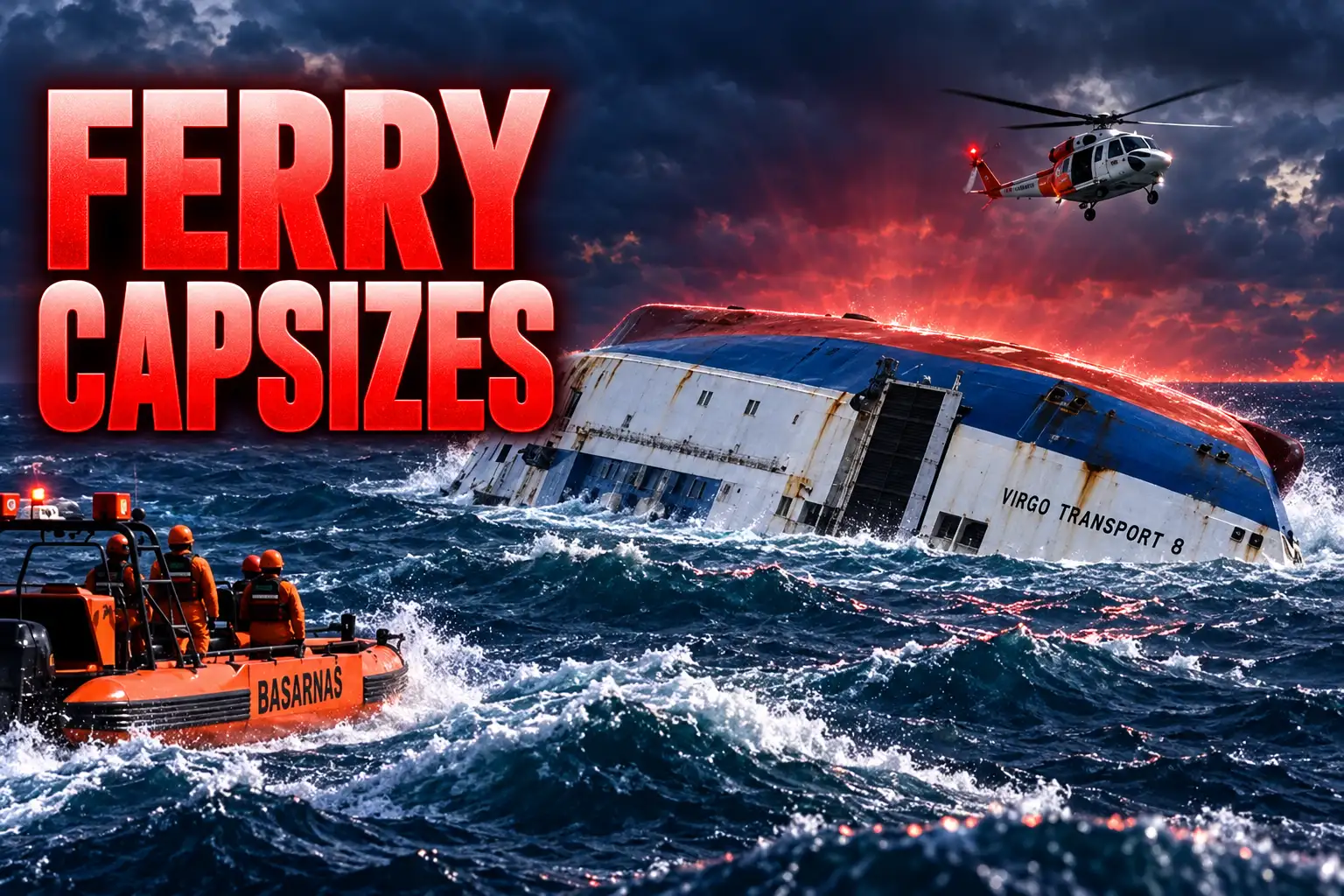
A Basarnas video from the scene shows a large red-and-black ship lying capsized and partly under, its red underside clear above the chop, with two small boats working the hull. Transport Minister Dudy Purwagandhi said a passing helicopter was the first to report that the ferry had flipped. He told a briefing the ship had not fully gone under when crews reached it.
Contact was lost about 2 a.m. on Sunday, September 13, near Masalembo, about 80 nautical miles south of Banjarmasin. PT Virgo, the operator, called in a distress report at 04:10. Sudayana said waves ran more than 8 feet and that even a 131-foot Basarnas ship was at great risk in that sea.
The Ferry Spent 38 Years in Japanese Waters
Virgo Transport 8 is not a new island hopper. Shipping registries log IMO 8625179 as a passenger Ro-Ro cargo ship built in 1987, now 39 years old, and 4,277 gross tons and 119 metres long, with a deadweight of 2,612 tonnes. The same hull is listed as a passenger car carrier built in 1987.
THE HULL ON THE REGISTER
| Measure | Virgo Transport 8 |
|---|---|
| Length | 119 metres |
| Gross tonnage | 4,277 |
| Deadweight | 2,612 tonnes |
| Year built | 1987 |
| Type | Passenger Ro-Ro cargo |
| Flag | Indonesia |
| IMO number | 8625179 |
Japanese route records put that hull on the Kokura-Matsuyama crossing as Ferry Kurushima until the end of June 2025. International files show the name change to Virgo Transport 8 that June. The ship is managed by PT Virgo Karya Shipping, and yard records put a recent stop at ASL Marine in Batam, the usual refit door for second-hand Japanese ferries entering Indonesian trades.
It began the Surabaya-Banjarmasin run in July. Captain Arief Yunianto had the bridge on this crossing. Japanese ship-watchers recognised the profile as soon as wreck photos moved, a ferry that had worked a sheltered Inland Sea route for 38 years and then drew a Java Sea overnight with trucks in the garage.
Masalembo Has Taken Ships Before
Heri Purwanto, head of the Banjarmasin port authority and harbormaster office, put the listing and the lost contact in Masalembo waters. That name is old in Indonesian wreck files. In 1981, KM Tampomas II caught fire and sank near the Masalembo Islands on a Jakarta-Makassar run, the same open Java Sea that Surabaya ships still cross because the ticket is cheaper than a flight.
Indonesia has some 17,000 islands, and ferries carry people and freight that air fares price out. A review of official accident files from 2018 to 2021 found 265 of 586 passenger-ship cases ended in sinking or capsize. The Java Sea sat in that study as a high-risk passenger-ship lane, heavy traffic meeting open water.
Setyo Nugroho, dean of marine technology at Institut Teknologi Surabaya, has said human error sits behind almost 90 percent of ship accidents in Indonesia, from weak upkeep to cargo that is never properly weighed. The KNKT, the National Transportation Safety Committee, has not issued a cause for Virgo Transport 8. The water, the age of the hull, and the cargo mix are already the pattern, even before that report.
JAVA SEA FERRY LOSSES IN THE FILE
- January 27, 1981: KM Tampomas II catches fire and sinks near the Masalembo Islands on a Jakarta-Makassar crossing.
- August 2, 2026: KMP Mutiara Sentosa 2 burns off Madura after leaving Surabaya for Makassar; five people die and 238 names are later listed.
- August 2026: A second ferry fire, on a ship travelling from Bali, kills one person.
- September 13, 2026: Virgo Transport 8 capsizes near Masalembo on the Surabaya-Banjarmasin run, with 129 still missing on Monday.
Four entries, one sea, and the same departure city on two of the last three. Surabaya keeps sending Ro-Ros into the Java Sea. The sea keeps sending some of them back as wrecks.
Two Other Ferries Burned in August
Sudayana’s Monday briefing sat on top of a month Indonesia had already spent pulling people off burning ferries. In August, two passenger ships carrying hundreds of people caught fire. Five died when a ferry burned off Madura island. One person died in a fire on a ferry travelling from Bali.
The Madura fire was KMP Mutiara Sentosa 2, Surabaya to Makassar, the same home port as Virgo Transport 8. Basarnas later put 238 people on that ship’s list, with 233 taken off alive and five dead. Families still came forward with names that were not on the paper. Manifest gaps are a known fault on these runs, which is why the 129 figure on Virgo Transport 8 may still move if relatives report people the list never carried.
Dudy said the cause of Sunday’s capsize was under investigation and that any later safety order would wait on the KNKT. August’s fires are already in that committee’s tray. September’s wreck is now in the same pile, from the same sea, five weeks after the Madura blaze.
Most People on Board Were Truck Crews
Wire copy called this a passenger ship, which is true on the certificate and thin on the list. KSOP Banjarmasin, reading the manifest, said the 243 people broke down as 30 crew, 27 ship-related workers, 59 adult passengers, one child, and 126 drivers and assistants. More than half the names were truck crews. The ship also held 89 vehicles.
WHO THE LIST ACTUALLY NAMED
- Truck crews: 126 drivers and assistants, the largest group on board.
- Paying passengers: 59 adults and one child.
- Ship’s company: 30 crew, with Arief Yunianto as captain.
- Ship workers: 27 other people tied to the vessel’s work.
- Garage load: 89 vehicles rolling Java goods toward Banjarmasin.
This is how food, marble, parts, and packaged freight still move between East Java and South Kalimantan. Drivers sleep on the overnight crossing because a ferry ticket and a truck bay cost less than flying the load. When the garage deck is packed, a Ro-Ro’s stability lives or dies on how those trucks are lashed and how a beam sea hits the side.
At Tanjung Perak in Surabaya, relatives of crew waited on names. Fredy said his youngest sibling, Stevie Manuhua, worked on board as a keyboard player, hired to keep passengers awake on a long Java Sea night. In Banjarmasin, a woman who gave her name as Putri said she had been on the phone to her husband Herman when the signal died. “Then after that there was no more contact, we couldn’t reach him,” she said.
Rescuers Are Still Sweeping Open Water
Most of the people pulled out of the water on Sunday came off passing ships, not the first government cutter. The merchant ship MV Haida brought 69 people into Trisakti Port in Banjarmasin on Sunday evening for medical checks. A tanker and a fishing boat also picked up survivors. Navy ships and aircraft later joined Basarnas, the water police, and local boats around the last known position.
Rinto Arahab, a passenger taken to a rescue centre in Banjarmasin, said he held the railings after the ship flipped, then climbed to a higher point as the wreck rolled in the sea. Many people were asleep when the list started around 2 a.m. Survivors later said they heard no danger alarm and that plenty of people had no life jackets on.
I felt resigned. I could only pray for my safety.
Rinto Arahab, passenger, in Banjarmasin
He also described the scramble inside. “People were panicking. Some climbed onto tables, some were pushing each other,” Arahab said. The upturned hull was still afloat on Sunday, which left a narrow hope that some of the 129 were in air pockets. Sudayana would not say whether people were still inside the ferry or had drifted farther off. Purwanto’s office set up an emergency post at Trisakti to sit families next to KSOP, Basarnas, Pelindo, and the navigation district until the names resolve.
What Investigators Have Said So Far
Edy Prakoso, a Basarnas operations official, said the ship leaned hard after strong waves hit the starboard side. Mohammad Syafii, the Basarnas chief, said the master’s account was a large wave on that same side and a rapid capsize. Those are first statements, not a finished KNKT file. Purwanto said whether the cause was weather, a technical fault, or a human error, and what it did to the cargo, was still being checked.
WHAT WE KNOW
- The turn: The ferry listed about 2 a.m. on Sunday near Masalembo and was found capsized, red underside up.
- The count: 243 people and 89 vehicles were on the paper; 108 are alive, six are dead, 129 are missing.
- The hull: A 39-year-old Japanese Ro-Ro, 119 metres, 4,277 gross tons, on a run it began in July.
WHAT IS UNCONFIRMED
- The cause: A starboard wave is the master’s story; KNKT has not ruled on stability, lashing, or weather warnings.
- The hull: Air pockets inside the wreck have not been proven, and no official has said trapped people were found.
- The list: Ferry counts in these waters often move once families report names the manifest never carried.
On Monday the death toll was still six, 622 people were still searching, and 129 names still had no answer from a 39-year-old ferry lying upside down in the Java Sea.

Ford Cuts 2027 F-150 Raptor Prices by Stripping Gear

Samsung’s Home Up Patch Catches the Fold 8 Icon Drift

X Sells Cashtag Trade Traffic to Five U.S. Brokers

Pete Alonso’s 300th Homer Turns Citi Field on the Mets

Staffline Temps Keep the Pilgrim’s Enniskillen Line Moving

The Orchard Bug Forced Zcash to Open an Empty Pool

The $5.99 Game That Won Steam’s 2026 Summer Sale

Don Lee Joins Hemsworth as Extraction 3 Starts Shooting

YouTube Shorts Retires Dislikes and Swaps Likes for Hearts

NEURA Robotics Is Spending Its $1.4B on a Machine Stack
-
 NEWS4 months ago
The Orchard Bug Forced Zcash to Open an Empty Pool
-
 GAMING4 months ago
The $5.99 Game That Won Steam’s 2026 Summer Sale
-
 ENTERTAINMENT6 months ago
Don Lee Joins Hemsworth as Extraction 3 Starts Shooting
-
 NEWS4 months ago
YouTube Shorts Retires Dislikes and Swaps Likes for Hearts
-
 NEWS4 months ago
NEURA Robotics Is Spending Its $1.4B on a Machine Stack
-
 AUTO6 months ago
Kawasaki Bets the New Z1100 Against Its Own Supercharger
-

 BUSINESS5 months ago
Norway’s Export Bank Backs Nscale’s $790 Million Narvik Loan
-
 GAMING4 months ago
Game of Thrones Dragonfire Follows Boston’s Conquest Playbook