
AUTO
Toyota’s Electric C-HR Leaves the Cheap Twin to Subaru
Toyota’s 2026 C-HR returns as a 338-hp AWD EV priced above the front-drive bZ, while Subaru keeps the cheaper long-range twin.

Toyota prices the 2026 C-HR at $37,000, $2,100 above its own front-drive bZ, and sells the revived name only with all-wheel drive.
The SE starts at $37,000 before destination, and the XSE lists at $39,000. Subaru already builds the cheaper front-drive twin Toyota will not badge as a C-HR, and the $7,500 federal credit had already expired when the first cars reached U.S. lots in March 2026.
The C-HR Name Survived a Five-Year Gap
This C-HR shares a name with a car Americans stopped buying, and almost nothing else. The old one was a front-drive, 144-horsepower crossover with a CVT, first shown as a concept at the 2014 Paris Auto Show and meant for Scion. By the time it reached North America in early 2017, Scion was gone, so it wore a Toyota badge from day one.
U.S. sales peaked at 49,642 in 2018, then slid to 35,707 in 2021. After the 2022 model year, Toyota ended sales in the United States and Canada and pointed compact-SUV buyers to the Corolla Cross and the RAV4. The second-generation C-HR went to Europe. North America got a compact battery-electric concept in 2022 instead, and that study is the car now in showrooms.
HOW THE C-HR LEFT AND CAME BACK
- 2014: Toyota shows the C-HR concept in Paris, still aimed at Scion.
- Early 2017: The production crossover goes on sale in North America as a Toyota after Scion is shut down.
- 2018: U.S. sales peak at 49,642, the high-water mark of the nameplate here.
- 2022: Toyota ends U.S. and Canadian sales; Europe keeps a new generation, and Toyota shows a compact BEV concept.
- Feb. 18, 2026: Toyota prices the electric C-HR from $37,000, excluding destination, and promises March dealer arrivals.
- March 2026: The dual-motor C-HR reaches U.S. Toyota stores as the company’s third battery-electric model.
On paper the new car is more than twice the old one. Dual motors, one in each eAxle, make 338 horsepower, with 198 lb-ft of torque up front and 125 lb-ft at the rear, and Toyota quotes 0 to 60 mph in 4.9 seconds. Every U.S. C-HR is all-wheel drive. There is no front-drive grade, no small battery, and no gas or hybrid path back to the name people remember.
Developed from a compact BEV concept Toyota first presented in 2022, the new C-HR BEV is among the 21 electrified models in the U.S. Toyota lineup, and third BEV available in the U.S.
Toyota USA Newsroom, Feb. 18, 2026
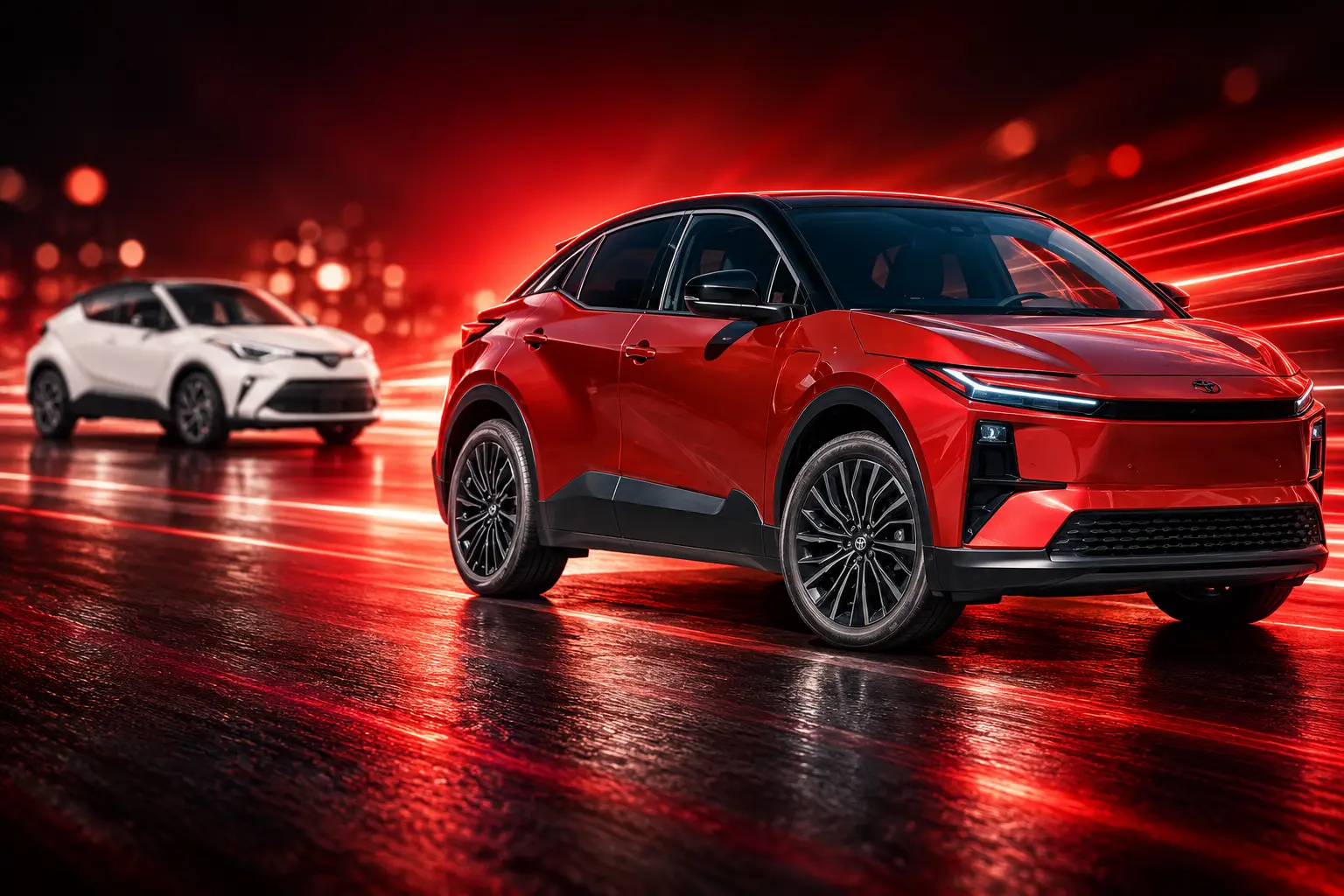
It rides the e-TNGA skate Toyota also uses for the bZ and the bZ Woodland, and that Subaru uses for the Uncharted. Length is 177.9 inches, width 73.6 inches, height 63.8 inches, wheelbase 108.3 inches. The battery is a 74.7-kWh lithium-ion pack under the floor. Launch coverage keeps treating this as a bZ sibling in a sharper suit, which is the honest read: the C-HR name is marketing, not mechanical continuity.
What the 2026 C-HR Costs Against the bZ
The SE lists at $37,000 and the XSE at $39,000, both before a $1,450 destination charge. The front-drive bZ XLE starts at $34,900 with 236 miles, the $2,100 gap. An AWD bZ XLE is $39,900 for 288 miles, so the C-HR is the cheaper 338-horsepower AWD Toyota.
That split is the whole showroom problem. The cheapest bZ uses a 57.7-kWh pack, one motor, and a 236-mile rating, so it is a different, slower car. Match the 74.7-kWh battery and the front-drive bZ XLE Plus is $37,900 with 221 horsepower and 314 miles. You pay $900 more than a C-HR SE, lose all-wheel drive, and gain 27 miles of sticker range. The AWD bZ at $39,900 makes 338 horsepower and is rated at 288 miles, which is one mile more than the C-HR SE and $2,900 more money.
PRICE AND RANGE IN TOYOTA AND SUBARU SHOWROOMS
| Model | MSRP | Drive | Power | EPA range |
|---|---|---|---|---|
| C-HR SE | $37,000 | AWD | 338 hp | 287 miles |
| C-HR XSE | $39,000 | AWD | 338 hp | 273 miles |
| bZ XLE FWD | $34,900 | FWD | 1 motor | 236 miles |
| bZ XLE FWD Plus | $37,900 | FWD | 221 hp | 314 miles |
| bZ XLE AWD | $39,900 | AWD | 338 hp | 288 miles |
| Uncharted Premium FWD | $34,995 | FWD | 221 hp | 308 miles |
| Uncharted Sport | $39,795 | AWD | 338 hp | 287 miles |
MSRP figures exclude destination. The tested XSE, in Tandoori with a Midnight Black Metallic roof, stickered at $43,429 once options stacked on. Two trims is the entire C-HR menu. The SE already has the 14-inch screen, heated front seats, a heated steering wheel, a power liftgate, and Toyota Safety Sense 3.0. Paying $2,000 more for the XSE buys 20-inch gunmetal wheels that cut the EPA rating from 287 miles to 273 miles, with no extra horsepower in return.
Subaru Sells the Front-Drive Twin
Subaru priced the mechanical twin on Dec. 9, 2025, and the entry car is the one Toyota will not build. The Uncharted Premium FWD starts at $34,995, makes 221 horsepower, and is rated at 308 miles of EPA range on front-wheel drive. Subaru said that grade would be offered in limited numbers. It is also one of the few Subarus that does not send power to the rear axle.
Step up to the Uncharted Sport and the hardware matches the C-HR SE: two motors, 338 horsepower, 287 miles, 18-inch wheels. Subaru wants $39,795 for that car, $2,795 more than Toyota’s SE. The Uncharted GT, on 20-inch wheels, is $43,795 and 273 miles, the same range hit the C-HR XSE takes. Ground clearance is a hair higher on the Subaru, 8.2 inches versus 8.0 inches on the Toyota, which is a brochure line, not a trail rating.
Toyota’s choice is the tell. It already makes a 221-horsepower, 300-mile-class front-drive compact on this platform, because Subaru sells it. Putting that grade in a C-HR body would have undercut the bZ XLE Plus and given Toyota a $35,000 electric hatch with more range than the AWD C-HR. Instead the C-HR is AWD or nothing, so the long-range cheap seat in this architecture sits at a Subaru store. Chevrolet’s Bolt, from $27,600 to $31,600, and Nissan’s Leaf, from $29,990 to $38,990, still undercut both badges if the shopper will take front-wheel drive and a different cabin.
A 4.9-Second Sprint, Then 243 Real Miles
Toyota’s 4.9-second claim is the number you feel first. Instant torque off the line is the usual electric shove, and on an interstate it is enough to clear a truck without drama. The SE rides on 18-inch black alloys; the XSE uses 20-inch gunmetal multi-spoke wheels, which is why the EPA rating drops 14 miles. Paddle shifters on the wheel cycle through four levels of regen, so you can lean on one-pedal slowing or let it coast.
A week of mixed highway and mountain driving in Southwestern Virginia, including a round trip to the Amtrak station in Roanoke on I-81 and I-581 plus a 60-mile loop to Draper Mountain Overlook, put 3.7 miles on each kilowatt-hour. That works out to 125 MPGe, ahead of the XSE’s EPA combined figure of 112 MPGe (122 city, 102 highway). Range on that car settled around 243 miles, about 30 miles short of the 273-mile window sticker, and it moved with ambient temperature and air-conditioning use. The SE is the efficiency play, with 117 combined MPGe on 18-inch wheels (127 city, 107 highway) and the 287-mile rating.
THE VIRGINIA TEST VERSUS THE WINDOW STICKER
- Observed use: 3.7 miles per kilowatt-hour, or 125 MPGe, on mixed highway and mountain roads.
- XSE sticker: 112 MPGe combined and 273 miles of EPA range.
- Working range: about 243 miles, 30 miles under the XSE rating, once heat and cooling entered the day.
- Sprint: 0 to 60 mph in 4.9 seconds, Toyota’s figure, with 338 horsepower on tap in both trims.
DC fast charging is quoted at around 30 minutes from 10% to 80% in ideal conditions, through a native NACS port that opens Tesla Superchargers and, with the included NACS-to-CCS adapter, other public cabinets. A CHAdeMO adapter lives with the cable in a cubby under the cargo floor. An 11-kW onboard charger handles home and workplace Level 2. Battery warmup for a fast-charge stop can run from the screen or kick in when navigation is set to a DC station, if the Drive Connect trial or subscription is active. Silence on a mountain descent is the part of the week that sold the powertrain; range still moved around with the weather, which is the open complaint on a 273-mile XSE.
The Hood Still Hides Orange Cables
Lift the hood and there is no frunk. Orange cables and the electric hardware sit where an engine would, the same packaging Toyota has used on its small Lexus battery cars. Most rivals tuck a cable bag or a small bin up front. The C-HR treats the nose like a hybrid bay that happens to have no engine in it.
Inside, the 14-inch Toyota Audio Multimedia touchscreen does almost all of the work, with two climate dials, a volume knob, and a few long buttons for the defrosters. The 7-inch digital cluster sits in a Prius-style hood, so you get a high display without a head-up unit. Wireless Apple CarPlay and Android Auto, two Qi pads, four USB-C ports, Bluetooth, and a six-speaker stereo are standard. Dual-zone climate and heated front seats are standard too. Front legroom is 42.1 inches; the rear bench is a tight 32.2 inches for three. Cargo is 25.3 cubic feet behind the 60/40 seatbacks and 59.5 cubic feet with them folded, plus a privacy cover.
WHAT THE XSE ADDS OVER THE SE
- Wheels and range: 20-inch gunmetal wheels replace the SE’s 18-inch alloys and cut EPA range from 287 miles to 273 miles.
- Seats: SofTex and synthetic suede, an 8-way power passenger seat, and driver memory; the SE is fabric/SofTex with a manual passenger seat.
- Cameras and assist: Panoramic View Monitor, Traffic Jam Assist, and Lane Change Assist join the standard Safety Sense 3.0 suite.
- Audio and roof: A nine-speaker JBL system with an 8-channel 800-watt amp and a 9-inch subwoofer, plus an available fixed-glass panoramic roof.
The SE already has rain-sensing wipers, low-profile roof rails, a power back door, and parking assist with automatic braking. If the job is errands and a 4.9-second merge, the extra $2,000 on the XSE is mostly dress and cameras, paid for in miles. Plug & Charge, Remote Connect climate and charge controls, and a digital key all ride on trial subscriptions that later convert to paid plans, which is the modern Toyota fine print, not a C-HR quirk.
No Federal Credit on a Japan-Built EV
The C-HR went on sale in March 2026. The IRS says the New Clean Vehicle Credit is not available after Sept. 30, 2025 for vehicles acquired after that date. A buyer who signs this year is shopping a Japan-built EV at full MSRP, with no $7,500 federal offset. Some California dealers were still advertising a state instant rebate on the C-HR, the bZ, and the bZ Woodland in early October 2026, which is a local patch, not a substitute for the old 30D credit.
That timing is baked into the price fight above. A $37,000 AWD C-HR would have looked different with a $7,500 hole in the invoice. Without it, the car has to win on the 338-horsepower dual-motor package, the 287-mile SE rating, and the simple fact that Toyota’s own AWD bZ costs more. The front-drive shopper who wants 308 miles for $34,995 is still walking to Subaru, because Toyota reused a dead badge and then declined to sell the cheap twin it already makes.
Frequently Asked Questions
Does the 2026 Toyota C-HR Qualify for a Federal EV Tax Credit?
No. The IRS closed the New Clean Vehicle Credit to vehicles acquired after Sept. 30, 2025, and this C-HR arrived at U.S. dealers in March 2026. Under the old 30D rules, final assembly also had to take place in North America, and this car is built in Japan, so it would have failed that test even if the credit had still been open. Income caps were $300,000 for joint filers, $225,000 for heads of household, and $150,000 for other filers, and the SUV MSRP cap was $80,000, which this C-HR would have cleared on price alone.
How Long Does the 2026 C-HR Take to Charge at Home?
The EPA lists an 8.0-hour charge at 240 volts for both the SE and the XSE. Toyota includes an 11-kW onboard charger and a dual-voltage 120-volt/240-volt cable, so a 240-volt wall box is the home setup the rating assumes, not a public fast charger. Level 1 on a household outlet is an overnight-plus proposition and is the backup cord, not the daily plan.
What Does the 2026 Toyota C-HR Weigh?
Curb weight is 4,322 pounds on the SE and 4,366 pounds on the XSE. The 44-pound gap tracks the 20-inch wheels and the extra seat motors and cameras on the XSE. The turning circle is 36.0 feet on both grades, which is tight for a 177.9-inch crossover and part of why the car still works in a parking garage the old C-HR was built for.
Where Is the 2026 Toyota C-HR Built?
Final assembly is in Japan, the same country Subaru lists for the Uncharted. That shared plant geography is why neither compact was a candidate for U.S.-assembly loan breaks that require a United States plant, and why the old North America assembly test under 30D would have locked both of them out of the federal credit even before Congress ended it.
What Warranty Covers the 2026 C-HR Battery?
Toyota covers Electric Vehicle Driving Components, including the traction battery, for 8 years or 100,000 miles, whichever comes first. Listings also carry a 3-year/36,000-mile basic vehicle warranty. Complementary maintenance is quoted for two years or 25,000 miles on some window stickers, which is a service plan, not a battery guarantee.

UPI MDR Delay Hands Traders the Calendar After Paytm Falls

Google Messages Builds Nine In-Chat Games After Samsung’s Exit

Anthropic’s $100 Million Academy Trains the Firms That Bill Both Sides

Toyota’s Electric C-HR Leaves the Cheap Twin to Subaru

Markets Bet the Fed Skips October After Hawkish Minutes

The Orchard Bug Forced Zcash to Open an Empty Pool

The $5.99 Game That Won Steam’s 2026 Summer Sale

Don Lee Joins Hemsworth as Extraction 3 Starts Shooting

YouTube Shorts Retires Dislikes and Swaps Likes for Hearts

NEURA Robotics Is Spending Its $1.4B on a Machine Stack
-
 NEWS4 months ago
The Orchard Bug Forced Zcash to Open an Empty Pool
-
 GAMING4 months ago
The $5.99 Game That Won Steam’s 2026 Summer Sale
-
 ENTERTAINMENT6 months ago
Don Lee Joins Hemsworth as Extraction 3 Starts Shooting
-
 NEWS4 months ago
YouTube Shorts Retires Dislikes and Swaps Likes for Hearts
-
 NEWS4 months ago
NEURA Robotics Is Spending Its $1.4B on a Machine Stack
-
 AUTO6 months ago
Kawasaki Bets the New Z1100 Against Its Own Supercharger
-

 BUSINESS5 months ago
Norway’s Export Bank Backs Nscale’s $790 Million Narvik Loan
-

 GAMING4 months ago
Game of Thrones Dragonfire Follows Boston’s Conquest Playbook