
NEWS
Huawei Aims the Mate XT 2 at Gulf and Asia Buyers
Richard Yu will take the Mate XT 2 overseas first for Middle East and Asia Pacific buyers, with Europe still only a hope.

Huawei will sell the Mate XT 2 Ultimate Design outside China, and Richard Yu has already named the first customers. They live in the Middle East and Asia Pacific, not in the United States.
Europe is a hope he voiced in Shenzhen on September 29, 2026, with no date, no price, and no carrier on the table.
Richard Yu Named the Buyers First
Yu is executive director of Huawei and chairman of its consumer business. He sat with international reporters in Shenzhen on September 29, and the company posted a written summary of that session on October 5. The line that decides who this phone is for is short.
We’ll gradually make this tri-fold phone available in the overseas market. Many users in the Middle East and Asia Pacific love it. I also hope that we can bring it to other markets like Europe.
Richard Yu, chairman of Huawei’s Consumer BG, September 29 roundtable
— Huawei (@Huawei) October 5, 2026
He did not read out a country list or a ship week. He named a taste. Buyers in the Middle East and Asia Pacific already like the tri-fold, and Europe is something he hopes to reach. The full roundtable remarks from Richard Yu also put a hard ceiling on how large that overseas phone business is today.
Huawei once held the world’s top smartphone share. Yu said it now sells only several million phones a year outside China. Wearables are a separate case; he said Huawei is number one in China and globally in that category. The Mate XT 2 is a halo device that starts at 19,999 yuan ($2,980) at home, so the first overseas lots will be prestige stock, not a volume dump.
He added that Huawei is considering bringing HarmonyOS to the global market slowly, step by step. That software choice will do more to filter buyers than any press-line about a “global” tri-fold.
The 2025 Overseas Map Already Exists
This route has been driven before. The original Mate XT, the first mass-market tri-fold, left China on February 18, 2025, at €3,499 for 16 GB of memory and 1 TB of storage. Huawei printed the price in euros. The live shops were not in Berlin or London.
WHERE THE FIRST MATE XT ACTUALLY WENT
- Malaysia: The international unveil was staged in Kuala Lumpur.
- Indonesia: Confirmed in the first overseas batch with the euro price.
- Philippines: Same first-wave list as the other ASEAN shops.
- United Arab Emirates: On sale with Saudi Arabia in the Gulf.
- Saudi Arabia: Paired with the UAE as the early Middle East pair.
- Mexico: The only Americas shop named in that 2025 wave.
Huawei’s UK office said then that the phone was not coming to the UK or the United States for the time being. IDC put Huawei’s smartphone share outside China at 0.3% in 2024. The first Mate XT overseas product page still shows that older Z-fold design for the markets that did get it.
Yu’s new comments retrace that map rather than open a new one. Gulf states and parts of Asia Pacific already sell Huawei phones to people who do not expect Google apps in the box. Those accounts are the order book that matters. A European carrier listing would be a different fight over radio bands, repair shops, and software.
What the Mate XT 2 Ships With in China
China has had the phone since September 12, when sales opened at 10:08 a.m. after a September 7 launch in Guangzhou. The hardware that will travel, if it travels, is this China spec, and it is not a refresh of the accordion fold that made the first Mate XT famous.
Screens, Weight, and the Privacy Surcharge
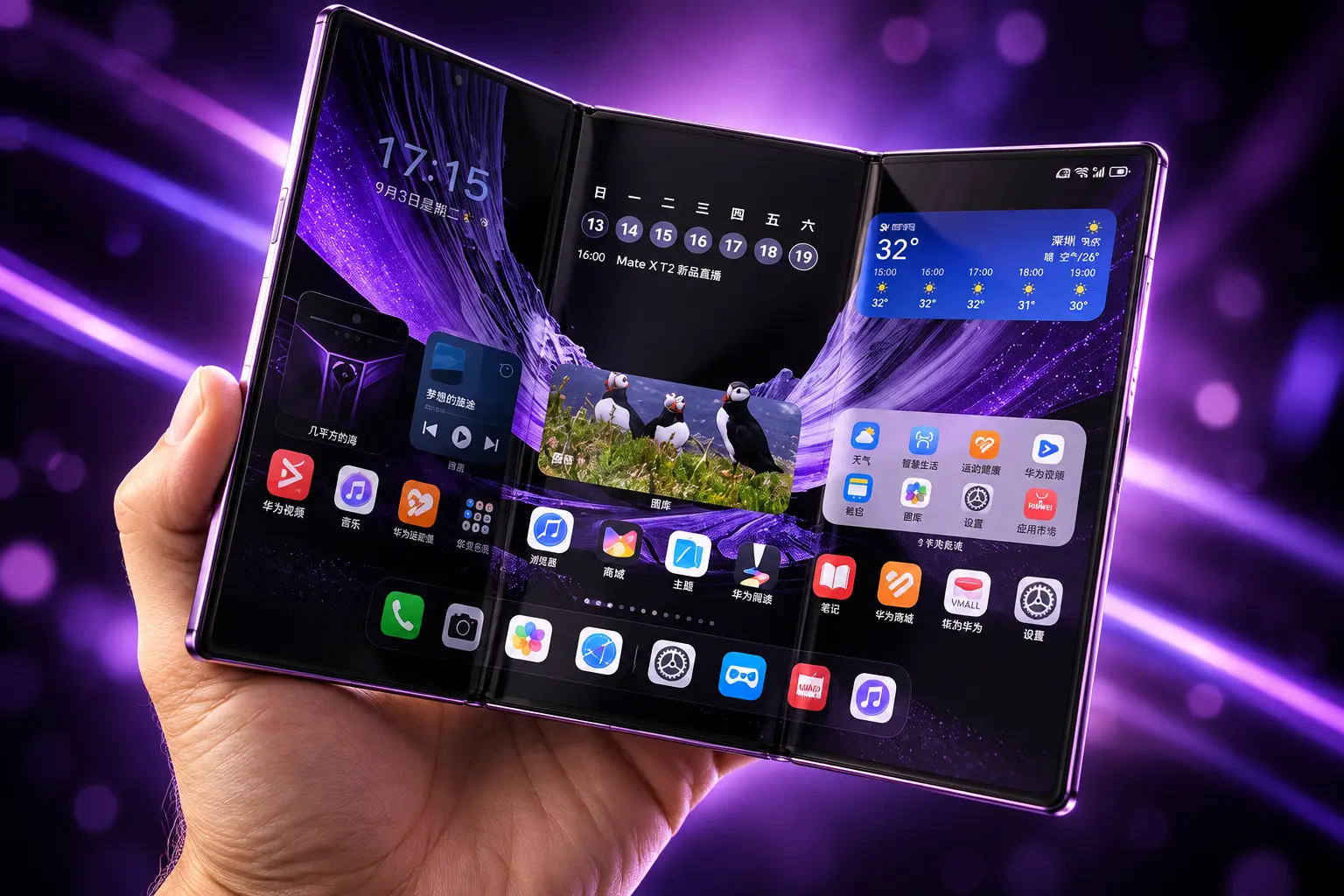
Both side wings now fold inward over the center, the same basic layout Samsung used on the Galaxy Z TriFold, so the large inner panel tucks away when the phone is closed. Huawei calls the mechanism a second-generation Tian Gong hinge with a linkage and no gears. The inward fold protects the screen. It also drops the half-open 7.9-inch middle mode that the first Mate XT used as a third layout.
Huawei’s 10.2-inch inner display and Kirin 9050 Pro sheet lists a 6.5-inch cover panel at 2442 × 1140 with a 1-120 Hz LTPO range. The inner panel is 2232 × 3184, a 3K sheet. On the standard models that inner sheet tops out at 90 Hz. The Lingdun privacy versions, which dim the side view with a dual-pixel stack, run 1-120 Hz on the inner panel as well.
The phone weighs about 299 g, or about 304 g with the outer screen film. Folded it is 157.2 mm tall, 77 mm wide, and 12.3 mm thick. Open it spans 219.2 mm, with the thinnest stretch of the body at 3.5 mm. Dust and water ratings are IP58 and IP59. Colors on the China sheet are Brocade Purple, Bright White, and Mysterious Black. Every model ships with 16 GB of RAM.
CHINA STORAGE AND PRICE
| Configuration | Price (yuan) | Inner screen |
|---|---|---|
| 16 GB + 256 GB | 19,999 | Standard, 1-90 Hz |
| 16 GB + 512 GB | 21,999 | Standard, 1-90 Hz |
| 16 GB + 1 TB | 23,999 | Standard, 1-90 Hz |
| 16 GB + 1 TB Lingdun | 24,999 | Privacy, 1-120 Hz |
| 16 GB + 2 TB Lingdun, stylus set | 29,999 | Privacy, 1-120 Hz |
The 2 TB stylus bundle is the 29,999 yuan ($4,470) collector set, listed in Brocade Purple. Rear cameras are a 50 MP main on a 1/1.28-inch sensor with a variable f/1.49-f/4.0 aperture, a 40 MP ultrawide, a 50 MP 3.5x periscope, and a third-generation Red Maple color sensor. Both faces carry 8 MP ultrawide cameras.
The Chip China Had to Stack
Inside is the Kirin 9050 Pro, the first phone chip Huawei has put into mass sale with its LogicFolding layout, which stacks logic layers instead of relying only on a finer process node. The product page says overall device performance is 42% higher than the previous Mate XT generation. The battery is 5,600 mAh typical and 5,450 mAh rated, with 66 W wired charging and 50 W wireless charging. China units run HarmonyOS 7.0. Yu told reporters that more phones will use LogicFolding chips, while also saying advanced semiconductor capacity in China still cannot meet demand.
HarmonyOS 7 Leaves Google on the Outside
The China phone is not an Android product in the sense Western carriers mean. There is no Play Store in the box, no Android Auto, and no Wear OS hook. AppGallery is the store, and it is built for HarmonyOS software. Banking, maps, and ride-hailing apps that a European buyer treats as basic often have no native build.
WHAT CHINA UNITS DO NOT INCLUDE
- Google apps: Gmail, Maps, YouTube, and the Play Store are not preinstalled and are not supported as system services.
- Android Auto: Car links that depend on Google’s stack are out.
- Wear OS watches: Huawei’s own watches pair; a Pixel Watch does not.
- A published EMUI SKU: The first overseas Mate XT ran EMUI 14.2 on Huawei’s global site; no such build has been announced for the XT 2.
Yu said more than 90 million phones, PCs, and tablets already run HarmonyOS 6 and HarmonyOS 7, with 100 million expected by the end of 2026. He put the HarmonyOS app and service count above 450,000, with 11 million registered developers and more than 23,000 app partners. That installed base is concentrated where Huawei never lost daily use, which is why the Middle East and Asia-Pacific users he named are not a footnote. They are the people who can open the box and keep working.
If overseas XT 2 units ship with HarmonyOS 7, the software wall travels with the hinge. If they ship an EMUI build like the first Mate XT, the overseas phone is a different product than the one selling in China. Yu has not said which way that decision will go.
Europe Still Has No Official Tri-Fold
Samsung put the Galaxy Z TriFold on sale in South Korea on December 12, 2025, then in the United States on January 30, 2026, at $2,899. It also named China, Taiwan, Singapore, and the UAE. It did not put that phone on official European shop shelves, and the limited run sold out. Samsung’s tri-fold weighs 309 g. Huawei’s is about 299 g. Both unfold to a tablet-sized inner sheet. Both skipped a normal European retail launch.
The overlap that does exist is in the Gulf. The UAE sat on Samsung’s short list and on Huawei’s 2025 Mate XT list. That is the prestige circuit Yu is talking about when he says users in the Middle East love the tri-fold. The United States is closed to Huawei phones under the 2019 restrictions, which is why Samsung could take that slot and Huawei cannot. Europe is the shelf both companies left empty.
WHAT WE KNOW
- The commitment: Yu said Huawei will gradually make the tri-fold available overseas.
- Named demand: He pointed to users in the Middle East and Asia Pacific.
- The US wall: Official Huawei phone sales have been shut out of the United States since 2019.
- China stock: Retail sale has been live since September 12, 2026.
WHAT IS UNCONFIRMED
- Europe: No country, carrier, or week has been named.
- Price: No international yuan, euro, or dollar list exists for the XT 2.
- Software: No word on HarmonyOS 7 versus an EMUI overseas build.
- Radio: No market-by-market 5G band sheet for export units.
A European listing would also need a repair plan for a 10.2-inch inner panel and a hinge Huawei itself wraps in extra screen-swap terms at home. None of those pieces has been posted.
Nearly 100,000 Units and No Overseas Date
Yu used the roundtable to put China volume on the record. The first generation and its optimized model exceeded 1 million units. The XT 2, which went on sale in September, had already shipped nearly 100,000 units by late September, and he estimated this model would exceed 1 million as well. He said Huawei holds 75% of China’s foldable phone market.
THE TRIFOLD CALENDAR
- September 7, 2026: Huawei unveils the Mate XT 2 Ultimate Design in Guangzhou with HarmonyOS 7 and the Kirin 9050 Pro.
- September 12, 2026: China retail sale opens at 10:08 a.m., from 19,999 yuan.
- September 29, 2026: Yu tells international reporters the phone will go overseas gradually, naming Middle East and Asia Pacific users, and that nearly 100,000 units have already shipped.
- October 5, 2026: Huawei posts the roundtable summary on its official X account.
- February 18, 2025: The first Mate XT goes overseas at €3,499, into Malaysia, Indonesia, the Philippines, the UAE, Saudi Arabia, and Mexico.
Chip supply is still tight, and Yu said the jump in memory prices over the past two years has limited smartphone volume. He also said Huawei hopes Chinese semiconductor capacity will ramp so the company can build more advanced products for consumers in China and overseas. That is the closest thing he offered to a timetable, and it is not a date.
Until a country list and a software build land, the Mate XT 2’s overseas life is the one Yu already described: a slow release aimed at people who already like the phone, in the Middle East and Asia Pacific, while Europe waits on a hope and the United States stays outside the shops.

UPI MDR Delay Hands Traders the Calendar After Paytm Falls

Google Messages Builds Nine In-Chat Games After Samsung’s Exit

Anthropic’s $100 Million Academy Trains the Firms That Bill Both Sides

iPhone Air 2 Tries to Fix Thinness by Going Thinner

Toyota’s Electric C-HR Leaves the Cheap Twin to Subaru

The Orchard Bug Forced Zcash to Open an Empty Pool

The $5.99 Game That Won Steam’s 2026 Summer Sale

Atlantic City Turned WWE’s Return Into a Civic Night

Don Lee Joins Hemsworth as Extraction 3 Starts Shooting

YouTube Shorts Retires Dislikes and Swaps Likes for Hearts
-
 NEWS6 months ago
The Orchard Bug Forced Zcash to Open an Empty Pool
-
 GAMING6 months ago
The $5.99 Game That Won Steam’s 2026 Summer Sale
-
 NEWS6 months ago
Atlantic City Turned WWE’s Return Into a Civic Night
-
 ENTERTAINMENT7 months ago
Don Lee Joins Hemsworth as Extraction 3 Starts Shooting
-
 NEWS5 months ago
YouTube Shorts Retires Dislikes and Swaps Likes for Hearts
-
 NEWS5 months ago
NEURA Robotics Is Spending Its $1.4B on a Machine Stack
-

 BUSINESS6 months ago
Norway’s Export Bank Backs Nscale’s $790 Million Narvik Loan
-

 GAMING6 months ago
Game of Thrones Dragonfire Follows Boston’s Conquest Playbook