
BUSINESS
Norway’s Export Bank Backs Nscale’s $790 Million Narvik Loan
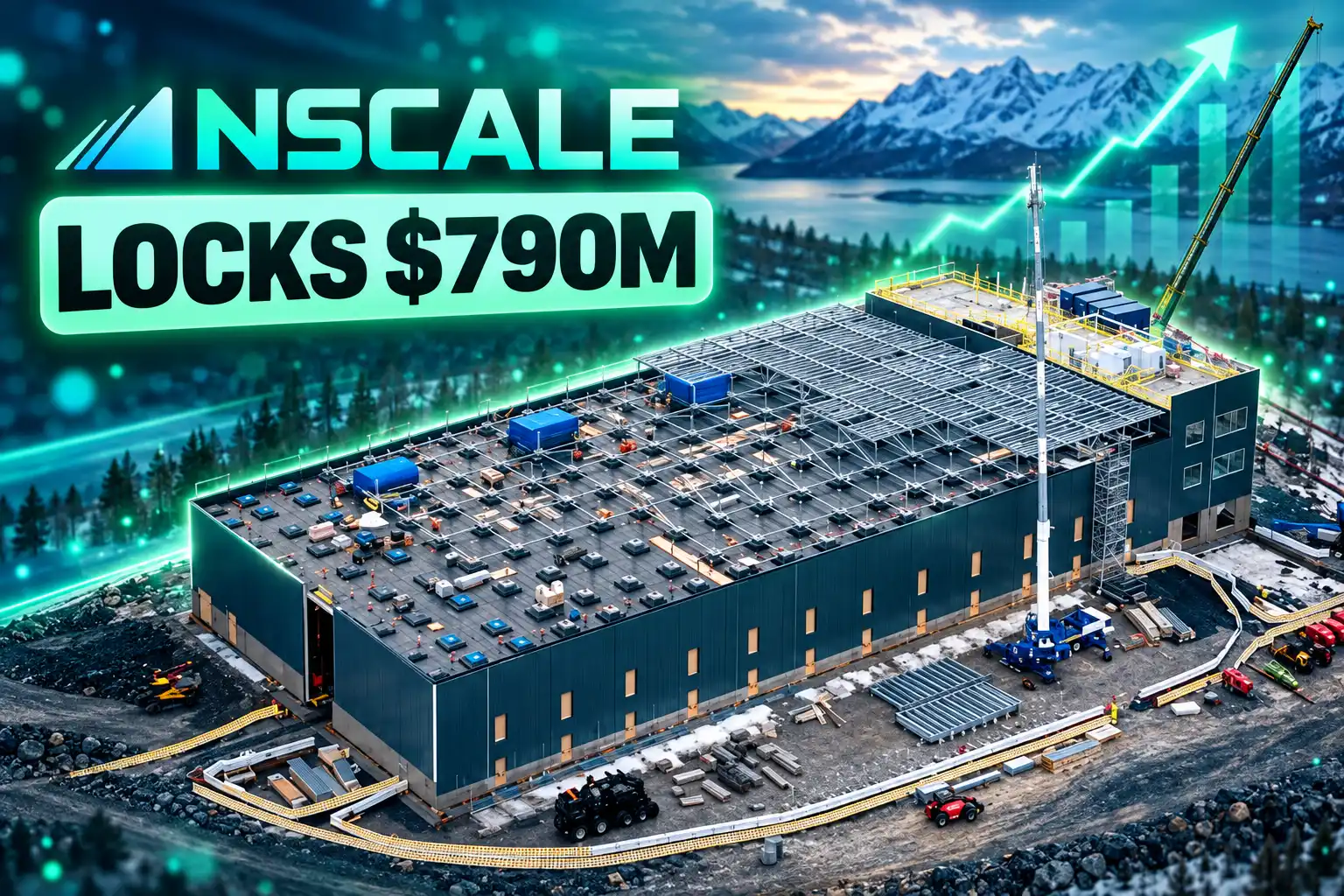
Nscale’s $790 million Narvik facility has Eksfin in for $241.7 million, booking Microsoft GPU hours as Norwegian export after Aker rolled the joint venture.

Nscale locked in $790 million of committed bank money on 11 May 2026 for the AI data center it is building outside Narvik, Norway. ABN AMRO, DNB, Eksfin, Nordea and SEB wrote the facility, and the same papers carry an uncommitted extra $790 million if the company adds 115 MW at the site.
The London company called the campus the largest AI infrastructure investment in Norway. The overlooked underwriter is the Norwegian state. Export Finance Norway is in for $241.7 million because Microsoft will pay in dollars for capacity used outside the country.
Five Lenders and the $790 Million Narvik Facility
Nscale announced additional $790 million in financing from the five-house group, with ABN AMRO Bank N.V., DNB Bank ASA and Nordea Bank Abp, filial i Norge as bookrunners. Eksfin, formally Eksportfinansiering Norge, and Skandinaviska Enskilda Banken AB joined as mandated lead arrangers. ABN AMRO is Dutch. The others are Nordic. The money is debt, not a new equity round.
The facility sits on top of a $1.4 billion delayed-draw term loan from February 2026 and a $2 billion Series C closed on 9 March 2026. Add the three committed cheques and the stack since February is $4.19 billion, before anyone draws the accordion. Nscale did not publish tenor, margin or covenants.
THE CAPITAL STACK BEHIND NARVIK
| Date | Instrument | Amount | Who put it up |
|---|---|---|---|
| February 2026 | Delayed-draw term loan | $1.4 billion | Lenders on the earlier facility |
| 9 March 2026 | Series C equity | $2 billion | Aker ASA and 8090 Industries, with others |
| 11 May 2026 | Committed bank financing | $790 million (about 7.3 billion kroner) | ABN AMRO, DNB, Eksfin, Nordea, SEB |
| Uncommitted option | Accordion tied to 115 MW | $790 million | Same lender group, if they agree to fund it |
Josh Payne, Nscale’s founder and chief executive, said the May package and the earlier raises “position Nscale at the forefront of global AI infrastructure, delivering scalable, high-performance capacity to meet rapidly growing demand for our services.” The sentence does not name the state. The state is in the syndicate anyway.
What Eksfin’s $241.7 Million Buys
Trade minister Cecilie Myrseth told the Storting on 19 May 2026 that Eksfin’s slice is $241.7 million, about 2.2 billion kroner, inside the $790 million total rather than on top of it. That is 30.6 percent of the committed facility. Sofie Marhaug, energy spokesperson for Rødt, had asked why a London company with Microsoft as customer needed a state export loan at all.
Myrseth’s follow-up answer on 3 June 2026 said Eksfin’s board treated the case on 21 April, twenty days before Nscale’s press release. Ownership nationality is not the test, she wrote. Export from Norway is. Since 2017, after the white paper on greener and smarter industry, Eksfin has been allowed to finance domestic projects if at least 50 percent of the resulting turnover is export-related, on market terms, with private banks sharing the risk.
The Board Sat After the Roll-Up
Marhaug’s question pointed at the calendar. Aker Nscale was set up in July 2025 as a 50/50 joint venture. On 9 March 2026 that vehicle was folded into Nscale Global Holdings Ltd in London, and Aker became a minority holder in the parent. The Eksfin board then met on 21 April. She asked whether a file approved as a Norwegian 50/50 plant was paid out after the Norwegian share had been more than halved, and she asked for the underlying export-share numbers. The ministry did not send the file to the Storting. It repeated that Eksfin, not the department, decides single cases.
Marhaug also put Nscale Glomfjord AS’s 2024 accounts into the record: an operating profit of 18 million kroner, then a 119 million kroner pre-tax loss after finance costs that she said ran to about 70 percent of turnover, with negative equity. Those figures are her parliamentary claim, not a new audit. She argued that group interest and licences can move profit out of Norway, which would undercut the tax case for a state loan. Eksfin’s published test does not mention tax paid in Narvik. It mentions invoices.
Dollar Invoices Met the Export Test
Eksfin’s own wording, quoted by the minister, is the mechanism that turned a GPU hall into an export case.
The service that will be produced shall be consumed in its entirety outside Norway. The payment flows are foreign-currency income because invoicing is in USD to a foreign legal entity (that is, export income in the national accounts). A contract has been signed with an international customer for the purchase of 100 percent of the capacity. That means the export-share requirement is met. Production will take place in Norway in that the capacity is delivered from Norwegian infrastructure with Norwegian labour, which triggers Norwegian value creation.
Eksfin explanation, quoted by Cecilie Myrseth, Minister of Trade and Industry, written answer to the Storting, 3 June 2026
On that reading, the product is not a building in Nordland. The product is compute billed in dollars to a foreign legal entity and used abroad. Microsoft is that customer. The labour and the concrete stay in Norway, which is how the file also claims Norwegian value creation.
HOW EKSFIN CLASSIFIED THE CAMPUS
- The 50 percent test: Domestic projects qualify if at least half of resulting turnover is export-related, a bar set after the 2017 industry white paper.
- The invoice path: Billing in USD to a foreign legal entity counts as export income in the national accounts.
- The offtake: A contract for 100 percent of capacity with an international customer met the share test in this file.
- The commercial claim: Eksfin says it is not giving support, and that it expects repayment plus a return that matches the risk, on the same terms as the private banks.
That last point is Myrseth’s defence against the subsidy charge. It does not answer Marhaug’s other complaint, which is that a hall whose entire output leaves the country still draws on a northern grid that already has data centers in the queue.
Microsoft Signed for the Hall OpenAI Left Unsigned
The “recently signed agreement” in the May loan release is the 14 April 2026 expansion with Microsoft. Nscale said the 230 MW Narvik campus will add more than 30,000 NVIDIA Rubin GPUs in 2027, and that the site is now run solely by Nscale after the joint-venture roll-up. Jon Tinter, Microsoft’s president of business development and ventures, said the add-on “helps ensure Microsoft customers have access to the advanced AI infrastructure they need as demand continues to grow across Europe.”
A year earlier the same ground had another name on it. On 31 July 2025, Nscale, Aker and OpenAI launched Stargate Norway in Kvandal, just outside Narvik, aiming at 100,000 NVIDIA GPUs by the end of 2026, 230 MW to start, and a further 290 MW of ambition. OpenAI did not close a capacity contract. Microsoft filled the unsigned Narvik capacity instead, and the May lenders underwrote that offtake rather than a Stargate lease that never landed.
English chatter around the April swap treated it as OpenAI stepping back from a second Stargate site. The sharper point for the loan is narrower. Eksfin’s test needed a signed international buyer for 100 percent of capacity. Microsoft supplied that signature. The banks then supplied the debt. Azure may still run OpenAI models on rented chips; the lease, and the export file, name Microsoft.
The Norwegian Owner Is Now a Minority
Aker remains the industrial name most Norwegians attach to the plant, and it is still the largest shareholder. It is not the owner of a 50/50 Norwegian project company. On 9 March 2026, Aker said it put $350 million of cash into the Series C, rolled its 50 percent Aker Nscale stake into the parent, and moved from 9.3 percent to about 23.9 percent on a fully diluted basis, or 27.3 percent of share capital. The round valued Nscale at about $14.6 billion post-money. Øyvind Eriksen, Aker’s president and chief executive, is vice chair of Nscale’s board. Kristian Røkke stepped from chief executive of Aker Nscale to an adviser role on the Norway work.
Eriksen said the roll-up simplified the structure and that “Norway remains a core part of Nscale’s industrial footprint.” The legal fact underneath that sentence is the one Marhaug flagged. The campus is an asset of a British parent. The export loan still cleared because the invoices and the labour, not the share register, were the test.
THE YEAR THAT MADE THE LOAN BANKABLE
- 31 July 2025: Nscale, Aker and OpenAI launch Stargate Norway at Kvandal, with 230 MW planned and a further 290 MW of ambition.
- 9 March 2026: Nscale closes a $2 billion Series C at a $14.6 billion valuation and folds Aker Nscale into the London parent.
- 14 April 2026: Microsoft expands its deal for more than 30,000 NVIDIA Rubin GPUs at the 230 MW campus, for 2027 delivery.
- 21 April 2026: Eksfin’s board approves its participation on export grounds.
- 11 May 2026: Nscale announces the $790 million committed facility and the matching uncommitted accordion.
- 19 May 2026: Myrseth confirms Eksfin’s $241.7 million share to the Storting.
- 26 May 2026: Vattenfall signs the first-phase power contract for 2027 to 2031.
- 6 July 2026: Nscale and Nordkraft form Nordscale Operations AS to run the Narvik facilities.
Sheryl Sandberg, Susan Decker and Nick Clegg joined the Nscale board with the Series C. That is governance for a company already talking, in later briefings, about a U.S. listing. It is not what qualified the Narvik file for Eksfin. The offtake did that.
Swedish Power for a Norwegian Hall
Two weeks after the loan news, Vattenfall and Nscale announced a long-term renewable power purchase agreement for the first phase at Kvandal. The contract covers a significant part of the electricity needed from 2027 to 2031. Operations are due to start in 2027 on 100 percent renewable power. The megawatt volume was not disclosed.
Ronny Brunstad, managing director of Vattenfall Norway, said long-term electricity agreements give energy-hungry industries “predictability and security in an increasingly volatile energy market.” Stian Jenssen, managing director for Nscale Scandinavia, called renewable electricity “a vital part of our business model.” Vattenfall is Swedish-owned and sells into Norway. The marketing of Narvik still leans on Arctic cooling and Norwegian hydropower. The first-phase contract on the page is a Nordic PPA with a Swedish counterparty.
Marhaug’s earlier question had already put grid numbers into the Storting record. She said data centers then accounted for about 20 percent of reserved grid capacity in the NO4 price area and 45 percent of the connection queue. Those shares are her figures. The political charge that followed the Eksfin loan was simpler: the state can write a 2.2 billion kroner ticket for export compute, and still not guarantee the electrons in Nordland.
WHERE THE ARGUMENT SPLITS
- Myrseth and Eksfin: The loan is commercial, repayable, and valid because 100 percent of capacity is sold abroad and billed in dollars, with work done in Norway.
- Marhaug: A Microsoft hall owned through a London parent should not need export credit, and the northern grid already has data centers occupying reserved capacity and the queue.
Nscale has used the power question as leverage for the next phase, warning that further build-out depends on connections the grid may not give. The accordion in the May papers is the financial version of that warning. It only becomes money if someone also finds 115 MW.
Another 115 Megawatts Ride on the Accordion
The committed $790 million is for the campus as it stands, described as a 230 MW project. The extra $790 million is uncommitted and earmarked for a further 115 MW. If that option is drawn, nameplate power at Narvik becomes 345 MW. It is not automatic. An uncommitted accordion still needs the lenders to say yes.
That 115 MW should not be added to the 290 MW expansion Nscale floated in July 2025, when Stargate Norway was still a three-party launch. Those are different figures from different papers. The older ambition implied a long-run campus around 520 MW if 230 MW plus 290 MW were both built. The May accordion finances 115 MW of that road, and only if the banks reopen their wallets.
POWER ON THE PAGE
- Initial campus: 230 MW at Kvandal, outside Narvik, with Microsoft as the contracted user of the 2027 capacity.
- Accordion option: 115 MW more, paired with another $790 million that has not been committed.
- Older ambition: a further 290 MW described in the July 2025 launch, not the same line as the accordion.
- First power contract: Vattenfall, 2027 to 2031, a significant share of first-phase demand, volume undisclosed.
Utility desks will recognise the shape. Accordion lines, offtake contracts, and a state export house sitting next to commercial banks are how pipelines and power plants get built. The object here is a GPU hall whose output is a dollar invoice. The banks underwrote megawatts and a tenant, not a model.
Nordkraft Will Run the Floor in Bjerkvik
On 6 July 2026, Nscale and the regional energy group Nordkraft formed Nordscale Operations AS to manage the Narvik facilities. Nscale Norway AS owns 51 percent. Nordkraft owns 49 percent. The main office is on site in Bjerkvik, outside Narvik. Nordkraft had already supplied operations during construction; the new company makes that a local joint venture with jobs in facilities, mechanical work, HR and HSE. It does not move the export invoices, and it does not change Eksfin’s file. It puts a northern operator on the floor of a campus whose customer is in Redmond.
Nscale and Nordkraft AS, a Norwegian energy group, have entered into a strategic partnership to manage our AI data center operations in Narvik. pic.twitter.com/MwsyDsryU7
— Nscale (@nscale) July 6, 2026
Payne’s May line placed Nscale at the front of global AI infrastructure. The Norwegian facts underneath are more specific. A Dutch bank, three Nordic banks and the state’s export house committed $790 million after Microsoft signed for the 2027 chips. Eksfin took $241.7 million of that on an export theory built from dollar bills. Aker is the largest shareholder and no longer a 50/50 partner in a Norwegian project company. Vattenfall will sell a large share of the first years of power. Nordkraft will help run the building. The accordion is still uncommitted, and the GPUs are still a 2027 delivery.
Frequently Asked Questions
How much of Nscale’s $790 million Narvik loan did Eksfin take?
Trade minister Cecilie Myrseth’s 19 May 2026 answer put Eksfin at $241.7 million, about 2.2 billion kroner, which is 30.6 percent of the committed $790 million facility and is not a separate pot on top of that total.
What does the uncommitted $790 million accordion actually allow?
It is optional extra borrowing, paired with a further 115 MW at Narvik, and it does not land unless the same lenders agree to fund it; Nscale has not published the tenor, margin or covenants that would apply if they do.
Where is the Narvik AI campus being built?
The halls are at Kvandal, just outside Narvik in Nordland, inside the Arctic Circle, and the local operating joint venture’s main office is on site in Bjerkvik.
Does Aker still own the Narvik project as a 50/50 Norwegian joint venture?
No. On 9 March 2026 Aker rolled that 50 percent Aker Nscale stake into Nscale Global Holdings Ltd, and its holding became about 23.9 percent fully diluted, or 27.3 percent of share capital, making it the largest shareholder in the London parent rather than co-owner of a separate Norwegian project company.
Who are the bookrunners and the mandated lead arrangers?
ABN AMRO, DNB and Nordea’s Norwegian branch are bookrunners; Eksfin and SEB are mandated lead arrangers, which is why a Dutch bank sits in a facility often described, wrongly, as a five-bank Nordic club.

AI Shrinks the Coding Jobs Computer Science Was Built For

Agentic AI Speeds Drug Work While FDA Rules Stay Draft

Ripple Treasury GSmart AI Cites Policy Before Cash Moves

Copilot Capital Bets on Green Eagle’s 90 GW Autopilot

Walmart Puts Dunkin on the App to Sell More Groceries

The Orchard Bug Forced Zcash to Open an Empty Pool

The $5.99 Game That Won Steam’s 2026 Summer Sale

Don Lee Joins Hemsworth as Extraction 3 Starts Shooting

YouTube Shorts Retires Dislikes and Swaps Likes for Hearts

NEURA Robotics Is Spending Its $1.4B on a Machine Stack
-
 NEWS4 months ago
The Orchard Bug Forced Zcash to Open an Empty Pool
-
 GAMING4 months ago
The $5.99 Game That Won Steam’s 2026 Summer Sale
-
 ENTERTAINMENT6 months ago
Don Lee Joins Hemsworth as Extraction 3 Starts Shooting
-
 NEWS4 months ago
YouTube Shorts Retires Dislikes and Swaps Likes for Hearts
-
 NEWS4 months ago
NEURA Robotics Is Spending Its $1.4B on a Machine Stack
-
 AUTO6 months ago
Kawasaki Bets the New Z1100 Against Its Own Supercharger
-
 AUTO6 months ago
The Kawasaki Z1100 Awakens Sugomi With Less Peak Power
-
 GAMING4 months ago
Game of Thrones Dragonfire Follows Boston’s Conquest Playbook