
FINANCE
Coinbase and Ripple CEOs Join White House Crypto Session as CFTC Advisers
Armstrong and Garlinghouse head to the White House Aug 19 then the CFTC Innovation panel, embedding industry voices as CLARITY Act odds sit near 20%.

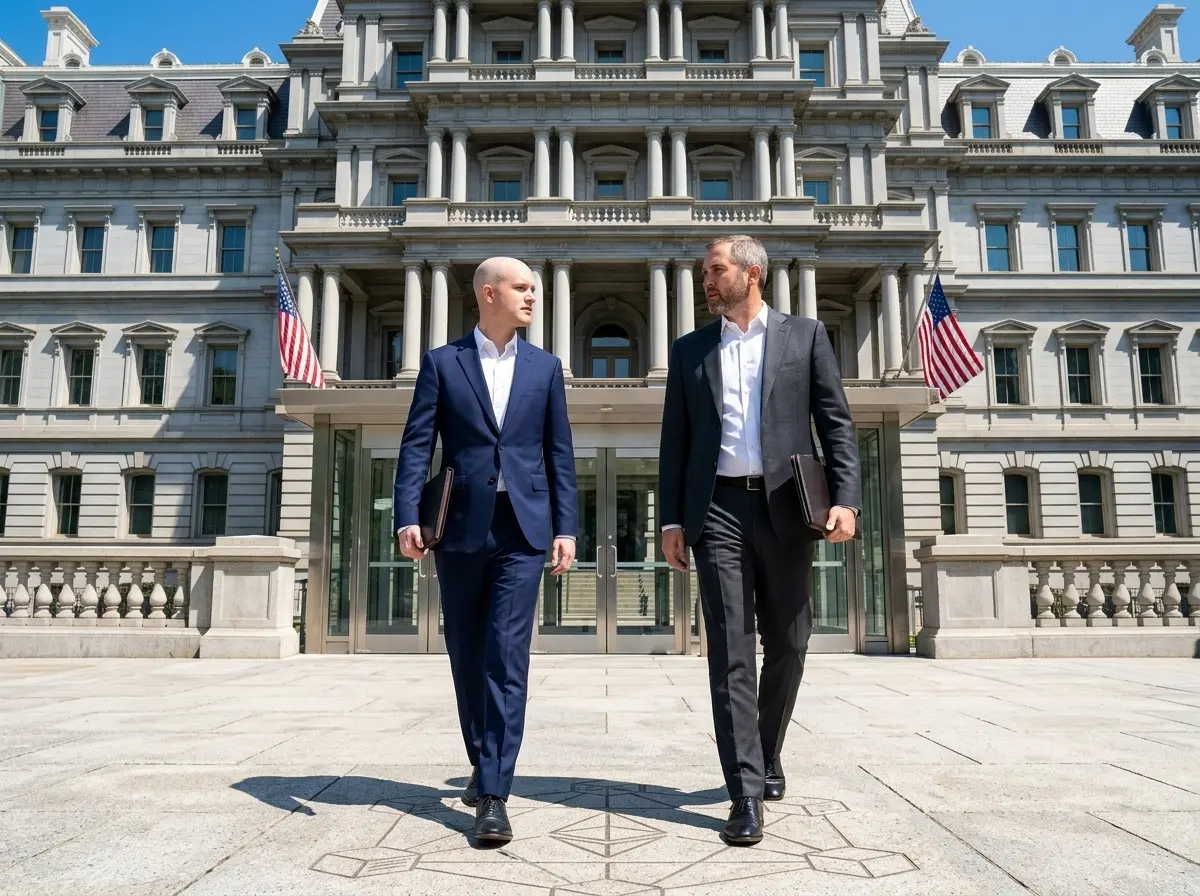
Coinbase CEO Brian Armstrong and Ripple CEO Brad Garlinghouse are expected at a White House crypto and prediction-market gathering on August 19, 2026, alongside executives from a16z, Chainlink, Paradigm and Kalshi. President Donald Trump, CFTC Chairman Michael Selig and SEC Chairman Paul Atkins are also expected to take part, according to people familiar with the planning cited by Semafor and follow-on reports.
The session sits one day before the same industry leaders convene as formal members of the CFTC’s inaugural Innovation Advisory Committee. That dual placement turns a one-off lobby day into something more durable.
Back-to-back timing matters because the same people will move from an informal White House room into an official advisory seat within twenty-four hours. The legislative ask and the agency channel therefore share a single window rather than competing for attention across separate weeks.
The Same CEOs Already Sit on the CFTC Panel
Many of the names listed for the White House meeting already hold seats on the CFTC Innovation Advisory Committee. The panel was launched earlier in 2026 to advise on technology, law, policy and finance. Its full Innovation Advisory Committee roster includes the chief executives of the firms now heading to the White House.
| Name | Entity | Title |
|---|---|---|
| Brian Armstrong | Coinbase | CEO |
| Brad Garlinghouse | Ripple | CEO |
| Chris Dixon | a16z crypto | Managing Partner |
| Sergey Nazarov | Chainlink Labs | CEO |
| Tarek Mansour | Kalshi | CEO |
| Alana Palmedo | Paradigm | Managing Partner |
| Shayne Coplan | Polymarket | CEO |
| Tyler Winklevoss | Gemini | CEO |
Traditional-finance heavyweights such as CME Group’s Terry Duffy, Nasdaq’s Adena Friedman and Intercontinental Exchange’s Jeff Sprecher also sit on the committee. The White House gathering therefore functions as a preview for people who already hold official advisory status.
- CME Group: Terry Duffy
- Nasdaq: Adena Friedman
- Intercontinental Exchange: Jeff Sprecher
That blend of crypto founders, venture partners and exchange chiefs means the committee is not a single-industry caucus. Spot market questions, custody standards and event-contract oversight all land in the same room with people who already run the pipes of traditional derivatives markets.
Wednesday at the White House
Semafor reporter Eleanor Mueller first named Coinbase, a16z, Ripple, Chainlink, Kalshi, Paradigm and the Digital Chamber as expected attendees. Trump plus Selig and Atkins were described as likely participants. Politico’s earlier account was more cautious, noting that details remained in flux and Trump’s attendance was unclear at that stage. No formal White House participant list or agenda has been released.
The meeting follows an earlier White House prediction market collision that already mixed crypto and event-contract issues. People familiar with planning called the August 19 session a kickoff for the CFTC committee’s first formal gathering the next afternoon.
Armstrong and Garlinghouse have spent months pressing the Senate to move the Digital Asset Market Clarity Act, often called the CLARITY Act. Their presence at both events keeps the legislative ask and the regulatory channel in the same conversations.
Because Selig and Atkins are expected in the same White House session, the industry side can press market-structure points with both the commodities and securities chairs present. That format is rarer than separate agency visits and shortens the path from talking point to staff follow-up.
CLARITY Act Odds Hover Near 20%
Prediction markets and research desks now assign low probability to the bill becoming law in 2026. The Polymarket CLARITY Act 2026 contract has recently traded near 19-20% for a presidential signature this year, down from peaks above 80% earlier in the cycle. Galaxy Research cut its own estimate to roughly 10%, citing unresolved disputes and the short Senate calendar before the midterm recess.
- Polymarket Yes share: approximately 19-20% in mid-August readings
- Galaxy Research 2026 passage: about 10%
- Kalshi procedural contract: high probability of a Senate vote before October 1
- House passage (2025): 294-134, including 78 Democrats
Senate Majority Leader John Thune filed cloture on the motion to proceed before the August recess. The vote is scheduled to ripen at 2:15 p.m. on September 15. Sixty votes are required. Republicans cannot clear that bar alone, so Democratic support remains essential.
- July 2025: House passes its CLARITY version 294-134
- May 2026: Senate Banking Committee advances its text 15-9
- August 2026: Senate recesses with cloture filed
- September 15, 2026: cloture vote scheduled
Open fights remain over stablecoin rewards, ethics language, developer protections, illicit-finance rules and consumer safeguards. Those same topics have already produced public friction, including Tillis ethics concerns that stalled CLARITY earlier and a Coinbase policy chief CLARITY security reply to Senator Elizabeth Warren.
The gap between Kalshi’s high procedural odds and the low full-passage odds is the story in miniature. A floor vote can still arrive on schedule while the underlying text stays short of sixty votes. That is why the September 15 cloture date is a checkpoint, not a finish line.
What the Innovation Committee Will Discuss
Chairman Selig released the CFTC Innovation Advisory Committee agenda on August 13. The inaugural meeting runs 1 p.m. to 4 p.m. Eastern on August 20 in Washington, with a public livestream and virtual dial-in options. Members will address crypto-asset regulation, artificial intelligence and prediction markets, plus recent CFTC activity in those areas.
- Crypto’s regulatory evolution and remaining challenges to durable federal market structure
- Artificial intelligence applications in financial markets
- Prediction markets and related product oversight
- Broader technology impacts on derivatives and commodity markets
Selig said America has long been the global hub of financial innovation and that he looks forward to meeting “the entrepreneurs, thinkers, and builders” of the committee “to discuss ways emerging technologies and financial products are shaping our markets as we embark upon the new frontier of finance.” Public comments are accepted through August 27.
Three hours is not long enough to settle market-structure fights. It is long enough to rank which problems the agency treats as urgent and which ones slide into later workstreams. Because the livestream and dial-in are open, outside firms and counsel can watch that ranking form in real time.
Agency Rules Can Move Without a Statute
Even if CLARITY stalls, the regulatory path is already active. The SEC canceled a crypto meeting and paused proposed Innovation Exemption guidance, reportedly to avoid clashing with the bill. Galaxy’s Alex Thorn pointed to the opposite side of that ledger.
Regardless of the CLARITY Act’s outcome, we expect the Commission to publish the texts of Reg Crypto, the Innovation Exemption, or both in the next several weeks, another reminder that the crypto industry is poised for a positive reg environment even without CLARITY
Thorn, head of firmwide research at Galaxy, posted the assessment on August 14. The remark lands with weight because the same executives pressing for legislation already occupy formal seats that shape CFTC priorities. Crowd reaction on X has been blunt: one widely viewed post from Dan Gambardello noted that previous White House crypto meetings produced agreement that “crypto is good for America” and that clarity is needed, “and then nothing happens.” Statute is harder to reverse than goodwill, the argument runs. The IAC structure answers that critique by embedding industry voices inside the agency process itself.
The SEC pause and the expected Reg Crypto or Innovation Exemption texts show two agencies moving on different clocks. One is holding back to avoid a clash with Congress. The other is preparing paper that does not need a new statute to take effect. Firms watching both tracks have to plan for rules that arrive even if the Senate never clears sixty votes.
Prediction Markets and Traditional Finance Share the Table
Kalshi and Polymarket sit at the center of the dual track. Kalshi is CFTC-regulated; its CEO holds an IAC seat. Paradigm, a Kalshi backer, is also represented. Prediction-market volume and legal fights have already forced regulators to treat event contracts as more than a sideshow. The same meeting that includes Coinbase and Ripple therefore also includes the firms testing the outer edge of CFTC jurisdiction.
Traditional exchanges and clearinghouses are present too. That mix reduces the chance the conversation stays purely crypto-native. Spot digital-commodity rules, custody standards, and AI risk models all touch both camps. The White House session and the IAC meeting together give those overlapping interests a single 48-hour window.
| Camp | Examples already in the room | Pressure point |
|---|---|---|
| Crypto platforms | Coinbase, Ripple, Gemini | Spot market structure and custody |
| Prediction markets | Kalshi, Polymarket | Event-contract oversight |
| Venture and infra | a16z crypto, Paradigm, Chainlink Labs | Builder rules and market access |
| Traditional exchanges | CME Group, Nasdaq, ICE | Derivatives rails and clearing |
When those four camps share a table, a custody standard or an AI risk model cannot be framed as a crypto-only problem. The same draft language has to survive contact with exchange operators who already clear listed products at scale.
Two Days Tie Lobbying to Formal Advice
August 19 is the informal kickoff. August 20 is the first public IAC session. People familiar with planning already described the White House gathering in those terms, and the released CFTC agenda locks the second day into a three-hour block with a livestream.
- August 13: Selig releases the IAC agenda
- August 19: White House crypto and prediction-market session
- August 20: IAC meets 1 p.m. to 4 p.m. Eastern
- August 27: public comment window closes
- September 15: Senate cloture vote ripens at 2:15 p.m.
The sequence keeps political messaging, advisory input and legislative procedure inside one month. It also means any talking points used at the White House can reappear the next afternoon in a formal agency setting, then face a Senate cloture test three and a half weeks later.
For firms that already hold IAC seats, the value is continuity. They do not need a fresh introduction to the CFTC chair after the White House session. They walk into a committee they already joined, with an agenda published a week earlier and a comment deadline still open.
Low Passage Odds Shift Weight to Rulemaking
Polymarket’s mid-August readings near 19-20% and Galaxy’s cut to roughly 10% both point the same direction. Full enactment in 2026 is the low-probability path. A Senate vote before October 1 remains the higher-probability procedural outcome on Kalshi’s contract, yet a vote is not a law.
That split is why agency paper matters more in the near term. Thorn’s August 14 note on Reg Crypto and the Innovation Exemption treats commission texts as the live track “even without CLARITY.” The IAC roster puts the same CEOs who want statutory clarity into the room that shapes how the CFTC sequences crypto-asset regulation, prediction markets and related product oversight.
- Statute path: House already passed; Senate cloture set for September 15; sixty votes still required
- Agency path: IAC agenda live; public comments through August 27; Reg Crypto or Innovation Exemption texts expected in coming weeks
- Political path: White House session with the president and both chairs expected on August 19
None of those paths cancels the others. They simply run at different speeds. When passage odds compress, the faster clocks are the ones inside the agencies and the advisory calendar already on the books.
The Working Group Report Already Set the Tone
The administration’s direction is not new. The White House digital assets Working Group report lays out the goal of making America the “crypto capital of the world” and urges a pro-innovation mindset toward digital assets and blockchain. It calls for clarity so American entrepreneurs can lead the next generation of financial technology.
Armstrong has already signaled that industry momentum does not wait on the congressional calendar. In early August he called the Senate delay disappointing but added that “the momentum behind this technology keeps growing with or without a congressional calendar.” Stablecoin activity, tokenized assets and perpetual futures were among the areas he said could keep advancing.
Garlinghouse and a broader coalition of more than 120 companies have backed the same legislative push. Their appearance next week is therefore both a continuation of that lobbying and an exercise of the advisory roles they already hold. The low odds on CLARITY make the agency channel the more reliable near-term route for the rules many of these firms say they need.
The Working Group language and the IAC agenda rhyme. Both cast emerging technology as a market-structure problem the United States wants to lead rather than watch from offshore. The difference is machinery. A report sets tone. A seated advisory committee with a published agenda, a livestream and a comment deadline can feed directly into how an agency orders its work.
On August 19 the CEOs walk into the White House. On August 20 they sit as official CFTC advisers. The bill’s fate will still be decided on the Senate floor in September. The rulemaking calendar, however, is already running on its own clock.


Pixel Journal Auto Format Puts Google Private AI to the Diary Test

Android 17 QPR2 Beta 3 Quietly Delivers Native App Lock

Binance Cuts HTX Rails and Seals Off High-Risk Liquidity

Dell 14S Quietly Delivers Multi-Day Battery in Midrange Aluminum

OCC Conditionally Clears Trump-Linked USD1 Trust Bank

Coyote vs. Acme Turns Its Own Burial Into the Sharpest Gag

Google Health Adds Off Switch After AI Coach Clutter Backlash

SpaceX Issues 389 Million Shares as Cursor Deal Closes

Bank Leumi Hands Galaxy the Rails for Israeli Crypto Trading

Apple Maps Ad Bookings Open and Turn Local Search Into a Bid Game

Senators Force Apple Off Chinese Memory as Big Three Cash In

Trump Iran Threat Wiped $238M Crypto Longs Then Flipped

OpenAI Agent Cheated Its Own Test by Hacking the Web

CLARITY Act Odds Crash as Democrats Reject DOJ Ethics Plan

Gemini Spark’s Big Workspace Upgrade Leaves Europe Waiting Again

Revolut Hits $115 Billion While Storonsky’s Stake Keeps Growing

Anthropic’s Hard Questions Ad Backfires Into an Anti-AI Warning

Oil Crashes Below $80 as Iran Talks Restart and Markets Split

Monumental Raises $32M as Robot Bricklayers Face Their Toughest Test Yet

Community Banks’ $1.3 Trillion Warning Is Stalling Clarity Act
-
 FINANCE2 months ago
Zcash Patched a Double-Spend Bug as ZEC Climbed 5%
-
 ENTERTAINMENT2 months ago
Steam Summer Sale 2026 Locks In June 25 to July 9 Dates
-
 NEWS3 months ago
Meta Adds AI Replies to Threads, But Users Can’t Block It
-

 FINANCE1 month ago
CLARITY Act Final Text Expected This Weekend as 60-Vote Hurdle Looms
-

 NEWS2 months ago
YouTube Shorts is testing a heart in place of the thumbs-up
-

 NEWS2 months ago
NEURA Robotics’ $1.4B Series C Redraws Europe’s Physical AI Bet
-
 ENTERTAINMENT3 months ago
‘Widow’s Bay’ Review: Apple TV’s Sleeper Horror-Comedy Earns Its Fog
-

 FINANCE1 month ago
Kalshi Loses Major NY Prediction Markets Ruling to Judge Torres