
FINANCE
CLARITY Act Odds Crash as Democrats Reject DOJ Ethics Plan
Polymarket’s CLARITY Act odds fell to 39% after seven Senate Democrats rejected DOJ-only ethics enforcement, the same agency policing Trump’s own crypto conflicts.

Polymarket traders cut the CLARITY Act’s odds of becoming law this year to 39% on Thursday, a 26 point drop in a single day. The crash followed a joint statement from seven Senate Democrats rejecting the crypto market structure bill’s newest draft, with $2.31 million changing hands on the contract in 24 hours.
The fight centers on a few dense paragraphs most voters will never read: who gets to enforce the ethics rules once they become law. Senate Republicans have drawn what one lead negotiator called a “red line” around keeping that power inside the Justice Department (DOJ), the same executive branch agency that answers to a president who reported more than $1.4 billion in crypto income last year.
Seven Senators, One Rough Afternoon for the Odds
According to Polymarket, the prediction market where users trade contracts on real world outcomes, odds on the Digital Asset Market Clarity Act, known as the CLARITY Act, had been drifting downward for weeks before Wednesday’s specific shock. Republicans briefed crypto industry officials, including Coinbase CEO Brian Armstrong, before releasing the revised text.
Financial reporter Eleanor Mueller then relayed comments from Senator Angela Alsobrooks, a Maryland Democrat, describing the ethics enforcement plan as “wild and unserious and stone-cold crazy.” She added, “We must empower state-level attorneys general. For many of us, that is an absolute. It’s an absolute that we cannot completely rely on the DOJ given what we’ve seen.”
Within hours, seven Democrats, Catherine Cortez Masto, Alsobrooks, Cory Booker, Ruben Gallego, John Hickenlooper, Mark Warner and Raphael Warnock, issued a joint statement. “The Republican-proposed text of the CLARITY Act as it currently stands falls short,” they wrote. “Key provisions including those addressing ethics for elected officials, consumer protection, illicit finance, conflicts of interest and market integrity must be strengthened.”
They left the door open. “We have been working in good faith with our Republican colleagues for the past year and will continue doing so to get this over the finish line,” the statement said. Alsobrooks and Gallego were the only two Democrats who voted for the bill in committee back in May.
The Wednesday swing capped a month of steadily souring forecasts across more than one venue.
| Source | Date | Passage Odds | Context |
|---|---|---|---|
| Galaxy Research | Mid-July 2026 | 50% | Cited a tight pre-recess Senate calendar |
| Polymarket | Wednesday, July 22 | About 65% | Before the Democrats’ joint statement |
| Polymarket | Thursday, July 23 | 39% | After the statement; $2.31 million traded in 24 hours |
Each estimate moved the same direction. A bill that traders once treated as a near lock now reads as a coin flip.
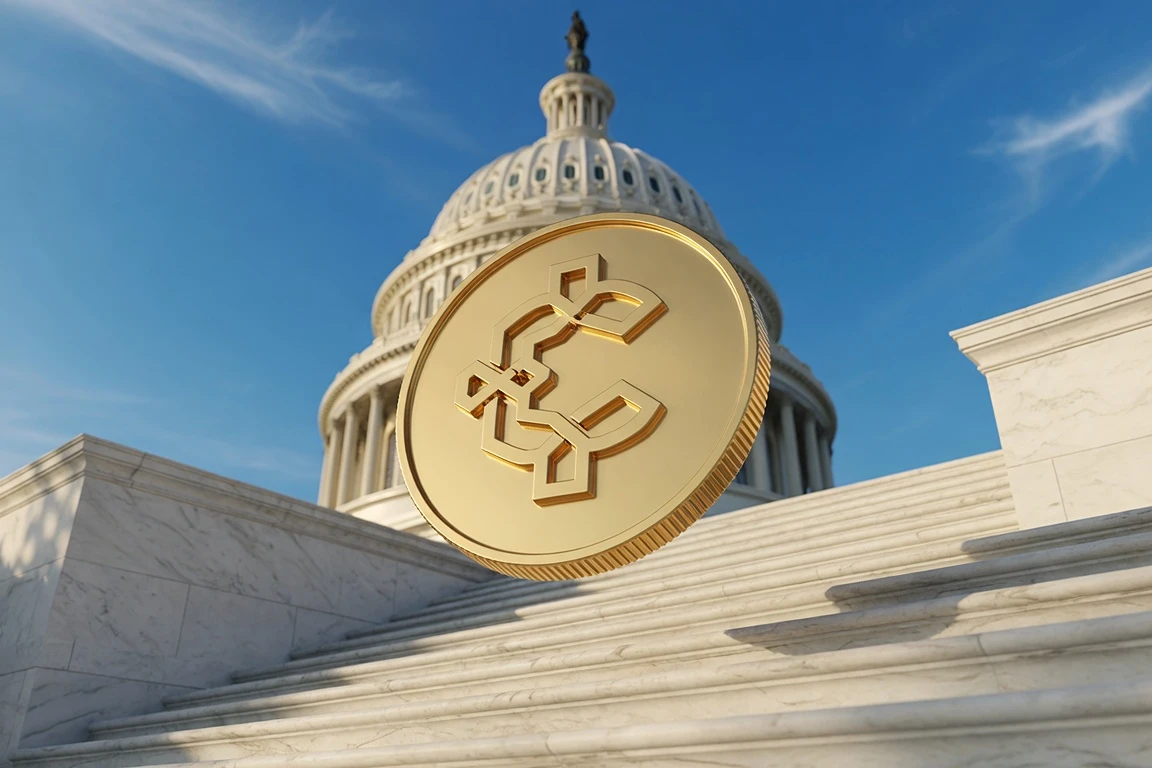
The Red Line Over Who Holds the Enforcement Pen
The specific provision gives the Department of Justice sole authority to enforce the bill’s ethics rules. Earlier drafts already drew scrutiny for handing Trump’s own Justice Department the enforcement pen. Democrats now want state attorneys general to share or lead that power instead.
Senator Cynthia Lummis, the Wyoming Republican leading GOP negotiations, told CoinDesk that letting state attorneys general bring criminal or private cases under the ethics provision was a “red line” for Republican negotiators, who had worked with Democrats for weeks before hitting the impasse.
Senator Kevin Cramer of North Dakota said on Fox Business that keeping enforcement inside the Justice Department, rather than handing it to state prosecutors, appeared to have gained acceptance among Republican negotiators. John Deaton, the XRP advocate and attorney, made a similar case publicly, arguing a single federal enforcer produces more uniform rules than fifty state attorneys general with different political priorities.
Senator Elizabeth Warren, the top Democrat on the Senate Banking Committee, argued the ethics text as written would leave Trump’s crypto businesses largely unchecked.
- Lummis and Cramer (Republicans) – say enforcement must stay with the Justice Department for uniform federal rules, calling state led enforcement a dealbreaker
- Alsobrooks and Warren (Democrats) – say DOJ only enforcement cannot be trusted to police a president who profits from crypto, and want state attorneys general empowered
- John Deaton (crypto attorney) – sides with Republicans, warning that fifty state enforcers would fragment the rules Congress is trying to standardize
Neither camp has moved. Lummis said the ethics section would keep being negotiated through the weekend alongside a handful of other unresolved issues.
What Trump’s $1.4 Billion Bought Into the Fight
President Trump’s 2025 financial disclosure, a 927 page filing with the Office of Government Ethics, showed $1.4 billion in crypto income for the year, the largest single category of his earnings. Most of it, $635 million, came through a licensing deal with Celebration Coin for the $TRUMP meme coin, part of $636 million booked through CIC Digital LLC. Another nearly $197 million came from his stake in Stablecoin Holdco, the parent company of World Liberty Financial.
Crypto accounted for the largest single chunk of Trump’s more than $2 billion in total disclosed income for the year. Reuters has separately estimated the Trump family’s crypto related profit at more than $2.3 billion since he returned to office in January 2025, a cumulative figure that runs wider than the single year disclosure.
World Liberty Financial’s stablecoin business ties directly into the stablecoin law that just marked its first year in force, a reminder that Trump’s crypto holdings touch more than one pending piece of legislation.
The draft ethics package itself is specific. It would:
- Ban the President, Vice President, members of Congress and federal judges, plus their spouses, from issuing or sponsoring a crypto asset
- Require those officials to sell their crypto holdings, place them in a blind trust, or both
- Extend to Supreme Court justices and judges on the Court of International Trade, according to Lummis
- Expire on January 20, 2029, the final day of Trump’s current term
That last date is not a rounding error. A rule written to restrain a sitting president’s crypto conflicts is set to lapse the same day he leaves office, whether or not Congress ever revisits it.
Trump personally shaped the language behind this draft. He met White House Chief of Staff Susie Wiles, Acting Attorney General Todd Blanche, Lummis and Senator Bernie Moreno of Ohio in the Oval Office to work out the ethics terms. Democrats were not in the room.
A Long, Fragile Paper Trail Since FIT21
The CLARITY Act follows the industry’s first real attempt at market structure rules. The House passed FIT21 by a 279 to 136 vote in May 2024, with 71 Democrats crossing over, backed by a coalition letter from more than fifty digital asset firms. The bill still died, because the Senate never brought it to a vote.
CLARITY’s Senate path has been just as bumpy. The Banking Committee advanced it 15 to 9 in May, with only Alsobrooks and Gallego crossing party lines. The Agriculture Committee later passed its companion version on a strict party line vote. An early agreement on stablecoin yield collapsed when Coinbase objected, and it took roughly four months after the committee votes for Republicans to schedule floor action.
The U.S. has always been at the forefront of financial innovation, and the coming weeks are likely the last real chance we will have for years to get this right.
Lummis wrote that in the statement accompanying her release of the merged Banking and Agriculture text this week, framing the moment as a closing window rather than a routine markup.
Why Does the August 7 Deadline Matter So Much?
The Senate leaves Washington after August 7 for its summer recess, and floor time before then is scarce. Republicans hold 53 seats, seven short of the 60 votes needed to break a filibuster, so at least seven Democrats must cross over, and possibly more if Republicans defect.
Senators Josh Hawley and Rand Paul both voted against the GENIUS Act, the stablecoin law that passed last year, which is why some vote counts put the real Democratic requirement closer to 10 rather than seven. The vote count math that keeps getting tougher was already a live problem before this week’s ethics fight.
If Democrats and Republicans cannot close the gap before August 7, the CLARITY Act joins a growing pile of unfinished business waiting for a Senate calendar that gets more crowded, not less, once midterm campaigning starts in the fall.
Frequently Asked Questions
What Is the CLARITY Act?
The CLARITY Act is a Senate bill that would set market structure rules for crypto trading platforms, splitting oversight of digital assets between the Securities and Exchange Commission and the Commodity Futures Trading Commission. It builds on FIT21, the House version that passed in 2024 but never got a Senate vote.
What Is Polymarket?
Polymarket is a prediction market where users trade contracts tied to the outcome of real world events, including elections and legislation. Prices move as traders buy and sell, so a contract’s price reflects the market’s live estimate of an event’s probability, in this case the CLARITY Act passing in 2026.
How Is the CLARITY Act Different From the GENIUS Act?
The GENIUS Act, signed into law last year, regulates stablecoins specifically. The CLARITY Act is broader, aiming to define which crypto tokens count as securities versus commodities and which federal agency oversees each category of trading platform.
Could the CLARITY Act Still Pass This Year?
Yes, negotiators on both sides say talks continue. But if the bill misses the August 7 recess, it returns to a Senate calendar crowded with appropriations bills and midterm campaigning, which could push a vote into next year.


Replit Opens Its London Office Inside an AI Crowd

Straight Circle Trailer Lands Without a U.S. Date

Anemo Labs Bets £700,000 on an AI Sense of Smell

Nintendo Prices the Zelda 40th Switch 2 at $519

Copilot Capital Buys the Autopilot Already Running 90 GW

Ground A Raises €9.1 Million for a Pallet Laser

Gibney’s Musk Film Opens in Venice Without Its Subject

Torvalds Blames AI for a Full-Fat Linux 7.3-rc2

Dexter Returns Sharper, Older, and Stuck Between Killers

Meta’s Muse Agent Can Spend Before the Privacy Lock

Walter’s TWG Insists No Fraud as Insurer Probes Force Cleanup

30-Year Yield Hits 5.32% Highest Since 2007 as Debt Supply Locks In Costs

PCE Stays at 3.7% as Gas and Tariffs Outrun Coming Revisions

Evernorth S-4 Clears Path for Active XRP Treasury on Nasdaq

Astute’s $1.2M bet makes B2B creator deals feed AI discovery

Strategy Parks $1.59B Cash While Bitcoin Stack Stays Flat

Instinct Hits $2.5 Billion as AI Agent Access Sparks Trust Fights

CLARITY Act Cloture Opens a Door Ethics Still Blocks

Oracle’s 2.8 GW Bloom Deal Exposes the AI Power Bypass

Space Mirror Demo Revives 1993 Russian Night-Light Test
-
 FINANCE3 months ago
Zcash Patched a Double-Spend Bug as ZEC Climbed 5%
-
 ENTERTAINMENT3 months ago
Steam Summer Sale 2026 Locks In June 25 to July 9 Dates
-

 FINANCE2 months ago
CLARITY Act Final Text Expected This Weekend as 60-Vote Hurdle Looms
-
 NEWS4 months ago
Meta Adds AI Replies to Threads, But Users Can’t Block It
-
 ENTERTAINMENT5 months ago
Extraction 3 Is Officially Coming to Netflix in 2027
-

 NEWS3 months ago
YouTube Shorts is testing a heart in place of the thumbs-up
-

 NEWS1 month ago
Senators Force Apple Off Chinese Memory as Big Three Cash In
-

 NEWS3 months ago
NEURA Robotics’ $1.4B Series C Redraws Europe’s Physical AI Bet