
FINANCE
CLARITY Act’s Ethics Fix Would Hand Trump’s Own DOJ the Enforcement Pen
Bipartisan Senate negotiators near CLARITY Act ethics language, but enforcement of Trump’s crypto conflicts would run through his own Justice Department.

Bipartisan Senate negotiators met on Capitol Hill Tuesday to finish ethics language for the Digital Asset Market CLARITY Act, the crypto bill both parties call close to a floor vote. Ethics is still the biggest snag. Decentralized finance rules are also on the table, negotiators say.
The fix now on the table would route enforcement of those ethics rules through the president’s own Justice Department, not independent state prosecutors, the arrangement Democrats spent weeks trying to avoid.
Where Tuesday’s Meeting Left the Ethics Language
Crypto policy journalist Eleanor Terrett broke the news of Tuesday’s session, writing that discussions taking place on Capitol Hill relating to ethics were underway. She said negotiators are also weighing new DeFi (decentralized finance) provisions, though ethics remains the harder problem to solve.
Terrett’s thread also relayed word from Senator Cynthia Lummis’s office, one of the bill’s lead architects. A White House spokesperson told her last week’s meeting “went well” and that “the ethics text set to release in the coming days will reflect that productive conversation.”
Senate Majority Leader John Thune said there is a “good chance” lawmakers reach an agreement, though he cautioned that talks could still shift direction before anything is final.
The underlying bill would still let the Commodity Futures Trading Commission (CFTC) regulate digital commodity exchanges and brokers, while the Securities and Exchange Commission (SEC) keeps authority over securities-like tokens, the core framework the industry has wanted for two years.
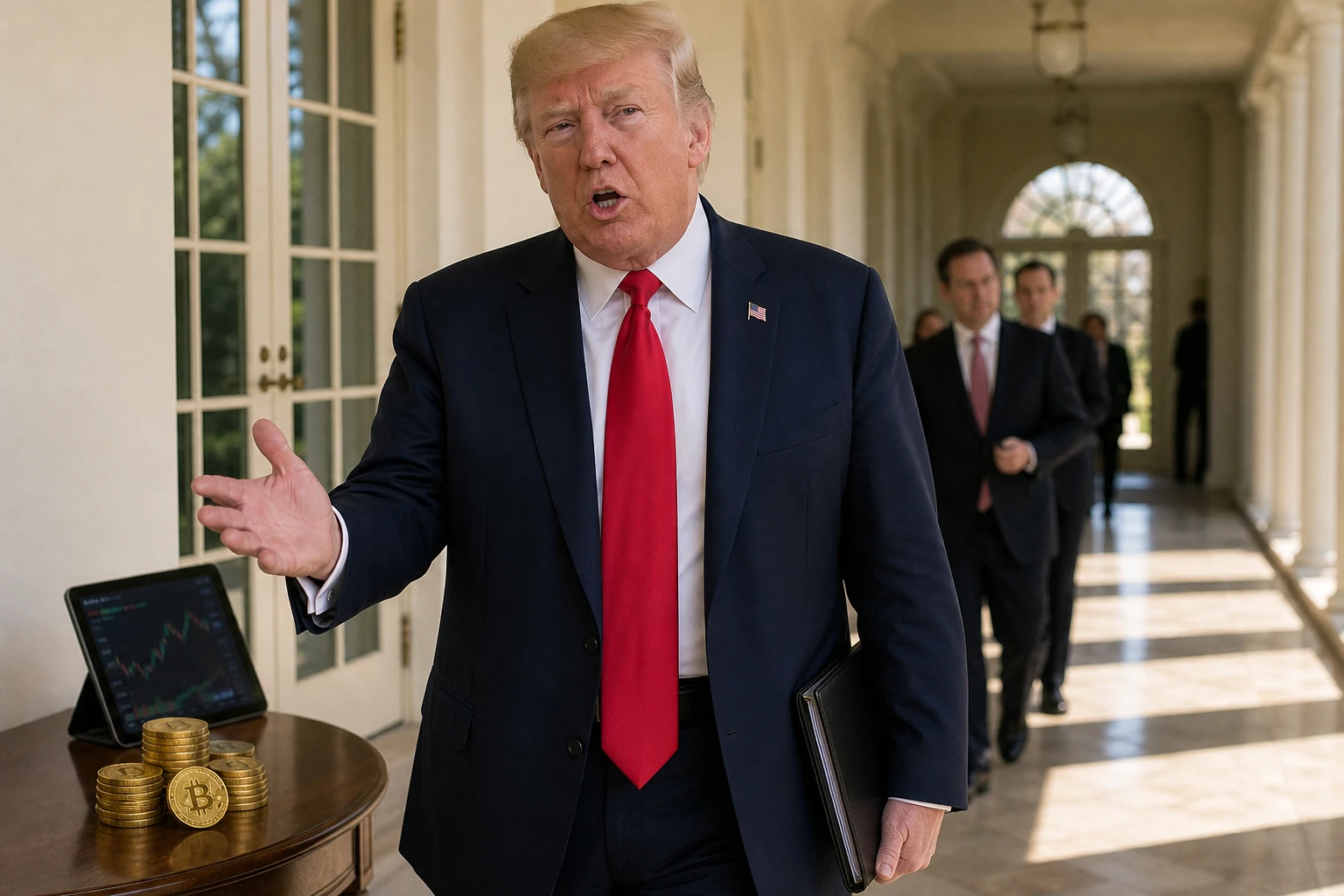
The 1962 Statute the Bill Is Racing to Patch
The reason Congress needs a bespoke ethics clause at all traces back further than this year’s fight. The government’s main conflict-of-interest law is a 1962 statute, and it already bars officials from acts affecting a personal financial interest while they work on government matters.
Congress carved out one big exception when it wrote that law: the president and vice president. A Congressional Research Service analysis of federal ethics rules found they cover executive branch officials generally, but expressly excludes the President and Vice President.
That carve-out is why nothing in existing law stops a sitting president from signing crypto legislation while holding more than a billion dollars in crypto assets. The CLARITY Act’s ethics section would be the first statute written specifically to close that gap for the crypto industry.
Whose Justice Department Would Police the President
Ethics text is one thing. Who enforces it is another, and that question has moved through at least three versions in three weeks.
A merged Senate draft released July 13 dropped ethics language altogether. Democratic Senators Chris Murphy, Chris Van Hollen and Jeff Merkley held a press conference opposing the bill that same day, saying they could not back cloture without it.
Negotiators then floated giving state attorneys general standing to sue the Justice Department if it failed to enforce the rule. That idea got a tentative yes in a closed-door session before the White House and Republican negotiators withdrew it. The fallback left enforcement to the discretion of the sitting U.S. Attorney General, an official who serves at the president’s pleasure and can be removed by him. Democrats rejected that version as too weak.
| Enforcement Option | Who Would Enforce It | Where It Stands |
|---|---|---|
| Original merged draft, released July 13 | No dedicated ethics clause existed | Sank after Sens. Murphy, Van Hollen and Merkley opposed it publicly |
| State attorney general standing to sue | State AGs suing the DOJ over enforcement lapses | Tentatively agreed in closed-door talks, then withdrawn by the White House and GOP negotiators |
| Attorney general discretion, per Sen. Cramer’s July 21 account | The sitting U.S. Attorney General | Republicans call it settled language; Democrats call it insufficient |
Senator Kevin Cramer described the state of play on July 21. Instead of state attorneys general, he said, the Justice Department would implement the ethics provisions. Negotiators have already agreed on the ethics language itself, he said, adding, “I believe we’re almost at the finish line.”
CoinDesk reported the same day that the core question, how far crypto limits on officials should reach, had narrowed. The enforcement question had not. Democratic negotiators were still not satisfied with routing enforcement through an attorney general who answers to the same president the rule targets.
The Clarity Act will not get approved in the Senate without it.
Senator Kirsten Gillibrand, a New York Democrat, said that in May at the Consensus Miami conference, two months before Tuesday’s session. Her position has not moved since.
The Trump Family’s Crypto Stake in the Outcome
Democrats have put numbers on exactly what the ethics rule would touch. Trump’s 2025 financial disclosure logged about $1.4 billion in crypto-related income, the largest single category on the form.
- World Liberty Financial – the family-founded venture behind the USD1 stablecoin, a token whose oversight already runs through the stablecoin law that just turned one
- The TRUMP memecoin – responsible for roughly $636 million of that disclosed income on its own
- The MELANIA memecoin – a companion token tied to the First Lady’s name
- Bitcoin mining ventures – additional family-linked operations named repeatedly in the dispute
Family-linked estimates for total crypto earnings since Trump returned to office run closer to $2.3 billion, per Reuters figures cited across crypto trade press. Five senior Senate Democrats, including Banking Committee ranking member Elizabeth Warren, cited the $1.4 billion figure in a letter renewing calls for hearings into the holdings. The letter also flagged a reported 49% stake in World Liberty Financial held by investors linked to the United Arab Emirates.
The White House has denied any conflict of interest, saying Trump’s assets sit in a trust managed by his children.
DeFi and Consumer Protections Ride the Same Bill
Ethics is not the only piece still moving. Negotiators are also working through new provisions for decentralized finance, the corner of crypto where lending and trading run on blockchain code rather than a bank or exchange.
Separately, lawmakers have kept refining customer protection language. Reports indicate the latest changes strengthen safeguards for digital asset consumers, though the specific new requirements are not yet public.
Coinbase vice chair Ryan VanGrack summed up the changes as giving the bill “more teeth.” The changes address gaps in the existing framework for digital asset users, he said, without detailing exactly what the new requirements would be.
Fifty Three Republicans Are Still Seven Votes Short
None of the ethics language matters if the bill cannot clear the Senate floor. Republicans hold 53 seats. Reaching the 60-vote cloture threshold means Republicans need at least seven Democrats to cross over, and possibly more if a couple of Republicans peel off.
Only two Democrats, Ruben Gallego of Arizona and Angela Alsobrooks of Maryland, broke with their party when the Senate Banking Committee advanced the bill in May. That leaves the Senate math even tougher than it looked in May, with the floor calendar shrinking by the day.
The clock has produced a rough timeline of its own.
- July 17, 2025: The House passes the CLARITY Act, 294 to 134, with more than 70 Democrats crossing over.
- May 14, 2026: The Senate Banking Committee advances the bill 15 to 9, with only Gallego and Alsobrooks crossing party lines.
- June 5, 2026: Galaxy Research’s Alex Thorn cuts his 2026 passage estimate from 75% to 60%, citing the stalled ethics track.
- July 13, 2026: A merged Senate draft omits ethics language entirely, prompting a formal Democratic press conference against it.
- July 16, 2026: Trump meets Senate Republicans at the White House. A Lummis spokesperson later calls the session productive.
- July 17, 2026: Republicans release updated bill text. Prediction market Polymarket’s odds on 2026 passage jump to 45%, up from 24% four days earlier.
- July 21, 2026: Senator Kevin Cramer says negotiators have agreed on ethics language routed through the Justice Department, calling the talks nearly finished.
GovTrack’s own model, built from how similar bills have historically fared, puts the bill’s chance of enactment at just 30%, a reminder that momentum in the room has not yet turned into votes on paper.
What Breaks If the Senate Misses August Recess
Senator Lummis has warned that failure this year likely means waiting until 2030, after a Congress of unknown makeup, to restart the process from scratch.
Passage would also still require the House to sign off on whatever text the Senate produces, since that chamber passed a different version of H.R. 3633 back in July 2025.
A slip past this window carries a cost beyond Capitol Hill. Europe’s crypto rules keep gaining ground while Washington negotiates ethics text line by line.
Thune has pledged a floor vote before senators leave town. The Senate’s August recess begins August 8, giving negotiators barely two weeks to turn Tuesday’s talks into finished text, a floor vote and a House sign-off.


Veridue Raises $4 Million to Speed Energy Deal Diligence

Healey Adds a £150m Rung for Northern Scale-Ups

Ten Deals Took Most of Europe’s August Tech Money

Holmes Hired Fielder to Film Her Last Days

Molten Bets £100m of Plc Cash on Late-Stage Tech

Garlinghouse Cited Dutch Gold, and London Got the Bars

byFounders Bets $4.3 Million on Fluencify After $2M ARR

Alpha Gang Puts A-List Stars on a Zellner Wager

Angel Bets a Recut PG-13 Chase on Ritchson and Wilson

Flex IT and T1A Combine to Own Corporate Device Supply

Walter’s TWG Insists No Fraud as Insurer Probes Force Cleanup

30-Year Yield Hits 5.32% Highest Since 2007 as Debt Supply Locks In Costs

PCE Stays at 3.7% as Gas and Tariffs Outrun Coming Revisions

Evernorth S-4 Clears Path for Active XRP Treasury on Nasdaq

Astute’s $1.2M bet makes B2B creator deals feed AI discovery

Strategy Parks $1.59B Cash While Bitcoin Stack Stays Flat

Instinct Hits $2.5 Billion as AI Agent Access Sparks Trust Fights

Oracle’s 2.8 GW Bloom Deal Exposes the AI Power Bypass

CLARITY Act Cloture Opens a Door Ethics Still Blocks

Amber’s €7M locks Mittelstand knowledge inside Europe
-
 FINANCE3 months ago
Zcash Patched a Double-Spend Bug as ZEC Climbed 5%
-
 ENTERTAINMENT3 months ago
Steam Summer Sale 2026 Locks In June 25 to July 9 Dates
-

 FINANCE2 months ago
CLARITY Act Final Text Expected This Weekend as 60-Vote Hurdle Looms
-
 NEWS4 months ago
Meta Adds AI Replies to Threads, But Users Can’t Block It
-
 ENTERTAINMENT5 months ago
Extraction 3 Is Officially Coming to Netflix in 2027
-

 NEWS3 months ago
YouTube Shorts is testing a heart in place of the thumbs-up
-

 NEWS1 month ago
Senators Force Apple Off Chinese Memory as Big Three Cash In
-

 NEWS3 months ago
NEURA Robotics’ $1.4B Series C Redraws Europe’s Physical AI Bet