
ENTERTAINMENT
Paul Schrader’s AI Cast Runs Into a Union Test
Paul Schrader will generate the Black leads for Three Guns at Dawn, a move that now collides with SAG-AFTRA’s 2026 bar on synthetic performers.

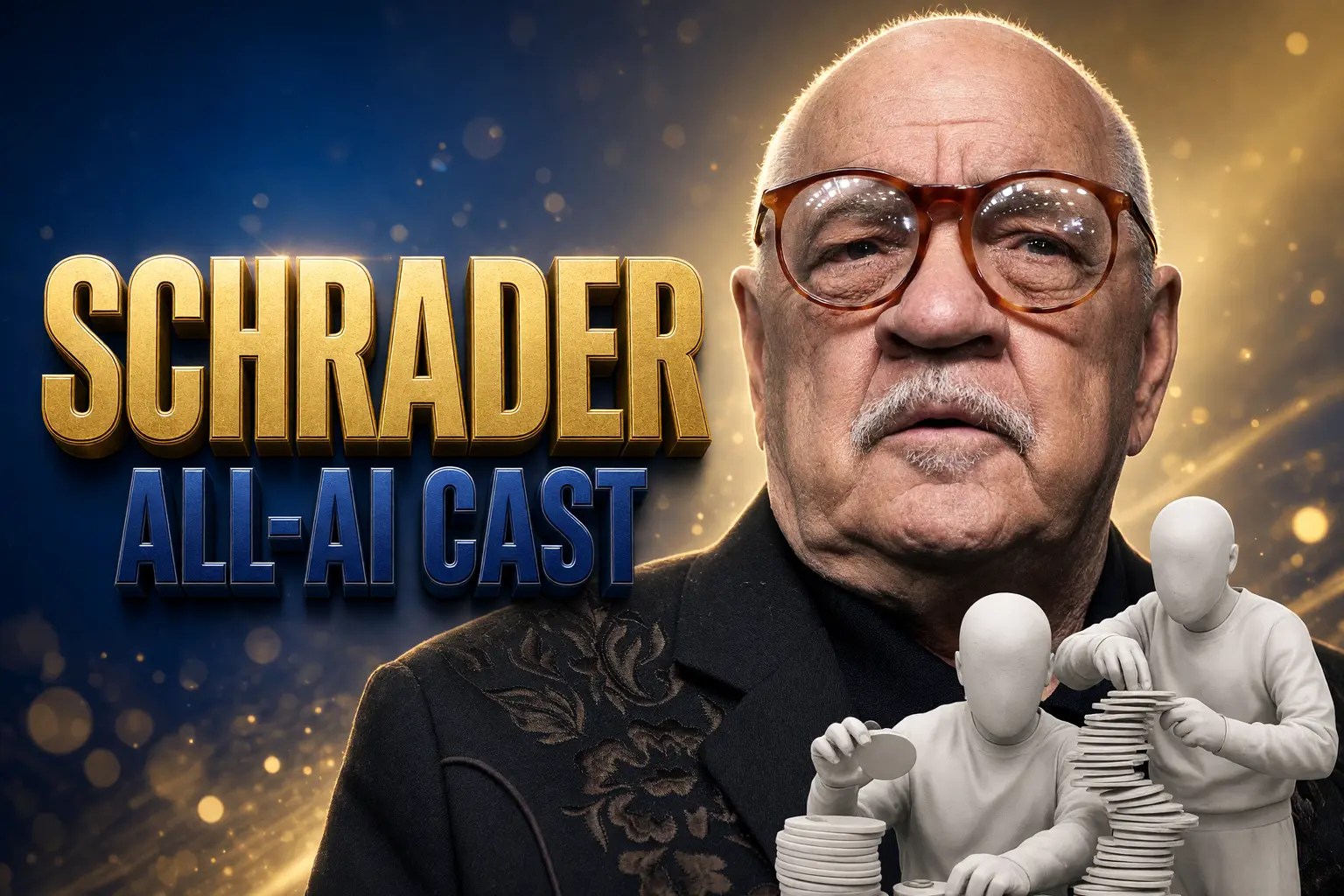
Paul Schrader, 80, said in Venice that he will generate the three Black brothers in Three Guns at Dawn because living actors would not play them. The crime noir, once sold to Netflix with Antoine Fuqua producing, is now an all-AI film built around what Schrader calls human prototypes.
He frames that as a practical fix. The union that just rewrote its film contract treats it as the thing the new rules were written to slow down.
Schrader Will Generate the Brothers Himself
Speaking after the Venice premiere of The Basics of Philosophy, Schrader walked back through a script he has been carrying for years. He wrote it about three Black brothers in South Central Los Angeles, all of them bad, all of them trying to kill each other. Fuqua, he said, was going to produce.
THE THREE BROTHERS
- The cop: A corrupt officer, one of the three leads Schrader has pitched since the 2023 strike.
- The dealer: A drug trafficker, the second brother in the original noir.
- The third: The remaining brother, described in Venice as a sexual criminal and, in earlier remarks, as a serial killer.
He and Fuqua sent the script out. The answers, as Schrader tells it, were all no.
We sent it out to actors, and no Black actors wanted to play in a movie where there are no good Black people. And it sort of died. But then AI came along, and I didn’t need Black actors.
Paul Schrader, writer-director, speaking in Venice after The Basics of Philosophy
Asked if that meant he would create the actors himself, he said, “We’re making them!” He also said AI will generate everything in the film. A few days earlier he had already told interviewers he is doing one film that is all AI and another with about 15 minutes of it. The all-AI title is this one. The shorter pass is lined up for The Doors of Perception, his planned ayahuasca movie.
On the same round of interviews he put the labor fight in one line: “Those jobs are gone, babe.” Then: “You can scream ‘Stop AI’ all you want, but you can’t stop it.”
The South Central Noir Netflix Once Bought
The AI version did not appear out of nowhere. Schrader wrote Three Guns at Dawn during the 2023 Hollywood strikes and spent the next two years trying to staff it as a human picture. Fuqua, the Training Day and Equalizer director, came on as producer, sold the script to Netflix, and wanted Schrader to direct.
Schrader was not sure he should. In early 2024 he said the story sat in an African-American neighborhood, and he asked himself whether that was cultural appropriation. Fuqua, he said, told him it was not. Schrader still floated a workaround: co-direct with a Black filmmaker, because “today, there are hundreds of Black filmmakers,” and Blue Collar, his first film, had been made in a different era.
HOW THE PROJECT CHANGED
- 2023: Writes the South Central noir during the actors’ and writers’ strikes, with three Black brothers at the center.
- January 2024: Says Fuqua has sold the script to Netflix and wants him to direct; he is divided and suggests co-directing with a Black filmmaker.
- September 2, 2026: Says Fuqua is no longer involved and the film “has now become something different” and is being reconfigured as an AI project.
- September 4, 2026: Describes it as a noir about three brothers “built around AI-generated human prototypes rather than name actors.”
- September 6, 2026: In Venice, ties the AI turn to Black actors refusing a film with “no good Black people,” and says, “We’re making them!”
Whether the title survives the rebuild is unclear. The premise has. Three criminal brothers, a South Central frame, and, if Schrader follows through, no flesh-and-blood lead among them. Netflix has not said whether it still holds the project now that the human cast, the Black co-director idea, and Fuqua are gone. Fuqua has not said why he left.
Why Black Actors Would Not Take the Parts
Schrader’s account is blunt, and it is also one-sided. He has not named the actors who passed, the agencies that passed, or whether the offer was a paid lead or a name-talent package with a white writer-director attached to a script full of crooks. He has not said whether anyone who is not already famous was asked.
That last gap is doing a lot of work. Hollywood is not short of Black performers who spend months chasing a single speaking role. A director of Schrader’s standing can usually find someone if the check clears and the part is real. The cleaner reading of his own timeline is that name talent walked, Fuqua walked, and AI then became a way to keep the script alive without another round of nos.
Villainy is not a new problem in Black film. Training Day, the movie that made Fuqua a brand, is built on a corrupt cop. Plenty of later crime pictures have asked Black leads to be cruel, weak, or both. What Schrader ran into looks less like a ban on bad guys and more like a specific refusal of this package: his voice, this trio, no “good” Black person in sight, and a director who had already said out loud that he might be the wrong man for the neighborhood.
He is not new to picking a fight with the room. Years after Taxi Driver and Raging Bull, he is still willing to swing at canon, including his earlier attack on Eyes Wide Shut. The AI turn fits that habit. It also lets him skip the part of directing that involves other people’s leverage.
WHAT WE KNOW
- The claim: Schrader says he and Fuqua sent the script out and no Black actors would play in a movie with no good Black people.
- The workaround: He says the film will be populated by AI-generated human prototypes, not name actors, and that AI will generate everything.
- The old buyer: Fuqua sold an earlier version to Netflix and wanted Schrader to direct.
WHAT IS UNCONFIRMED
- The names: Which actors, and at what quote, actually saw the script.
- The streamer: Whether Netflix still has any claim on the AI rebuild.
- The money: Whether anyone has funded an all-synthetic Schrader noir, or insured it.
Until those three facts move, “no Black actors wanted this” remains his version of a failed casting process, not a census of the profession.
The 2026 Contract Puts Synthetics on a Short Leash
If Three Guns at Dawn is made as a union picture, Schrader is not arguing with a vibe. He is arguing with a contract that closed in the spring.
SAG-AFTRA reached a four-year TV/Theatrical deal with the studios on May 2, 2026. Members ratified the deal by 91.42 percent to 8.58 percent on June 4, with a 19.25 percent return. Minimum rates rise 3 percent a year from July 1, 2026 through June 30, 2030. The AI chapter is the part that lands on this film.
Producers agreed to a principle strongly favoring human performances. They also agreed they do not intend to use a synthetic in a human role that would otherwise be performed by a human unless the synthetic brings “significant additional value” to the motion picture compared with a human or a digital replica. If that bar is met, the producer still has to negotiate terms with the union before use. Violations can go to arbitration, and the union says damages are uncapped.
That is the significant additional value bar for synthetics, and it is aimed at exactly the move Schrader is advertising: skip the humans, keep the story, call the faces prototypes. “Avoiding a casting headache” is not a value the contract describes. “Nobody would take the part” is not one either.
REPLICA VERSUS SYNTHETIC UNDER THE 2026 DEAL
| Type | What it is | What the 2026 deal requires |
|---|---|---|
| Digital replica | A digital asset that resembles a specific person | Clear consent, separate pay, and an articulable business reason to scan |
| Synthetic | A digital asset that looks human but is not recognizable as a specific individual | Significant additional value versus a human or a replica, notice and bargaining with the union, uncapped damages for violations |
Schrader is trying to live in the second row. Synthetics are the faces that belong to nobody, so there is no actor to call, and no replica rider to sign. The 2026 text anticipated that dodge. It says a synthetic still has to beat a human, and even beat a replica of a human, on value. Then the producer has to bargain anyway.
Significant Additional Value Is the Test
The union’s own summary calls that a high bar. It also notes a second problem studios care about more than morals. A performance generated by a synthetic cannot be copyrighted. A chatbot script cannot be copyrighted. The companies on the other side of the deal are not tech firms; they live on characters, stars, and merchandising they can own. An all-synthetic Schrader noir that cannot be locked down as property is a strange thing to ask a streamer to fund.
Producers Have to Bargain First
SAG-AFTRA’s contracts FAQ is plainer still. Producers are not permitted to use synthetics without first bargaining with the union. They have committed to a notice and bargaining schedule. Human performers, the union says, will continue to do the work covered by the Codified Basic and Television Agreements. Digital replication can count as human performance for the comparison, which means a fake face has to beat even a licensed copy of a real one.
That does not stop an independent, non-union shoot. It does stop the easy fantasy that a veteran director can announce prototypes, skip the bargaining table, and still expect a major company’s money, logo, and awards campaign.
A Synthetic Lead Is Harder to Own
The replica fight and the synthetic fight are cousins, not twins. For three years the union has been writing consent rules for faces that already belong to someone. In June 2026 it said more than 16,000 people had signed its open letter urging Congress to pass the NO FAKES Act, a bill that would create a federal property right over likeness, covering voice and image in the age of digital clones. That track is about stolen people.
Schrader is trying the other door. If the brothers are not Denzel, not Jonathan, not anyone a camera has already met, there is no likeness to steal. There is also no star to sell, no residuals to pay, and, if the union’s copyright point holds, no performance to register. The audience still has to care about silicon the way it cares about carbon. Schrader thinks it will. He has said people already do, pointing at cartoons and motion-capture spectacles. A crime film about three men killing each other is a colder ask than a blue alien.
Financiers have a simpler spreadsheet. A human star is expensive and late and can say no. A synthetic is cheap and quiet and cannot walk off. It also cannot open a festival, sit in a talk-show chair, or be owned the way a face on a poster is owned. The 2026 deal prices that trade on purpose. If a producer wants the cheap quiet, the producer has to prove the extra value and then write a check to the union’s satisfaction.
No backer has stood up next to Schrader’s prototypes. Until one does, Three Guns at Dawn is a speech with a title.
The Portrait Painters Already Lost This Fight
Schrader is not conflicted, or he will not perform conflict. In Venice he said some people think AI is coming and some think it is here, and that he understands why artists are upset. “Musicians are getting hit first. Then actors.” He reached for the 19th century.
“It’s like portrait painters saying, ‘We have to stop photography, or we’re going to be out of a job,’” he said. “And the answer is, ‘You are out of a job.’”
That is the second-order fact hiding under the race row. Once a director can answer a refused role with a generated face, every later refusal gets more expensive for the actor and cheaper for the production. The authenticity fights of the last decade, over who is allowed to play gay, trans, disabled, or Black, assumed the part still needed a person. Schrader is saying it does not. The union spent the spring trying to write the opposite into a four-year deal.
This agreement delivers on those goals and addresses critical issues, bringing the long-desired path to merger of our benefit plans into focus, implementing stringent rules that will ensure synthetics remain the exception in our industry instead of the rule.
Duncan Crabtree-Ireland, SAG-AFTRA national executive director and chief negotiator, on the 2026 TV/Theatrical deal
Sean Astin, the union’s president, called the same contract a strong deal that builds on 2023 and said members understood that protecting the profession means preparing for change before it arrives. Schrader is the change arriving on a press line, with a script about three brothers and a promise that the jobs are gone.
He still has to get the film made. He still has to clear a bar that treats a synthetic lead as an exception, not a mood. And he still has to find someone who will pay for faces that no actor would play, and that no studio can quite own.


Veridue Raises $4 Million to Speed Energy Deal Diligence

Healey Adds a £150m Rung for Northern Scale-Ups

Ten Deals Took Most of Europe’s August Tech Money

Holmes Hired Fielder to Film Her Last Days

Molten Bets £100m of Plc Cash on Late-Stage Tech

Garlinghouse Cited Dutch Gold, and London Got the Bars

byFounders Bets $4.3 Million on Fluencify After $2M ARR

Alpha Gang Puts A-List Stars on a Zellner Wager

Angel Bets a Recut PG-13 Chase on Ritchson and Wilson

Flex IT and T1A Combine to Own Corporate Device Supply

Walter’s TWG Insists No Fraud as Insurer Probes Force Cleanup

30-Year Yield Hits 5.32% Highest Since 2007 as Debt Supply Locks In Costs

Evernorth S-4 Clears Path for Active XRP Treasury on Nasdaq

PCE Stays at 3.7% as Gas and Tariffs Outrun Coming Revisions

Astute’s $1.2M bet makes B2B creator deals feed AI discovery

Strategy Parks $1.59B Cash While Bitcoin Stack Stays Flat

Instinct Hits $2.5 Billion as AI Agent Access Sparks Trust Fights

Oracle’s 2.8 GW Bloom Deal Exposes the AI Power Bypass

Amber’s €7M locks Mittelstand knowledge inside Europe

CLARITY Act Cloture Opens a Door Ethics Still Blocks
-
 FINANCE3 months ago
Zcash Patched a Double-Spend Bug as ZEC Climbed 5%
-
 ENTERTAINMENT3 months ago
Steam Summer Sale 2026 Locks In June 25 to July 9 Dates
-

 FINANCE2 months ago
CLARITY Act Final Text Expected This Weekend as 60-Vote Hurdle Looms
-
 NEWS4 months ago
Meta Adds AI Replies to Threads, But Users Can’t Block It
-
 ENTERTAINMENT5 months ago
Extraction 3 Is Officially Coming to Netflix in 2027
-

 NEWS3 months ago
YouTube Shorts is testing a heart in place of the thumbs-up
-

 NEWS1 month ago
Senators Force Apple Off Chinese Memory as Big Three Cash In
-

 NEWS3 months ago
NEURA Robotics’ $1.4B Series C Redraws Europe’s Physical AI Bet