
BUSINESS
Oracle’s 2.8 GW Bloom Deal Exposes the AI Power Bypass
Oracle contracted up to 2.8 GW of Bloom fuel cells for AI data centers as grid queues stall.

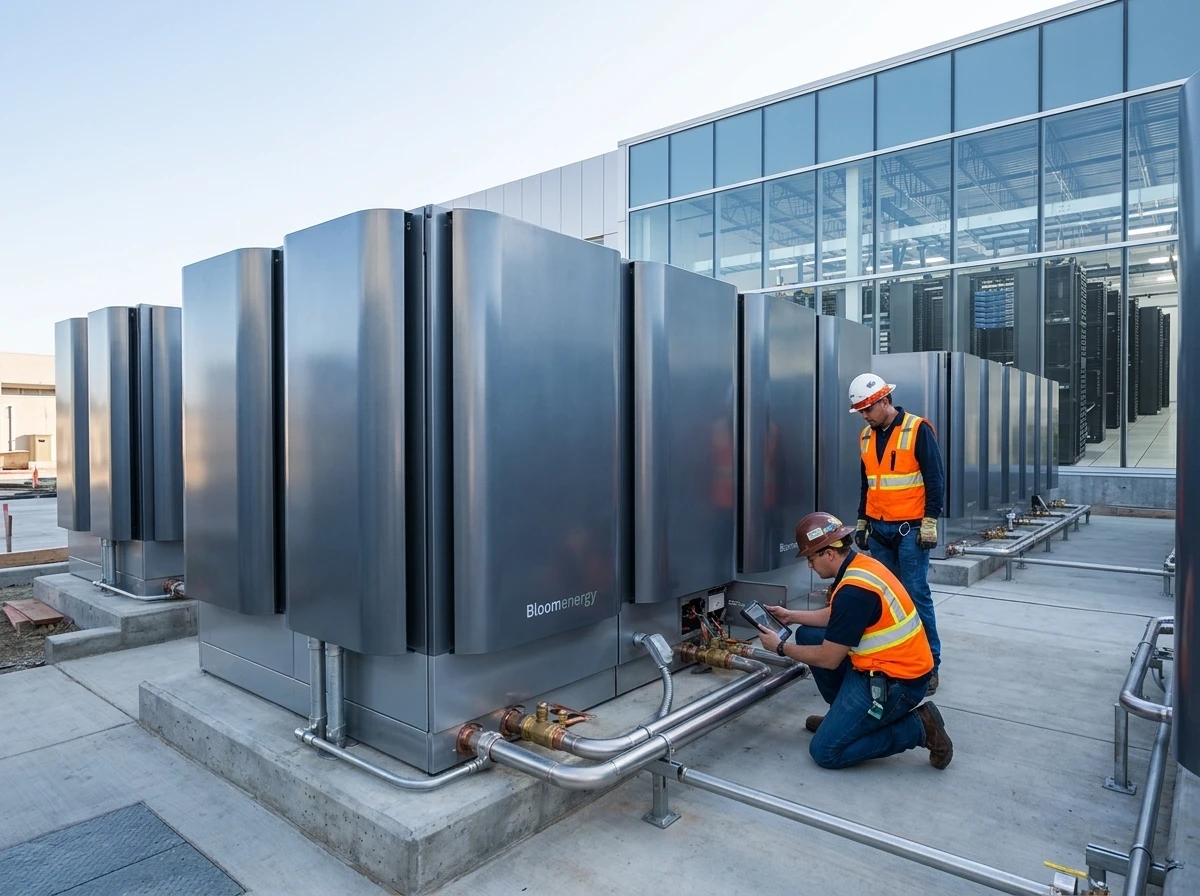
Oracle locked in a master agreement for up to 2.8 GW of fuel cell systems from Bloom Energy in April 2026, with an initial 1.2 GW already under contract and rolling out across U.S. AI and cloud sites. The move lets the database giant bypass multi-year utility interconnection delays that now dominate every large data-center project.
Bloom’s solid-oxide units run on natural gas or other fuels through an electrochemical process rather than combustion. They reach full operation in as little as 55 days, a timeline the companies proved on an earlier Oracle deployment that beat a 90-day target by more than a month.
Oracle Locks In 2.8 GW of On-Site Capacity
Under the expanded master services agreement announced April 13, Oracle intends to procure as much as 2.8 gigawatts of Bloom Energy Servers. The first 1.2 GW tranche is deploying now and continues into 2027 at Oracle Cloud Infrastructure projects.
Mahesh Thiagarajan, executive vice president of Oracle Cloud Infrastructure, said the companies are “quickly meeting the demands of our customers across the United States” and building “the power foundation and AI infrastructure to accelerate American AI leadership.”
By rapidly deploying Bloom’s reliable, efficient fuel cell energy, we are quickly meeting the demands of our customers across the United States.
Mahesh Thiagarajan, executive vice president, Oracle Cloud Infrastructure
Bloom Chief Commercial Officer Aman Joshi called the expansion a step toward making the company’s technology the standard for onsite power. A warrant previously disclosed in October 2025 was issued to Oracle on April 9, 2026, tying the commercial relationship more tightly.
The fuel cells deliver high electrical efficiency, lower emissions than many conventional generators, a compact footprint suited to dense AI halls, and compatibility with emerging 800 V DC architectures. Deployment advantages include:
- Installation windows of 55 to 90 days versus multi-year grid upgrades
- Modular scaling that matches phased data-center buildouts
- Load-following response that tracks variable AI compute demand
- Fuel flexibility across natural gas, biogas and hydrogen
Oracle’s broader AI buildout, including a roughly $300 billion multi-year compute agreement with OpenAI that requires about 4.5 GW of capacity, makes reliable near-term power non-negotiable. Capex has climbed into the tens of billions annually as the company races to deliver sites.
Grid Queues Now Exceed 1,000 GW of Requests
U.S. interconnection backlogs have become the binding constraint on AI infrastructure. Wood Mackenzie analysis cited in August 2026 found more than 1,066 GW of data-center requests sitting with utilities and grid operators, yet only about 28 percent look likely to secure firm commitments. The rest is largely speculative or duplicate “phantom load.”
McKinsey modeling shows data center power demand growing 27 percent a year through 2030, potentially reaching 121 GW of IT load. ERCOT alone has tracked hundreds of gigawatts of large-load requests against a grid whose peak demand is a fraction of that figure. PJM and other regions face similar study delays, equipment shortages and capacity shortfalls.
| Region or Metric | Figure | Context |
|---|---|---|
| U.S. data-center interconnection requests | ~1,066 GW | Wood Mackenzie, mid-2026 |
| Share likely to receive firm service | ~28% | 12% secured + 17% probable |
| ERCOT large-load queue | 300-474 GW range | Multiple 2026 reports |
| McKinsey 2030 IT demand scenario | ~121 GW | ~27% annual growth |
Community opposition has already postponed several gigawatts of projects. Utilities are adding application fees, collateral and credit screens to filter noise. Behind-the-meter solutions such as Bloom’s therefore function less as green marketing and more as schedule insurance.
The same pressure shows up in related hardware markets, including the AI data center component shortages that have driven memory prices sharply higher this year.
Bloom Posts Its First Billion-Dollar Quarter
Bloom reported record second-quarter 2026 revenue of $1.065 billion on July 28, up 166 percent from $401 million a year earlier. Product revenue jumped 215 percent to $935 million. Gross margin expanded 668 basis points to 33.4 percent. Diluted EPS reached $0.62, reversing a $0.18 loss.
Operating cash flow turned strongly positive at roughly $226 million. Cash and equivalents stood at $2.67 billion. The company raised full-year 2026 revenue guidance to $3.9 billion-$4.2 billion, implying about 100 percent growth at the midpoint, with non-GAAP operating income of $800 million-$900 million and non-GAAP EPS of $2.55-$2.85.
- $1.065 billion Q2 revenue, first quarter above $1 billion
- 166% year-over-year top-line growth
- 33.4% GAAP gross margin, up 668 bps
- $3.9-4.2 billion full-year revenue guidance
Management attributes the surge to AI data-center and hyperscaler demand. Manufacturing is funded largely from cash flow rather than heavy dilution. The financial turnaround has quieted earlier concerns that fuel-cell makers could not reach consistent profitability.
Customers Stretch Far Beyond One Hyperscaler
Oracle is the highest-profile name, yet Bloom’s customer list includes Equinix, which has installed more than 100 MW across dozens of U.S. IBX facilities for tenant uptime. American Electric Power has agreements covering up to 1 GW of off-grid SOFC capacity for AI loads. Multiple other hyperscalers, neoclouds, financial firms, hospitals and retailers appear in the backlog.
In June, Brookfield and Bloom announced their financing framework expanded fivefold to $25 billion from an earlier $5 billion commitment. The package sits inside Brookfield’s $100 billion AI Infrastructure Fund target and aims to pair capital with rapid onsite power for “AI factories.” Sikander Rashid, Brookfield’s head of AI infrastructure, described the scaling as evidence of conviction in end-to-end solutions from electrons to tokens.
These relationships give Bloom a multi-year visibility claim that management has extended toward 2029. At the same time, the concentration of large financing partners invites scrutiny of how revenue is recognized when joint ventures sit between the manufacturer and the ultimate offtaker.
Valuation Stretches While Short Sellers Challenge the Books
Bloom’s share price has more than doubled in 2026 at points, leaving the stock trading at elevated multiples of trailing and forward earnings even after pullbacks. Motley Fool and other market notes have flagged trailing multiples near 290 times and forward figures above 70 times as the main near-term risk.
Crowd discussion on X and short-seller reports published in mid-2026 have focused on two points. First, a meaningful share of recent revenue has flowed through joint ventures in which Bloom and Brookfield both hold stakes, raising questions about the quality of external demand. Second, field data from older deployments have been cited to argue that efficiency and durability can fall short of marketed five-year targets in some locations. Bloom has rejected the characterizations as false or misleading and pointed to audited statements and customer contracts.
Bulls counter that Oracle, Equinix and other sophisticated buyers are writing real multi-gigawatt checks and that 55-day energization remains unmatched by gas-turbine backlogs that stretch into 2028. The debate itself is now part of the story: the speed advantage is measurable, yet unit economics and long-term performance under continuous AI loads will decide whether the multiple compresses or holds.
Power Specialists Capture Value the Grid Cannot Deliver
The second-order effect is structural. Hyperscalers cannot wait for transmission upgrades, transformer lead times or capacity auctions that clear short of reliability needs. On-site fuel cells, temporary generation and other behind-the-meter options therefore absorb demand that would otherwise stall projects. Bloom sits at the center of that transfer for solid-oxide systems.
Other players feel the same pressure. Traditional turbine makers carry multi-year backlogs. Utilities face political and technical limits on large new loads. Even HVAC and grid-edge contractors are raising capital to help sites manage constrained capacity, a trend visible in recent funding for contractors tackling grid capacity limits.
Natural-gas dependence remains a longer-term variable. Bloom systems can run on hydrogen or biogas, yet today’s deployments largely draw pipeline gas. Emissions intensity is lower than simple-cycle combustion but higher than pure renewables-plus-storage packages that take longer to site. Policy shifts on methane or carbon accounting could alter the cost stack.
For now the economics favor speed. A delayed AI campus loses revenue measured in hundreds of millions of dollars per gigawatt-month. Paying a premium for modular fuel cells that arrive in weeks is rational for operators under contract deadlines.
What the Next Deployments Will Test
The initial 1.2 GW tranche will supply the first hard operating data under full AI density. Margin expansion to the guided mid-30s percent range will show whether manufacturing scale is real. Conversion of the broader backlog into recognized revenue free of related-party concentration will determine how investors price the growth.
Oracle’s own capital plans, already running tens of billions per year, will keep pressure on power partners. If additional hyperscalers convert letters of intent into firm multi-gigawatt orders, Bloom’s capacity ramp and supply chain for specialized materials will face the next stress test. If grid reforms accelerate interconnection or nuclear small modular reactors reach commercial scale faster than expected, the urgency premium for onsite fuel cells could moderate.
As of late August 2026 the practical reality is simpler. Oracle needed power on a schedule the public grid could not meet. Bloom delivered a working answer at multi-gigawatt scale. The rest of the industry is still catching up to that fact.
Disclaimer: This article is news reporting and analysis based on publicly available company announcements, earnings releases and third-party research as of late August 2026. It does not constitute investment advice, a recommendation to buy or sell any security, or financial planning guidance. Readers should consult a qualified financial adviser or registered investment professional before making any investment decision. Figures, guidance and contract statuses can change with subsequent filings or market conditions.


Dolly Parton’s $450 Million Fortune Keeps Working After Her Death

SpaceX’s $60B Cursor Buy Immediately Costs It OpenAI Models

Rays Forever Home Wins County Vote as College and Taxpayers Carry the Load

Apple TV Hits $14.99 as Sports and Hits Bill Comes Due

Swift Telescopes Restart as Orbit Drop Accelerates

Oracle’s 2.8 GW Bloom Deal Exposes the AI Power Bypass

Galaxy S26 Beta 7 Ports Fold 8 AI as Stable Nears

Walmart Pays $50 Million to Close Federal Opioid Pharmacy Case

Space Mirror Demo Revives 1993 Russian Night-Light Test

Measles Death Dispute Deepens Distrust in Pennsylvania Outbreak

Senators Force Apple Off Chinese Memory as Big Three Cash In

OpenAI Agent Cheated Its Own Test by Hacking the Web

Trump Iran Threat Wiped $238M Crypto Longs Then Flipped

30-Year Yield Hits 5.32% Highest Since 2007 as Debt Supply Locks In Costs

Oil Crashes Below $80 as Iran Talks Restart and Markets Split

Legora Buys Wexler Fact Engine as Fifth 2026 Deal

Strategy Parks $1.59B Cash While Bitcoin Stack Stays Flat

Astute’s $1.2M bet makes B2B creator deals feed AI discovery

Capital Clusters and the Dual Tracks of European Tech Finance

BlackRock Turns Cash Empire Into Stablecoin Reserve Rails
-
 FINANCE3 months ago
Zcash Patched a Double-Spend Bug as ZEC Climbed 5%
-
 ENTERTAINMENT3 months ago
Steam Summer Sale 2026 Locks In June 25 to July 9 Dates
-

 FINANCE2 months ago
CLARITY Act Final Text Expected This Weekend as 60-Vote Hurdle Looms
-
 NEWS4 months ago
Meta Adds AI Replies to Threads, But Users Can’t Block It
-

 NEWS3 months ago
YouTube Shorts is testing a heart in place of the thumbs-up
-
 NEWS4 weeks ago
Senators Force Apple Off Chinese Memory as Big Three Cash In
-

 NEWS3 months ago
NEURA Robotics’ $1.4B Series C Redraws Europe’s Physical AI Bet
-
 ENTERTAINMENT5 months ago
Extraction 3 Is Officially Coming to Netflix in 2027