
NEWS
Senators Force Apple Off Chinese Memory as Big Three Cash In
Bipartisan senators give Apple until August 21 to drop blacklisted CXMT and YMTC memory, locking demand for Samsung SK Hynix Micron amid AI shortage.

A bipartisan group of US senators gave Apple until August 21, 2026, to commit in writing that it will not source memory chips from blacklisted Chinese firms CXMT and YMTC. The letter lands in the middle of an AI-driven DRAM and NAND shortage that already forced Apple to raise prices on Macs, iPads, home devices and Vision Pro.
Led by Indiana Republican Jim Banks and New York Democrat Chuck Schumer, the group also includes Democrats Andy Kim and Jeanne Shaheen plus Republicans Mike Crapo and Pete Ricketts. Apple has not responded publicly.
Senators Set an August 21 Line
The demand, first reported by Bloomberg, targets any use of ChangXin Memory Technologies (CXMT) or Yangtze Memory Technologies Co. (YMTC) chips, even in devices made only for the Chinese market. Both companies sit on the Pentagon’s updated 1260H list of Chinese entities believed to support Beijing’s military. YMTC also appears on a Commerce Department blacklist that restricts controlled technology transfers.
Lawmakers argue a China-only arrangement still creates risk. Once a part clears Apple qualification, worldwide extension becomes a single procurement decision. They also asked whether Apple shared intellectual property during component qualification, a step that may require a Commerce Department license.
Once a part clears qualification for Apple production, extending it worldwide is a single procurement decision away
The senators wrote that line in the letter to CEO Tim Cook. The same group pressed Apple on whether it had sought priority allocation from US or South Korean memory suppliers. That answer will shape the company’s path into the 2027 iPhone cycle.
The written commitment they want is binary. Either Apple closes the door on both firms across every market, or it leaves open a channel that the senators treat as a national-security gap. The letter’s dual ask, on sourcing and on IP sharing, ties commercial procurement to export-control process in a single document.
Because the deadline is fixed and public, silence after August 21 would itself become a market signal. Investors already treated the letter headlines as actionable; a non-answer would extend that uncertainty into the next product-planning window.
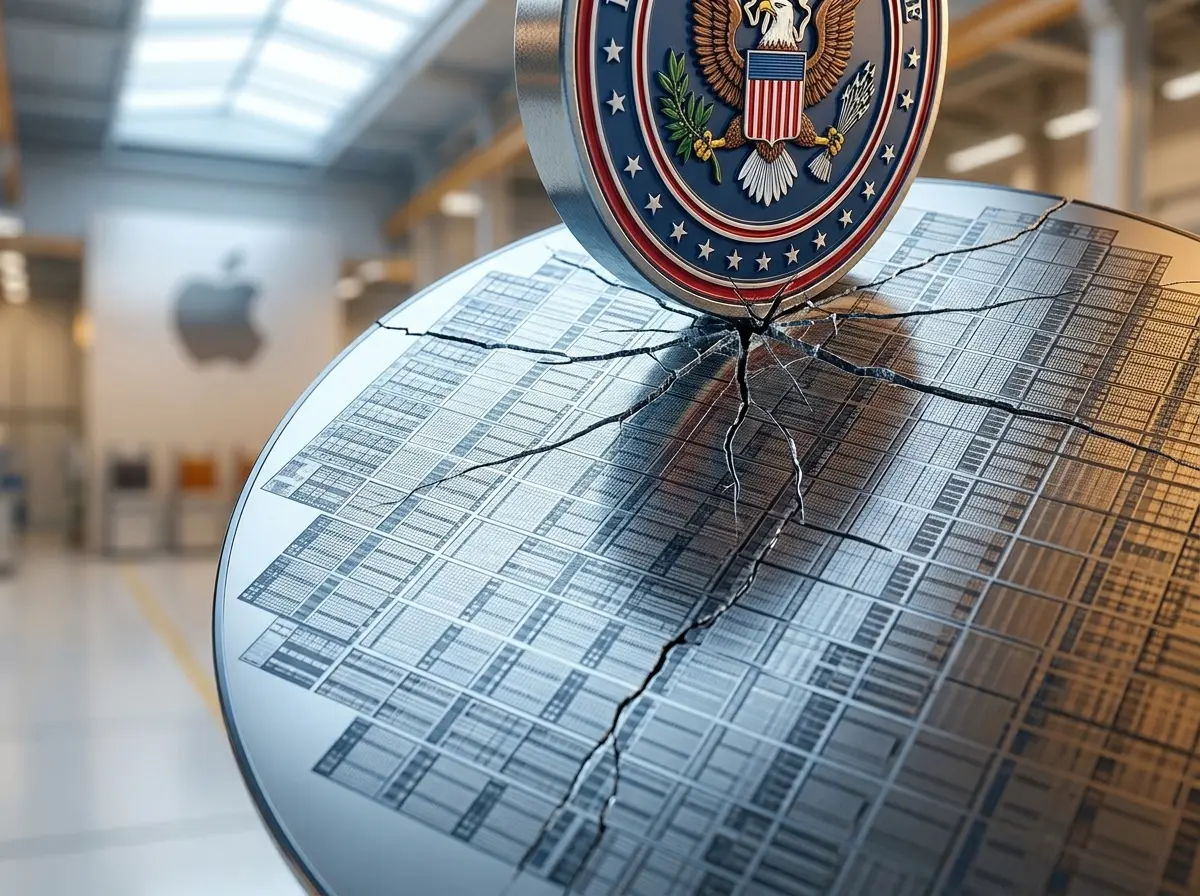
Memory Prices Already Forced Apple’s Hand
Global DRAM and NAND prices surged as AI data centers absorbed the bulk of output from Samsung, SK Hynix and Micron. Consumer electronics makers felt the squeeze first. Apple announced across-the-board price increases in June 2026. Cook told the Wall Street Journal that everything needs to be on the table regarding supply.
- AI absorption: Data-center demand locked high-bandwidth memory capacity at the Big Three.
- Consumer squeeze: Smartphones, PCs and tablets faced higher component costs and reduced allocation.
- Apple response: Price hikes hit Macs, iPads, home products and Vision Pro in a single wave.
- China option: CXMT and YMTC offered potential volume relief that Washington now seeks to close.
Crypto-native infrastructure operators face a parallel crunch. Firms such as Core Scientific have pivoted toward AI data-center deals amid the same competition for chips and power.
The June increases showed Apple could no longer absorb component inflation inside its own margins. Raising sticker prices on Macs, iPads, home devices and Vision Pro in one wave transferred part of the cost to customers. Closing the Chinese relief valve would remove one remaining path to cheaper volume and leave the company more exposed to whatever the approved suppliers quote next.
That sequence matters for the 2027 cycle. Price hikes already landed. Priority-allocation talks, if they happen, would be the next lever. Without them, Apple enters the next iPhone build competing for residual capacity after AI customers take their share.
Samsung SK Hynix and Micron Collect the Upside
If Apple complies, the Big Three keep every unit of Apple demand. That volume arrives on top of already tight HBM capacity reserved for AI customers. South Korean chipmakers and Micron stand to gain both volume certainty and pricing power. Samsung and SK Hynix recently cemented a $950B AI chip deal with Nvidia, Broadcom and others, further locking high-end supply.
| Supplier | Status vs Apple | Key Constraint | Recent Marker |
|---|---|---|---|
| Samsung / SK Hynix | Core approved suppliers | HBM locked to AI | $950B multi-year AI deals |
| Micron | Core approved supplier | US production ramp | Benefits from any China block |
| CXMT | Pentagon 1260H listed | Senate pressure to exclude | Shanghai IPO raised ~$8.5B |
| YMTC | Pentagon + Commerce listed | Prior 2022 block repeated | NAND flash focus |
Investors on X framed the outcome bluntly: Apple’s margin compression becomes memory margin expansion for the approved suppliers. The letter is not yet a legal ban, yet closing the Chinese relief valve moves DRAM pricing more than it moves AAPL in the short run.
Volume certainty compounds the pricing power already visible in the AI deals. When HBM lines are reserved for data-center customers, every additional consumer unit Apple must buy from the same suppliers tightens the residual pool. Micron’s US ramp and the South Korean producers’ multi-year commitments therefore reinforce one another. Apple compliance would route still more demand into that constrained channel.
CXMT Priced a Record Debut the Same Week
CXMT completed its Shanghai STAR Market IPO earlier the same week the letter surfaced. Shares soared 466 percent on its Shanghai debut, ending near RMB 49. The company’s market capitalization briefly topped $547 billion before settling near $490 billion, making it the most valuable mainland-listed firm at the close. It raised at least $8.5 billion, China’s largest debut since 2010 and 212 times oversubscribed.
Comparisons remain sobering. SK Hynix sits near $881 billion, Micron near $1 trillion and Samsung Electronics near $1.1 trillion. CXMT’s 8 percent global DRAM share still trails the leaders, yet the IPO valued Chinese self-reliance ambitions at peak AI-memory prices. Losing a potential Apple qualification removes a prestige Western customer just as the stock found its first public price.
| Company | Market Cap Marker | DRAM Position |
|---|---|---|
| Samsung Electronics | Near $1.1 trillion | Global leader tier |
| Micron | Near $1 trillion | Global leader tier |
| SK Hynix | Near $881 billion | Global leader tier |
| CXMT | Settled near $490 billion | About 8 percent share |
The valuation gap is structural. Even after a 466 percent debut pop and a brief run above $547 billion, CXMT still prices at roughly half the smallest of the Big Three. An Apple qualification would have narrowed the prestige gap faster than share gains alone. Without it, the IPO story rests more heavily on domestic demand and on the same AI-memory cycle that already favors the incumbents’ HBM lines.
The 2022 YMTC Episode Returns with Higher Stakes
Apple explored NAND flash from YMTC for iPhones in 2022. Bipartisan opposition killed the effort. The current letter mirrors that episode, only this time the shortage is deeper and AI demand has rewritten the entire memory market. Lawmakers now treat even China-only qualification as a national-security risk.
AAPL closed July 30 at $338.19, down 0.56 percent or $1.89 from the prior $340.08 close. The stock traded as high as $344 before noon, then shed roughly $6 in under two hours as the letter headlines hit. Pre-market July 31 quotes sat near $336.39. Markets priced margin risk and a forced supply-chain rethink in real time.
- 2022: YMTC NAND talks collapsed under Washington pressure.
- 2026: CXMT DRAM and YMTC both targeted with an explicit August 21 written commitment.
- Stock reaction: sharp late-day drop on the letter news, continued pre-market softness.
- Broader link: AI bubble fears already tied tech and crypto valuations after a $650 billion selloff.
The pattern shows lawmakers treating memory supply as a permanent national-security lever rather than a one-off commercial decision.
What changed between the two episodes is the depth of the shortage and the breadth of the target list. In 2022 the fight centered on YMTC NAND for iPhones. In 2026 the same bipartisan instinct covers both CXMT DRAM and YMTC, and it rejects a China-only workaround that might once have looked like a compromise. The stock’s intraday reversal, from a $344 high to a close at $338.19, showed how quickly that harder line reprices Apple’s near-term margin path.
The Letter Turns Shortage Into Leverage
AI demand already locked high-bandwidth memory at Samsung, SK Hynix and Micron. Consumer makers, Apple included, absorbed higher costs and thinner allocations. The senators’ letter arrives on top of that squeeze and converts a commercial shortage into a policy constraint.
Two pressure channels now run in the same direction:
- Market channel: Data-center buyers hold priority on HBM and keep consumer DRAM and NAND tight.
- Policy channel: The Pentagon 1260H list and the Commerce blacklist, reinforced by the August 21 demand, aim to keep CXMT and YMTC out of Apple’s bill of materials.
Either channel alone would lift pricing power for the approved suppliers. Together they reduce Apple’s alternatives at the same moment the company must plan the 2027 iPhone build. Cook’s earlier remark that everything needs to be on the table now collides with a Senate roster that wants one option struck from the table in writing.
Crypto infrastructure firms such as Core Scientific, already pivoting toward AI data-center deals, illustrate how widely the same chip-and-power competition reaches. Apple’s consumer volumes sit inside that wider contest, not outside it.
Bipartisan Pressure Follows a Clear Timeline
The current campaign did not appear from nowhere. It extends a sequence that links the 2022 YMTC fight to this summer’s IPO-week letter and to parallel Senate deadlines on technology rules.
- 2022: Bipartisan opposition ends Apple’s YMTC NAND exploratory talks for iPhones.
- June 2026: Apple lifts prices across Macs, iPads, home devices and Vision Pro as DRAM and NAND costs surge.
- Same week as the letter: CXMT’s Shanghai STAR Market IPO raises at least $8.5 billion and briefly values the firm above $547 billion.
- July 30: Letter headlines hit; AAPL fades from a $344 intraday high to a $338.19 close.
- August 7: Separate Senate calendar deadline on technology supply-chain rules.
- August 21, 2026: Written commitment deadline set for Apple on CXMT and YMTC.
Stacking the August 21 demand beside the earlier August calendar item shows lawmakers treating chip supply as a recurring oversight file, not a single vote. Each date forces a disclosure or a decision. Apple’s still-pending answer is the next disclosure on that calendar.
The roster itself, Banks and Schumer in the lead with Kim, Shaheen, Crapo and Ricketts, signals that the pressure is not confined to one party or one chamber faction. That breadth lowers the odds of a quiet commercial carve-out and raises the cost of simply waiting the letter out.
Priority Allocation Questions for the Next iPhone
Lawmakers asked whether Apple has already sought priority allocation from US or South Korean suppliers. A yes would signal the company is preparing for life without the Chinese option. A no would leave the 2027 iPhone cycle exposed to whatever capacity the Big Three can spare after AI customers take their share.
Compliance locks Apple into higher-cost, constrained supply. Non-compliance risks further political escalation and potential Commerce or Pentagon follow-on actions. Either path leaves Samsung, SK Hynix and Micron holding stronger cards. CXMT’s post-IPO valuation must now clear without the Apple qualification story that helped fuel the debut.
The August 21 deadline sits beside another tight Senate calendar deadline this month, underscoring how Washington is stacking hard dates on technology supply chains. Apple’s written answer, when it arrives, will tell the market which side of the winner-loser ledger the company accepts for the next product cycle.
Margin math follows the supply math. If Apple secures priority allocation, it still pays inside a tight market, yet it gains some certainty for 2027 builds. If it does not, the company competes for leftover wafers after AI contracts clear. In both cases the Big Three keep the volume and the pricing power the letter helps protect. The only open variable is how publicly Apple accepts that ledger when it answers the senators.


UK AI Mega-Rounds Capture Europe’s H1 2026 Funding Rebound

Highland Europe’s €1.1B Fund VI Draws Public Backing for Scaleups

TÖNNJES Backs Bikekey to Scale Digital Bike IDs Beyond Theft

Intropy’s $11M Seed Cracks Manual Spare Parts Moat

Inforcer’s $50M Series C Turns MSP Control Planes Into SMB AI Shields

Meta AI Lifts Instagram Scroll Time as Lawsuits Mount

Redmi Note 17 Leak Puts Giant Si-C Batteries in Midrange

Police Chiefs Back CLARITY Act as Passage Odds Sink Below 30%

Perceptron $6.5M Round Cracks AI Data Gatekeeping

HONOR MagicOS 11 Sets August 6 Date and Forces the Glass Race

CLARITY Act Final Text Expected This Weekend as 60-Vote Hurdle Looms

Kalshi Loses Major NY Prediction Markets Ruling to Judge Torres

Fed Minutes Cite AI Demand as Inflation Risk, Put a 2026 Hike Back on the Map

Marker AI Writing Startup Lands $13M Seed Led by Index Ventures

Dota 2 Esports World Cup 2026: Spirit Defends $2M Title In Paris

Meta’s Muse Spark 1.1 Beats Rivals on Price, Trails on Coding

CS2 Premier Season 5 Lands With Cache and a C4 Damage Rework

ARC Intelligence Closes €4M Seed Round in Roughly a Week

Finto Picks Munich Over Silicon Valley After YC, Raises $3.4M

Backrooms Returns to Theaters as the Everything Must Go Edition
-
 FINANCE2 months ago
Zcash Patched a Double-Spend Bug as ZEC Climbed 5%
-
 ENTERTAINMENT2 months ago
Steam Summer Sale 2026 Locks In June 25 to July 9 Dates
-
 FINANCE4 weeks ago
CLARITY Act Final Text Expected This Weekend as 60-Vote Hurdle Looms
-
 NEWS3 months ago
Meta Adds AI Replies to Threads, But Users Can’t Block It
-
 ENTERTAINMENT2 months ago
‘Widow’s Bay’ Review: Apple TV’s Sleeper Horror-Comedy Earns Its Fog
-
 NEWS5 months ago
U.S. Navy Deploys Solar-Powered Lightfish Drone to Patrol Oceans
-
 NEWS8 months ago
FolderFresh Review: This Free Tool Automates Windows File Organizing
-
 FINANCE3 weeks ago
Kalshi Loses Major NY Prediction Markets Ruling to Judge Torres