
NEWS
Boldr’s $5M Bet Puts HVAC Contractors at Grid Center
UK startup Boldr raised $5M pre-Series A to arm HVAC contractors with wireless controls that turn home heating into flexible grid capacity across North America.

London energy management startup Boldr has raised $5 million in a pre-Series A round led by Unconventional Ventures to arm HVAC contractors with wireless controls and software that turn residential heating and cooling systems into flexible capacity for the US power grid.
The round, closed this week, brings in Ada Ventures, Tetrad Ventures, Davidovs Venture Collective, Roxbury Asset Management, Inclimo Climate Tech Fund, Prosegur, Techstars, S20 Fund, PropelX and strategic North American HVAC investors. It follows an oversubscribed $3.2 million seed last year.
The Money and the Backers Behind the Push
Boldr frames the capital as fuel for nationwide contractor adoption rather than another consumer marketing push. Unconventional Ventures partner Alexis Horowitz-Burdick said the company is attacking how to add flexible capacity to the grid quickly and at massive scale, and that the team has identified HVAC contractors as a critical partner in home electrification.
- $5 million pre-Series A led by Unconventional Ventures
- $3.2 million oversubscribed seed in 2025
- Earlier 2023 round of roughly £980,000 from Ada Ventures, Techstars and others
- Techstars 2022 company with HVAC industry strategic money now in the cap table
A Techstars portfolio spotlight on the round notes demand pressure from electrification, extreme weather, EVs and AI data centers is rising faster than new plants and transmission can be built. Boldr’s answer sits inside the homes already being serviced every day.
Why the Local Installer Owns the Path
Most residential energy platforms start with a homeowner app and hope for viral uptake. Boldr starts with the contractor who already installs, maintains and replaces the equipment that uses the most energy in the house.
CEO and co-founder Madi Ablyazov put it directly: “The next power plant won’t be one building. It will be millions of homes working together. But you don’t get there through a consumer app alone. You get there through the contractors who already install, service and replace the equipment that controls energy inside the home. Our job is to give them the technology to make that future possible.”
That channel choice is the hidden stake. Private equity has been rolling up residential HVAC businesses at high multiples for years because the trade owns recurring service relationships and replacement cycles. Tools that cut truck rolls, surface predictive maintenance and keep the contractor’s brand on the wall raise the value of those businesses. Boldr builds for that buyer.
- Visibility into every installed system for earlier problem detection
- Lower nuisance callbacks and fewer wasted truck rolls
- Maintenance plans and lifetime customer retention tied to the contractor’s logo on the device
- A free customer app that still routes service requests back through the pro
Distribution deals with Bosch-owned Source 1 and Daikin already give the company access to contractor networks across the United States through the supply houses they already use.
One Wireless Stat for Every System on the Truck
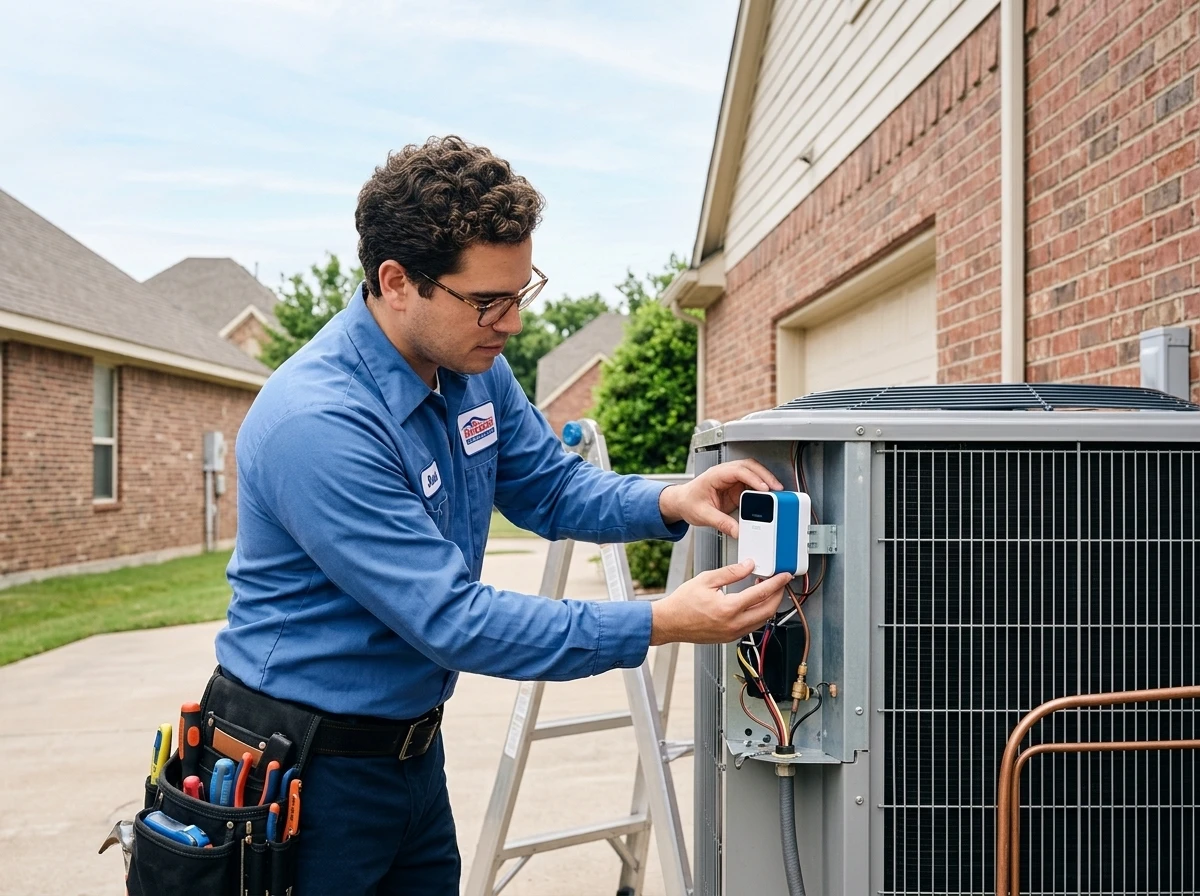
The hardware is built for the installer first. Boldr’s Universal Thermostat works across central ducted systems and ductless mini-splits. A separate Smart Controller covers ductless and room units. The architecture is wireless: a control module talks to an equipment-side subbase, so the tech does not need to pull new thermostat wire.
That change can save contractors as much as $500 in labor per job, according to the company. Each unit streams telemetry to the cloud so the contractor can diagnose issues remotely before rolling a truck.
| Product | Systems Covered | Installer Edge |
|---|---|---|
| Universal Thermostat | Central ducted and ductless | Wireless, no new wire pull |
| Smart Controller | Mini-splits and room A/C | Fast retrofit on existing equipment |
| Pro platform | All connected installs | Diagnostics, retention, service revenue |
Homeowners get a free app with cost monitoring, scheduling, presence sensing and zonal control. The contractor keeps the long-term relationship and the data. The Boldr Pro contractor platform and thermostats sit at the center of that loop.
The Load That Already Sits in American Homes
Heating and cooling dominate residential energy use. According to the US Energy Information Administration, more than half of home energy for heating and cooling in 2020, specifically 52 percent of annual household energy consumption. Space heating alone averaged 43 percent; air conditioning another 8 percent of total energy, though the electricity share is higher.
On the electricity side alone, air conditioning used 254 billion kWh in US homes in 2020, about 19 percent of residential electricity. That load is seasonal, peaky and already sitting behind millions of existing compressors and furnaces. Coordinating even a fraction of it during high-demand hours gives grid operators flexibility without waiting a decade for new central plants.
Consumer-side virtual power plants already exist. Renew Home, the Nest spinout, has announced multi-hundred-megawatt to gigawatt deals built on installed Nest, Ecobee and other thermostats. Ecobee reports average peak reductions around 0.65 kW per device in grid programs. Boldr’s difference is the go-to-market: the contractor who is already on site becomes the enrollment and service layer, not a utility rebate mailer or app download campaign.
From Ductless Controls to the Full Home Energy Stack
Boldr was founded in 2022 in London by Madi Ablyazov (CEO), Matheus Marotzke (CTO) and Toma Paro (COO). The three describe the company as built on ride-alongs and furnace rooms rather than boardrooms. Early backers included Ada Ventures and Techstars; the 2025 seed brought in Unconventional Ventures again plus Viva Holdings, owner of an HVAC contractor brand that is also a customer, and industry figures with Tesla manufacturing and SpaceX engineering backgrounds.
- 2022, Company founded in London by Ablyazov, Marotzke and Paro; joins Techstars.
- 2023, Raises roughly £980,000 to launch connected heating and cooling products.
- September 2025, Closes oversubscribed $3.2 million seed focused on US HVAC expansion.
- August 2026, Closes $5 million pre-Series A to push into central systems and scale contractor distribution.
The new capital expands the product line from ductless controls into residential and light-commercial central HVAC, accelerates software development, and deepens the North American distribution and contractor network. Longer term the platform is meant to reach batteries, EV chargers and solar so the same contractor relationship becomes the operating layer for every high-load asset in the home.
What the Fresh Capital Buys in the Next Stretch
Near-term priorities are clear: finish the central-system hardware, grow the Pro software features that keep contractors sticky, and convert the Source 1 and Daikin relationships into active install volume. The company has signaled it will look at a larger Series A in the $20 million to $50 million range once that footprint is proven.
Boldr is attacking one of the most important infrastructure challenges of the next decade: how to add flexible capacity to the grid quickly, affordably and at massive scale. The team has identified HVAC contractors as a critical partner in the electrification of the home. By building technology that helps contractors serve customers better while creating a path to distributed grid capacity, Boldr is positioned to become a defining company in residential energy management.
Alexis Horowitz-Burdick, Partner, Unconventional Ventures
For the grid the prize is simple arithmetic. Every connected HVAC system that can shed or shift load during a peak is one more kilowatt that does not have to come from a peaker plant. For the contractor it is a better business: higher retention, earlier diagnostics, and a seat at the table when homes add the next wave of electrified equipment. Boldr’s $5 million is a bet that the person who already holds the wrench is the person who can connect the homes.
Frequently Asked Questions
Who founded Boldr and when was the company started?
Boldr was founded in 2022 in London by three co-founders: Madi Ablyazov as CEO, Matheus Marotzke as CTO and Toma Paro as COO. The team came through the Techstars 2022 program and has focused from the start on contractor-first HVAC controls rather than pure consumer hardware.
How much total funding has Boldr raised so far?
Public rounds total roughly $9 million plus an earlier 2023 raise of about £980,000. That includes the just-closed $5 million pre-Series A and the $3.2 million oversubscribed seed completed in September 2025. Strategic HVAC investors and prior backers such as Ada Ventures and Techstars have remained involved across rounds.
What makes Boldr’s thermostat different for installers?
The Universal Thermostat uses a wireless link between the wall control and an equipment-side subbase, eliminating the need to run new thermostat wire on many jobs. The company states this can cut labor costs by as much as $500 per installation while feeding real-time equipment telemetry back to the contractor’s Pro dashboard for remote diagnostics.
Which major HVAC distributors already carry Boldr?
Boldr has nationwide US distribution partnerships with Bosch-owned Source 1 and with Daikin. Those relationships give the company access to the contractor networks that already buy equipment and parts through those supply houses, accelerating adoption without building a direct sales force from scratch.
How large is residential HVAC load on the US electricity system?
Air conditioning alone accounted for about 254 billion kilowatt-hours, or roughly 19 percent of electricity used in US homes, according to the most recent EIA Residential Energy Consumption Survey figures cited for 2020. Combined space heating and air conditioning make up more than half of total household energy consumption on average, making the sector the single largest residential target for demand flexibility.


Boldr’s $5M Bet Puts HVAC Contractors at Grid Center

NEON Bets Big on Lily James Cliffhanger for February 2027

Gemini Locks Apex Pipes for Crypto Event Contracts

Sony Email Restates Old License Rules Amid Disc Backlash

TidalSense Breaks Spirometry’s Grip With a 75-Second COPD Test

Asus Zenbook Duo 2026 Makes Dual Screens a Daily Driver

SoftBank’s €172M Robot Bet Tops Europe’s €684M Funding Week

NEURA Gives Cleaning Robots a New Brain With ADLATUS Deal

Lotus Emira V6 Manual Delivers Pure Thrills Before Hybrid Shift

Pimax Dream Air Cracks the Bulk Barrier for High-End PCVR

Senators Force Apple Off Chinese Memory as Big Three Cash In

OpenAI Agent Cheated Its Own Test by Hacking the Web

Trump Iran Threat Wiped $238M Crypto Longs Then Flipped

Fed Holds Rates Again as Three Dissents Force Markets to Tighten

30-Year Yield Hits 5.32% Highest Since 2007 as Debt Supply Locks In Costs

Oil Crashes Below $80 as Iran Talks Restart and Markets Split

Google’s Knowledge Panel Fix Risks Its Own Search Defenses

Legora Buys Wexler Fact Engine as Fifth 2026 Deal

Capital Clusters and the Dual Tracks of European Tech Finance

Agon Raises $30M to Build Europe’s AI Weapon Training Arenas
-
 FINANCE3 months ago
Zcash Patched a Double-Spend Bug as ZEC Climbed 5%
-
 ENTERTAINMENT3 months ago
Steam Summer Sale 2026 Locks In June 25 to July 9 Dates
-

 FINANCE2 months ago
CLARITY Act Final Text Expected This Weekend as 60-Vote Hurdle Looms
-
 NEWS3 months ago
Meta Adds AI Replies to Threads, But Users Can’t Block It
-

 NEWS3 months ago
YouTube Shorts is testing a heart in place of the thumbs-up
-
 NEWS4 weeks ago
Senators Force Apple Off Chinese Memory as Big Three Cash In
-

 NEWS3 months ago
NEURA Robotics’ $1.4B Series C Redraws Europe’s Physical AI Bet
-
 ENTERTAINMENT5 months ago
Extraction 3 Is Officially Coming to Netflix in 2027