
GAMING
Sony Email Restates Old License Rules Amid Disc Backlash
Sony’s terms email repeats standard license language used by every major storefront, colliding with the #PSBlackout and 2028 disc end.

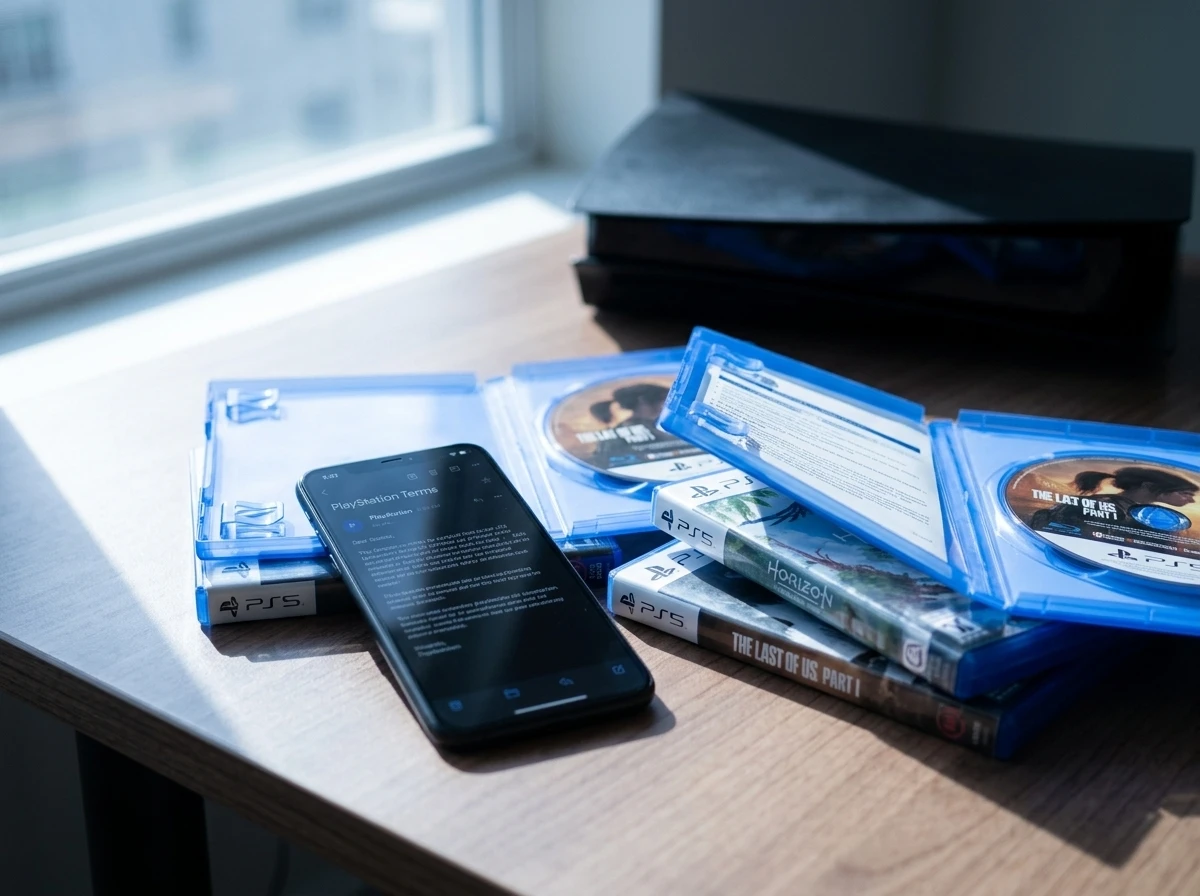
Sony sent PlayStation account holders a full copy of its terms of service, code of conduct, end-user license agreement and privacy policy over the past weekend. The email, subject-lined “PlayStation Terms, Copy for your records,” restates that digital software is licensed, not sold, just as the week-long #PSBlackout protest against ending physical discs began.
The language itself is not new. It has sat in PlayStation agreements since the PS3 era. What changed is the calendar: Sony already plans to stop physical disc production in January 2028 for all new titles, and a preservation group is urging players to power down consoles and skip purchases through August 30.
That overlap turned a compliance mailing into a public argument. The contract text had been available for years. The 2028 cutoff and the blackout put a hard date next to the same sentences, so players read them as a live warning rather than boilerplate.
The Email Spells Out a Limited Personal License
Recipients who opened the attachments found the familiar clause under the heading “The License to you.” The PlayStation Software EULA section 1.4 states the core rule in plain terms.
The Software is licensed to you, not sold. You are granted a limited, non-exclusive, non-transferable, and personal license to play or use the Software for your private, non-commercial use on the system or device it was intended for.
PlayStation Software Application End User License Agreement
Rights not expressly granted stay with Sony, including all intellectual property. The same section lists acts that immediately void the license: renting or sublicensing the software, modifying or reverse-engineering it, obtaining it outside authorized channels, emulating it, hacking or cheating, boosting services, copying or broadcasting without consent, and bypassing security measures.
- Account closure, termination, ban or suspension can cut access to paid virtual content.
- Offline modes are not guaranteed and may change or end at Sony’s discretion.
- Online features can be discontinued after reasonable notice; the offline portion that remains is still licensed, not owned.
- Liability in some regions is capped near £100.
India-region emails used slightly different shopping-store wording that reaches the same conclusion: you buy a personal licence for private use and do not own the digital product. Version notes point to an April 2026 revision of the broader terms, not a fresh rewrite of the ownership clause.
The attachments therefore function as a records package, not a policy change. Users who never opened the storefront legal pages now hold the same limits in their inbox, timed against a disc phase-out already on the public calendar.
Blackout Week Meets the Reminder
DoesItPlay, a game-preservation community, organized the #PSBlackout from August 23 at 7 p.m. local time through August 30. Participants are asked to log out, leave consoles off, make no purchases and avoid subscriptions for seven days. The group frames the action as a response to the 2028 disc decision plus earlier studio closures and live-service missteps.
The email waves hit between August 18 and 22. Some users said they received the message even though they had not powered on a PS4 or PS5 for months. Verge senior correspondent Tom Warren posted screenshots that drew more than two million views. Tom Warren called the timing a choice in the middle of the disc backlash and ownership debate.
- July 1, 2026, Sony Blog announces physical disc production for new PlayStation games ends January 2028; pre-2028 titles stay unaffected.
- Late July 2026, DoesItPlay and creators call for a one-week blackout in August; a Change.org petition gathers hundreds of thousands of signatures.
- August 18-22, 2026, Terms-copy emails arrive in PSN inboxes worldwide.
- August 23-30, 2026, #PSBlackout runs; players stay offline and spend nothing on PlayStation platforms.
Crowd posts on X treated the email as gasoline on an existing fire. One widely shared summary listed the practical risks: licenses can vanish with an account ban, chats and clips can be recorded, shared clips can carry ads with no cut for the player, and liability stays low. The common thread was less surprise at the legal text than frustration that the only remaining hedge against permanent loss is disappearing.
The blackout’s design is narrow on purpose. It aims at one week of revenue and engagement metrics rather than a permanent boycott, so the platform can measure a dip without facing an open-ended exit. Whether that dip registers is the argument between skeptics and supporters already playing out on X.
Steam, Xbox and Nintendo Use Nearly Identical Wording
The selective heat on Sony is the point that most rewrites skip. Valve, Microsoft and Nintendo all publish matching “licensed, not sold” language.
| Platform | Core Ownership Clause | Key Restriction |
|---|---|---|
| PlayStation | “The Software is licensed to you, not sold.” Limited, non-exclusive, non-transferable, personal license for private non-commercial use. | Account ban or closure can terminate access to paid content; reverse-engineering and emulation void the license. |
| Steam (Valve) | “The Content and Services are licensed, not sold. Your license confers no title or ownership.” | Requires Steam account and often an internet connection; license ends with agreement or subscription termination. |
| Xbox / Microsoft | “All Digital Goods are licensed, not sold.” Access subject to license terms, payment and codes of conduct. | Compliance required; additional terms can apply at acquisition. |
| Nintendo | “The Software is licensed, not sold, to you” under a non-exclusive, revocable license for personal non-commercial use on the console. | Use limited to what the agreement expressly authorizes; highly restrictive framing. |
Push Square editor Sammy Barker checked the documents side by side and found “broadly the same language in all of their terms and conditions.” The Steam Subscriber Agreement license clause is especially clear that no title transfers. Physical discs carry similar license disclaimers on the software itself; the difference is the physical object can be resold, lent or kept offline without an account check.
Industry-wide wording explains why the legal text alone rarely sparks a platform-specific revolt. The heat attaches when one company pairs that text with a firm end date for the format that still offered resale, lending and account-free play.
What the License Blocks in Practice
Players cannot transfer a digital title to another account, sell it second-hand, or keep a guaranteed offline copy if Sony ends support. A ban for any reason, including code-of-conduct issues or account recovery failure, can wipe the library. Expired third-party licenses have already removed purchased movies from libraries in the past. A 30-day online license check introduced earlier in 2026 for some post-update digital purchases added another layer of periodic verification for newer titles.
- No transfer of a digital title between accounts
- No second-hand sale of the purchase
- No guaranteed offline copy after support ends
- Library loss possible after ban, closure or failed recovery
- Periodic online checks on some newer digital purchases
None of these powers are unique to the latest email. They have been the operating reality of closed console ecosystems for more than a decade. The email simply made the fine print harder to ignore while the disc exit date sat on the calendar.
Physical Media Never Delivered Full Legal Title Either
Commenters repeatedly note that a disc is still a licensed copy of software. You own the plastic and the right to use the license encoded on it, not the copyright. You generally cannot make backup copies or run the game outside authorized hardware. The practical edges remain real: a disc works if the account dies, travels to a friend’s console, and sits on a shelf when servers shut down. Digital libraries do none of those things by default.
| Practical edge | Physical disc | Account-tied digital license |
|---|---|---|
| Play after account loss | Still possible on the disc | Access can end with the account |
| Lend or move to another console | Disc can travel with the player | Tied to the original account |
| Keep a copy when servers shut down | Shelf copy remains usable offline | Depends on what offline mode Sony still allows |
| Resale or second-hand market | Object can be sold or traded | No transfer of the purchase |
GOG’s DRM-free model is the frequent counter-example. Most console and major PC storefronts do not match it. Ending disc production for new PlayStation titles removes the last mass-market format that still delivered those practical edges for first-party and third-party games alike. Retail will still sell code-in-a-box packages after 2028, but those codes resolve to the same account-tied license.
Preservation Groups See the Larger Pattern
DoesItPlay and allied creators treat the disc decision as the final straw after studio closures, live-service pivots and reduced support for older hardware. Their blackout deliberately targets revenue and engagement metrics for one week rather than permanent cancellation. Skeptics on X argue a time-boxed protest is easy for a platform holder to wait out; supporters say any visible drop in concurrent users and store traffic still registers.
Sony’s July blog post called the disc phase-out a natural response to consumer preference for digital. CFO comments later indicated the company intends to proceed cautiously but does not expect lasting sales damage. The terms email did not address preservation or ownership policy. It simply reminded users of the existing contract.
For players who already live mostly digital, the email changes nothing about day-to-day play. For those who keep physical collections as insurance against account loss, delisting or server shutdowns, the 2028 date removes the insurance. That gap, not the novelty of the license text, is what turned a routine compliance mailing into a flashpoint during blackout week.
Code-in-a-Box Still Points Back to the Same License
Retail shelves will not go empty the day disc pressing stops for new titles. Code-in-a-box packages remain available after the January 2028 cutoff. The box is physical. The product inside is not.
Those codes redeem into the identical personal, non-transferable license described in the email. They do not restore resale, lending or account-free offline play. Pre-2028 disc titles stay unaffected under the July blog announcement, so older plastic keeps its practical edges. Everything released after the cutoff funnels into the account-tied model the EULA already defines.
That split matters for collectors and preservationists. A living shelf of earlier discs can still move between consoles and survive an account problem. The new-release pipeline cannot. The email did not create that split. The 2028 date locks it in for every future PlayStation game.
The Protest Window Closes Before the Format Does
The blackout ends August 30. Disc production for new games continues into early 2028. Players therefore have a multi-year stretch in which both formats still ship, even as the license reminder sits in millions of inboxes.
How that stretch is used is outside the scope of the email. The mailing restates limits that have applied since the PS3 era. The calendar around it, from the July announcement through blackout week to the 2028 cutoff, is what gave those limits fresh weight.
The protest ends August 30. New disc titles keep shipping until the January 2028 cutoff. After that date the only copies of future PlayStation games will be the licenses described in the email that just landed in millions of inboxes.


Boldr’s $5M Bet Puts HVAC Contractors at Grid Center

NEON Bets Big on Lily James Cliffhanger for February 2027

Gemini Locks Apex Pipes for Crypto Event Contracts

Sony Email Restates Old License Rules Amid Disc Backlash

TidalSense Breaks Spirometry’s Grip With a 75-Second COPD Test

Asus Zenbook Duo 2026 Makes Dual Screens a Daily Driver

SoftBank’s €172M Robot Bet Tops Europe’s €684M Funding Week

NEURA Gives Cleaning Robots a New Brain With ADLATUS Deal

Lotus Emira V6 Manual Delivers Pure Thrills Before Hybrid Shift

Pimax Dream Air Cracks the Bulk Barrier for High-End PCVR

Senators Force Apple Off Chinese Memory as Big Three Cash In

OpenAI Agent Cheated Its Own Test by Hacking the Web

Trump Iran Threat Wiped $238M Crypto Longs Then Flipped

Fed Holds Rates Again as Three Dissents Force Markets to Tighten

30-Year Yield Hits 5.32% Highest Since 2007 as Debt Supply Locks In Costs

Oil Crashes Below $80 as Iran Talks Restart and Markets Split

Google’s Knowledge Panel Fix Risks Its Own Search Defenses

Legora Buys Wexler Fact Engine as Fifth 2026 Deal

Capital Clusters and the Dual Tracks of European Tech Finance

Agon Raises $30M to Build Europe’s AI Weapon Training Arenas
-
 FINANCE3 months ago
Zcash Patched a Double-Spend Bug as ZEC Climbed 5%
-
 ENTERTAINMENT3 months ago
Steam Summer Sale 2026 Locks In June 25 to July 9 Dates
-

 FINANCE2 months ago
CLARITY Act Final Text Expected This Weekend as 60-Vote Hurdle Looms
-
 NEWS3 months ago
Meta Adds AI Replies to Threads, But Users Can’t Block It
-

 NEWS3 months ago
YouTube Shorts is testing a heart in place of the thumbs-up
-
 NEWS4 weeks ago
Senators Force Apple Off Chinese Memory as Big Three Cash In
-

 NEWS3 months ago
NEURA Robotics’ $1.4B Series C Redraws Europe’s Physical AI Bet
-
 ENTERTAINMENT5 months ago
Extraction 3 Is Officially Coming to Netflix in 2027