
NEWS
Ground A Raises €9.1 Million for a Pallet Laser
Ground A closed a €9.1 million pre-seed to industrialise a pallet-sized drone laser, while German law still blocks firing over civilian airports.

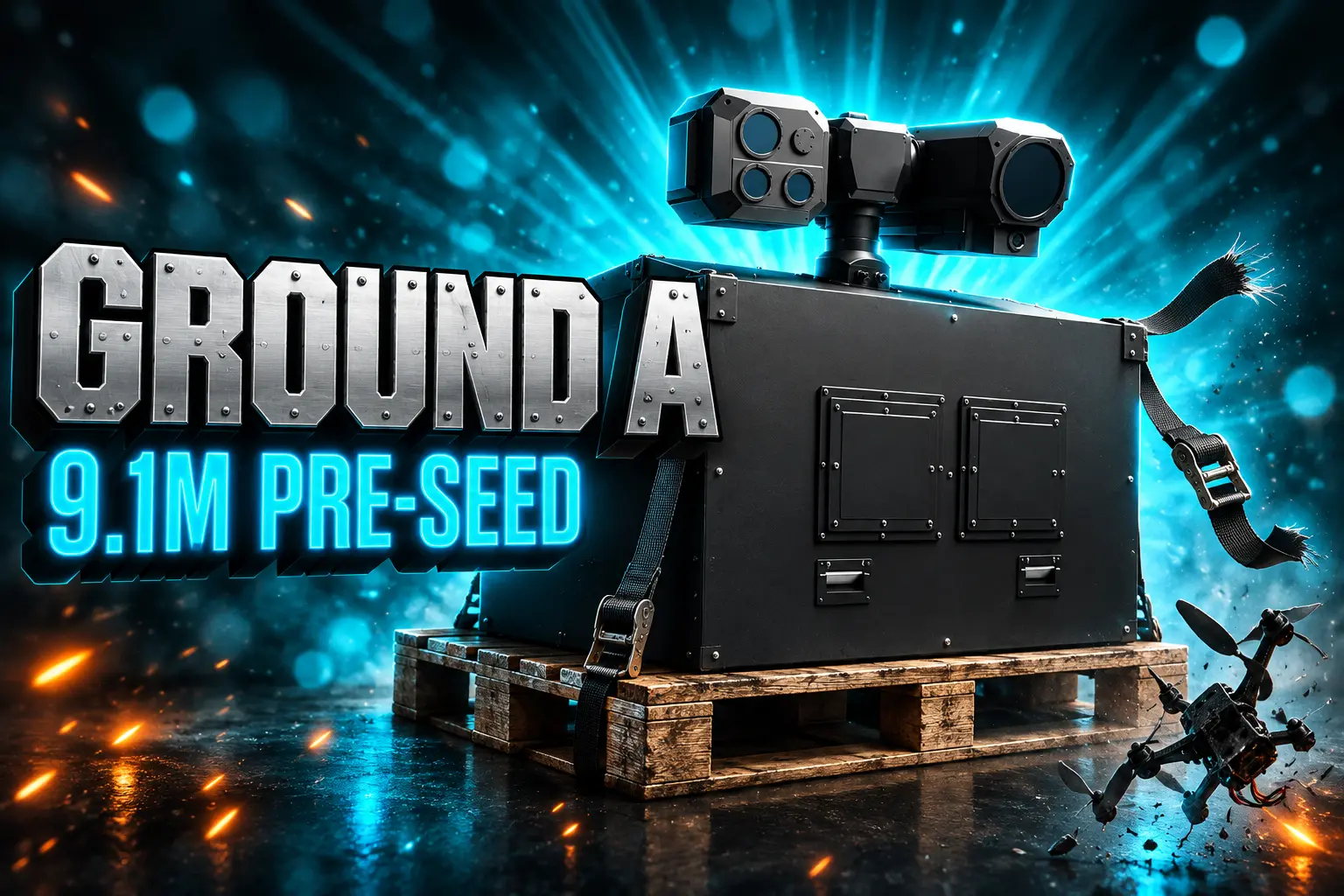
Ground A closed a €9.1 million pre-seed round in June to put a pallet-sized laser counter-drone system on a path to German series production. The Düsseldorf firm, founded in January 2026, left stealth on 8 September with the GA 1000 still in tests, a unit that weighs less than 200 kilograms and fits a Euro pallet.
Europe already has programmes that can burn a drone with light. Ground A is trying to make a version small enough to carry, priced in the low single-digit millions of euros, and built as a series product that plugs into existing command networks. German airspace law still will not let that beam fire freely over a civilian airport.
Ground A Closes a €9.1 Million Pre-Seed Round
The round, about $10.6 million, was led by Munich’s Vsquared Ventures. Quantum Systems joined as a corporate investor, with GRIF, Robin Capital, ABACON, Leblon Capital and OVNI Capital. On the cap table as well are Florian Seibel and Sven Kruck of Quantum Systems, Andreas Nauerz of J14 Capital, Marlon Braumann, and ARX Robotics managing director Stefan Roebel.
Dr Tobias Brune, the chief executive and co-founder, built the company with Daniel Hariri as technical chief and Roland Ralph Spiegelhalder on operations. Brune, who holds a doctorate in materials science from RWTH Aachen, had spent years scaling machines for aerospace and defence customers at two large firms. He told an interviewer that was not the usual founder path. He changed course after watching cheap FPV drones do serious damage with little in the way of a cheap reply.
The team went from three people at founding to five by March and 25 by September. Ground A’s own site says the prototype phase was finished within months of incorporation, and Brune puts the jump from prototype to testing at seven months. No GA 1000 has been sold. The cash is meant to finish prototypes, get first machines out, and grow the team, with another round planned for 2027 to lift manufacturing.
FROM JANUARY TO A 2027 LINE
- January 2026: Ground A is founded in Düsseldorf, with a Berlin branch.
- March 2026: Headcount reaches five.
- June 2026: The €9.1 million pre-seed closes.
- 8 September 2026: The company leaves stealth, shows the system in Berlin, and says it now has 25 people.
- Autumn 2026: A joint demonstration is planned with Munich interceptor startup Tytan Technologies.
- 2027: Series production is planned, and a further funding round is meant to expand the plant.
Benedikt von Schoeler, general partner at Vsquared, said counter-drone kit has to be mobile and quick to field, both for standing watch on civilian sites and for short-notice military use, and that Ground A is trying to scale from day one. Brune put the same point more bluntly: Europe needs systems that work and that can be made in large numbers.
What the GA 1000 Does in Three Seconds
On the company site the GA 1000 is sold as one box: radar, multi-sensor fusion, computer vision, proprietary AI, and a high-energy laser on a fast pan-tilt mount. It is built to detect, classify and track small, agile drones on its own. The shot stays with a human operator, a point Brune keeps repeating because German rules of engagement are expected to demand it.
Self-contained energy modules are meant to run the unit off-grid. The packs are stackable, swapped in the field, and recharged, so the same pallet can sit on a vehicle, at a remote site, or beside a plant. Ground A lists 360-degree detection and early acquisition at a range of several kilometres.
THE GA 1000 ON PAPER
- Weight and carry: Less than 200 kilograms, Euro-pallet footprint, moved by four people.
- Cycle time: About three seconds to identify a drone, lock on and start firing, then about one second of laser time on the airframe.
- Laser and battery: Single-digit kilowatt class, focused on a Euro-coin spot, with one hour of laser time on the battery.
- Price band: A system is meant to cost a low single-digit millions of euros, depending on the package.
- Fit: Designed to plug into existing air-defence and NATO command networks, and onto land, sea and air platforms including tanks and unmanned ground vehicles.
Brune splits the market in two. Heavy directed-energy programmes in the 50 to over 100 kilowatt class, including work he groups with Rheinmetall and MBDA’s HoWiSM, are in his view a different product, and he does not expect them to be fully operational until 2029. Ground A is chasing the lighter, software-tied layer that can be moved by a small crew.
Four Sensors, a Euro Coin and a Human Trigger
At a Berlin test range on 8 September, technicians and guests wore laser safety glasses while the beam did the work. In the focal spot the drones caught fire, flashed, and fell with a trail of smoke. That is the specimen, not a slide: a short dwell, a small glowing point, then a cheap airframe coming apart.
The hard part, Brune said, is automatic tracking of tiny FPV drones that do not fly in a straight line. Four optical sensors sit on the unit. He claims that suite can pick up a bee swarm at two kilometres and still resolve individual bees. Latency is handled in milliseconds, with the tracker trying to predict where the target will be, not where it was.
Effectiveness is energy on a small patch, which is why he says a single-digit kilowatt laser is enough if it stays on a Euro-coin area. A one-second burn is the working figure in practice. Theoretical rates that assume drones arriving in a neat line do not survive contact with a real raid, because each track has to be found again.
A short burst is cheap as electricity. The engineering that actually decides whether this pallet works outdoors is dumping waste heat and holding beam quality in rain and dust, which is where compact lasers have failed before. Ground A has not published weather limits or a cost per shot of its own.
Today our first system is in the testing and validation phase, on the verge of market launch. This kind of speed is urgently needed for Germany, Europe and allied nations. We deliberately focused on advancing the product first and delivering results before talking more broadly about Ground A.
Dr Tobias Brune, CEO and co-founder, Ground A
He also said he is glad several firms are in the field, because he does not think a viable, scalable answer exists yet. That is a founder talking his book, and it is also the state of the European catalogue.
Backing the Laser That Kills Drones
Quantum Systems is a German drone maker. It is also a Ground A investor. Seibel, a Quantum Systems co-founder, put in personal money as well. Asked about that cheque, Brune said, “I hope that my smile convinced him.” He added that drones and the tools that stop them will keep chasing each other, because the aircraft keep getting cheaper and more autonomous, and that Seibel understands both sides.
In July Quantum Systems announced a $1.2 billion Series D that valued the company at about $8 billion, with Airbus among the co-leads. Putting that firm on a laser that burns drones is not charity. If cheap aircraft are going to fill European airspace, the same industry group wants a say in how they are stopped, and on whose command network.
The GA 1000 is written as an open fit, not a lone tower. A planned autumn 2026 demo with Tytan points the same way. Tytan builds a kinetic interceptor, listed at more than 250 km/h, more than 15 kilometres of range, and a 5 kilogram airframe, and it already has Bundeswehr work on site protection. A laser on a pallet and a small hit-to-kill drone are different tools for different ranges. Ground A is pitching the cheap, close-in shot that does not throw a round into a crowded city.
Frankfurt Airport Still Bars the Beam
The product story runs into a legal wall at home. Brune said a laser still cannot be used freely in German airspace, including over Frankfurt Airport. Detection and tracking can be sold now. If domestic law moves the way France already has, he said, the laser can be retrofitted so the same box can actually knock drones down.
That gap is the second-order problem. A four-person pallet is useless as a civilian shield if only the state may fire, and the state is still arguing with itself. After sabotage against companies and other sites, the federal government and the states are talking about new drone-defence powers. A Federal Interior Ministry spokeswoman said a working shield raises complex legal questions around the state’s monopoly on force, and that those talks run between ministries and between Berlin and the Länder.
Some of the statute has already moved. On 26 February 2026 the government set out armed forces may assist police with drone defence, including armed force as a last resort, after a reform of the Federal Police Act on 8 October 2025. The Bundeswehr has also published expanded inland drone-defence powers under the Aviation Security Act, allowing weapons or other effectors against unmanned aircraft in defined cases.
Interior Minister Alexander Dobrindt has gone further in public. After a 4 August 2026 drone incident at Leipzig/Halle Airport, in which a small drone hit a parked aircraft, he said Russia’s hybrid attacks had become daily life: “These attacks will increase, but we can defend and protect ourselves.” The interior ministry’s package, as described around that interview, would station rapid federal police counter-drone units in nine cities (Frankfurt am Main, Munich, Hamburg, Berlin, Stuttgart, Düsseldorf, Leipzig, Hanover and Cologne) and give operators of power, water and defence plants the legal right to fend drones off themselves, rather than only detect them.
Germany’s foreign office media arm posted the Berlin unveiling the same day.
https://x.com/en_germany/status/2097293875719123112
WHAT WE KNOW
- The beam: A laser still cannot be used freely in German airspace; Ground A can already offer detection and tracking and says the effector can be added later.
- The statute: Bundeswehr support to police, and inland use of force against unmanned aircraft, have been widened in 2025 and 2026, but the civilian trigger is still in talks.
- The customers Ground A names: military users plus energy, telecoms, transport, health sites, and, if the brief is stretched, prisons and border units.
WHAT IS UNCONFIRMED
- The factory: Ground A is talking to two German states about a production site and wants a fast decision; no location is public.
- The volume: Plans discussed around the launch put next year’s output on the order of 100 systems; that is a target, not an order book.
- The law: No date is set for the retrofit window Brune described, and no GA 1000 sale has been disclosed.
Until those three items move, the company is selling a sensor that might grow a gun.
How Cheap the Shot Needs to Be
The reason anyone is funding pallet lasers is the missile bill. A defender that spends a six-figure interceptor on a plywood decoy loses the raid even when the sky is clear. Directed energy is the attempt to flip that sum: pay for the box once, then spend electricity.
Britain has already put a number on a heavier naval system. DragonFire costs just £10 per shot, according to the Ministry of Defence, after trials against drones flying at up to 650 km/h, and a £316 million contract is meant to put it on a Type 45 destroyer from 2027. The same notice says the beam is accurate enough to hit a £1 coin from a kilometre, and that missiles cost hundreds of thousands of pounds per round.
Ground A has not published its own electricity cost. It is selling a much smaller laser, on a battery, at a system price in the low single-digit millions of euros, against naval and vehicle programmes that live in another power class.
THE COST OF THE SHOT
| System | Form and power | Status | Price cue |
|---|---|---|---|
| GA 1000 (Ground A) | Euro pallet, four-person lift, single-digit kW, less than 200 kg | Testing and validation, no units sold | Low single-digit millions of euros per system; one hour of laser time on the battery |
| DragonFire (MBDA, QinetiQ, Leonardo) | Ship-borne high-power laser | Royal Navy from 2027 | £10 per shot; £316 million contract |
| Heavy HEL class (Brune’s grouping, incl. HoWiSM) | 50 to over 100 kW | Full operations 2029, per Brune | Described by Brune as a different system |
| Missile interceptors (UK comparison) | Kinetic round | In service | Hundreds of thousands of pounds per shot, per the Ministry of Defence |
A pallet at a few million euros only wins if it can be bought in dozens, left on a perimeter, and fired often. That is why the 2027 line on the calendar matters more than the smoke trail in Berlin.
The Factory, Two States and 2027
Ground A says it is setting up modular series production in Germany. Brune wants a site decision soon so the build can start. The next financing round, planned for 2027, is the one that is supposed to expand capacity in a serious way. Series production itself is planned from 2027.
He is not alone in that queue. Hannover’s INLEAP Photonics closed a €20 million seed round on 1 September 2026 to scale its own laser drone defence, and it is already in Bundeswehr-linked tests. Fiberbridge, also in Hannover, is in the same race. Trumpf’s laser development chief has talked about offering a laser weapon by 2027. Brune’s line that there is no scalable product yet is the sales pitch; it is also an admission that Germany now has several teams trying to industrialise the same shot.
THE GERMAN LASER QUEUE
- Ground A: Pallet-sized GA 1000, €9.1 million pre-seed, 25 people, tests under way, plant talks with two states.
- INLEAP Photonics: €20 million seed, Bundeswehr and Cyber Innovation Hub work, pitching very fast beam steering and urban-safe intercepts.
- Tytan Technologies: Kinetic interceptors, not a laser, lined up for an autumn 2026 joint demo with Ground A.
- Heavy primes: 50 to 100-plus kW programmes that Brune treats as a later, larger class.
Demand, Brune said, will keep growing, including at civilian plants far from any front. That may be true. It does not close the gap between a 25-person startup, a beam that German law still treats as a special case, and a 2027 factory that does not yet have a postcode. The GA 1000 is in validation. The cheque is a wager that the pallet, not the physics lecture, is what Europe is short of.


Replit Opens Its London Office Inside an AI Crowd

Straight Circle Trailer Lands Without a U.S. Date

Anemo Labs Bets £700,000 on an AI Sense of Smell

Nintendo Prices the Zelda 40th Switch 2 at $519

Copilot Capital Buys the Autopilot Already Running 90 GW

Ground A Raises €9.1 Million for a Pallet Laser

Gibney’s Musk Film Opens in Venice Without Its Subject

Torvalds Blames AI for a Full-Fat Linux 7.3-rc2

Dexter Returns Sharper, Older, and Stuck Between Killers

Meta’s Muse Agent Can Spend Before the Privacy Lock

Walter’s TWG Insists No Fraud as Insurer Probes Force Cleanup

30-Year Yield Hits 5.32% Highest Since 2007 as Debt Supply Locks In Costs

PCE Stays at 3.7% as Gas and Tariffs Outrun Coming Revisions

Evernorth S-4 Clears Path for Active XRP Treasury on Nasdaq

Astute’s $1.2M bet makes B2B creator deals feed AI discovery

Strategy Parks $1.59B Cash While Bitcoin Stack Stays Flat

CLARITY Act Cloture Opens a Door Ethics Still Blocks

Instinct Hits $2.5 Billion as AI Agent Access Sparks Trust Fights

Oracle’s 2.8 GW Bloom Deal Exposes the AI Power Bypass

AI data centers win as RAM kits jump nearly 500 percent
-
 FINANCE3 months ago
Zcash Patched a Double-Spend Bug as ZEC Climbed 5%
-
 ENTERTAINMENT3 months ago
Steam Summer Sale 2026 Locks In June 25 to July 9 Dates
-

 FINANCE2 months ago
CLARITY Act Final Text Expected This Weekend as 60-Vote Hurdle Looms
-
 NEWS4 months ago
Meta Adds AI Replies to Threads, But Users Can’t Block It
-
 ENTERTAINMENT5 months ago
Extraction 3 Is Officially Coming to Netflix in 2027
-

 NEWS3 months ago
YouTube Shorts is testing a heart in place of the thumbs-up
-

 NEWS1 month ago
Senators Force Apple Off Chinese Memory as Big Three Cash In
-

 NEWS3 months ago
NEURA Robotics’ $1.4B Series C Redraws Europe’s Physical AI Bet