
FINANCE
OCC Conditionally Clears Trump-Linked USD1 Trust Bank
OCC grants preliminary conditional approval for World Liberty Trust to issue USD1 under federal supervision, embedding Trump family stakes in crypto bank rails.

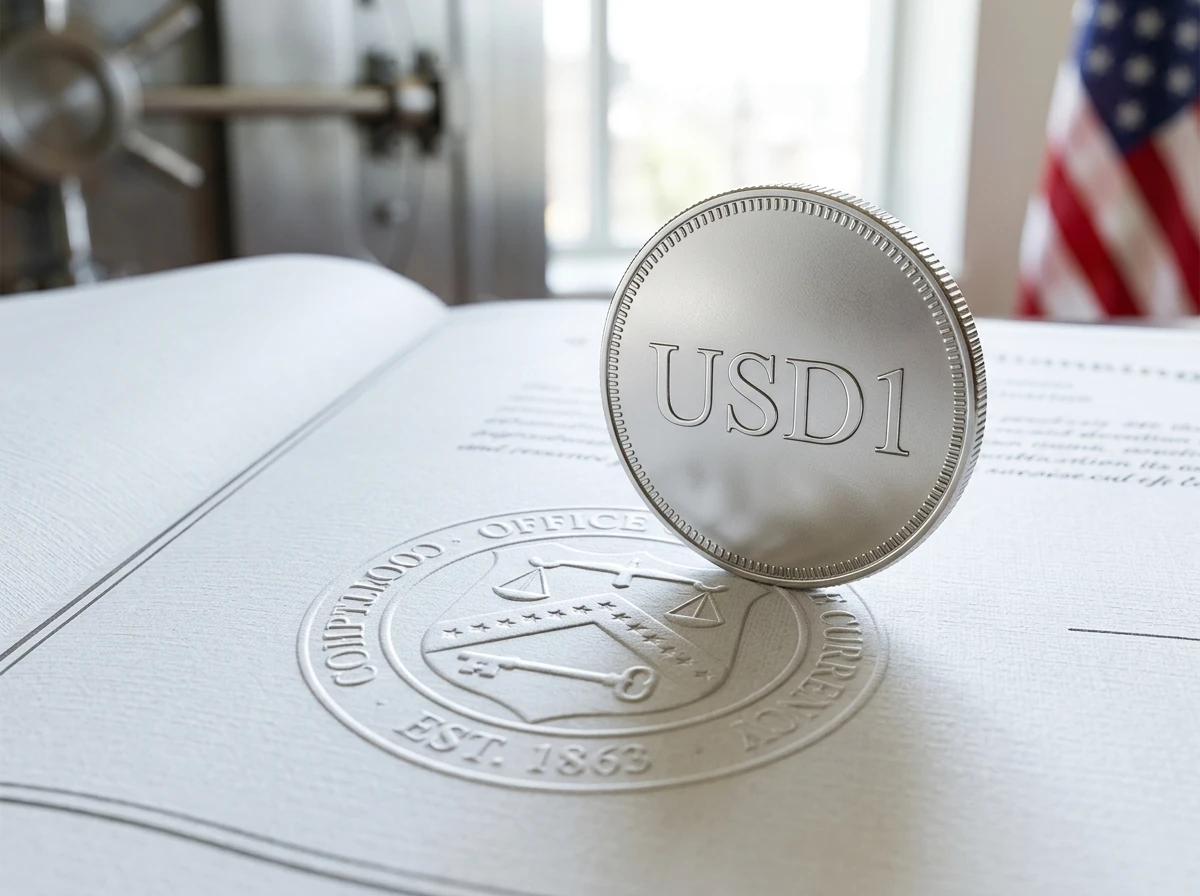
The Office of the Comptroller of the Currency granted World Liberty Financial preliminary conditional approval on August 14, 2026, to organize World Liberty Trust Company, National Association, a de novo national trust bank built to issue, redeem and custody its USD1 stablecoin under federal supervision. USD1 already exceeds $4 billion in circulation. The move pulls those functions in-house from BitGo and places a Trump family-linked issuer inside the same OCC framework now used by Circle, Ripple and others.
That is the first-order news. The second-order effect is sharper: a sitting president’s economic stake now sits inside federally supervised crypto-bank rails, and the approval instantly reopened ethics fights and legislative counter-moves that pure-play stablecoin firms largely avoid.
What the Conditional Charter Permits
World Liberty Trust Company would operate as an uninsured national trust bank headquartered in Bay Harbor Islands, Florida, and wholly owned by WLTC Holdings LLC. Its planned activities are narrow: non-fiduciary issuance and redemption of USD1 plus reserve management; fiduciary digital-asset custody for institutional clients; and conversion services that let custody customers exchange approved stablecoins for USD1.
The preliminary conditional approval letter makes clear this is not final authorization to open. The bank must still meet every pre-opening requirement. The OCC retains the right to modify, suspend or rescind the preliminary grant if interim developments warrant it. Career staff handled the review under delegated authority, the letter states, and the Comptroller’s office consulted government ethics officials.
| Requirement | Detail |
|---|---|
| Minimum capital | $20 million tier 1 capital; greater of 50% or $10 million in eligible liquid assets |
| GENIUS Act compliance | Must conform, cease or divest stablecoin activities to match the Act and rules |
| Passivity commitments | StringZ Holdings RSC (DE) LLC, DT Marks SC LLC and AMGUS, LLC confirmed passive indirect investments |
| Asset transfer from BitGo | OCC approved exemption under Regulation W for the new bank’s purchase of reserves and liabilities |
| Internal controls | Qualified internal audit manager; segregated customer assets; AML and sanctions screening; regular OCC exams |
| Other | Advance notice of major business-plan changes; Federal Reserve Bank stock application |
Trust banks of this type do not take retail deposits or make loans. They do not carry FDIC insurance. Under the GENIUS Act, payment stablecoins are explicitly not deposits.
The Board and Operating Team
WLTC plans a five-member board that mixes World Liberty founders with independent directors from accounting, regulation and markets.
- Zach Witkoff, Chair: co-founder and CEO of World Liberty Financial; President and Chairman of the proposed trust bank
- Scott Alper: President and Chief Investment Officer of Witkoff Group
- Robert Witkoff: former Co-Chief Investment Officer of The Chubb Corporation
- Jeffrey Weiner (independent): former Chairman and CEO of Marcum LLP
- Erin Baskett (independent): FINRA Board of Governors member and founder of Sine Qua Non Capital
Mack McCain is slated as Chief Trust Officer. Daniel Dietzel, former CFO of institutional prime broker Hidden Road, is named Chief Financial Officer. The structure is designed to place issuance, custody and reserve management under one supervised roof with independent directors in the room.
What makes a stablecoin trustworthy is the strength of the reserve behind it, and who stands accountable for it. A national trust bank brings USD1 issuance, custody, and reserve management together under OCC supervision, examined on the same standards that have governed banks for generations.
Zach Witkoff said that in the World Liberty announcement of the OCC grant. On X the same day he added that the ambition is “to build the most trusted and widely used digital dollar in the world while strengthening the role of the U.S. dollar across the global economy,” a post that drew more than 60,000 views.
Shifting Issuance and Reserves Off BitGo
Today BitGo Bank & Trust serves as exclusive issuer and custodian for USD1. Reserves sit in U.S. dollars on deposit, U.S. government money market funds and cash equivalents, with monthly attestations. The USD1 reserve and custody structure has supported growth across major exchanges and multiple chains since the 2025 launch.
Once open, World Liberty Trust intends to acquire and assume the USD1 reserve assets and related liabilities from BitGo. The OCC granted a written exemption from certain Regulation W quantitative limits and collateral rules for that transfer because it is tied to formation of the new bank. The practical result is vertical integration: the same supervised entity mints and burns the token, holds the reserves, and offers institutional custody.
Fee-free issuance and redemption at launch is part of the stated plan. For institutions already using USD1 for cross-border settlement and treasury, the change replaces a third-party arrangement with direct federal oversight of the issuer itself.
Family Stake Turns a Charter into a Flashpoint
DT Marks DEFI LLC, an entity affiliated with President Donald Trump and family members, owns about 38 percent of the holding company that controls World Liberty Financial, per company disclosures reported by Politico. The entity and Trump family members also hold 22.5 billion of the governance tokens. Trump disclosed nearly $600 million in income from World Liberty token and equity sales in 2025 as part of broader crypto-related earnings.
World Liberty and the White House have said the president does not manage the company and that no leaders or employees work for the federal government. Passivity commitments from named investors appear in the OCC file. Critics were unmoved. Sen. Elizabeth Warren called the approval “the most brazen act of self-dealing our financial system has ever seen” and, with other Democrats, unveiled legislation the same day that would bar regulators from approving banks owned or controlled by the president, vice president, members of Congress or certain other officials.
Citizens for Responsibility and Ethics in Washington described it as the most egregious example to date of presidential businesses profiting from the office. On X, former Coinbase counsel Hailey Lennon wrote that she had not expected the OCC to clear the application given the perceived political conflict. Crowd reaction split between those who saw crypto firms finally becoming regulated infrastructure and those who saw a regulator appointed by the president clearing a family-linked vehicle.
That is the second-order distinction. Circle, Ripple, Paxos and Fidelity received similar charters without a sitting president’s economic interest attached. This one carries permanent political risk premium even if every technical condition is met.
One More Name in a Fast-Growing Trust Charter Wave
World Liberty is late to a list that expanded rapidly after the GENIUS Act created clearer federal space for payment stablecoin issuers. On December 12, 2025, the OCC announced five national trust bank conditional approvals in a single day: de novo charters for First National Digital Currency Bank (Circle) and Ripple National Trust Bank, plus conversions for BitGo, Fidelity Digital Assets and Paxos.
| Firm / Entity | Type | Key date | Status snapshot |
|---|---|---|---|
| Circle (First National Digital Currency Bank) | De novo | Conditional Dec 2025; full approval July 2026 | Circle National Trust operating path open |
| Ripple National Trust Bank | De novo | Conditional Dec 2025 | Conditional |
| BitGo, Fidelity Digital Assets, Paxos | Conversions | Conditional Dec 2025 | Conditional |
| Bridge, Crypto.com, others | Various | Early 2026 | Conditional wave continued |
| World Liberty Trust Company | De novo | Conditional Aug 14, 2026 | Pre-opening conditions pending |
Circle’s full approval in July 2026 showed one route from conditional grant to open doors. Readers tracking that sequence can see Circle’s path to full OCC trust bank for the commercial and market reaction side. World Liberty’s application, filed early in 2026, now sits in the same pipeline with the political overlay layered on top.
Democratic scrutiny of the broader set of crypto trust applications is not new. Earlier requests for OCC records and pauses formed part of earlier Democratic pressure on crypto trust charters. The World Liberty decision simply concentrated that pressure on one high-profile file.
What Full Approval Would Change and What Stays Contested
If World Liberty Trust satisfies every remaining condition and receives final authorization, it can issue and redeem USD1 directly, manage the reserves itself, and offer institutional custody under continuous OCC examination. That removes the BitGo intermediary layer, simplifies multi-state operations under a single federal charter, and gives counterparties a supervised balance sheet for the stablecoin’s liability side.
The bank has committed not to become a “bank” under the Bank Holding Company Act and has no current plan to seek a Federal Reserve master account. CRA does not apply because the institution will not be FDIC-insured. Public commenters raised systemic-risk, emoluments and foreign-investor points; the OCC treated most of those as outside the statutory factors for this limited-purpose charter or already addressed by passivity letters and GENIUS Act conditions.
What we know
- Preliminary conditional approval dated August 14, 2026, Control No. 2026-Charter-344521
- USD1 market capitalization above $4 billion; reserves in cash, government money-market funds and cash equivalents
- Minimum $20 million tier 1 capital required before opening
- Trump-affiliated entity holds roughly 38 percent of the controlling holding company plus large token holdings
What remains open
- Exact timing of final approval and commencement of operations
- Whether every pre-opening condition, including staffing and capital, is met without modification
- Fate of the new Democratic legislation targeting presidential-family bank ownership
- How counterparties and other regulators price the political-risk overlay over time
WLFI token price moved higher on the announcement before giving back part of the gain, per market data cited in initial coverage; the broader crypto market was soft the same day. Price reaction is secondary. The durable change is structural: another large dollar stablecoin is migrating onto national trust bank rails at the same moment the issuer’s ownership profile guarantees years of oversight theater.
Crypto firms spent years seeking bank partners. A growing cohort is now becoming the federally supervised banks. World Liberty’s conditional charter proves the pathway works even under maximum political heat. It also proves that when the owners include the president’s family, the second-order consequence is permanent contestation that no amount of capital or independent directors fully erases.


Pixel Journal Auto Format Puts Google Private AI to the Diary Test

Android 17 QPR2 Beta 3 Quietly Delivers Native App Lock

Binance Cuts HTX Rails and Seals Off High-Risk Liquidity

Dell 14S Quietly Delivers Multi-Day Battery in Midrange Aluminum

OCC Conditionally Clears Trump-Linked USD1 Trust Bank

Coyote vs. Acme Turns Its Own Burial Into the Sharpest Gag

Google Health Adds Off Switch After AI Coach Clutter Backlash

SpaceX Issues 389 Million Shares as Cursor Deal Closes

Bank Leumi Hands Galaxy the Rails for Israeli Crypto Trading

Apple Maps Ad Bookings Open and Turn Local Search Into a Bid Game

Senators Force Apple Off Chinese Memory as Big Three Cash In

OpenAI Agent Cheated Its Own Test by Hacking the Web

Trump Iran Threat Wiped $238M Crypto Longs Then Flipped

CLARITY Act Odds Crash as Democrats Reject DOJ Ethics Plan

Revolut Hits $115 Billion While Storonsky’s Stake Keeps Growing

Gemini Spark’s Big Workspace Upgrade Leaves Europe Waiting Again

Anthropic’s Hard Questions Ad Backfires Into an Anti-AI Warning

Oil Crashes Below $80 as Iran Talks Restart and Markets Split

Duda’s New AI Tools Speed Up Agencies, but Risk Sameness

Monumental Raises $32M as Robot Bricklayers Face Their Toughest Test Yet
-
 FINANCE2 months ago
Zcash Patched a Double-Spend Bug as ZEC Climbed 5%
-
 ENTERTAINMENT2 months ago
Steam Summer Sale 2026 Locks In June 25 to July 9 Dates
-
 NEWS3 months ago
Meta Adds AI Replies to Threads, But Users Can’t Block It
-

 FINANCE1 month ago
CLARITY Act Final Text Expected This Weekend as 60-Vote Hurdle Looms
-

 NEWS2 months ago
YouTube Shorts is testing a heart in place of the thumbs-up
-

 NEWS2 months ago
NEURA Robotics’ $1.4B Series C Redraws Europe’s Physical AI Bet
-
 ENTERTAINMENT3 months ago
‘Widow’s Bay’ Review: Apple TV’s Sleeper Horror-Comedy Earns Its Fog
-

 FINANCE1 month ago
Kalshi Loses Major NY Prediction Markets Ruling to Judge Torres