
NEWS
Apple Maps Ad Bookings Open and Turn Local Search Into a Bid Game
Businesses can book Apple Maps ads now with a 15% credit promo; the move converts high-intent searches into a permanent paid discovery layer for US and Canada.

Apple opened booking for paid placements inside Apple Maps on August 14 for businesses in the United States and Canada. Campaigns will not appear until the full launch later this year, yet firms can already lock inventory and claim a Grand Opening Promo that returns 15 percent of qualifying spend as a monthly statement credit.
The credit runs for up to 12 months, applies the following month, and caps at $1,000 per month for those who pay by credit card and book by October 11, 2026. There is no minimum media buy. The surface change is small. The second-order shift is larger: Apple is converting one of the last clean, high-intent discovery tools on the iPhone into a bid marketplace.
That conversion puts pressure on any firm that depends on category searches from people already nearby. Booking early is less about creative polish and more about securing position before the auction thickens.
The Promo That Buys Early Inventory
Apple is running the incentive hard because first-mover data and share matter. Eligible businesses that complete booking through Apple’s advertising site with a credit card before the October cutoff receive the 15 percent monthly statement credit for a full year. Credits appear the next month and stop at the $1,000 monthly ceiling.
- 15% back on monthly campaign spend as statement credit
- Up to 12 months duration from start of eligibility
- $1,000 monthly cap on the credit amount
- October 11, 2026 booking deadline via credit card
The calendar itself is part of the offer. Key dates already on the record line up this way:
- August 14: Booking opened for paid placements in the United States and Canada.
- Later this year: Campaigns begin to appear when the full launch arrives.
- October 11, 2026: Credit-card booking deadline to claim the Grand Opening Promo and its monthly statement credit.
Apple already claims over a billion monthly business searches on Maps and says one in two of those searches ends with a user action such as calling, navigating, or visiting. Gen Z and Millennials make up 57 percent of Maps users on the company’s own figures. Those numbers explain why the promo exists: Apple wants local dollars locked in before competitors react and before organic spots feel crowded.
Because there is no minimum media buy, smaller storefronts can test the channel without a large upfront commitment. The $1,000 monthly ceiling on the credit still favors advertisers who can sustain spend near that level for a full year. Firms that book after the cutoff simply miss the statement-credit window while still facing the same eventual auction.
Two Places Ads Will Appear
Apple has defined only two inventory spots for the initial rollout. Both sit at moments of decision rather than interruption.
| Placement | When it appears | User moment |
|---|---|---|
| Suggested Places | Before a search begins, on the main search screen | Inspiration while the user is still browsing |
| After-search listings | In results when the query matches what the business offers | High-intent choice after the category is already decided |
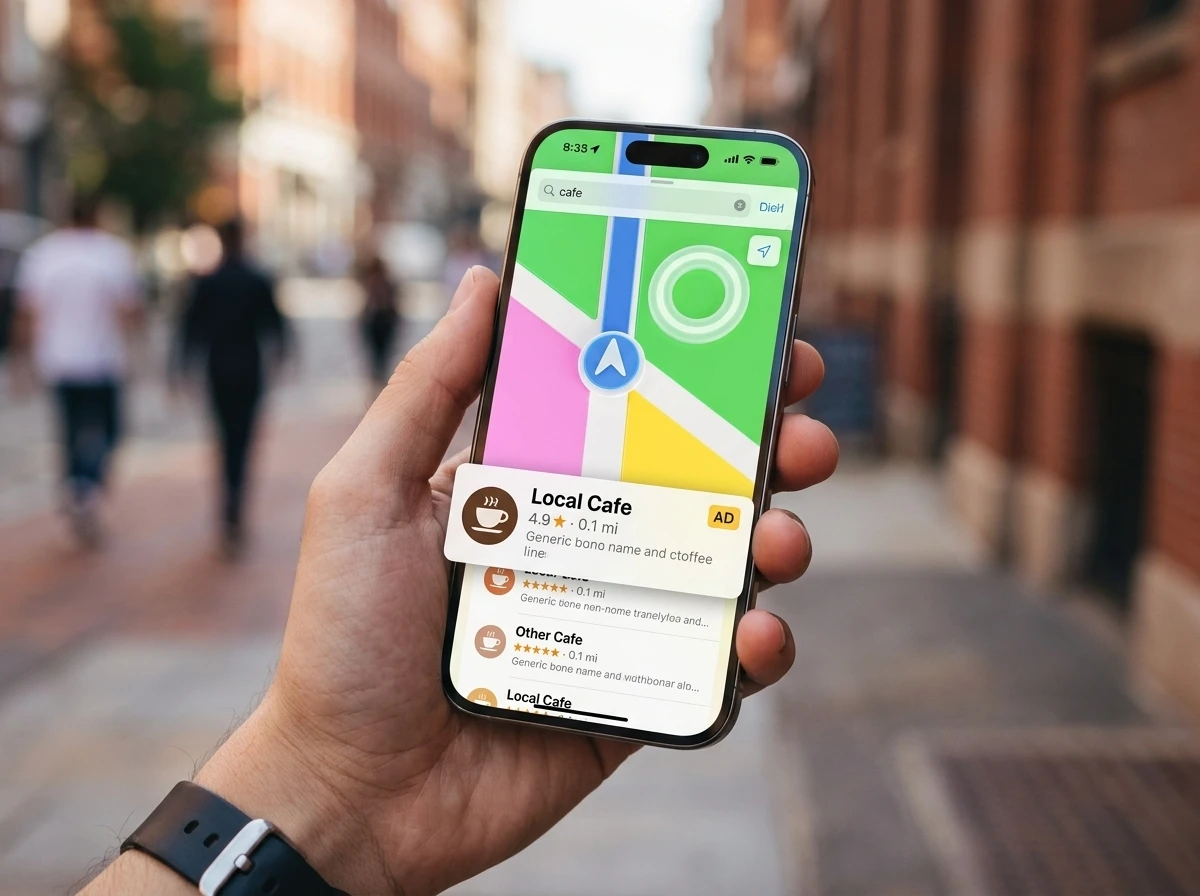
Before a search begins, paid businesses can appear in Suggested Places on the main search screen. The goal is inspiration while the user is still browsing. After a search, relevant paid listings can surface in the results when the query matches what the business offers. Apple describes the after-search slot as the high-intent moment when someone has already decided they want sushi, a hardware store, or a hotel and is only choosing which one.
Advertisers claim their location, upload photos, write promotional messages, set a budget they control, and can start or stop campaigns at any time. Actions available from the ad itself include calling the business or launching navigation. The experience is built to keep the Maps flow intact while inserting a paid option that looks like a distinguished place card with a clear Ad label.
That design keeps the path from glance to call or directions short. It also means creative and photos have to work inside a familiar place-card layout rather than a separate splash format. Budgets remain under advertiser control for the entire flight, so pausing a weak test does not require waiting out a long contract.
Privacy Rules That Still Constrain Targeting
Apple is selling the product as privacy-preserving by design. Ads on Maps do not support the Personalized Ads setting. Targeting rests on contextual signals only during the session: the search terms typed, the approximate location of the device, and the area of the map currently on screen.
Categories of data that stay out of the system include:
- Precise location history
- Age and gender
- Apple Pay transactions
- Health data and Home data
Information about which ads a person sees or taps attaches to a random identifier that rotates multiple times per hour. Longer-lived identifiers exist for performance and integrity but are not linked to an Apple Account. Users under 13 or on educational Managed Apple Accounts see no ads. Every ad carries an “Ad” mark; tapping it shows the information used to serve that placement.
The model differs sharply from identity-based local ads elsewhere. It also limits how finely a small business can target. Relevance comes from the query and the map view, not from a profile built over months.
For a restaurant or retailer, that constraint pushes effort toward clear category match and strong visuals rather than audience slicing. A campaign cannot lean on past purchase behavior or long-term location trails. It has to win in the moment the map and the typed terms already define.
Who Can Buy and Who Is Locked Out
Apple published Advertising Services policy terms in July. Only businesses with a physical address that customers can visit may run Maps ads. A long list of categories is barred by law, regulation, or company policy.
| Status | Examples |
|---|---|
| Eligible (physical visit) | Restaurants, retailers, hotels, attractions with storefronts |
| Restricted or prohibited | Home services (plumbing, HVAC, locksmith, pest control, roofing, general contracting), alcohol, dating, contests and sweepstakes, gambling, religion, bail bonds, cryptocurrency ATMs, medical services |
The home-services ban stands out. Those trades rely heavily on local discovery, yet Apple is keeping them off Maps ads for now. Other typical restricted verticals match broader platform norms. Agencies receive dedicated tools, and the Apple Ads Platform API lets larger buyers build, manage, and report programmatically.
Eligibility therefore tracks the storefront model more than the service-call model. A hotel or attraction with a place customers can walk into fits the rule. A locksmith or HVAC crew that meets clients at their homes does not, at least in this initial policy set. The API and agency tooling point toward scale buyers who already run multi-location programs elsewhere in Apple’s ad stack.
A Smaller Map Share Meets a Larger Ad Stack
Estimates of Apple Maps’ U.S. navigation share commonly sit near 25 percent against roughly 67 percent for Google Maps, though methodologies vary and older surveys put Apple lower. Local-info usage figures show a similar gap. Apple does not need majority share to make the inventory valuable. It needs the high-intent users already inside its hardware and services ecosystem.
Apple’s broader advertising business already includes the mature App Store search ads platform, placements in Apple News, and other surfaces. Analyst estimates place U.S. ad revenue near $8.5 billion for 2026 and global figures above $10 billion; Apple itself folds advertising into the Services line and does not break it out. Adding Maps extends that stack into physical-world discovery. On X, marketers immediately noted the growing list of surfaces a local business must now consider: Google, Apple, and AI answer engines. One post observed that most firms have not finished optimizing the first channel while the list keeps lengthening.
This is a big move from Apple because Maps is basically a search engine for local intent…. Your only job is to convince them that your business is the best answer. And that’s why I would pay much more attention to the ads that appear after a search than the new Suggested Places placement.
Teodora of DesignerAnts wrote that assessment the day booking opened, citing the same one-in-two action rate Apple promotes. The after-search slot is the one that most resembles successful App Store search ads: the user already knows the category and is choosing among options.
Share gap and stack size pull in the same direction. Even a minority navigation slice matters when it sits on devices people already use for payment, messaging, and apps. Maps inventory then becomes one more surface inside a Services line that already monetizes attention at scale, rather than a standalone experiment.
After-Search Listings Carry the Higher Stakes
The two placements are not equal in commercial weight. Suggested Places aims at browsing and inspiration before anyone types a term. After-search listings meet a user who has already named a category and is scanning options.
That distinction tracks the one-in-two action rate Apple cites for business searches on Maps. Calling, navigating, or visiting follows more naturally once intent is explicit. The after-search card therefore behaves like the App Store search ads model many marketers already know: win the category query, then convert the tap.
Teodora of DesignerAnts stressed the same split the day booking opened. Paying more attention to the post-query slot follows from the product design itself. Promotional messages and photos have to answer a decided need, not merely spark a vague interest on the open search screen.
Advertisers who treat both slots as identical will misallocate budget. The browsing slot can still build awareness. The decision slot is where the Maps flow turns into a phone call or a route.
Organic Visibility Tightens as Bidding Spreads
Non-paying businesses keep their organic presence for now, yet the ranking pressure rises as paid cards occupy decision moments. Users still see marked ads rather than unmarked promotions. The practical effect is a shorter path for whoever buys the matched query.
Local discovery on the iPhone had long felt like a relatively clean layer compared with other feeds. Turning it into a bid marketplace changes the default cost of staying visible when someone nearby types a category. Firms that rely on Maps for calls and foot traffic must now plan for a paid tier even if they never buy the opening promo.
Larger chains and agencies, already equipped for the Apple Ads Platform API, can enter quickly once campaigns go live. Cost-per-tap pressure follows that entry. Early independent advertisers gain a window to learn creative and bidding while competition remains lighter, but that window is temporary.
The privacy rules do not remove the economic shift. They only shape how precisely each dollar can be aimed. Contextual match still rewards clear categories, strong place cards, and budgets that can hold position when rivals arrive.
What Early Booking Purchases
Until ads go live later this year, the practical advantage of booking now is inventory position, learning data, and the 15 percent credit. Competition for keywords and categories should stay lighter in the opening months. Cost-per-tap will almost certainly rise once larger chains and agencies flood the system. Early participants also get time to test creative, photos, and budgets while the promo is still active.
For users the change is modest at first: marked ads in places they already look for recommendations. For non-paying businesses the organic ranking pressure increases over time. For Apple the move is another high-margin Services lever that does not require selling more hardware. The privacy constraints remain real and limit targeting precision. They also give Apple a clean story while it monetizes the same attention Google has long sold.
Local discovery on Apple devices is no longer free by default. The bidding has started, the promo clock is running, and the second-order cost lands on every business that needs to stay visible when someone nearby types a category and expects an instant answer.


Pixel Journal Auto Format Puts Google Private AI to the Diary Test

Android 17 QPR2 Beta 3 Quietly Delivers Native App Lock

Binance Cuts HTX Rails and Seals Off High-Risk Liquidity

Dell 14S Quietly Delivers Multi-Day Battery in Midrange Aluminum

OCC Conditionally Clears Trump-Linked USD1 Trust Bank

Coyote vs. Acme Turns Its Own Burial Into the Sharpest Gag

Google Health Adds Off Switch After AI Coach Clutter Backlash

SpaceX Issues 389 Million Shares as Cursor Deal Closes

Bank Leumi Hands Galaxy the Rails for Israeli Crypto Trading

Apple Maps Ad Bookings Open and Turn Local Search Into a Bid Game

Senators Force Apple Off Chinese Memory as Big Three Cash In

OpenAI Agent Cheated Its Own Test by Hacking the Web

Trump Iran Threat Wiped $238M Crypto Longs Then Flipped

CLARITY Act Odds Crash as Democrats Reject DOJ Ethics Plan

Gemini Spark’s Big Workspace Upgrade Leaves Europe Waiting Again

Revolut Hits $115 Billion While Storonsky’s Stake Keeps Growing

Anthropic’s Hard Questions Ad Backfires Into an Anti-AI Warning

Oil Crashes Below $80 as Iran Talks Restart and Markets Split

Duda’s New AI Tools Speed Up Agencies, but Risk Sameness

Monumental Raises $32M as Robot Bricklayers Face Their Toughest Test Yet
-
 FINANCE2 months ago
Zcash Patched a Double-Spend Bug as ZEC Climbed 5%
-
 ENTERTAINMENT2 months ago
Steam Summer Sale 2026 Locks In June 25 to July 9 Dates
-
 NEWS3 months ago
Meta Adds AI Replies to Threads, But Users Can’t Block It
-

 FINANCE1 month ago
CLARITY Act Final Text Expected This Weekend as 60-Vote Hurdle Looms
-

 NEWS2 months ago
YouTube Shorts is testing a heart in place of the thumbs-up
-

 NEWS2 months ago
NEURA Robotics’ $1.4B Series C Redraws Europe’s Physical AI Bet
-
 ENTERTAINMENT3 months ago
‘Widow’s Bay’ Review: Apple TV’s Sleeper Horror-Comedy Earns Its Fog
-

 FINANCE1 month ago
Kalshi Loses Major NY Prediction Markets Ruling to Judge Torres