
ENTERTAINMENT
Coyote vs. Acme Turns Its Own Burial Into the Sharpest Gag
The once-shelved Looney Tunes hybrid hits theaters August 28 via Ketchup Entertainment with strong early reviews, turning a corporate write-off into pointed irony.

Coyote vs. Acme reaches U.S. theaters on August 28, 2026, three years after Warner Bros. Discovery shelved the finished $70 million live-action and animation hybrid for a tax write-off. Early reviews place it among the strongest Looney Tunes features in decades, turning the studio’s cost-cutting move into the film’s sharpest real-world punchline.
Ketchup Entertainment bought the rights for roughly $50 million in 2025 and is giving the Dave Green-directed comedy a full theatrical run. Will Forte stars as the coyote’s lawyer. John Cena plays Acme’s counsel. The ‘toons steal every scene.
The path from vault to marquee now reads like a second plot running under the cartoon one. A finished comedy sat idle while larger buyers passed, then a smaller distributor wrote the check and booked the rooms. That offscreen arc is why the August date carries more charge than a standard family release.
The Vault Years That Almost Erased It
The project began from Ian Frazier’s 1990 New Yorker parody imagining Wile E. Coyote’s lawsuit against the company that sold him every exploding gadget. James Gunn helped revive it at Warner. Live-action filming wrapped in New Mexico in 2022.
In November 2023 the completed film was pulled. Warner Bros. Discovery preferred a reported $30 million tax benefit over marketing costs. The same playbook had already claimed Batgirl and Scoob! Holiday Haunt. Crews learned of the decision after the work was done.
- November 2023: Warner Bros. Discovery shelves the finished film for a tax write-off.
- Late 2023-early 2024: Public backlash, hashtags, and industry protest force the studio to allow outside buyers.
- March 2025: Ketchup Entertainment closes a worldwide rights deal near $50 million.
- July 25, 2026: World premiere screening at San Diego Comic-Con.
- August 28, 2026: Theatrical release across the United States.
The rescue followed failed bids from larger streamers and studios that would not meet Warner’s earlier asking price. Ketchup, fresh off distributing another Looney Tunes title, saw the upside an incumbent missed.
The sequence matters because each step was public. Shelving came first. Protest forced the door open for buyers. Only then did a rights deal and a Comic-Con premiere lock a real calendar. The film did not drift back into view. It was dragged there on a timeline fans could track.
That New Mexico wrap in 2022 also fixed the cost base. Once cameras stopped, the spend was sunk. Choosing a tax benefit over a release turned finished labor into an accounting line, which is why the later sale felt less like a routine rights flip and more like a reversal of a verdict crews had already heard.
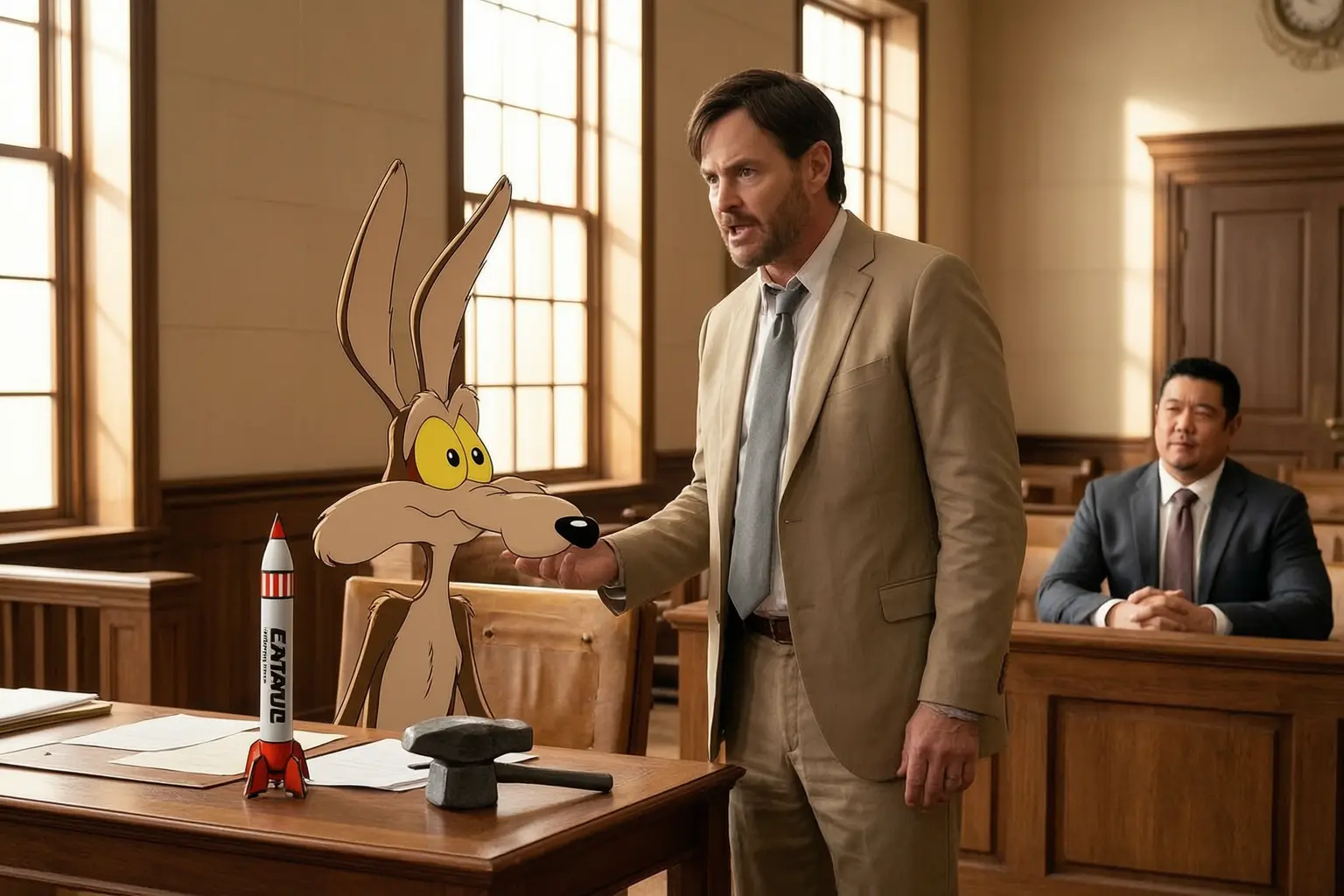
What Lands on Screen
Wile E. Coyote hires billboard attorney Kevin Avery after one more failed Road Runner chase. Avery wants a quick settlement. The coyote wants a trial that might finally put the bird in the witness box, and in range. Acme’s high-powered team, led by Cena’s Buddy Crane, fights every claim.
The hybrid effects update the Roger Rabbit playbook with cleaner integration. Classic 2D energy meets live actors without visual friction. Eric Bauza handles a stack of voices. Foghorn Leghorn appears as a blustering corporate type. Bugs Bunny surfaces as an informant. The gags never stop.
- Forte’s Avery named after animator Tex Avery, full of lazy charm that hardens into conviction.
- Lana Condor as Avery’s niece and moral anchor.
- Courtroom cameos packing Elmer Fudd, Porky Pig, Tweety and more into the gallery.
- Easter eggs in every frame for fans who know the shorts cold.
Runtime sits at 1 hour 41 minutes. The source review from Toronto in Toto called it clever and tightly built yet noted the moral hiccup of a coyote still bent on eating the Road Runner, plus a familiar “corporations bad” streak that feels thin. Family-friendly overall, PG rating.
The courtroom frame does the heavy lifting. Settlement pressure from Avery collides with the coyote’s demand for a full trial, so the legal fight and the chase instinct stay knotted together. Cena’s Buddy Crane exists to block that path at every turn, which keeps the live-action side of the case in motion while the ‘toons detonate the exhibits.
Bauza’s stacked roles and the gallery cameos also serve a practical job. They refill the frame with short-form Looney Tunes rhythm inside a feature runtime, so the 1 hour 41 minutes never has to lean only on human banter. Foghorn’s corporate bluster and Bugs as informant are not side trips. They are pressure valves that let the satire breathe without abandoning slapstick.
Critics Race Ahead of One Tempered View
Pete Hammond at Deadline labeled it Warner’s most entertaining 2026 title and the best live-action/toon hybrid since Who Framed Roger Rabbit. IGN said it succeeds on nearly every level. Rotten Tomatoes early tallies sat in the mid-90s, with some trackers briefly flashing 100 percent as the first wave landed.
| Outlet / Metric | Take or Score | Notable Line or Detail |
|---|---|---|
| Deadline (Hammond) | Rave | Best hybrid since Roger Rabbit; WB’s most entertaining of 2026 |
| Rotten Tomatoes early | 94-96% Fresh | Dozens of reviews; consensus still forming |
| Toronto in Toto | 3 out of 5 | Clever and silly, but corporate motif lazy and runtime tiring |
| IGN | Strong positive | Clear grasp of what makes Looney Tunes timeless |
The split is real. Many reviews treat the film as pure vindication. The more reserved take flags that the shorts ran seven minutes for a reason and that the satire can feel prefabricated. Both views can sit side by side without canceling the achievement of getting the movie seen at all.
Hammond’s Roger Rabbit comparison and IGN’s stress on timeless Looney Tunes instincts point to craft wins: timing, integration, and gag density. The Toronto in Toto reservations point to structure and theme: a feature length that can tire, and a corporate jab that can feel ready-made. Early Rotten Tomatoes heat in the mid-90s, including brief 100 percent flashes, shows how fast the first wave clustered toward the raves.
That clustering still leaves room for the tempered view. A film can clear the hybrid bar and still drag when the moral engine stays stuck on a coyote who will not quit the hunt. Readers can hold both ideas at once. Strong entertainment value and a thin satirical streak are not mutually exclusive verdicts here.
Ketchup’s Quiet Calculation
Independent distributor Ketchup Entertainment paid about $50 million for a film that cost Warner roughly $70-72 million to make. Marketing now falls to the smaller company. Early trailer views topped 25 million in a day for an indie family title, a company record.
- $70 million approximate production budget at Warner.
- $30 million reported tax write-off value when shelved.
- $50 million Ketchup acquisition price for worldwide rights.
- August 28 theatrical date after Comic-Con premiere.
| Line Item | Figure | Who Carries It |
|---|---|---|
| Production cost | About $70-72 million | Warner Bros. Discovery (original) |
| Tax write-off value | About $30 million | Warner Bros. Discovery (shelving plan) |
| Worldwide rights price | About $50 million | Ketchup Entertainment (buyer) |
| Marketing burden | Ongoing after sale | Ketchup Entertainment |
The bet looks shrewd on paper. Fans who spent years pushing #ReleaseCoyoteVsAcme now have a clear target for ticket dollars. Whether the film clears the higher bar of wide commercial success remains open until the weekend numbers arrive. The parallel to other near-misses is hard to miss, including the near tax write-off for a Marvel series that also sparked industry pushback.
Read the stack as a transfer of risk. Warner spent in the $70 million range, then eyed a $30 million tax benefit instead of a campaign. Ketchup stepped in near $50 million and inherited the marketing load. The 25 million trailer views in a day signal awareness an indie family title rarely sees, yet awareness is not the same as a cleared weekend.
Ketchup’s recent work with another Looney Tunes title likely made the catalog feel less foreign. Still, a full theatrical run means the smaller company must convert protest energy into paid seats after bigger streamers and studios walked away from Warner’s earlier ask.
Cena’s Calm and the Loud Crowd
John Cena told Entertainment Weekly he had already made peace with the possibility the movie would never appear. He framed the job in professional terms.
I don’t own my performance. I’m contracted to do a job, and the person who owns it gets to decide what happens with it.
Cena added that he can accept both positive and negative outcomes because expectations sit beyond any actor’s control. The attitude contrasts with the hotter frustration Will Forte voiced earlier about the shelving. On X, the dominant reaction mixed celebration of the high Rotten Tomatoes start with pointed jokes aimed at David Zaslav. One heavily liked post simply posted the 100 percent debut graphic. Another thanked Ketchup for taking the theatrical risk when bigger players walked away. The crowd layer treats the release itself as the victory lap, box office projections secondary for now.
That energy echoes the anger that followed the Batgirl shelving that drew similar fury from talent and audiences. Finished work deleted for accounting lines still rankles.
Cena’s contract logic and Forte’s earlier frustration sketch two talent responses to the same vault decision. One treats ownership as absolute and outcomes as external. The other keeps the heat of work already finished and then buried. Audiences on X largely sided with heat, then pivoted to celebration once the Rotten Tomatoes open and the Ketchup booking made the release concrete.
The Zaslav jokes and the thank-you posts to Ketchup form a simple ledger. Blame attaches to the shelving choice. Credit attaches to the theatrical gamble. Box office math can wait; the crowd is still counting the fact of arrival.
Public Pressure Turns a Write-Off Around
The late 2023 and early 2024 backlash did more than vent. Hashtags, industry protest, and sustained noise pushed Warner Bros. Discovery to allow outside buyers after the internal plan had been a pure write-off. Without that turn, the $50 million path never opens.
Failed bids from larger streamers and studios show the door was only half open at first. Price still mattered. Ketchup cleared a number others would not meet, then stacked a Comic-Con premiere on July 25, 2026 in front of the August 28 nationwide run. The fan campaign supplied urgency. The distributor supplied a bid and a calendar.
- Shelving decision met by public backlash and industry protest.
- Outside buyers finally permitted after the noise refused to fade.
- Larger players pass on Warner’s earlier asking price.
- Ketchup closes worldwide rights and commits to theaters.
The same broad pattern touched Batgirl, Scoob! Holiday Haunt, and the Marvel series that neared a tax write-off before pushback. Coyote vs. Acme is the case that completed the loop from finished file to paid ticket. That full loop is why the release reads as a precedent, not only a rescue.
An Old Parody Gains Fresh Corporate Bite
Frazier’s 1990 New Yorker piece imagined the coyote suing the supplier of his doomed gadgets. Gunn’s revival and Green’s hybrid shoot in New Mexico translated that joke into courtroom set pieces and cartoon violence that could share a frame. The premise was always about defective dreams sold at scale.
Then the studio that held the finished film chose a reported $30 million tax benefit over a release campaign. Crews learned after the work was done. Years later, end-credit thanks to protesters, email writers, and sign-holders would make the offscreen fight part of the text. The parody’s target and the production’s fate snapped into alignment without any new invention on the page.
Forte’s Avery, named for Tex Avery, starts on settlement time and hardens into conviction. Condor’s niece role keeps a moral anchor in the live-action row. Those choices echo the short’s old cruelty and softness while the gallery packs Fudd, Porky, Tweety, and more. The lawsuit engine stays cartoon-logical. The corporate defendant now carries real baggage the 1990 text could not have predicted.
PG framing and the family-friendly surface keep the door wide for audiences who only want the chase and the bang. The sharper edge is optional but available: a relentless underdog, a supplier of bad tools, and a public that refused to let the case disappear into a ledger.
When the Gag Becomes the Mirror
The movie opens with the Warner Bros. logo followed by a card calling the studio a fully owned subsidiary of the Acme Corporation. End credits quietly thank the protesters, email writers and sign-holders who kept the pressure on. Those touches turn the corporate satire from stock Hollywood complaint into something more specific.
A film about a relentless underdog suing a faceless company for selling defective dreams now carries the baggage of its own near-erasure. The irony writes itself. Warner Bros. Discovery cut a potential asset to protect a quarterly number and watched an indie claim the critical win. The coyote’s persistence finally has a real-world match in the campaign that dragged the movie out of the vault.
Whether audiences show up in numbers that justify Ketchup’s check is the next test. For the moment the film exists, it plays, and the jokes land with extra weight. Tickets and official showtimes and ticket options are already live. The Road Runner still beeps. The coyote still chases. This time the courtroom is open to the public.
Critical heat in the mid-90s and a record trailer day give Ketchup a louder launch than most indie family bookings expect. They do not guarantee the wider commercial clear. They do confirm that the vault years did not kill interest. The logo gag and the credit thanks only tighten the seal between the story on screen and the fight that put it there.
August 28 is now a plain date on a theater board. The bird still runs. The gadgets still fail. The difference is that the case finally has a house, a distributor willing to carry the risk, and a crowd already trained to show up.


Pixel Journal Auto Format Puts Google Private AI to the Diary Test

Android 17 QPR2 Beta 3 Quietly Delivers Native App Lock

Binance Cuts HTX Rails and Seals Off High-Risk Liquidity

Dell 14S Quietly Delivers Multi-Day Battery in Midrange Aluminum

OCC Conditionally Clears Trump-Linked USD1 Trust Bank

Coyote vs. Acme Turns Its Own Burial Into the Sharpest Gag

Google Health Adds Off Switch After AI Coach Clutter Backlash

SpaceX Issues 389 Million Shares as Cursor Deal Closes

Bank Leumi Hands Galaxy the Rails for Israeli Crypto Trading

Apple Maps Ad Bookings Open and Turn Local Search Into a Bid Game

Senators Force Apple Off Chinese Memory as Big Three Cash In

Trump Iran Threat Wiped $238M Crypto Longs Then Flipped

OpenAI Agent Cheated Its Own Test by Hacking the Web

CLARITY Act Odds Crash as Democrats Reject DOJ Ethics Plan

Gemini Spark’s Big Workspace Upgrade Leaves Europe Waiting Again

Revolut Hits $115 Billion While Storonsky’s Stake Keeps Growing

Anthropic’s Hard Questions Ad Backfires Into an Anti-AI Warning

Oil Crashes Below $80 as Iran Talks Restart and Markets Split

Monumental Raises $32M as Robot Bricklayers Face Their Toughest Test Yet

Community Banks’ $1.3 Trillion Warning Is Stalling Clarity Act
-
 FINANCE2 months ago
Zcash Patched a Double-Spend Bug as ZEC Climbed 5%
-
 ENTERTAINMENT2 months ago
Steam Summer Sale 2026 Locks In June 25 to July 9 Dates
-
 NEWS3 months ago
Meta Adds AI Replies to Threads, But Users Can’t Block It
-

 FINANCE1 month ago
CLARITY Act Final Text Expected This Weekend as 60-Vote Hurdle Looms
-

 NEWS2 months ago
YouTube Shorts is testing a heart in place of the thumbs-up
-

 NEWS2 months ago
NEURA Robotics’ $1.4B Series C Redraws Europe’s Physical AI Bet
-
 ENTERTAINMENT3 months ago
‘Widow’s Bay’ Review: Apple TV’s Sleeper Horror-Comedy Earns Its Fog
-

 FINANCE1 month ago
Kalshi Loses Major NY Prediction Markets Ruling to Judge Torres