
NEWS
ChatGPT Turns the Image Wait Into Ad Space
OpenAI will test visual ads during ChatGPT image generation in October, using that wait as the first slot in a live ad-measurement stack.

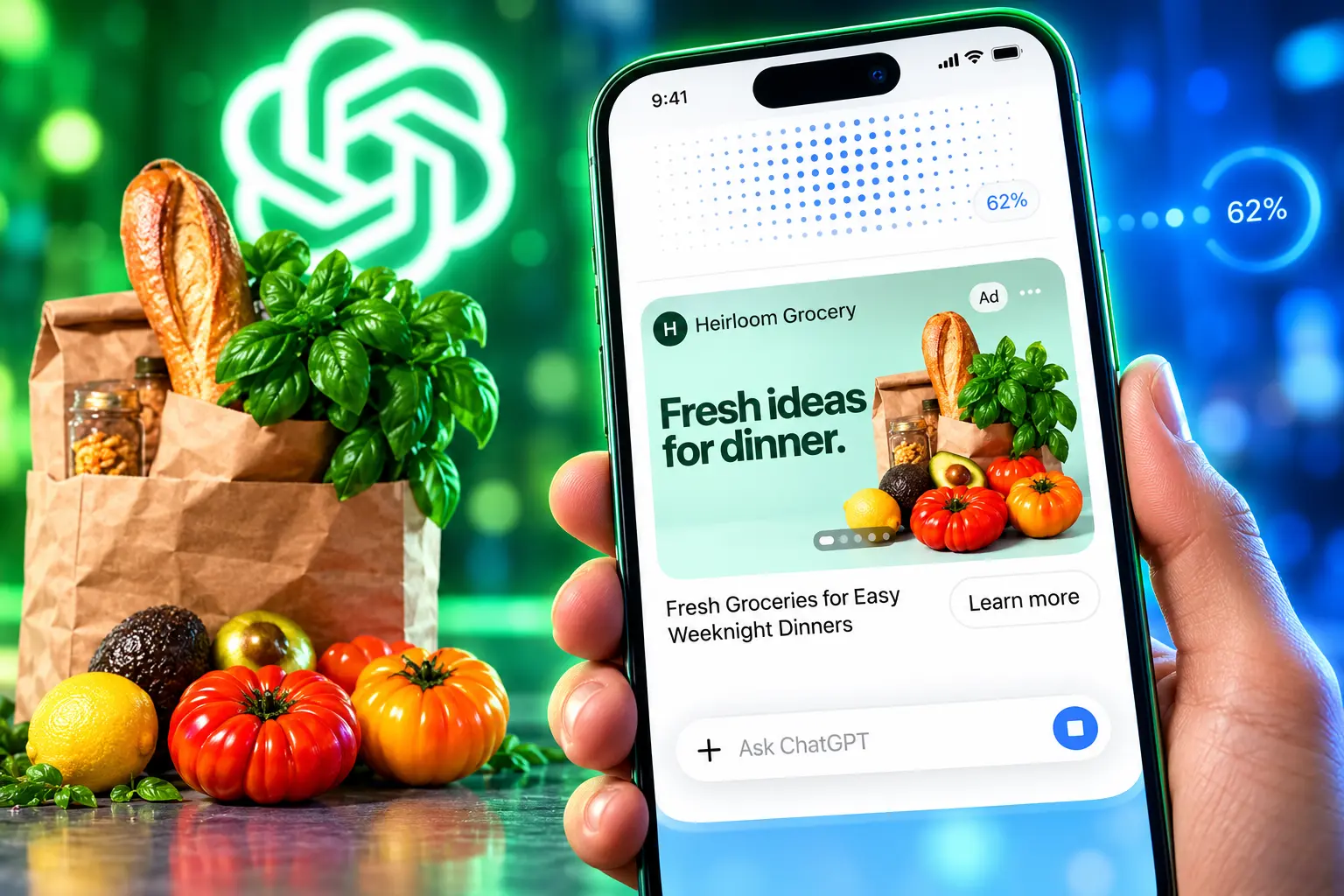
OpenAI will test visual ads in ChatGPT during image generation later in October for Free and Go users in the United States. The ads use pictures of products and services, sit apart from the image being made, and carry a clear label.
ChatGPT reaches 1.2 billion people each week, and OpenAI is already wiring that traffic into the conversion tools brands use on other platforms. The new pictures are extra inventory for a machine that is running.
Product Pictures While Your Image Loads
On October 5, 2026, OpenAI said a new visual format will help people imagine how a product or service could fit into their lives. Sample screenshots from the company show ChatGPT on a phone putting up a grocery brand’s product photos and a Learn more button while an image request is still processing.
Initially, we’ll test this new ad format during image generation in ChatGPT for users on the Free and Go plans.
OpenAI, product announcement, October 5, 2026
The company says the ads stay labeled and remain separate from the image ChatGPT is creating, and that advertising does not change the answers the model writes. Image generation is the only surface named for this test. OpenAI has not said when the format will show up in ordinary chat, or in any country outside the United States.
WHAT THE PICTURES ARE FOR
- Inspiration: Still photos meant to show a product in a setting a shopper might want.
- Usage: Frames that show how an item is used, not only how it looks on a shelf.
- Experience: Scenes that sell what a service feels like, from a trip to a class.
That is a different job from the first ChatGPT ads, which sat as sponsored copy under a written answer. Here the ad is a picture competing for the same eyes that asked for a picture.
Which ChatGPT Plans Will See the Visual Ads?
The visual test is limited to Free and Go users on the Free and Go plans in the United States, with an initial group of advertisers. Plus, Pro, Business, Enterprise, and Education accounts stay ad-free, the same split OpenAI set when it first put ads into ChatGPT.
WHO SEES ADS, AND WHO DOES NOT
- Weekly reach: OpenAI puts ChatGPT at 1.2 billion people a week and calls it the largest AI-native consumer platform.
- Ad plans: Logged-in adults on Free and on Go, which OpenAI priced at $8 a month when it brought the plan to the United States.
- Ad-free plans: Plus, Pro, Business, Enterprise, and Education do not get ads, including this visual test.
- A Free-tier exit: People on Free can opt out of ads in the Free tier in exchange for fewer daily free messages, or they can move up to Plus or Pro.
Go already charges money and still carries ads. The quiet product decision inside the test is that $8 a month buys more usage, not a clean screen. Silence still sits on the $20 Plus plan and above.
OpenAI also says it will not show ads in accounts where a user is under 18, or where the system predicts that age. Advertisers, the company says, do not get chats, chat history, memories, or personal details. They get aggregate numbers such as views and clicks.
A 3 Billion-Image Habit Meets a Shorter Wait
On September 8, 2026, OpenAI said people create more than 3 billion images every week across ChatGPT Images and the GPT-Image models in the API. That figure mixes consumer chats with developer traffic, so it is not a clean count of ChatGPT waits. It is still a picture of how often this company is already drawing images.
The same post said Images 2.5 cut image-generation latency by up to 50% compared with Images 2.0. Engineering spent the last year making people wait less. The ads team is now selling the seconds that remain.
A shorter wait does not kill the slot. It compresses it. If the spinner is briefer, the ad has to land faster, which is why a still photo with a Learn more button fits the moment better than a long sponsored paragraph.
Why the Wait Became Ad Inventory
A labeled card next to a progress shimmer is a pause people already expect. They asked for an image, they know the model needs a beat, and their eyes are idle on the same screen. That is a cleaner place to park a product photo than the space under advice, where the ad sits beside something the user treated as an answer.
OpenAI’s own tracking is built for glances that never become clicks. In an early look at global campaigns aimed at deeper outcomes, 52.7% of eligible one-day view-through conversions landed within an hour of the matched ad impression. Many of those sales, sign-ups, or other counted actions happened after someone saw an ad and did not click it.
The company now lets advanced conversion tools learn from eligible view-through events as well as clicks, so a purchase after a look can steer the next ad. For reports, advertisers can add a one-day view-through window beside whatever click window matches their buying cycle. Those report settings, OpenAI says, do not change how campaigns optimize.
That design fits an image wait. People watching a picture render are not in a clicking mood. They are killing a few seconds. If the system can take credit for what happens after a look, the spinner is a sellable impression, not dead time.
ChatGPT Ads Plug Into Tools Brands Already Use
The October 5 posts spend as much space on measurement as on the new pictures. OpenAI says its approach supports in-house tools and outside partners, including a pixel and a Conversions API that can record purchases, leads, installs, and sign-ups. Hightouch, Tealium, and LiveRamp can send conversion data from systems brands already run.
THE CHATGPT ADS MEASUREMENT STACK
| Job | Firms OpenAI named |
|---|---|
| Send conversion data | Hightouch, Tealium, LiveRamp |
| Web and app attribution | AppsFlyer, Triple Whale, Adjust, DV Rockerbox, Northbeam, Branch, Singular, Kochava, Airbridge, Tenjin |
| Full-funnel measurement | Fospha, Measured, INCRMNTAL |
| Geo incrementality tests | Haus, Measured, WorkMagic |
| Brand resonance tests | Kantar, Cint |
| Brand suitability pilots | DoubleVerify, Integral Ad Science |
Incrementality work is still early, OpenAI says. Haus, Measured, and WorkMagic are exploring geo tests that change ads in some regions and leave others as a control, so a brand can see whether ChatGPT Ads caused extra sales rather than catching people who would have bought anyway. Kantar and Cint are in early tests on brand resonance.
The early numbers OpenAI chose to publish come from campaigns already running, not from the visual test, which has not started.
EARLY PARTNER RESULTS ON EXISTING ADS
| Brand | Finding | Measured by |
|---|---|---|
| WeightWatchers | Attributed cost per acquisition 15.3% below its blended paid-search benchmark | DV Rockerbox |
| Dose | 2.3 times more incremental orders than last-click counting; 67% of those incremental purchases from new customers | WorkMagic |
| Portland Leather | 93% of visitors from ChatGPT Ads were new | Triple Whale |
Those three findings are not the same kind of proof. One is a cost comparison with search. One is a geo lift against last-click. One is a share of new site visitors. None of them is a public spend figure, sample size, or test of the visual format. They are sales arguments for a channel that wants to be bought like paid search, not like a brand cameo inside a chatbot.
Ads Started as a Line Under Answers
Sam Altman, OpenAI’s chief executive, wrote in January that the company would not take money to change ChatGPT’s answers, and that conversations would stay private from advertisers. “It is clear to us that a lot of people want to use a lot of AI and don’t want to pay, so we are hopeful a business model like this can work,” he wrote, pointing to Instagram ads he had actually liked.
HOW CHATGPT ADS GREW THIS YEAR
- January 16, 2026: OpenAI publishes ads principles, brings Go to the United States at $8 a month, and says it will test ads on Free and Go for logged-in adults.
- February 9, 2026: The US test begins. Ads sit under answers, labeled as sponsored. Health, mental health, and politics are off limits. Free users can trade ads for fewer daily messages.
- March 26, 2026: OpenAI says it has seen no hit to consumer trust metrics and low dismissal rates, and that it will start pilots in Canada, Australia, and New Zealand.
- May 7, 2026: The company says it plans to expand the pilot to the United Kingdom, Mexico, Brazil, Japan, and South Korea.
- August 11, 2026: Ads launch in those five markets, with more countries still promised for the year.
- October 5, 2026: OpenAI adds the visual format and the wider measurement list. Testing in the US is due later in October.
The path is a slow widening of where a sponsored unit can sit, not a sudden pivot. First a line under text. Then more countries. Then a picture beside a spinner. Sponsored Agents, which OpenAI described in September as a way to start a chat with a business-backed agent after an ad click, sit on the same road even though they are not part of this image test.
Suitability Checks Still Cannot Read the Chat
OpenAI says placement guardrails judge whether a conversation is fit for advertising and are meant to keep ads out of emotionally vulnerable, sensitive, or otherwise unsuitable contexts. Automated review, human oversight, and ongoing monitoring are the enforcement stack it names. Qualifying advertisers also get Negative Phrases, a way to block placements that clash with their own brand rules.
PLACEMENT RULES OPENAI SAYS IT WILL KEEP
- Separation: Ads stay labeled and visually apart from the image being made and from organic answers.
- Independence: Advertising does not influence the answers ChatGPT provides, a line the company has repeated since January.
- Age: No ads in accounts that are under 18, or that the system predicts are under 18.
- Topics: The original US test barred health, mental health, and politics; the October 5 post speaks more broadly of vulnerable and sensitive contexts.
- Privacy: Advertisers do not receive chats, memories, or personal details, only aggregate performance numbers.
DoubleVerify and Integral Ad Science are running brand-suitability pilots in a controlled test setup, OpenAI says, so they can judge how the safeguards work without seeing private user conversations. That is the bind. Brands want proof that their ads will not sit next to a raw confession. OpenAI will not hand over the confession. The audit is of the fence, not of the field behind it.
ChatGPT is creating a fundamentally different advertising environment, where context is defined by the conversation itself rather than a page or video.
Mark Zagorski, CEO, DoubleVerify
Context defined by the conversation is exactly why the privacy claim has to do so much work. People already unload private detail people already share with chatbots that they keep from doctors and family. A product photo beside a generating birthday-cake image is a mild case. The same targeting logic, pointed at a harder chat, is the case the guardrails are there to catch, and the case no outside firm is being allowed to read.
OpenAI has not said when visual ads will move past image generation or past the United States. Businesses can already apply through the ChatGPT Ads portal. For Free and Go users who make pictures, the next change is simpler. Later in October, the wait itself is the thing being sold.

UPI MDR Delay Hands Traders the Calendar After Paytm Falls

Google Messages Builds Nine In-Chat Games After Samsung’s Exit

Anthropic’s $100 Million Academy Trains the Firms That Bill Both Sides

iPhone Air 2 Tries to Fix Thinness by Going Thinner

Toyota’s Electric C-HR Leaves the Cheap Twin to Subaru

The Orchard Bug Forced Zcash to Open an Empty Pool

The $5.99 Game That Won Steam’s 2026 Summer Sale

Atlantic City Turned WWE’s Return Into a Civic Night

Don Lee Joins Hemsworth as Extraction 3 Starts Shooting

YouTube Shorts Retires Dislikes and Swaps Likes for Hearts
-
 NEWS6 months ago
The Orchard Bug Forced Zcash to Open an Empty Pool
-
 GAMING6 months ago
The $5.99 Game That Won Steam’s 2026 Summer Sale
-
 NEWS6 months ago
Atlantic City Turned WWE’s Return Into a Civic Night
-
 ENTERTAINMENT7 months ago
Don Lee Joins Hemsworth as Extraction 3 Starts Shooting
-
 NEWS5 months ago
YouTube Shorts Retires Dislikes and Swaps Likes for Hearts
-
 NEWS5 months ago
NEURA Robotics Is Spending Its $1.4B on a Machine Stack
-

 BUSINESS6 months ago
Norway’s Export Bank Backs Nscale’s $790 Million Narvik Loan
-
 GAMING6 months ago
Game of Thrones Dragonfire Follows Boston’s Conquest Playbook