
NEWS
A MoS2 Coating Gives Survey Crews a Sharper eDNA Filter
CityUHK coated the mixed-cellulose disc China’s eDNA survey rule already names, lifting scarce-fish DNA detection and adding 15 taxa at Hoi Ha Wan.

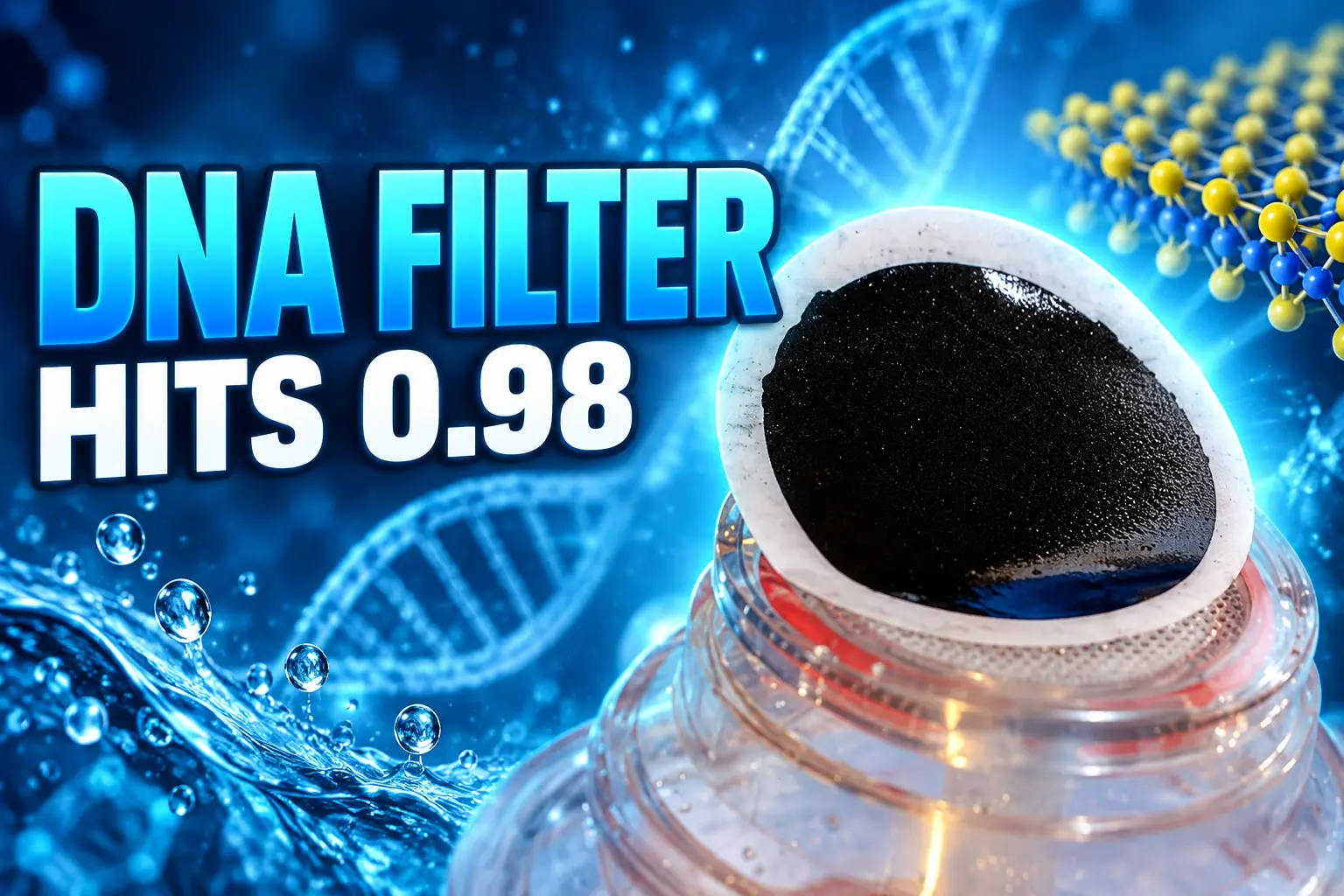
City University of Hong Kong researchers coated a standard mixed-cellulose filter with molybdenum disulfide and raised scarce-fish DNA detection from 0.50 to 0.98. The test, in National Science Review, used the same disc class China’s new inland eDNA survey guide already names.
That guide took effect on 1 September 2026. The Hong Kong coating is a materials tweak aimed at the crews who already filter water, not a new sampler.
A Cheap Coating Turns Ordinary Filters Into DNA Traps
Environmental DNA, or eDNA, is genetic material that fish shed into water as skin, mucus and waste. Crews filter seawater, extract what sticks to the disc, and match short sequences to species lists. In seawater the signal is thin, and ordinary discs miss a lot of it.
The CityUHK group, with Hong Kong Baptist University, laid an ultrathin sheet of metallic 1T-prime molybdenum disulfide (MoS2) on a mixed cellulose ester (MCE) filter. They call the result a MoS2-coated mixed cellulose membrane, and they present it as the first two-dimensional nanomaterial disc used to collect eDNA.
In a mock community of fish DNA, both discs found every species, and more than 84% of sequences were on target. The gap opened at the bottom of the mix. At 0.1 ng of input DNA, detection probability rose from 0.50 on the uncoated M0 disc to 0.98 on the coated M1 disc (p = 0.023). High-abundance DNA did not move.
Adsorption tests explain the lift. Experimental capacity (qe) rose from 0.88 mg/g to 2.01 mg/g, a 128% gain. Theoretical capacity (q0) rose from 0.54 mg/g to 1.25 mg/g, a 131% gain. At 22 ng/µL, the uncoated disc saturated in 0.98 minutes and the coated disc in 2.24 minutes, which is the extra load taking longer to fill.
M0 VERSUS M1 ON THE BENCH AND IN THE PARK
| Metric | Uncoated MCE (M0) | MoS2-coated (M1) |
|---|---|---|
| DNA adsorption qe | 0.88 mg/g | 2.01 mg/g |
| Theoretical capacity q0 | 0.54 mg/g | 1.25 mg/g |
| Detection at 0.1 ng DNA | 0.50 | 0.98 |
| Field mean ASV richness | 22.3 | 27.7 |
| Taxa found only on that disc | 2 | 15 |
ASV richness is a sequence-variant count, not a species list. The 15 extra field taxa sit in a later section. Science China Press, which publishes the journal, described the coating in March 2026 as a drop-in for existing filtration trains.
China’s New eDNA Rule Already Names This Filter
The overlooked user is not a journal editor. It is the sampling crew now told to run water through an MCE disc.
On 8 May 2026 the Ministry of Ecology and Environment approved HJ 1468-2026, a first-time technical guide for eDNA surveys of inland invasive aquatic animals. It took effect on 1 September 2026. The method is probe-based qPCR, not the metabarcoding used in the Hong Kong fish test, and it covers rivers (not river mouths), lakes, reservoirs and paddy fields.
The kit list is blunt. Crews filter about 1 L per sample, take three parallel samples at each point, and pass the water through 0.45 micrometre cellulose ester filters. If they cannot filter on the spot, they have 24 hours. That is the same mixed-cellulose family the CityUHK team coated. The standard was drafted by the Chinese Research Academy of Environmental Sciences, Yunnan University and the China National Environmental Monitoring Centre, under the 2023-2030 national biodiversity plan.
Marine programmes are already moving on a parallel track, still with ordinary discs.
WHERE eDNA IS ALREADY ON THE CLIPBOARD
- Inland invasives: HJ 1468-2026 now sets qPCR on 0.45-micrometre MCE discs for listed alien aquatic animals in inland waters.
- Jiaozhou Bay: Qingdao’s ecology monitoring centre ran a 2025 marine eDNA pilot and later reported Chinese crested tern DNA from environmental samples.
- South China Sea reefs: The South China Sea Ecological Center under the Ministry of Natural Resources issued coral-reef eDNA guidelines after pilots that began in 2022, including crown-of-thorns starfish warning work.
Kenneth Leung Mei-yee, CityUHK’s vice-president for research and director of the State Key Laboratory of Marine Environmental Health, said the ministry is promoting eDNA in biodiversity surveys and that the coating can support that push. The paper does not claim the inland qPCR rule has adopted MoS2. It shows a coating that fits the disc those inland crews, and many marine teams, already load.
Fifteen Extra Fish Showed Up at Hoi Ha Wan
Field water came from one random site in the 260-hectare Hoi Ha Wan park, a sheltered Sai Kung bay designated in July 1996 as part of Hong Kong’s first marine-park batch. The Agriculture, Fisheries and Conservation Department marks it for coral, mangroves and inshore fish, with commercial fishing banned inside the boundary.
The team took three replicates of 4 L with a Niskin bottle at 22.4675473 N, 114.3301480 E, and filtered on site onto M0 and M1 discs. After assignment, filtering and rarefaction they had 48 fish taxa. Thirty-one appeared on both discs. The uncoated disc alone found 2. The coated disc alone found 15.
Mean ASV richness rose from 22.3 to 27.7 (P = 0.024). Shannon diversity and evenness did not (P > 0.05). Bray-Curtis ordination of the two disc types overlapped, with NMDS stress of 0.001. The coating added rare detections without rewriting the community the park would report.
TAXA THAT DOMINATED THE HOI HA WAN READS
- Bloch’s gizzard shad: Nematalosa nasus led the local list on both discs.
- Anchovies: Gerres and Encrasicholina showed up in the extra detections the press note flagged.
- Silver-stripe round herring: Spratelloides gracilis sat among the common reads.
- Flathead gray mullet: Mugil cephalus is a coastal species ordinary nets also catch.
- Arrow-fin goby: Oxyurichthys added a benthic name to the same water.
Carangids appeared in the coated-disc extras as well. Jian-Wen Qiu of Hong Kong Baptist University’s biology department, a corresponding author, had already used eDNA in this bay. “Even within a small area, the mangrove area within Hoi Ha Wan showed distinct fish community structures in the eDNA,” he said of that earlier work, which asked whether a water sample could tell coral, mangrove and rocky shore apart.
The same group has also put eDNA against research trawls in western Hong Kong waters and found more fish names in the water than in the net. The MoS2 paper is the filter half of that argument: if the method already beats a trawl on richness, the remaining miss is the disc.
How Molybdenum Disulfide Grabs Loose DNA
MoS2 is a two-dimensional crystal, a sandwich of molybdenum between sulfur, used in electronics and as a dry lubricant. The eDNA disc uses the metallic 1T-prime phase. Sulfur atoms sit where they can hold the oxygen or nitrogen in DNA bases by van der Waals forces, not by forming new chemical bonds.
Computed binding energies for the bases fall between 0.23 and 0.65 eV below zero, in the van der Waals band. Binding distances stay above 2.8 Å, longer than a covalent bond. Guanine, cytosine and thymine prefer a vertical pose through sulfur-nitrogen or sulfur-oxygen contacts; molybdenum-nitrogen contacts are unstable in the same model.
That physics is why a thin coat can beat a thicker stack of cellulose. The disc is still a filter. The coat adds sticky sites for free DNA that would otherwise pass or wash off. Laboratory tanks holding tropical reef fish were the first check that the extra stick translated into names a surveyor would recognise.
Single-Layer Sheets on a Shop Filter
The build is a two-step materials job. Zhiyuan Zeng’s group in CityUHK’s Department of Materials Science and Engineering makes monolayer MoS2 by electrochemical lithium intercalation and exfoliation, then vacuum-filters the sheets onto the porous MCE base so they stack. Discs labelled M0 through M3 carry increasing coat loads; M1 was the field workhorse.
Corresponding authors are Leung; Zeng; Bolong Huang in CityUHK’s chemistry department, who ran the binding calculations; and Qiu. First authors are Liang Mei from Zeng’s group, Chun Ming How from Qiu’s group, and Mingzi Sun from Huang’s group. CityUHK, the Research Grants Council of Hong Kong and the Shenzhen Science and Technology Innovation Commission funded the work.
Zeng and Leung already share an Innovation and Technology Fund project on transition-metal dichalcogenide membranes for point-of-use water filters, listing MoS2 among the chemistries. The eDNA disc is that materials line pointed at a marine sampler rather than a drinking-water cartridge.
FROM PAPER TO PARK
- 29 January 2026: National Science Review posts the study as advance access (volume 13, nwag055).
- 12 March 2026: Dryad posts the aquarium and field sequence files from coated and uncoated discs.
- 8 May 2026: The ministry approves HJ 1468-2026, naming 0.45-micrometre mixed cellulose ester discs for inland eDNA work.
- 1 September 2026: That inland guide takes effect, two weeks before CityUHK recirculated the membrane results.
The membrane is simple to prepare and cost-effective, and can be directly integrated into existing water sampling filtration processes. It is expected to find future applications in marine conservation, ecological surveys and long-term environmental monitoring, and is particularly suitable for use in marine areas rich in biological resources but difficult to survey.
Kenneth Leung Mei-yee, Vice-President (Research), City University of Hong Kong
The paper does not list a unit price or a commercial supplier. It does say the discs can be made at scale, used as they are, and coated onto fibre substrates for higher-throughput water samplers.
The Community Score Stayed the Same
The honest limit is in the Hoi Ha Wan table. Extra taxa and a higher ASV mean did not move Shannon diversity or evenness. Two names still appeared only on the uncoated disc. The test is one site, three replicates, 4 L each, on one day, in a park whose fish list is already better known than most of the South China Sea.
HJ 1468-2026 will not, on its own, put MoS2 into marine metabarcoding. It is an inland qPCR protocol for named invaders. Marine crews in Qingdao, Zhoushan and the South China Sea still need their own filter rules. A coating that helps 0.1 ng of fish DNA on a mock plate may or may not help a turbid estuary where discs clog before they adsorb.
What the study does settle is narrower. On the disc class those inland rules already specify, and that many marine labs already buy, a molybdenum disulfide coat raised the odds of catching the scarce end of a fish mix and added 15 taxa in a Hong Kong marine park without changing the community score. That is a materials answer to a sampling bottleneck, written for the people who fold a filter, not for the people who write the species list after the run.
Frequently Asked Questions
Does China’s HJ 1468-2026 eDNA Guide Cover Seawater?
No. The May 2026 ministry guide applies to inland waters: rivers excluding river mouths, lakes, reservoirs and paddy fields. It uses probe-based qPCR for listed invasive aquatic animals, not the fish metabarcoding in the CityUHK marine test, and it was drafted by the Chinese Research Academy of Environmental Sciences, Yunnan University and the China National Environmental Monitoring Centre.
How Did the Team Put MoS2 Onto the Filter?
They used electrochemical lithium intercalation and exfoliation to make monolayer metallic 1T-prime MoS2 nanosheets, then vacuum-filtered those sheets onto a porous mixed cellulose ester base so they stacked as M0 through M3 coats; M1 went into the park.
Which Reef Fish Were in the Aquarium Test?
One litre of mixed water from four tanks held eyestripe surgeonfish (Acanthurus dussumieri), blue devil (Chrysiptera cyanea), threespot dascyllus (Dascyllus trimaculatus), stripey (Microcanthus strigatus) and blue tang (Paracanthurus hepatus), the five species the coated discs were asked to name before anyone went to Hoi Ha Wan.
What Do the Binding Energies Say About DNA on MoS2?
The most stable poses for DNA bases on 1T-prime MoS2 sit between 0.23 and 0.65 eV below zero, and all binding distances stay above 2.8 Å, which the authors read as van der Waals contact rather than a chemical bond, with sulfur-nitrogen or sulfur-oxygen contacts preferred over molybdenum-nitrogen ones.
How Many Mock-Community Repeats Backed the 0.98 Detection Rate?
The 0.98 versus 0.50 comparison at 0.1 ng of DNA used 10 repeats of a constructed marine-fish mix on M0 and M1 discs, a separate bench design from the three-by-4 L Niskin series at Hoi Ha Wan.
The next disc in this line, the authors write, can be the same coat on fibre substrates for high-throughput samplers. Until that kit exists, the working object is still a shop mixed-cellulose filter with a molybdenum disulfide skin, and the people who will notice it first are the ones already folding that filter in the field.

Ford Cuts 2027 F-150 Raptor Prices by Stripping Gear

Samsung’s Home Up Patch Catches the Fold 8 Icon Drift

X Sells Cashtag Trade Traffic to Five U.S. Brokers

Pete Alonso’s 300th Homer Turns Citi Field on the Mets

Staffline Temps Keep the Pilgrim’s Enniskillen Line Moving

The Orchard Bug Forced Zcash to Open an Empty Pool

The $5.99 Game That Won Steam’s 2026 Summer Sale

Don Lee Joins Hemsworth as Extraction 3 Starts Shooting

YouTube Shorts Retires Dislikes and Swaps Likes for Hearts

NEURA Robotics Is Spending Its $1.4B on a Machine Stack
-
 NEWS4 months ago
The Orchard Bug Forced Zcash to Open an Empty Pool
-
 GAMING4 months ago
The $5.99 Game That Won Steam’s 2026 Summer Sale
-
 ENTERTAINMENT6 months ago
Don Lee Joins Hemsworth as Extraction 3 Starts Shooting
-
 NEWS4 months ago
YouTube Shorts Retires Dislikes and Swaps Likes for Hearts
-
 NEWS4 months ago
NEURA Robotics Is Spending Its $1.4B on a Machine Stack
-

 AUTO6 months ago
Kawasaki Bets the New Z1100 Against Its Own Supercharger
-

 BUSINESS5 months ago
Norway’s Export Bank Backs Nscale’s $790 Million Narvik Loan
-

 GAMING4 months ago
Game of Thrones Dragonfire Follows Boston’s Conquest Playbook