
NEWS
Two Outpatient CAR-T Doses Cleared a Child’s Liver Tumor
Armored GPC3 CAR-T with IL-15 and IL-21 cleared a toddler’s chemo-resistant liver cancer in clinic, after earlier GPC3-CAR cells had produced no tumor responses.

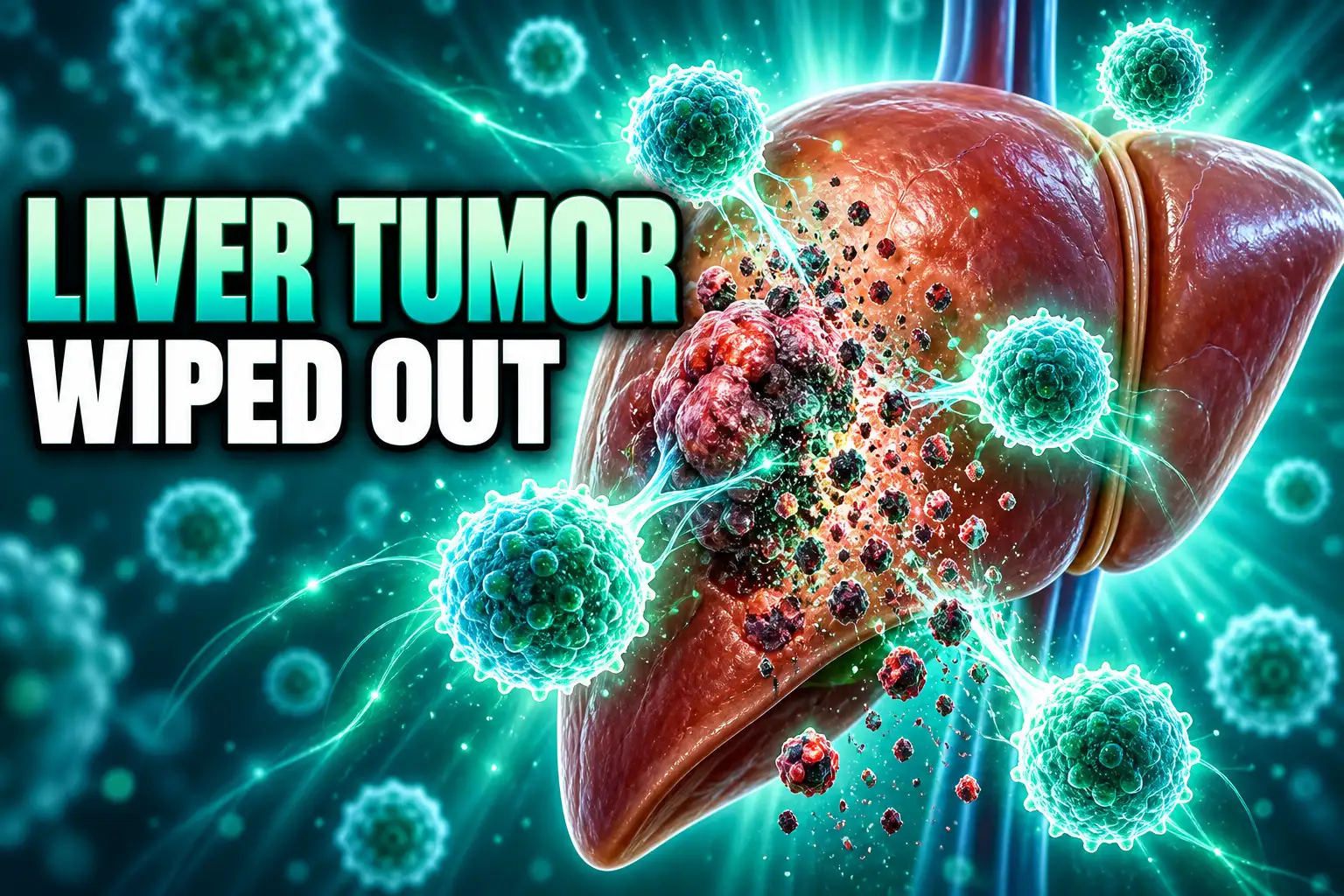
A 3-year-old boy with chemotherapy-resistant metastatic hepatoblastoma had no detectable cancer at least 12 months after two GPC3-CAR T infusions. The cells were his own, rewritten to recognize glypican-3 and to make IL-15 and IL-21, and both doses were given in clinic.
David Steffin, a pediatric oncologist at Baylor College of Medicine, wrote in a September 9, 2026, letter that the complete response came in the outpatient setting without systemic toxicity. The letter is one child from an early trial, not a completed study of the product.
Two Outpatient Doses Wiped Out a Returning Liver Tumor
When doctors first measured the mass, it filled the left lobe of the liver at 11.2 cm by 9.6 cm by 7.1 cm. The cancer had already reached his lungs, with signs it had reached bone as well.
WHAT THE CHILD HAD ALREADY BEEN THROUGH
- Up-front chemo: He received three courses of chemotherapy before any cell therapy was discussed.
- The liver operation: Surgeons removed the primary liver tumor after those courses.
- The lung operations: Two further operations took out cancer that had spread to his lungs.
- The relapse: A new lung tumor appeared anyway, and that rapid return is what sent him into the CARE study.
CARE T cells are autologous T cells given a GPC3-directed chimeric antigen receptor plus genes for IL-15 and IL-21. After the first infusion, CT scans showed a partial response and blood alpha-fetoprotein, a marker of tumor activity, fell. He received the second dose eight weeks later. Later scans showed no remaining disease apart from residual scarring, and he was still free of detectable cancer at 12 months.
This case demonstrates that a durable complete response in a chemotherapy-resistant solid tumor can be achieved entirely in the outpatient setting without systemic toxicity.
David Steffin, pediatric oncologist, Baylor College of Medicine
Steffin posted the same result on September 11, naming the family, Baylor, Texas Children’s Hospital, Seattle Children’s Hospital, and the NIH.
Excited to share our work in @NEJM! A child with refractory hepatoblastoma achieved a durable complete response after IL-15/IL-21 GPC3 CAR T cells.
Grateful to the patient & family and @AndrasHeczey, @CAGT, @BCM, @TexasChildrens, @SeattleChildrens & @NIH!https://t.co/Se1KjrV0ny— David Steffin (@davidsteffin) September 11, 2026
Andras Heczey, a pediatric oncologist at Seattle Children’s Hospital and a coauthor of the letter, said the case is evidence the cells may be a safe and effective option for hepatoblastoma and that GPC3-positive solid tumors need more testing. Coauthors also include Helen Heslop of Baylor and Malcolm Brenner of Houston Methodist Research Institute, senior figures in Baylor’s Center for Cell and Gene Therapy.
The First GPC3-CAR Product Left Tumors Untouched
This child’s product is the third GPC3-CAR construct Steffin and Heczey have taken into people. In a 2025 Nature paper on 18 patients, T cells that carried the GPC3 receptor alone were safe and peaked in the blood at two weeks, and they produced no objective antitumor responses without IL-15.
Adding IL-15 changed both the benefit and the cost. In 12 patients treated with those 15.CAR cells, 4 of 12 (33%) had an antitumor response and 8 of 12 (66%) had disease control. The same paper found a higher rate of cytokine release syndrome in the IL-15 cohort, with a relative risk of 3.3. Three of those patients needed rimiducid to trip an inducible caspase 9 switch that kills the engineered cells; symptoms then fell and circulating 15.CAR cells dropped.
THREE GPC3-CAR VERSIONS TESTED IN PEOPLE
| Product | Added cytokines | Tumor effect | Toxicity note |
|---|---|---|---|
| GPC3-CAR alone | None | No objective responses (6 patients) | Safe; peak expansion at 2 weeks |
| 15.CAR | IL-15 | 4 of 12 responses (33%); 8 of 12 disease control (66%) | More CRS; switch used in 3 patients |
| 15.21.GPC3-CAR (this child) | IL-15 and IL-21 | Complete regression lasting at least 12 months (1 child) | No systemic toxicity; outpatient |
By comparison, conventional CAR T cells already produce complete response rates over 80% in relapsed B-cell leukemias. Solid tumors have been the gap, in part because the tissue around them lacks the cytokines T cells need to stay alive. IL-15 is one of those cytokines. The 2025 paper showed it can raise expansion and tumor kill in GPC3-positive cancers, and that the extra activity comes with extra CRS.
Relapsed Hepatoblastoma Still Lacks a Rescue Standard
Hepatoblastoma is the most common liver cancer of childhood and usually appears before age 3, according to the National Cancer Institute. Most newly diagnosed children who can have their tumors cut out after cisplatin-based chemo do well. The ones who relapse after that sequence do not.
NCI treatment summaries put 3-year overall survival of 43 percent among children who had chemotherapy and surgery after a recurrence, with 3-year event-free survival of 34%. Those figures already assume the new tumors can be operated on. If residual disease cannot be removed, the same summaries point families toward a trial.
This boy had already had the liver cut out and two lung operations. The cancer came back anyway, and it had not yielded to chemo. That is the group for which there is still no agreed rescue regimen, which is why a complete regression after two clinic infusions is being read so closely, and why it cannot be treated as a new standard on one letter.
Why the Team Added IL-15 and IL-21
The receptor on these cells is built from an antibody that binds glypican-3, a surface protein found on several pediatric solid tumors and almost absent from healthy mature tissue. Combined immunohistochemistry series have found GPC3 in 131 of 135 hepatoblastomas. Binding is only half the job. Once a T cell is inside a solid tumor, it still has to divide, persist, and keep killing after repeated contact with the antigen.
IL-15 helps antigen-experienced T cells expand and survive. IL-21 was added because, in the team’s preclinical models, the pair outperformed IL-15 alone and helped the cells keep T cell factor-1, a protein tied to staying proliferative instead of burning out. NIH grant R01CA258866, led by Heczey, funded that dual-cytokine work. The CARE product also carries iCasp9, so a dose of AP1903 (rimiducid) can delete the cells if toxicity runs away, the same switch used in three patients on the IL-15-only product.
The wrong interleukin keeps getting attached to this case. IL-12 is a different cytokine and was not in these cells. The sequence that matters is narrower: GPC3-CAR alone did not shrink tumors, IL-15 armor did in 4 of 12 patients and raised CRS, and this child received both IL-15 and IL-21 and did not have systemic toxicity. One letter cannot prove the second cytokine is what spared him the storm. It does show that a dual-cytokine GPC3-CAR can be given twice in clinic in at least one child with bulky, pretreated disease.
CARE still uses lymphodepleting chemo. Participants receive cyclophosphamide and fludarabine for 3 days so the new cells have room to expand, then the T cells 48 to 96 hours later, thawed and injected over 5 to 10 minutes. Each dose is grown from the child’s own blood. That one-patient manufacturing step is unchanged. What changed in this case is where the child could be while the cells did their work.
GPC3 Is Already a Target in Adult Liver Cancer
Hepatoblastoma is rare. The protein these cells hunt is not. GPC3 is also found on hepatocellular carcinoma, yolk sac tumors, malignant rhabdoid tumors, Wilms tumor, some rhabdomyosarcomas, and liposarcomas, which is why CARE’s eligibility list is broader than one liver cancer of toddlers.
GPC3-POSITIVE CANCERS ON THE TRIAL LISTS
- Hepatoblastoma: The child’s diagnosis; GPC3 staining in 131 of 135 cases in combined IHC series.
- Hepatocellular carcinoma: The common adult liver cancer, listed on both pediatric IMPACT and a separate adult Baylor protocol.
- Yolk sac tumor, rhabdoid tumor, Wilms tumor: Embryonal cancers that often carry GPC3 and are named on CARE and IMPACT.
- Rhabdomyosarcoma and liposarcoma: Solid tumors on the same pediatric protocols, with more variable GPC3 staining.
IARC’s GLOBOCAN 2024 estimates put liver cancer as the third cause of cancer death worldwide, with 732,489 deaths (7.5% of cancer deaths), after lung cancer at 1.9 million (19.1%) and colorectal cancer (9.4%). New liver cases were estimated at 843,045 (4.1% of diagnoses). Most of that burden is hepatocellular carcinoma in adults, not hepatoblastoma.
If dual-cytokine GPC3-CAR cells can clear a chemo-resistant pediatric liver tumor without putting the patient in an ICU for CRS, the larger question is whether the same construct can be made for the GPC3-positive cancers that actually fill those death tables. An adult Houston Methodist study of 21.15.GPC3-CAR T cells is already listed for GPC3-positive solid tumors, including hepatocellular carcinoma. That study is a separate protocol from this child’s letter.
Houston and Seattle Are Still Enrolling Children
The letter does not report how other children on CARE have fared. Both pediatric studies of the dual-cytokine product remain in phase 1 dose escalation, which means the safe dose is still being found.
THE TWO OPEN PEDIATRIC GPC3 DUAL-CYTOKINE TRIALS
| Trial | Site | Start | Planned enrollment | Status |
|---|---|---|---|---|
| CARE (NCT04715191) | Texas Children’s Hospital, Houston | May 24, 2024 | 24 | Recruiting |
| IMPACT (NCT07148050) | Seattle Children’s Hospital | December 22, 2025 | 21 | Recruiting |
The phase 1 CARE trial in Houston, sponsored by Baylor with Steffin as responsible party, last updated its public record on August 6, 2026. Primary completion is estimated for August 1, 2027, with 15 years of gene-transfer follow-up after that. Blood is drawn to grow the cells, a retrovirus inserts the CAR plus IL-15, IL-21, and iCasp9, and the product is frozen until the child is ready. Optional tumor biopsies are written into the schedule so investigators can see whether the cells actually enter the mass.
Heczey is now in Seattle, where Michelle Choe is principal investigator of the parallel IMPACT study at Seattle Children’s. IMPACT opened on December 22, 2025, and is enrolling children and young adults ages 1 to 26 with relapsed or refractory non-CNS solid tumors that stain for GPC3. Choe is also a coauthor of the September 9 letter, listed at Fred Hutchinson Cancer Center. IMPACT uses the same lymphodepleting pair, a single IV infusion, the same rimiducid kill switch, and the same 15-year follow-up clock.
Neither record has posted efficacy results for the rest of the cohort. Dose escalation will decide whether this child’s course is the start of a pattern or a single deep response. Until those data exist, the usable facts are narrower: a dual-cytokine GPC3-CAR product, given twice, produced a complete regression lasting at least 12 months in one child whose metastatic hepatoblastoma had already beaten chemo and surgery, and it did so in clinic without systemic toxicity.
Disclaimer: This article is news reporting on a published single-patient letter and public trial records. It is informational only and is not medical advice, a treatment recommendation, or a prognosis for any child or adult with hepatoblastoma, hepatocellular carcinoma, or another GPC3-positive tumor. Families considering cell therapy should consult a pediatric oncologist or a solid-tumor immunotherapy team at a center that runs these trials, because eligibility, manufacturing, and toxicity monitoring are specific to each protocol. Response rates, safety findings, and enrollment status reflect the cited papers and ClinicalTrials.gov records as dated above and will change as CARE, IMPACT, and related studies accrue more patients.

Ford Cuts 2027 F-150 Raptor Prices by Stripping Gear

Samsung’s Home Up Patch Catches the Fold 8 Icon Drift

X Sells Cashtag Trade Traffic to Five U.S. Brokers

Pete Alonso’s 300th Homer Turns Citi Field on the Mets

Staffline Temps Keep the Pilgrim’s Enniskillen Line Moving

The Orchard Bug Forced Zcash to Open an Empty Pool

The $5.99 Game That Won Steam’s 2026 Summer Sale

Don Lee Joins Hemsworth as Extraction 3 Starts Shooting

YouTube Shorts Retires Dislikes and Swaps Likes for Hearts

NEURA Robotics Is Spending Its $1.4B on a Machine Stack
-
 NEWS4 months ago
The Orchard Bug Forced Zcash to Open an Empty Pool
-
 GAMING4 months ago
The $5.99 Game That Won Steam’s 2026 Summer Sale
-
 ENTERTAINMENT6 months ago
Don Lee Joins Hemsworth as Extraction 3 Starts Shooting
-
 NEWS4 months ago
YouTube Shorts Retires Dislikes and Swaps Likes for Hearts
-
 NEWS4 months ago
NEURA Robotics Is Spending Its $1.4B on a Machine Stack
-

 AUTO6 months ago
Kawasaki Bets the New Z1100 Against Its Own Supercharger
-

 BUSINESS5 months ago
Norway’s Export Bank Backs Nscale’s $790 Million Narvik Loan
-

 GAMING4 months ago
Game of Thrones Dragonfire Follows Boston’s Conquest Playbook