
NEWS
EveryCarbon Scales Circular Diols Inside a Food Factory
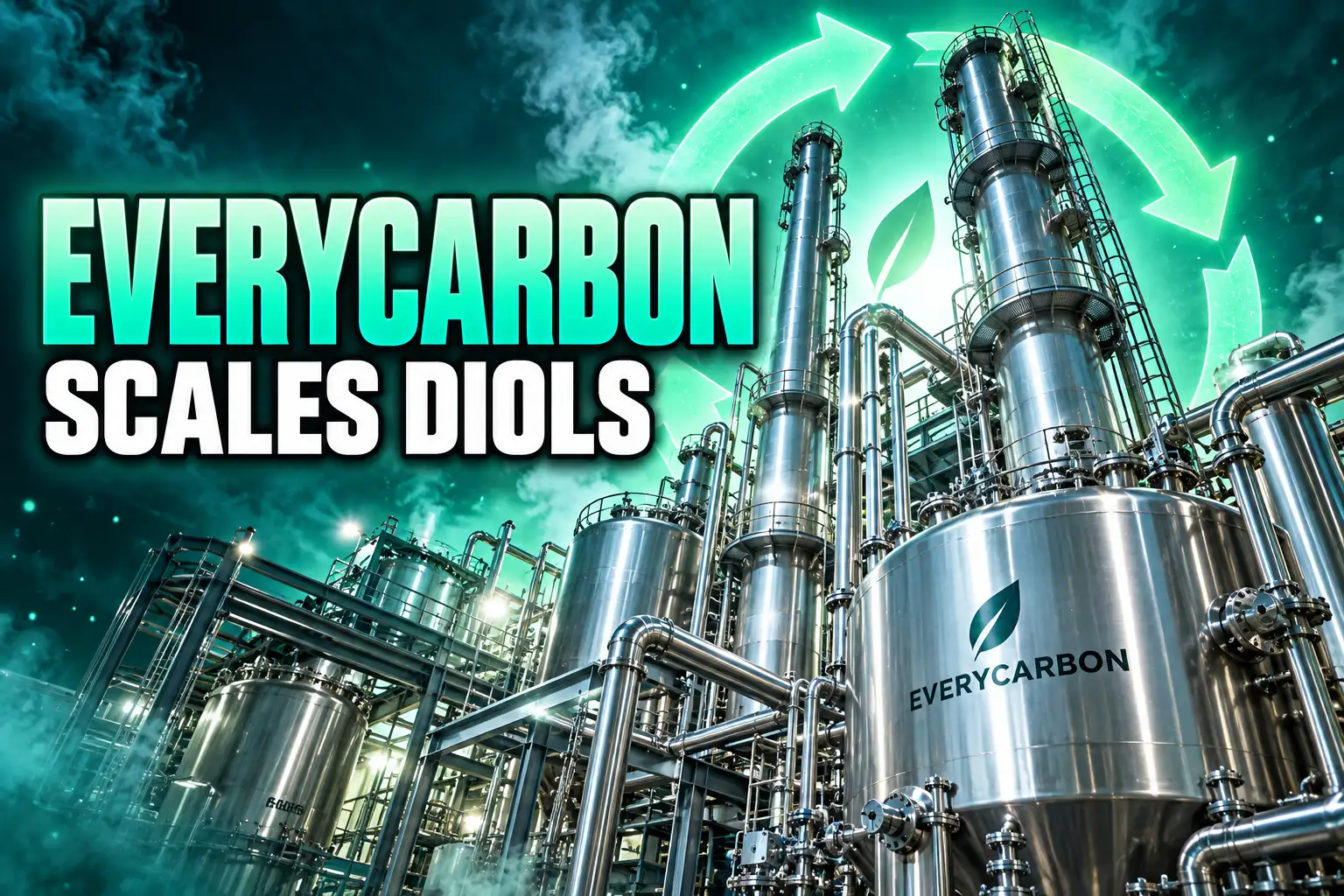
EveryCarbon will ferment circular diols in a 10,000-litre Popp Feinkost tank, testing a food plant as the factory for fossil-independent polyester.

EveryCarbon will retrofit a 10,000-litre tank at Popp Feinkost to test circular diols for its ECOne polyester, under a FLAIR subcontract led by TU Hamburg. The work was announced on 15 September 2026 and uses kit the food plant already owns.
The Hamburg University of Technology spin-out is not building a new chemical works. It is asking whether a salad factory’s tanks, gas and hot water can host the first industrial step of a fossil-independent resin line.
EveryCarbon Wins a FLAIR Slot at Popp Feinkost
EveryCarbon, which makes engineered polyester systems for tough industrial and construction settings, said it will scale circular diol making from the lab to a 10 m³ industrial pilot on Popp’s site. The diols feed ECOne, a polyester first aimed at performance insulation in demanding buildings and factories.
FLAIR stands for Funktionsmaterialien aus Lebensmittelabfällen durch prozess-Integriertes Recycling, or functional materials from food waste through process-integrated recycling. TU Hamburg leads the multi-year programme. EveryCarbon’s slice is a subcontract, and neither side published its cash value.
THE PILOT IN FIGURES
- Tank size: A 10,000-litre, 10 m³ vessel already on the Popp site will be retrofitted for waste hydrolysis.
- Product path: Food-waste hydrolysate made in Kaltenkirchen will move to EveryCarbon’s Stuttgart pilot and be turned into ECOne engineering resins.
- Host plant: Popp Feinkost in Kaltenkirchen, Schleswig-Holstein, is a deli-salad and spread maker with more than 400 staff in the Wernsing Food Family.
- Data layer: Fraunhofer IPA will build a data system meant to flag new material uses earlier and cut development time.
Sebastian Beblawy, EveryCarbon’s chief executive and co-founder, framed the 10,000-litre run as proof that old industrial kit can carry the next fossil-independent manufacturing layer.
This project allows us to validate continuous production of the building block used in ECOne, while showing how existing industrial infrastructure can be repurposed to reduce dependence on fossil-derived materials.
Sebastian Beblawy, Chief Executive Officer and Co-Founder, EveryCarbon
That is the second-order claim. The subcontract is a permit to try the cheaper path. If the tank runs, food plants with spare steel, heat and gas become a materials platform, and buyers who hate oil-linked diol prices get a second source without waiting for a greenfield biorefinery.
Popp Already Turns Wastewater Into Biogas
Popp is the overlooked party. The Kaltenkirchen works already treats organic load as an energy stream, not only as a disposal bill. FlexBio’s plant record lists an anaerobic system, first built in December 2018 and expanded in November 2022, handling 70,000 cubic metres of wastewater a year at a COD of 3,000 to 6,000 mg/l and making 626 MWh of energy a year through a 360 kWth biogas boiler and a CHP unit.
Ludger Seggering, a Popp authorised officer, said the wastewater is full of energy and that the FlexBio kit gave the company a way to make biogas from it. FLAIR now asks that same site to host hydrolysis, not only gas.
WHAT POPP ALREADY RUNS
| Asset | Already on the Kaltenkirchen site | FLAIR use |
|---|---|---|
| Process tank | Existing 10 m³ vessel | Retrofit for waste hydrolysis and continuous runs |
| Gas | Biogas plant, stores, desulphurisation, boiler and CHP | Tie the fermenter into site gas kit |
| Heat | Hot water supply for food processing | Tie the fermenter into site hot water |
| Feed | Food-processing side-streams plus organic wastewater | Make food-waste hydrolysate |
| Next step | No on-site polyester line | Truck hydrolysate to Stuttgart for ECOne resins |
The table is the whole bet. A new 10 m³ fermenter hall would need its own heat, gas, permits and staff. Popp already pays for those because salads and spreads make wet waste. EveryCarbon is trying to rent that overhead instead of duplicating it.
The limit sits in the last row. Hydrolysis can live on the salad line. The resin still will not. Until someone puts the conversion step on the same plot, the food plant is a feedstock station, not a materials factory.
SPRIND Adds €2.5 Million for Continuous Runs
FLAIR is a new wrapper around a process EveryCarbon has been building since late 2023. The company is a 2024 spin-out of Hamburg University of Technology, legally seated in Tübingen, with a mini-plant in the Stuttgart area. Beblawy, a KIT-trained biotechnologist, is chief executive.
Germany’s Federal Agency for Breakthrough Innovations, SPRIND, picked the team for its Circular Biomanufacturing Challenge, which began in November 2023 and runs three years. The brief is an end-to-end prototype that turns carbon-rich waste into products in a continuous bioprocess, without E. coli or baker’s yeast, and that shows at least 180 days of continuous production. TU Hamburg said the first-year award was up to €1.5 million to build that prototype.
EVERYCARBON’S PATH TO THE POPP TANK
- November 2023: SPRIND starts the three-year Circular Biomanufacturing Challenge and takes EveryCarbon into the first cohort.
- April 2024: TU Hamburg records a first-year award of up to €1.5 million for an end-to-end prototype.
- August 2025: EveryCarbon says its first lab and production containers arrive in Stuttgart for a mini-plant on real waste streams.
- October 2025: A SPRIND jury sends five teams, including EveryCarbon, into stage three with up to €2.5 million each for twelve months. TU Hamburg, on 23 October 2025, calls it a further €2.5 million.
- November 2025: EveryCarbon marks one year as a company, a headcount rise from 3 to 10, and 160 days of continuous operation on sewage sludge.
- 15 September 2026: EveryCarbon announces the FLAIR subcontract for the 10,000-litre Popp tank.
The 160-day sludge run and the 180-day SPRIND bar are different clocks. One is a feedstock EveryCarbon already pushed through its own kit. The other is the challenge rule still hanging over stage three, which SPRIND said would run twelve months from October 2025, with winners picked at the end of that year.
Hamburg University of Technology said the €2.5 million is meant to pay for a shift to continuous production and customer trials, plus new waste streams. Partners on that SPRIND work include the University of Hamburg’s Institute for Technical and Macromolecular Chemistry, Fraunhofer IPA, IMDEA Energía, LFKW Büsnau and juice maker Valensina. Valensina is the tell. EveryCarbon was already inside a food plant’s waste stream before FLAIR named Popp.
What the 10,000-Litre Retrofit Must Prove
Scale-up is the step where most new materials die. Titres that look fine in a flask fall over when mixing, heat and contamination become factory problems. FLAIR’s answer is to skip the new hall and force the process onto kit that already runs three shifts.
THE FLAIR SCALE-UP STEPS
- Tank retrofit: EveryCarbon will help convert an existing 10 m³ tank so it can hydrolyse waste on the Popp site.
- Utilities tie-in: The fermenter will be joined to the site’s gas kit and hot water and set up for continuous operation.
- Hydrolysate move: Once that system runs, food-waste hydrolysate will be taken to EveryCarbon’s Stuttgart pilot.
- Resin step: Stuttgart will convert the hydrolysate into ECOne engineering resins.
- New molecules: TU Hamburg and the University of Hamburg will develop new monomers and polymers from the same platform.
Continuous operation is the load-bearing test. A batch tank that runs for a press visit does not help a builder who needs resin every week. SPRIND already made 180 days the bar for the national challenge. FLAIR now asks the same behaviour of a vessel that shares a plot with mayonnaise and potato salad.
The 10 m³ tank is tiny next to Popp’s 70,000 m³ of wastewater a year. That gap is useful. If hydrolysis works in 10 cubic metres, the site has wastewater volume to spare. If it fails, the company has not poured a new factory into the ground.
ECOne Targets Performance Insulation First
EveryCarbon describes itself as a high-performance shielding materials firm. ECOne is the polyester those diols are supposed to feed. The first use case is performance insulation in harsh building and factory settings, with construction and solvent applications also on the company’s list. Gescher’s group has also talked about performance polymers for 3D printing once the platform chemical is cleaned up.
Diols are the two-alcohol building blocks that go into many polyesters. Most of that market still sits on oil. When crude and naphtha jump, insulation and industrial resin prices jump with them. EveryCarbon’s pitch to those buyers is a second feedstock, made from food-processing side-streams that Popp already has to handle.
TU Hamburg’s write-up of the process is more ambitious than a single resin. The Gescher team designed a cascade that tries to all carbon atoms in one target product, recycling side streams inside the process and sending CO2 back in as carbon feed. That is why the company is called EveryCarbon. Biogas plants, by design, let a lot of that carbon leave as gas. This route tries to keep it in a plastic.
No named insulation maker, contractor or chemical distributor has been announced as a launch customer. TU Hamburg said SPRIND money would fund first customer trials. FLAIR does not name those trials. Until a buyer specs the resin, ECOne is a target, not a SKU.
Gescher’s Institute Moves Fermentation Onto the Factory Floor
Prof. Johannes Gescher, head of the Institute of Technical Microbiology at TU Hamburg, has been on this process since it was a university project. In an earlier interview he said the group was working food-industry waste and sewage sludge, and that food-industry residues typically process faster while sludge is harder, more plentiful and less fought over. He said large parts of the cascade are biofilm-based, and that bioelectrochemical reactors supply electrons for CO2 reduction.
FLAIR is the moment that science leaves the bench. Gescher said food-waste hydrolysate has long been easy to valorise in papers and rare to run at a scale industry notices.
Food waste hydrolysate is a resource we’ve long known how to valorise scientifically, but rarely at a scale that matters industrially. The FLAIR project lets us take fermentation science out of the laboratory and validate it directly on an existing production site. Working with EveryCarbon on monomer and polymer development from this platform is a natural extension of research we’ve pursued for years, and this partnership gives us a real pathway to translate that work into materials with genuine industrial relevance.
Prof. Johannes Gescher, Head of the Institute of Technical Microbiology, TU Hamburg
University of Hamburg chemists will hunt new monomers and polymers from the same hydrolysate. Fraunhofer IPA’s data layer is supposed to guess uses before the usual trial-and-error loop. Those are research outputs. They matter if the tank runs. They do not replace a purchase order.
EveryCarbon said waste management and chemical production now operate as one working process in its mini-plant. FLAIR asks whether that sentence still holds when the fermenter shares a fence with a food line, a biogas boiler and a logistics yard.
The Hydrolysate Still Leaves Kaltenkirchen for Stuttgart
Two maps sit on top of each other. On one, Popp’s Kaltenkirchen plant becomes a chemical node: waste in, hydrolysate out, gas and heat reused. On the other, the valuable step still happens a few hundred kilometres south, in EveryCarbon’s Stuttgart kit, because that is where the company already installed containers in August 2025 and where LFKW Büsnau sits in the SPRIND partner list.
That split keeps capital down. It also keeps the proof incomplete. A construction buyer who wants fossil-independent polyester does not buy hydrolysate. They buy boards, parts or resin that passes their fire, strength and moisture tests. Those tests start after Stuttgart, not after the 10 m³ tank.
SPRIND still has to pick stage-three winners after the twelve-month window that opened in October 2025. FLAIR still has to show continuous hydrolysis on a live food site. Popp still has to live with a fermenter beside food production. EveryCarbon still has to turn someone else’s salad waste into a diol a resin line will accept.
Popp’s tank still has to run in continuous mode, the hydrolysate still has to reach Stuttgart, and ECOne still has to come out as a resin a builder will specify.

Ford Cuts 2027 F-150 Raptor Prices by Stripping Gear

Samsung’s Home Up Patch Catches the Fold 8 Icon Drift

X Sells Cashtag Trade Traffic to Five U.S. Brokers

Pete Alonso’s 300th Homer Turns Citi Field on the Mets

Staffline Temps Keep the Pilgrim’s Enniskillen Line Moving

The Orchard Bug Forced Zcash to Open an Empty Pool

The $5.99 Game That Won Steam’s 2026 Summer Sale

Don Lee Joins Hemsworth as Extraction 3 Starts Shooting

YouTube Shorts Retires Dislikes and Swaps Likes for Hearts

NEURA Robotics Is Spending Its $1.4B on a Machine Stack
-
 NEWS4 months ago
The Orchard Bug Forced Zcash to Open an Empty Pool
-
 GAMING4 months ago
The $5.99 Game That Won Steam’s 2026 Summer Sale
-
 ENTERTAINMENT6 months ago
Don Lee Joins Hemsworth as Extraction 3 Starts Shooting
-
 NEWS4 months ago
YouTube Shorts Retires Dislikes and Swaps Likes for Hearts
-
 NEWS4 months ago
NEURA Robotics Is Spending Its $1.4B on a Machine Stack
-

 AUTO6 months ago
Kawasaki Bets the New Z1100 Against Its Own Supercharger
-
 BUSINESS5 months ago
Norway’s Export Bank Backs Nscale’s $790 Million Narvik Loan
-

 GAMING4 months ago
Game of Thrones Dragonfire Follows Boston’s Conquest Playbook