
NEWS
Roman’s Wide Field Instrument Sees Its First Starlight
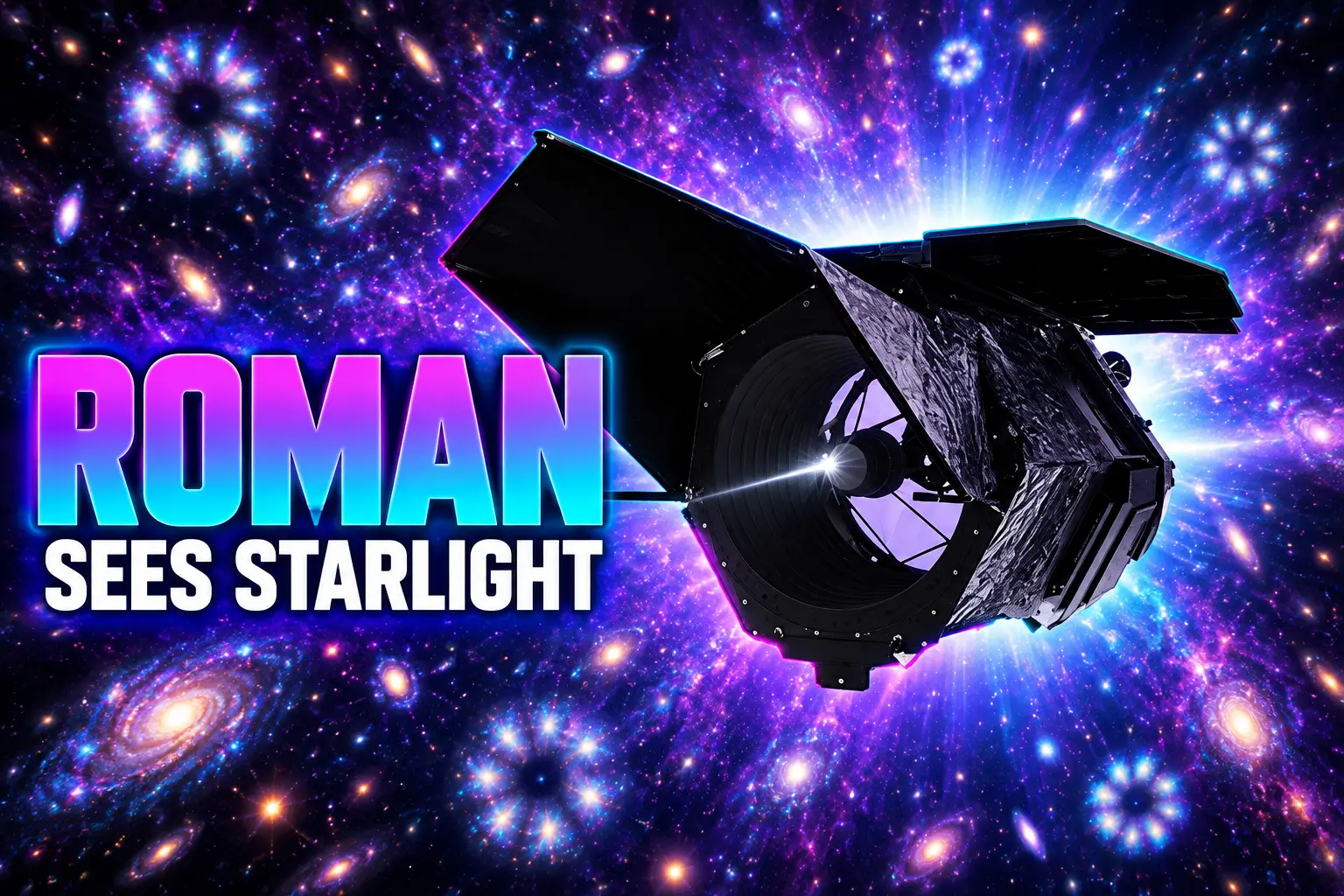
NASA has powered up Roman’s 300-megapixel survey camera and checked out its planet-imaging coronagraph, confirming both space bets on the cruise to L2.

NASA’s Nancy Grace Roman Space Telescope powered up its 300-megapixel Wide Field Instrument on September 11 and recorded its first starlight a few days later. The stars look like doughnuts because the camera is still in its launch pose, far from best focus.
The Coronagraph Instrument, a planet imager built to hide starlight, also passed its first full in-space checkout while Roman continues a three-month, million-mile cruise to the Sun-Earth Lagrange point L2. Both bets NASA packed onto this observatory are alive in flight.
Roman’s 300-Megapixel Camera Saw Its First Stars
The Wide Field Instrument, or WFI, is the survey camera that will do almost all of Roman’s science. NASA said the first photons of starlight to reach the detectors arrived with the array still stowed as it was for launch, so each star is spread over many thousands of pixels as a broad, doughnut-like blob.
That blur is the baseline engineers will use to align the optics and shrink those blobs into sharp points. The mission account @NASARoman put it plainly: “Sometimes your eyes need a minute to focus when you wake up.”
Sometimes your eyes need a minute to focus when you wake up. Roman's Wide Field Instrument just woke up for the first time EVER, and scientists have started adjusting its "eyes" so they can focus on the bigger picture.
Check out its first test image below https://t.co/lkv3LFMyMR pic.twitter.com/AnI6XU1MAm
— Nancy Grace Roman Space Telescope (@NASARoman) September 15, 2026
Josh Schlieder, the Wide Field Instrument scientist at NASA’s Goddard Space Flight Center in Greenbelt, Maryland, said the ground tests had finally been matched by a result in space.
After years of effort to build and test the instrument on the ground, we now have confirmation that it is operational in space. This is a huge milestone for the team at Goddard, our industry teams at BAE Systems, Inc. and Teledyne, and our science centers. There is much to do, but we are on our way to groundbreaking science.
Josh Schlieder, Wide Field Instrument scientist, NASA Goddard Space Flight Center
NASA still plans to release Roman’s first science images by early 2027. Those frames will be much sharper than the doughnut field sitting in the log now.
The 10-Day Wait Before the Heaters Went Off
The camera could not be switched on at launch. The team let the WFI rest for 10 days so it could dry out and shed contamination, holding the detectors at a relatively warm minus 85 degrees Fahrenheit (minus 65 Celsius) compared with the cold they need for science.
On the morning of September 11 they turned the instrument heater off and let the WFI fall to minus 225 Fahrenheit (minus 143 Celsius), then switched on all 18 infrared detectors. Combined, those chips have a sensing area about the size of a laptop screen. Each one is about the size of a saltine cracker.
Later that Friday night the calibration system came on. Saturday morning, September 12, test data started flowing to engineers on the ground. Saturday evening they ran the element wheel, a stack of filters, prisms, and other optics, in weightlessness for the first time. Sunday morning, September 13, they checked the focus mechanism that will be used on the hundreds of thousands of images the camera will take. While that work ran, the detectors kept cooling toward about minus 300 Fahrenheit (minus 183 Celsius).
FROM LAUNCH TO FIRST PHOTONS
- August 30, 2026: Lifts off at 7:26 a.m. EDT on a SpaceX Falcon Heavy from Launch Complex 39A at NASA’s Kennedy Space Center. Ground controllers at Goddard see telemetry seven minutes later, and the observatory separates 31 minutes into the flight.
- August 30, 2026: Solar panels and the lower instrument sun shade deploy 1 hour 23 minutes after launch. NASA Administrator Jared Isaacman said the mission was delivered ahead of schedule and on budget.
- September 1, 2026: The Coronagraph Instrument powers on from 7:27 to 8:22 a.m. EDT. The high-gain antenna and visor-like aperture cover also deploy.
- September 11, 2026: After the 10-day dry-out, the WFI heater is turned off, the camera cools to minus 225 Fahrenheit, and all 18 detectors come alive.
- September 12-13, 2026: Calibration data, the element wheel, and the focus mechanism are checked; first starlight is recorded with the array still far from best focus.
NASA said every one of those WFI checks matched what the instrument was built to do. Fine guidance, which will let Roman lock onto targets, is the next step, and focusing will collapse those doughnut stars into points.
Eighteen Detectors Cover More Than a Full Moon
The hardware behind that first frame is a mosaic of 18 Teledyne H4RG-10 detectors, each 4096 by 4096 pixels, sitting in the Cold Sensing Module. NASA’s technical sheet gives an active field of 0.8 by 0.4 degrees, or 0.281 square degrees once the gaps between chips are left out, sampled at 0.11 arcsec per pixel.
That patch is bigger than the apparent size of a full moon, with the same class of sharpness Hubble delivers in the infrared. An element wheel in front of the array carries 8 imaging filters from 0.48 to 2.3 microns, plus a prism and a grism for slitless spectroscopy from 0.75 to 1.93 microns. Goddard led the build with BAE Systems and Teledyne; L3Harris is among the other industrial partners on the observatory.
The same set of chips will also do the guiding, reading guide stars between science samples so Roman can slew and settle quickly. That rigid, stable design is why NASA says the telescope can survey the universe a thousand times faster than Hubble without long pauses between pointings.
Roman Will Survey the Sky a Thousand Times Faster
The 2.4-meter (7.9-foot) primary mirror is the same width as Hubble’s. The difference is how much sky that mirror feeds in one click. NASA compares the WFI field to Hubble’s infrared camera as about 200 times larger, and to Hubble’s Advanced Camera for Surveys or Webb’s NIRCam as at least 100 times larger.
HOW WIDE ONE ROMAN FRAME REALLY IS
| Camera | Field of view | NASA’s comparison |
|---|---|---|
| Roman Wide Field Instrument | 0.281 square degrees at 0.11 arcsec per pixel | 300-megapixel mosaic of 18 detectors |
| Hubble WFC3 infrared | about 200 times smaller than Roman | the infrared camera Roman is built to outrun |
| Hubble ACS / Webb NIRCam | about 100 times smaller than Roman | the wide optical and Webb near-infrared frames NASA uses as the other yardstick |
Over a five-year primary mission, NASA says Roman will image more than 50 times as much sky as Hubble covered in 30 years. Julie McEnery, Roman’s senior project scientist at Goddard, said, “We’ve never been able to view the universe with eyes like Roman’s before.”
Those eyes are meant for three jobs at once: a dark-energy map of how the universe has stretched, a census of how matter is clumped, and a search for planets that other methods miss. NASA expects the transit work alone to turn up around 100,000 worlds, with microlensing adding more than 1,000 planets on wider, colder orbits, including worlds as light as Mars.
The Coronagraph Is NASA’s Bet on Earth-like Worlds
The WFI is the survey engine. The Coronagraph is the other wager, a visible-light instrument NASA describes as a technology demonstration for future missions such as the Habitable Worlds Observatory concept, which would be built to photograph Earth-like planets. JPL built it; operators at the Coronagraph Commanding Center at Caltech/IPAC in Pasadena now talk to it in flight.
It woke up on September 1, then stretched every subsystem in the mid-September checkout: software, thermal control, mechanisms, cameras, and the avionics that drive them. Ground teams confirmed they could move the mechanisms that hold its masks, color filters, lenses, and prisms. Thermal control brought the hardware, aside from the detectors, to 72 degrees Fahrenheit (22 Celsius), a room-temperature choice that matches the material properties of its deformable mirrors and made ground testing easier.
That is a strange pairing on one spacecraft. The survey camera is heading for about minus 300 Fahrenheit. The planet imager is sitting in a shirtsleeve climate so its self-flexing mirrors behave the way they did in the lab.
Now that this test is complete, we’ve been decontaminating: sitting idle with our detectors warm so anything that’s stuck to the surface, such as water or trace chemicals, will tend to leave it. This will continue for 30 days, with occasional stops to do other early calibration activities.
Eric Cady, optical engineer leading coronagraph commissioning, NASA Jet Propulsion Laboratory
On September 16, JPL said testing of the coronagraph was going well. NASA has set aside three months of coronagraph observations, spread across the first year and a half of operations, to photograph older, colder giant planets and dusty disks in reflected visible light, closer in than the hot young super-Jupiters direct imaging has mostly shown so far.
How Roman’s Coronagraph Hides a Star
A coronagraph blocks a star’s glare so a faint planet can be seen in the leftover dark. Roman’s version is the first in space with active wavefront control and deformable mirrors, and Caltech/IPAC’s instrument documentation lists the five key technologies for future missions it is meant to prove together, not as lab parts on separate benches.
WHAT THE CORONAGRAPH HAS TO PROVE
- Wavefront control: A fast steering mirror, a focusing mirror, and two deformable mirrors with 48 by 48 actuators each push residual starlight out of a dark hole around the target.
- Deformable mirrors: Those self-flexing surfaces are the hardware NASA has not flown in this role before, and they are why the instrument runs near room temperature.
- Coronagraph masks: A Hybrid Lyot mode and shaped-pupil masks, each about the size of a U.S. quarter, change the diffraction pattern so glare falls away from the planet’s location.
- Photon-counting cameras: Electron-multiplying CCDs handle bright setup scenes and then count single photons from objects many millions of times fainter than the star.
- Post-processing: The instrument is built for raw contrasts of about 10-8, with processing aimed at pulling 10-9 planets out of leftover speckles.
Once Roman is in focus, bright stars in WFI frames will also carry a six-spike diffraction pattern from the struts that hold the secondary mirror, a signature that will mark later Roman pictures the way Hubble’s four spikes mark its own. The first doughnut image is still too unfocused for that pattern to matter. The coronagraph’s job is the harder one, taking the same star and carving a dark region beside it deep enough for a planet’s reflected light to show.
A Precise Burn Stretched the Mission Clock
The instruments are not the only part of the wager that has already paid. In a September 14 update, NASA said the first mid-course correction was accurate enough, with other fuel savings, to more than double the mission’s potential operating life. The primary science run is still five years. Extra propellant is extra time on the clock after that, if the hardware holds.
Roman will send down 1.4 terabytes of data every day once science starts, the highest rate of any NASA astrophysics mission so far. Machine learning and citizen scientists are already in the plan to flag the rare events in that flood. ESA, JAXA, France’s CNES, and the Max Planck Institute for Astronomy are among the international contributors; the Space Telescope Science Institute in Baltimore will help get the public data out.
THE COMMISSIONING SCOREBOARD
- Daily haul: 1.4 terabytes, the highest data rate NASA has flown for astrophysics.
- Planet search: around 100,000 worlds from transits, plus more than 1,000 from microlensing.
- Cruise: about one million miles remaining to a halo orbit around L2, where Webb already flies in a different path.
- First public frames: still aimed at early 2027, after focus, fine guidance, and the rest of the three-month checkout.
McEnery said there is no telling what more will be known, and seen, a year from the launch. For now the survey camera has opened on a field of unfocused stars, the planet imager is baking off water and trace chemicals at 72 degrees, and both instruments are doing what the decade of work on the ground was for: working, in space, on the way to L2.

Ford Cuts 2027 F-150 Raptor Prices by Stripping Gear

Samsung’s Home Up Patch Catches the Fold 8 Icon Drift

X Sells Cashtag Trade Traffic to Five U.S. Brokers

Pete Alonso’s 300th Homer Turns Citi Field on the Mets

Staffline Temps Keep the Pilgrim’s Enniskillen Line Moving

The Orchard Bug Forced Zcash to Open an Empty Pool

The $5.99 Game That Won Steam’s 2026 Summer Sale

Don Lee Joins Hemsworth as Extraction 3 Starts Shooting

YouTube Shorts Retires Dislikes and Swaps Likes for Hearts

NEURA Robotics Is Spending Its $1.4B on a Machine Stack
-
 NEWS4 months ago
The Orchard Bug Forced Zcash to Open an Empty Pool
-
 GAMING4 months ago
The $5.99 Game That Won Steam’s 2026 Summer Sale
-
 ENTERTAINMENT6 months ago
Don Lee Joins Hemsworth as Extraction 3 Starts Shooting
-
 NEWS4 months ago
YouTube Shorts Retires Dislikes and Swaps Likes for Hearts
-
 NEWS4 months ago
NEURA Robotics Is Spending Its $1.4B on a Machine Stack
-

 AUTO6 months ago
Kawasaki Bets the New Z1100 Against Its Own Supercharger
-

 BUSINESS5 months ago
Norway’s Export Bank Backs Nscale’s $790 Million Narvik Loan
-

 GAMING4 months ago
Game of Thrones Dragonfire Follows Boston’s Conquest Playbook