
AUTO
Kawasaki Bets the New Z1100 Against Its Own Supercharger
Kawasaki priced the 2026 Z1100 as a 136 PS unblown naked under the Z H2, trading 6 PS versus the old Z1000 for midrange and a full electronics pack.

Kawasaki launched the 2026 Z1100 as a 136 PS unblown supernaked meant to live under the supercharged Z H2. German factory list prices of 11,995 and 13,795 euros put the base bike and the SE with Brembo calipers and an Öhlins S46 shock on the rung above the Z900.
The last Z1000 left European dealers in 2020 with 142 PS. The new 1,099 cc four makes 6 PS less and 2 Nm more, a Euro 5+ trade Kawasaki is asking litre-naked buyers to accept.
Kawasaki Puts the Z1100 Between the Z900 and the Z H2
Kawasaki’s German launch note is blunt about the gap the bike is meant to fill. It calls the Z1100 the bridge between the strong-selling Z900 and the compressor-charged Z H2 models, which is a sales brief more than a peak-power brief. In Spain the Z H2 still lists with a supercharged 998 cc four rated at 200 PS and a ticket of €21,095, so the unblown flagship has to win on feel and price, not on a dyno printout.
UK list prices tell the same story in pounds. The Z1100 is £11,099 and the SE is £12,699, a £1,600 step for the named brakes and shock. Suzuki’s GSX-S1000 sits at £10,999, within £100 of the base Z, while UK dealers have advertised the Z H2 from £17,549. The Z900 was listed at £9,199 when the 1100 landed, which is the cheaper Kawasaki naked the new bike is supposed to sit above.
Dealers began taking the 2026 bikes in October 2025 after the 25 September 2025 reveal. A year on, the wager has not been rewritten: same motor, same mass, same Sugomi face, and a 2027 colour tweak instead of more power.
Sugomi describes core performance and styling elements found in Kawasaki’s Z Supernaked models. Imbued with Sugomi, their performance excites; a ride on a Z Supernaked is a visceral experience that stimulates the senses; engine and chassis tuning deliver a high level of control. Sugomi is also evident in their sharp styling, dynamic crouching form, and distinct silhouette.
Kawasaki, editors’ note, European launch
That paragraph is the company’s own pitch, and it is also the bet. If buyers still want a crouched Z that hits hard from the middle of the rev range, 136 PS is enough. If they came back for a fight with 180 PS triples and 200 PS fours, the H2 is the other door in the same showroom.
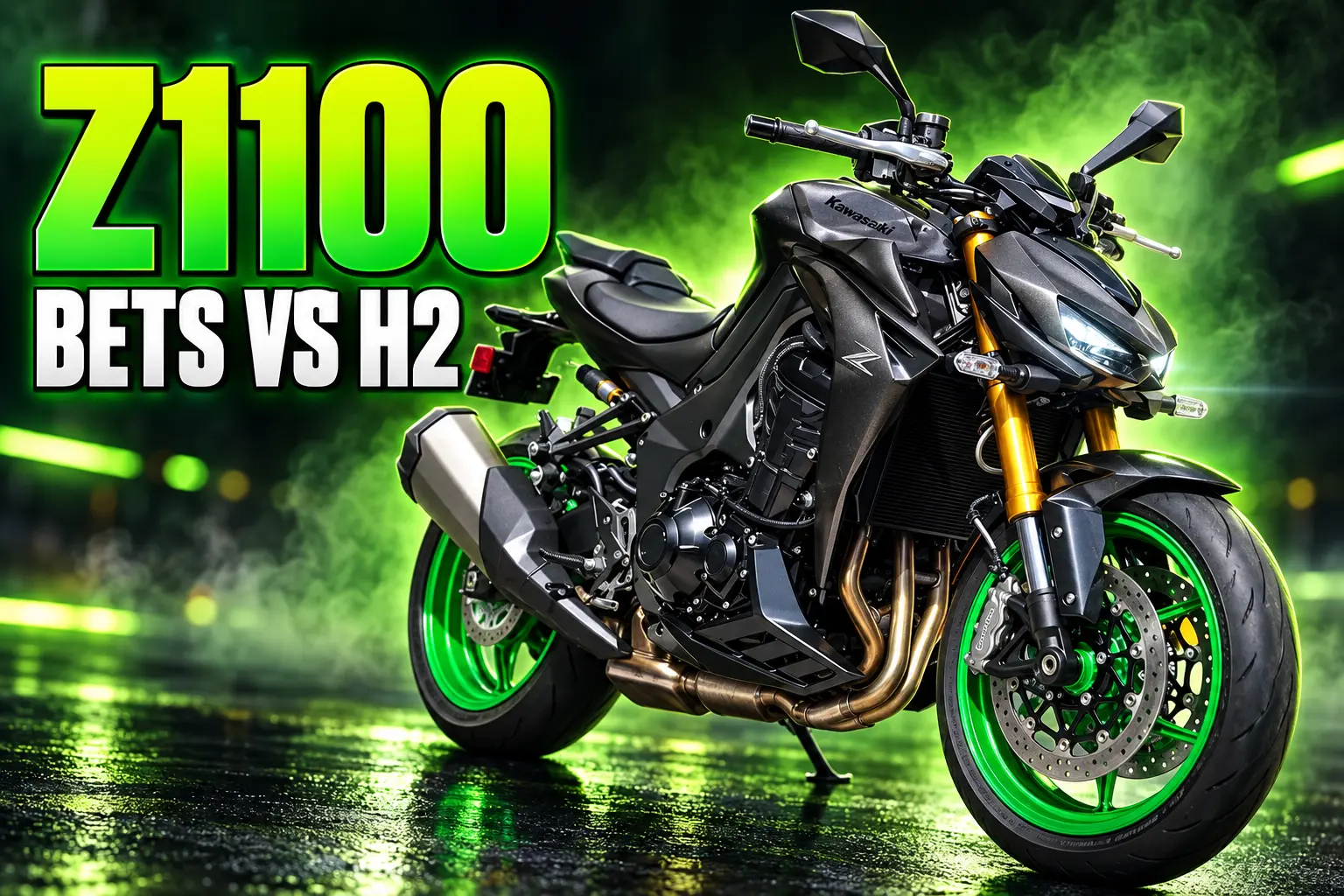
The Engine Gained 56 cc and Lost 6 PS
Kawasaki kept the 77.0 mm bore from the Z1000 and stretched the stroke from 56.0 mm to 59.0 mm, which is how 1,043 cc became 1,099 cc. A heavier flywheel, new pistons, revised cams and valve springs, and intake ports aimed at low-to-mid response sit on top of that extra 3 mm. Peak torque is now 113 Nm (11.5 kgf•m) at 7,600 rpm, 2 Nm above the old bike’s 111 Nm at 7,300 rpm, and it arrives 400 rpm later with a fatter path to get there.
Peak power is 100.0 kW, 136 PS, at 9,000 rpm. The 2014-on Z1000 made 142 PS at 10,000 rpm, so the new bike is 6 PS down and 1,000 rpm earlier at the top. Fifth and sixth gears are longer than on previous litre Z models, which is the touring half of the same trade: less scream on the motorway, more pull when the rider short-shifts.
The four is the family 1,099 cc unit already used in the Ninja 1100SX and Versys 1100, not a unique Z crankcase. Kawasaki retuned it for the naked, then wrapped it in a 4-2-1 system that dumps into a pre-chamber before a single silencer, a layout the company says keeps the mass down and the undercowl mean. Road tests of the related 1100SX had already logged the same pattern, more capacity and a few horses gone, with the useful work happening between about 4,000 and 8,000 rpm rather than at the limiter.
Handlebars moved 22 mm wider and 13 mm farther forward, which Kawasaki says makes the 221 kg machine feel lighter at every speed. That is a lot of bike to hide with a bar change. Wheelbase is 1,440 mm, seat height 815 mm, tank 17 litres, and the aluminium twin-tube frame, 41 mm Showa SFF-BP fork and horizontal back-link rear are the same architecture the Z1000 used, not a clean-sheet chassis.
What the SE Buys for the Extra Money
Both Z1100 models share the engine, the 221 kg wet weight, the 310 mm front discs and the Dunlop Sportmax Q5A tyres (120/70-17 front, 190/50-17 rear). The SE spend is concentrated at the rear shock, the front calipers and the jewellery: Brembo M4.32 radial monoblocs, Brembo discs, steel braided lines, an Öhlins S46 with a remote preload knob, gold fork tubes and green wheels. The fork internals stay Showa.
Z1100 VERSUS Z1100 SE VERSUS Z H2
| Spec | Z1100 | Z1100 SE | Z H2 |
|---|---|---|---|
| Induction and capacity | Unblown 1,099 cc | Unblown 1,099 cc | Supercharged 998 cc |
| Peak power | 136 PS at 9,000 rpm | 136 PS at 9,000 rpm | 200 PS (147 kW) |
| Wet weight | 221 kg | 221 kg | 239 kg |
| Front brakes | Monobloc, 310 mm discs | Brembo M4.32, 310 mm | Brembo M4.32 |
| Rear shock | Gas back-link | Öhlins S46, remote preload | H2-spec unit |
| List price | £11,099 / €11,995 factory | £12,699 / €13,795 factory | €21,095 in Spain |
German factory prices put an €1,800 gap between the two unblown bikes. That is a full Brembo and Öhlins package on a chassis that already has a quickshifter and cruise, which is why the SE is the version most testers have been given and the version aftermarket shops are already hanging cans on. Riders who want that kit pay up, a gap a full 2026 Z1100 road test already treated as the sharp edge of the bike.
Sugomi Now Runs Through a Five-Inch Screen
The old Z1000 was a cable-throttle brute with a small dash. The 1100 adds electronic throttle valves, which is what unlocks cruise control and the two-way KQS quickshifter as standard on both variants. A 6-axis IMU then feeds KCMF cornering management, KTRC traction control, KIBS combined braking, power modes, and four riding modes: Sport, Road, Rain and Rider (manual).
THE RIDER AIDS ON BOTH Z1100 MODELS
- The dash: A 5-inch colour TFT with turn-by-turn navigation and phone pairing, including voice commands.
- The throttle: Electronic throttle valves that also run cruise control and the dual-direction KQS shifter.
- The IMU: Six degrees of freedom for cornering traction, combined braking and the four riding modes.
- The app: Rideology the App Motorcycle for status, logs and setup when the bike is parked.
Kawasaki’s own Rideology page says riders can pull vehicle info and ride logs on a phone, change display units and set ride modes before they leave, and that the app is not meant to be used on the move. The savage LED face and finned undercowl are still the photos. The ride is now filtered through an IMU and a voice prompt, which is the 2026 meaning of Sugomi whether the press copy admits it or not.
At last, the #Kawasaki Z1100 steps into the light. The untamed Sugomi design philosophy evokes raw emotion paired with refined electronic rider aids to create a visceral experience. Aggressive. Refined. Designed to strike.
Awaken the 2026 #Z1100 at https://t.co/eGhjN1naK8. pic.twitter.com/ddtitv4A5V
— Kawasaki USA (@KawasakiUSA) October 13, 2025
221 kg Meets a Class That Got Lighter
Kawasaki quotes 221 kg fully fuelled for both Z1100 models, the same wet figure testers logged on the old bike and toward the heavy end of today’s supernaked cluster. Honda’s CB1000 Hornet is the 152 hp yardstick in this price band, Suzuki’s GSX-S1000 is the £10,999 alternative, and the serious power bikes, Triumph’s Speed Triple 1200 RS, KTM’s Super Duke, Ducati’s Streetfighter V4, live in a different money and horsepower bracket. The Z1100 is not trying to match 180 PS. It is trying to feel like a Z at 136 PS and not lose those buyers to the Hornet.
A July 2026 three-bike supernaked comparison still put the CB1000 Hornet SP ahead of the Z1100 SE and the GSX-S1000. Testers who have had the Kawasaki on the road praise the midrange and the SE’s Brembo feel, then come back to the mass when they push it around a car park and to a silhouette that has not moved far from 2014. Limited steering lock and switchgear that still looks last-decade show up in those notes as well. None of that kills the bike. It is the cost of keeping the old Z stance instead of chasing the Honda’s weight.
Dunlop’s Sportmax Q5A is the stock tyre, a sporty road compound, and the SE’s gold stanchions do not turn the Showa fork into an Öhlins front. The useful hardware upgrade is at the back and at the lever. Front travel is 120 mm and rear travel is 136 mm, so the chassis is still a road naked, not a clip-on sportbike with the fairing left off.
Hornet Riders Keep Crossing the Showroom Floor
The paper fight with Honda is not the whole market. One rider who had already gone from an MT-09 SP to a CB1000 Hornet SP took delivery of a Z1100 SE on 31 May 2026, which is the customer Kawasaki needs if the bet holds: people who have sat on the cheaper, punchier Honda and still want the crouched Z. Japanese plazas were still putting 2026 SE bikes on the floor in late August, and a UK owner filming a short blast called it favourite-child fun after two minutes, which is anecdote, not a dyno sheet, and still closer to Kawasaki’s brief than a peak-power chart is.
Aftermarket reaction has been practical rather than angry. Akrapovic already has a government-certified slip-on for the 2026 Z1100, which is what happens when a named four hits dealers and owners want the stock can gone. The argument on the timeline is not that 136 PS is fake. It is that some riders will pay for Sugomi and the SE’s lever feel even when a group test says the Hornet is the smarter buy.
Green Paint Is the Whole 2027 Update
Kawasaki confirmed 2027 colours in August 2026 and left the motor, the IMU and the SE hardware alone. The base bike stays Ebony / Metallic Carbon Gray. The SE keeps Metallic Matte Graphenesteel Gray / Metallic Matte Carbon Gray and adds Candy Flat Blazed Green on the radiator-shroud ducts and the undercowl. UK pricing was still from £11,099. Dutch dealers were told the 2027 pair would be in stores by the end of August 2026 at €13,199 and €14,999.
FROM SUGOMI TO THE GREEN UNDERCOWL
- 2014: Kawasaki puts the Sugomi brief on the Z1000, the crouched face the 1100 still wears.
- 2016 / 2020: The Z1000 leaves the USA, then Europe, as Euro 5 and the Z900 close the file.
- 25 September 2025: Kawasaki unveils the Z1100 and Z1100 SE as the unblown top of the Z line.
- October 2025: European dealers start taking the 2026 bikes at £11,099 and £12,699 in the UK.
- August 2026: 2027 colours land, green plastic on the SE, same 1,099 cc four underneath.
That timeline is the wager in dates. Five years after the Z1000 vanished from European floors, Kawasaki brought back the big unblown Z with more stroke, less peak power, a 5-inch screen and an SE tax, then spent the next model year on paint. The Sugomi concept first used on the 2014 Z1000 is still the headline. The supercharger stays on the other bike.
Frequently Asked Questions
What does Sugomi mean on the Kawasaki Z1100?
Kawasaki uses Sugomi for both the crouched Z silhouette and the sense of control from engine and chassis tuning, and it is not exclusive to the unblown bike. The Spanish Z H2 page still sells a “Sugomi and minimalist” design and puts the River Mark badge, reserved for supercharged models, on the headlight cowl, so the word now covers the 136 PS Z1100 and the 200 PS H2 at once.
How much power does the 2026 Kawasaki Z1100 make?
Kawasaki rates both the Z1100 and Z1100 SE at 100.0 kW (136 PS) at 9,000 rpm and 113 Nm at 7,600 rpm from the 1,099 cc four, with an 11.8:1 compression ratio and four 38 mm throttle bodies, the same peak figure on the base bike and the SE.
What is the difference between the Z1100 and the Z1100 SE?
The SE keeps the same Showa 41 mm SFF-BP fork internals as the base bike and adds gold stanchions, green wheels, Brembo M4.32 calipers and discs, steel braided lines, the Öhlins S46 with remote preload, and a USB-C port on the bars; it does not make more power or weigh less than 221 kg.
Does the Z1100 share its engine with the Ninja 1100SX?
Yes. The 1,099 cc inline-four also powers the Ninja 1100SX and Versys 1100, and the same capacity hike on those models cut peak power by about 6 hp versus the old 1,043 cc units, so the Z1100’s 6 PS drop versus the Z1000 is a Euro 5+ family pattern rather than a one-off tune.
How does the Z1100 differ from the Kawasaki Z H2?
The Z1100 uses an aluminium twin-tube frame and an unblown 1,099 cc four; the Z H2 uses a steel trellis frame, a balanced supercharged 998 cc engine, and the River Mark emblem Kawasaki keeps for compressor models, at 239 kg wet versus 221 kg for the 1100.
Dutch dealers were already being told to floor the 2027 Z1100 and Z1100 SE by the end of August 2026, still from €13,199 and €14,999, with the same 1,099 cc four under the new green plastic. The supercharger remains on the other Z in the window.

Copilot Capital Bets on Green Eagle’s 90 GW Autopilot

Walmart Puts Dunkin on the App to Sell More Groceries

The Public Bank That Still Closes Molten’s Growth Fund

Ascentiz Bets IFA on a Modular Exoskeleton Platform

BIS Puts a Public Timestamp Under Official Statistics on XRPL

The Orchard Bug Forced Zcash to Open an Empty Pool

The $5.99 Game That Won Steam’s 2026 Summer Sale

Don Lee Joins Hemsworth as Extraction 3 Starts Shooting

YouTube Shorts Retires Dislikes and Swaps Likes for Hearts

NEURA Robotics Is Spending Its $1.4B on a Machine Stack
-
 NEWS4 months ago
The Orchard Bug Forced Zcash to Open an Empty Pool
-
 GAMING4 months ago
The $5.99 Game That Won Steam’s 2026 Summer Sale
-
 ENTERTAINMENT6 months ago
Don Lee Joins Hemsworth as Extraction 3 Starts Shooting
-
 NEWS4 months ago
YouTube Shorts Retires Dislikes and Swaps Likes for Hearts
-
 NEWS4 months ago
NEURA Robotics Is Spending Its $1.4B on a Machine Stack
-

 BUSINESS5 months ago
Norway’s Export Bank Backs Nscale’s $790 Million Narvik Loan
-
 AUTO6 months ago
The Kawasaki Z1100 Awakens Sugomi With Less Peak Power
-
 GAMING4 months ago
Game of Thrones Dragonfire Follows Boston’s Conquest Playbook