
NEWS
BIS Puts a Public Timestamp Under Official Statistics on XRPL
BIS Working Paper 1374 hashes official SDMx files onto the XRP Ledger so revisions and AI feeds can be checked, while XRP itself is only a tiny fee.

The Bank for International Settlements published a 56-page working paper on 2 September 2026 that hashes official statistics onto the XRP Ledger. Researchers built a proof of concept so a downloaded file can be checked against a public timestamp. The test is research, not a live rollout, and the token itself barely enters the design.
What the paper actually changes is quieter. Official economic files, the ones AI systems and trading desks already pull, have had no native way to prove they still match the version a stats office released.
Official Statistics Still Cannot Prove Their Own Files
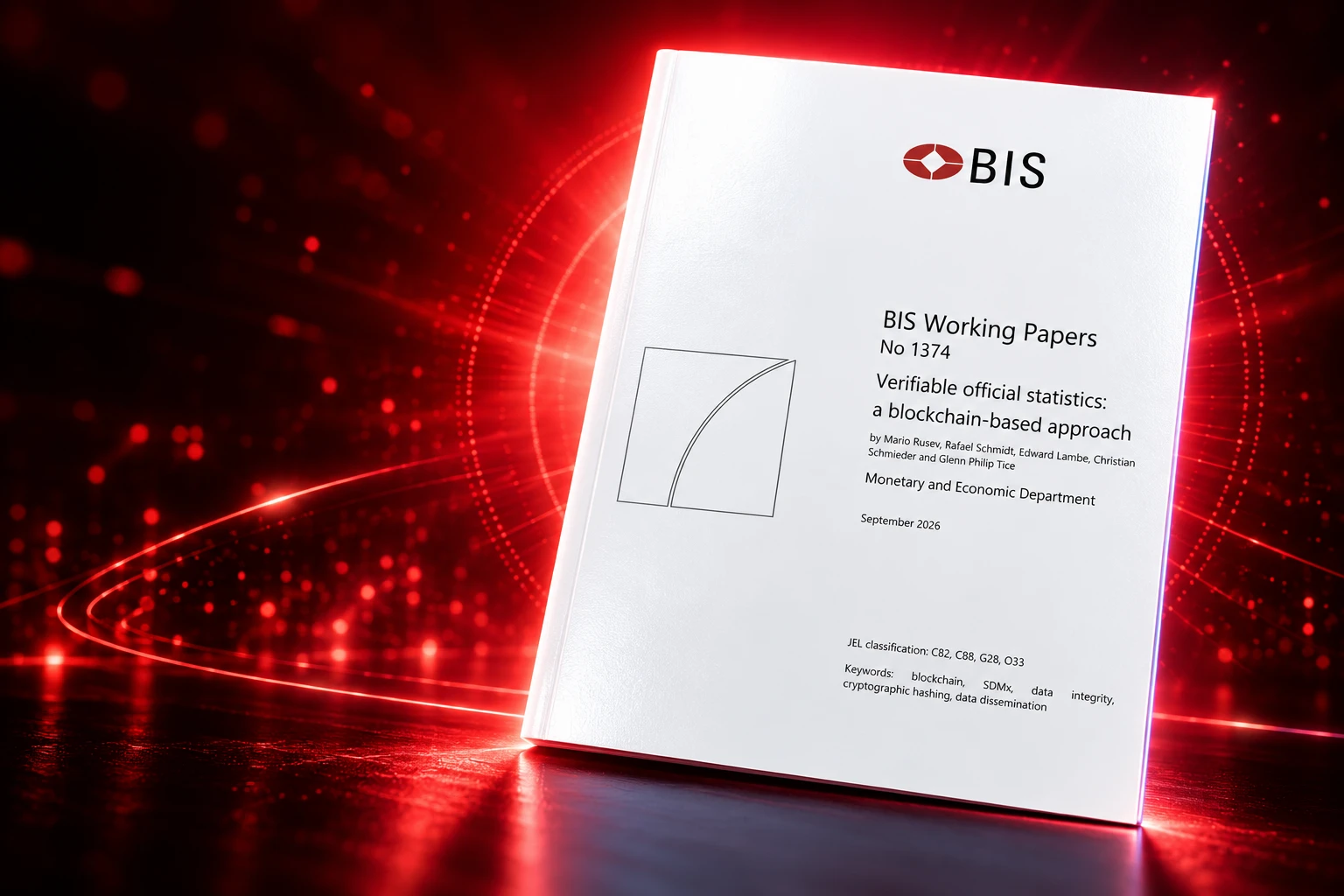
The 56-page working paper No. 1374, titled Verifiable official statistics: a blockchain-based approach, is signed by Mario Rusev of d-fine Austria GmbH and four BIS Monetary and Economic Department staff: Rafael Schmidt, head of MED IT; Edward Lambe, head of MED data engineering; Christian Schmieder, head of operations; and Glenn Philip Tice, a consultant and product manager. The views, the authors wrote, are their own and do not necessarily reflect the BIS or its member central banks.
They start from a gap inside SDMx, the Statistical Data and Metadata standard that international bodies use to move official numbers. The format organises exchange. It does not let a user prove a file still matches the copy the issuer released, including when a third-party portal or an AI system has touched it.
That is not a theoretical worry in the paper’s own telling. The authors cite an NBER event study by Bloom and colleagues (2026) on market uncertainty after the August 2025 dismissal of the head of the US Bureau of Labor Statistics, and they treat eroded trust in official numbers as a cost that is hard to price and real enough to motivate a check that does not depend on the publisher’s website staying honest.
THE SDMX SPONSOR GROUP
- The standard: SDMx is an ISO specification for describing, exchanging and sharing official statistics and their metadata.
- The sponsors: It is backed by eight international sponsor organisations, the BIS, the ECB, Eurostat, the ILO, the IMF, the OECD, the UN Statistical Division and the World Bank.
- The legal mark: The first technical version landed in 2004 and the ISO standard is ISO 17369:2013.
- The first live rails: The first global SDMx data exchanges in 2013 covered national accounts, balance of payments and foreign direct investment.
Users now pull those files from many mirrors. Producers want a cheap way to show the bytes are still theirs. The paper’s answer is a public notary that stores a fingerprint, not the tables.
How the Prototype Fingerprints a Dataset
Each SDMx message is normalised with Canonical XML 1.1, then hashed with SHA3-512 at the whole-file level and, when needed, at each time series. Those fingerprints become leaves in a Merkle tree. One root covering a batch is written into the Memos field of an XRP Ledger Payment, and the published file carries the ordered leaves plus a W3C Verifiable Credential signed by a publisher key bound to the anchoring XRPL address.
A consumer rebuilds the root from the file and checks it with one ledger lookup. The underlying figures never go on-chain. The same pattern, the authors said, can extend to other structured formats such as XBRL.
HOW A DATASET GETS ANCHORED
- Normalise: Strip any previous anchor tags and lock the XML into a stable form so the same file always hashes the same way.
- Fingerprint: Run SHA3-512 on the file, or on selected series, to get fixed 64-byte hashes.
- Fold: Combine those hashes into one domain-separated Merkle root, wrapping the leaf count into the value that will be stored.
- Stamp: Send a Payment whose memo holds only that root, using a public XRPL DevNet node at s.devnet.rippletest.net.
- Bind: Write the transaction hash, root and a signed credential back into the SDMx header so the file is self-contained.
In the worked example, the gateway pays a token amount of 0.00001 XRP (10 drops) so the network will accept the transaction, then waits a typical ledger close of 3 to 4 seconds. End-to-end publication on the prototype sat at a median of 3 to 5 seconds. Checking a file took 1 to 2 seconds, including the on-chain query.
Tests used a synthetic SDMX-ML 2.1 corpus built from BIS public structure definitions, from 10 KB (a few series) to 8 MB (several thousand). All reported runs used DevNet, which shares mainnet’s transaction format and close cadence. The authors did not run sustained mainnet load, hardware-backed signing, or adversarial conditions, and they said the times describe the prototype, not a hardened service.
Researchers Picked XRPL for Speed and Cost
Footnote 6 is blunt about the choice. The ledger used in the analysis has low nominal fees, fast consensus finality, available developer resources, and published technical analysis of its consensus protocol. The public docs sit at xrpl.org. The minimum cost of 10 drops is the network’s reference fee for a standard transaction, and that XRP is destroyed rather than paid to anyone.
Yet our approach is meant to be blockchain-agnostic and to work with solutions other than XRPL as well.
Mario Rusev, Rafael Schmidt, Edward Lambe, Christian Schmieder and Glenn Philip Tice, BIS Working Paper 1374
They even sketch a split: XRPL for cheap anchoring, Ethereum for DeFi hooks, and private chains for regulated shops, with the same fingerprints published in more than one place. Oracle networks such as Chainlink appear as a possible bridge so smart contracts on other chains could read verified SDMx data. That is a design note, not a vendor deal. The paper says references to firms and projects are illustrative and should not be read as an endorsement.
WHERE THIS BUILD SITS AGAINST EARLIER WORK
| Effort | SDMx semantics | Merkle batching | Publisher credential | Cost model |
|---|---|---|---|---|
| Statistics Canada (Klein et al, 2022) | Partial | No | No | No |
| US Commerce / Chainlink BEA feeds | No | No | No | No |
| PKI and Content Credentials | Partial | No | Partial | No |
| This prototype | Full | Full | Full | Full |
Statistics Canada had already looked at publishing dataset hashes on ledgers. The US Department of Commerce work with Chainlink puts BEA series such as real GDP and the PCE price index on-chain as data feeds. This paper’s claim is narrower and more clerical: bind the existing SDMx file, batch the stamps, and price the operating trade-off.
Ripple chief executive Brad Garlinghouse, posting on 4 September 2026, treated the choice as unsurprising on those same engineering grounds.
Is it any surprise that BIS is testing with XRPL.. low fees (check) fast settlement (check) and proven track record (check).https://t.co/M5AFdXYvz5
— Brad Garlinghouse (@bgarlinghouse) September 4, 2026
A Quiet Revision Would Leave a Public Trail
Section 8 is where the design stops being a lab demo and starts biting the people who publish and reuse the numbers. Each release is hashed and either anchored on its own or folded into a batch root. A later file that does not rebuild to that root fails the check. A stats office can still revise GDP or CPI, which they do as a matter of course. They cannot swap a silent PDF and keep the old stamp.
The authors then point a simple CUSUM detector at revision series. If monthly changes in a printed figure start to drift, the alarm is not “the blockchain caught a hacker.” It is that the public record of what was issued, and when, is now complete enough to notice odd restatements. Nowcasting models, they add, can re-run as preliminary data are revised and keep an audit trail of which inputs a central bank actually used.
That is the second-order effect. Third-party portals and AI systems that scrape official files currently have no cheap, independent check. Once a fingerprint is on a public ledger, a bad mirror is a failed hash, and a legitimate restatement is a new hash with a new time. Trust moves from “this PDF is on the agency site” to “this file matches the stamp.”
One Ledger Entry Covers Thousands of Datasets
The cost chapter is the part a token thesis cannot survive intact. Because thousands of fingerprints share one memo, the on-chain fee is the batch fee, not a per-file bill. The authors model that fee at the network minimum of 0.00001 XRP and, for the arithmetic, convert at $0.30 per XRP, an illustrative rate inside the paper, not a market quote. At that rate the fee is $0.000003 per transaction.
THE PROTOTYPE’S MEASURED OPERATING REGIME
| Item | Figure |
|---|---|
| Median publication time | 3 to 5 seconds |
| Verification time | 1 to 2 seconds |
| Fee per anchoring transaction | 0.00001 XRP (10 drops) |
| Paper’s conversion rate in the cost model | $0.30 per XRP |
| Modelled fee in dollars | $0.000003 per transaction |
| Test file sizes | 10 KB to 8 MB |
| Test network | XRPL DevNet |
Ordinary processing and storage dominate once batches are even modest. The live trade-off the authors solve for is batch size versus delay on urgent releases, not how much XRP a stats office would have to hold. Reading the paper as a supply squeeze skips that chapter. Heavy use, if it ever reached mainnet, would still look like a handful of memo payments.
Open Code, DevNet, and Hard Limits
The open-source XRPL reference implementation is a Docker stack: Streamlit at the front, FastAPI behind it, Keycloak for logins, and wallets funded from the DevNet faucet. Seeds live in memory and do not survive a restart. Publishing and checking are API calls. The sample payload in the repo is WS_CBPOL.xml. The README states, in plain language, that the build is a research prototype, not for production, and is not maintained.
The paper also flags a path through BIS Open Tech, the Bank’s public-goods software channel, and the SDMx community tools site. That is not a procurement, a Ripple contract, or a decision by member central banks to run live official statistics on XRPL.
WHAT WE KNOW
- The artefact: A working DevNet prototype, a cost model, and public code that hashes SDMx files and writes a Merkle root to an XRPL memo.
- The performance band: Publication in 3 to 5 seconds and verification in 1 to 2 seconds on a single-host test against DevNet.
- The privacy rule: Only fingerprints go on-chain; the statistical payload stays off the ledger.
WHAT IS UNCONFIRMED
- Mainnet use: No reported production anchoring of live BIS or national series on XRPL mainnet.
- Institutional adoption: No statement that the BIS or its members have selected XRPL as official statistics infrastructure.
- Token demand: No evidence in the paper that the design requires holding or transacting XRP beyond the destroyed fee.
Hype threads on X collapsed those blanks into a partnership. The sharper read, which a smaller set of posts actually bothered to make, is that researchers inside the BIS chose a public ledger on cost and speed, wrote the limits down, and left the gateway swappable.
Machines That Ingest GDP Get a Proof Hook
Section 12 is explicit about who this is for next. AI agents and automated trading systems that react to GDP and other releases, the authors wrote, need a check that finishes in seconds, because a delay of minutes or hours can wreck a machine that is already making decisions. They list zero-knowledge proofs, BBS+ selective disclosure, and automated verification by those agents as future extensions, not as features that shipped.
That is also why the 1 to 2 second verify time is in the paper at all. Human analysts can wait. A model that treats a scraped SDMX file as ground truth cannot. Give that model a hash and a ledger lookup, and a poisoned mirror fails before it enters the forecast. Leave it on today’s unsigned files, and the model has no way to know.
The authors close by listing other products that could consume a verified feed: inflation-linked contracts, tokenised bonds, dashboards such as the IMF climate indicators page. Those remain sketches. The thing that exists today is a 56-page method, a DevNet build, and a GitHub README that tells anyone cloning it not to put it in production. The trail under official numbers only appears if a stats office actually publishes to a live ledger. Until then, the stamp is a measured possibility, not a new rail.
Frequently Asked Questions
Is BIS Working Paper 1374 an official BIS policy?
No. The paper says the views are the authors’ and do not necessarily reflect the BIS or its member central banks, and it notes that the same study has been published in the Statistical Journal of the IAOS. References to firms, projects and technologies are labelled as illustrative, not as a legal or regulatory assessment or an endorsement.
What is SDMx, and when did it become an ISO standard?
SDMx is the Statistical Data and Metadata standard used to describe and share official statistics; ISO published it as ISO 17369:2013 after a 2004 technical version and an ISO Technical Specification in 2005. The first global data exchanges among the sponsor bodies, in 2013, covered national accounts, balance of payments and foreign direct investment, which is the traffic this prototype is trying to stamp without changing those workflows.
Did the prototype put official GDP or inflation figures on the XRP Ledger?
No. Only hashes and a Merkle root go on-chain. The GitHub tree ships a sample file named WS_CBPOL.xml, and the timed runs used a synthetic corpus generated from BIS public structure definitions rather than a live production feed of GDP or CPI.
Can a statistical agency run the same design on another blockchain?
Yes. The authors call the architecture blockchain-agnostic and describe publishing the same anchors on XRPL for cost, on Ethereum for DeFi integration, and on private chains for regulated settings, with cross-chain messaging (they name IBC, Wormhole and Chainlink CCIP) as one way to keep those copies aligned.
Disclaimer: This article is news reporting and analysis of a published research paper and an experimental software prototype. It is informational only and is not investment advice, trading advice, or a recommendation to buy, sell or hold XRP or any other asset. Readers who are considering a financial decision should consult a qualified investment adviser or licensed financial professional who can assess their own circumstances. Figures, test results and project statuses are those given in the cited BIS paper, repository and protocol documents as of the dates on those sources, and they can change if the authors, the Bank or the XRP Ledger network update their systems.

UPI MDR Delay Hands Traders the Calendar After Paytm Falls

Google Messages Builds Nine In-Chat Games After Samsung’s Exit

Anthropic’s $100 Million Academy Trains the Firms That Bill Both Sides

Toyota’s Electric C-HR Leaves the Cheap Twin to Subaru

Markets Bet the Fed Skips October After Hawkish Minutes

The Orchard Bug Forced Zcash to Open an Empty Pool

The $5.99 Game That Won Steam’s 2026 Summer Sale

Don Lee Joins Hemsworth as Extraction 3 Starts Shooting

YouTube Shorts Retires Dislikes and Swaps Likes for Hearts

NEURA Robotics Is Spending Its $1.4B on a Machine Stack
-
 NEWS5 months ago
The Orchard Bug Forced Zcash to Open an Empty Pool
-
 GAMING5 months ago
The $5.99 Game That Won Steam’s 2026 Summer Sale
-
 ENTERTAINMENT6 months ago
Don Lee Joins Hemsworth as Extraction 3 Starts Shooting
-
 NEWS4 months ago
YouTube Shorts Retires Dislikes and Swaps Likes for Hearts
-
 NEWS4 months ago
NEURA Robotics Is Spending Its $1.4B on a Machine Stack
-

 NEWS5 months ago
Atlantic City Turned WWE’s Return Into a Civic Night
-

 AUTO6 months ago
Kawasaki Bets the New Z1100 Against Its Own Supercharger
-

 BUSINESS5 months ago
Norway’s Export Bank Backs Nscale’s $790 Million Narvik Loan