
BUSINESS
Cloover Turns a $350 Million Installer Book Into a Utility
Cloover says it is profitable on a $350 million installation run-rate. The new $100 million credit line pays for hardware that feeds a 25-year virtual power plant.

Cloover said on 1 September 2026 it had turned profitable three years after launch, at a run rate of more than $350 million (€301.7 million). A new $100 million facility from a private-credit fund takes financing capacity above $1.3 billion.
The dollar figure is the value of solar, heat pumps, batteries and chargers sold through independent installers, annualised from July. The credit line pays for that kit. Cloover Energy then runs the homes as a fleet.
July Times Twelve Is Not Software Revenue
Co-founder Jodok Betschart was plain about the math. “300 Millionen Euro ist der Wert der Installationen, die wir verkaufen. Das ist die Runrate, heißt Juli-Zahlen mal zwölf,” he said. That is the volume moving through the platform, not a software fee.
He also said sales have risen four-fold since the January Series A. Around 20,000 installations a year now run through installer partners, and the company puts itself among the top three residential energy players in Germany, Europe’s largest energy market. Every job, it says, was sold by an independent firm.
THE RUN RATE, UNPACKED
- The $350 million: Value of systems sold and financed on the platform, July times twelve, not a classic software book.
- The 20,000 jobs: Annual installations through regional partners, with Cloover growing only as those firms grow.
- The three years: Founded in Berlin in 2023 by Betschart, Peder Broms and Valentin Gönczy, now claiming profit.
- The $100 million: Fresh debt from a private-credit fund, not a new equity round, earmarked for equipment and installs.
Profit at this pace is still rare among fast-growing energy firms that spend to grab share. Cloover’s own January pack already talked up scale. The September release is the first time the company has put a run rate this large next to a profit claim in a single public statement.
The Doorstep Still Belongs to the Regional Firm
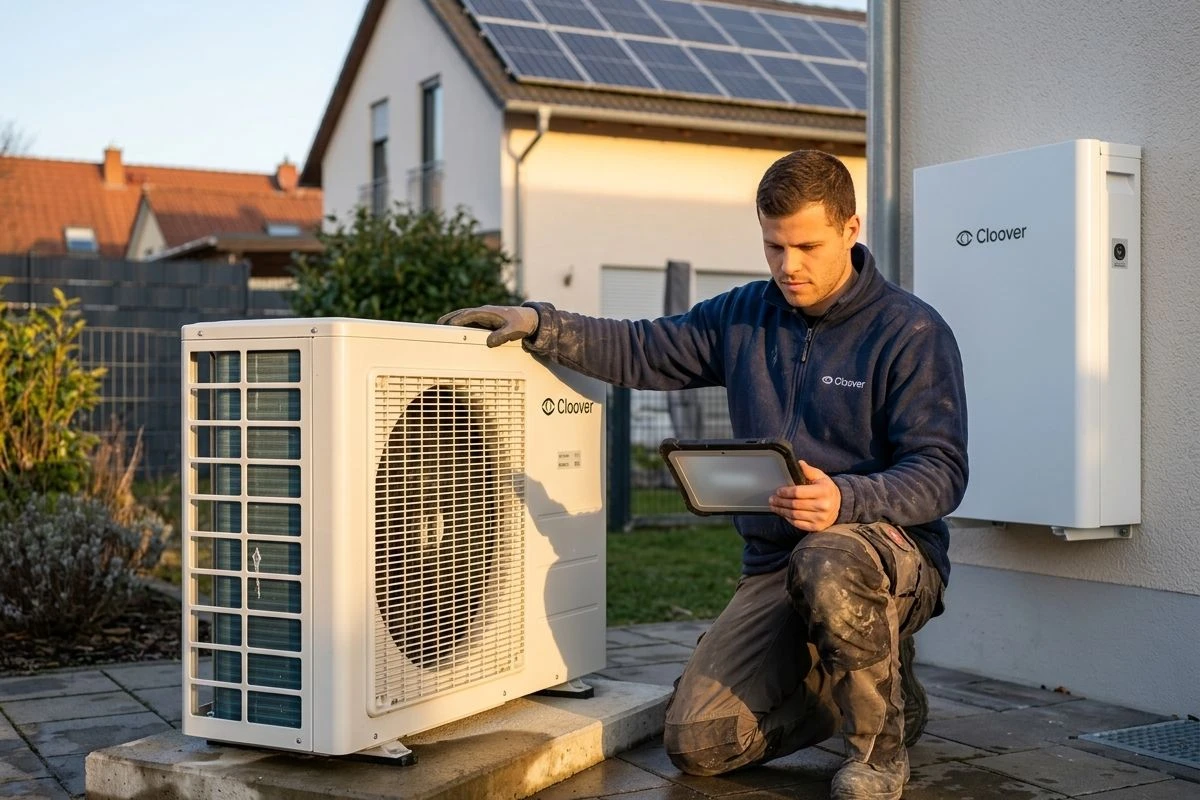
Cloover never built a branded sales army. It built software, credit and now energy products for the independent installers who, Betschart says, do more than 85 percent of home jobs. Those firms keep their name, their customers and their choice of hardware. Financing sits in the quote.
A homeowner gets a credit decision in under two minutes, pays nothing upfront, and can spread the bill over up to 25 years. The company site still lists more than 500 installer partners and claims they see 39 percent more revenue, 26 percent more customers and 32 percent more efficiency once the platform is in the van. Acceptance on the credit side sits above 90 percent, with no deposit and payout after the job is in.
The five markets on the book are Germany, Switzerland, the Netherlands, Sweden and Austria. Austria opened in early 2026 through Heizma, a Vienna heat-pump firm. Betschart said a €30,000 to €40,000 install there can be offered at €100 to €200 a month, which lets a partner close households a bank would have turned away.
NAMED PARTNERS ON THE BOOK
- Austria: Heizma, plus peter.at, Solavolta from Verbund, and WirSindSolar from Neoom, now Betschart’s strongest local names.
- Germany: Coppen, NordConcepte and Galvany, the firms he cited as the core of the home market.
- The offer in the kitchen: A two-minute underwrite, zero down, terms up to 25 years, sold under the installer brand.
Small installers, he has said, are often stuck on working capital. They cannot hold much stock, and households will not write a five-figure cheque on the day. The platform is built to clear both bottlenecks without taking the van or the customer list.
A Private-Credit Line Under an EIF Umbrella
The $100 million is debt. Betschart said it comes from a private-credit fund and goes straight into product: panels, heat pumps, storage and wallboxes. Total financing capacity is now more than $1.3 billion, backed by a $350 million guarantee from the European Investment Fund. In January the same backstop was described as €300 million, which at current rates is about that dollar figure, so the new fact is the extra credit, not a fatter public guarantee.
That public wrap sits in the EIF’s InvestEU debt toolbox. The closest named product is the InvestEU Sustainability Portfolio Guarantee, which is built for green residential work and for lenders who would otherwise not stretch this far on household tickets.
THE CAPITAL STACK SINCE 2023
- October 2023: Pre-seed of about €7 million as the Berlin platform starts.
- May 2024: Seed of $114 million led by Lowercarbon Capital, with 9900 Capital and QED Investors in the round.
- January 2026: Series A of $22 million led by MMC Ventures and QED, beside a $1.2 billion bank debt facility, with Bosch Ventures, Earthshot Ventures, Centrotec and BNVT Capital in the equity.
- 1 September 2026: $100 million private-credit facility added; the company says it is profitable and opens offices in the UK, France and Poland.
Equity on the books is still modest beside the debt. The January equity round was $22 million, and the company has said total equity raised sits a little above $30 million. The heavy lifting is credit that buys hardware, then waits on 25-year paper from households the installer already knows.
299,000 Heat Pumps and a Cash Problem
The German heating market is the pool Cloover is fishing. The German Heat Pump Association recorded 299,000 heating heat pumps sold in 2025, up 55 percent, and a 48 percent share that put the heat pump ahead of gas for the first time. The stock reached about 1.9 million units. Destatis found 73.6 percent of the roughly 58,900 new residential buildings finished in 2025 used a heat pump as the main heat source, with gas down to 10.5 percent.
GERMANY’S 2025 HEATING SHIFT
| Measure | 2025 figure | What moved |
|---|---|---|
| Heating heat pumps sold | 299,000 | Up 55 percent; 48 percent of heat-generator sales |
| Hot-water heat pumps | 49,500 | Up 20 percent |
| Share going into existing homes | 81 percent | About 243,300 retrofit units versus 55,700 in new builds |
| BWP base case for 2026 | About 330,000 | Roughly 10 percent growth if policy holds |
| New homes on a heat pump | 73.6 percent | Destatis, of about 58,900 completions |
Carolin Friedemann, who heads Initiative Climate Neutral Germany, has said the heat pump faces a financing problem, not an acceptance problem. Upfront cost is still the wall for most households. First-half 2026 already shows the pull: about 195,000 units went in, up more than 40 percent on the same stretch of 2025.
Betschart treats subsidy stops as a short-term gift, because households rush the deadline, and a long-term noise source. The curve he watches is total demand, which he says keeps rising. The product, he argues, has to work without a grant, because a 25-year ticket needs a payment path that does not vanish when Berlin or Vienna changes the form.
What Cloover Sells After the Panels Are On
Once the kit is in, Cloover Energy takes over. A home energy management and dynamic tariffs stack runs the house. Solar, batteries, heat pumps and EV chargers are pooled into a virtual power plant that the installer can offer under its own name. Cloover keeps the market plumbing in the back office.
The company calls that an AI-native neo-utility. A classic supplier owns plants, buys power and fights on the next price comparison. This model owns no generation. Its capacity is the installed base, and its product is what that base can do for the grid. House-by-house models forecast generation and use, then schedule storage and flexible loads inside limits the household sets, so a battery charges when power is cheap and a heat pump runs when it costs least.
NEO-UTILITY
- The asset: The financed home itself, not a power station on the company balance sheet.
- The cash: Export when prices spike, load-shifting that cuts grid fees, and automated trades on the intraday market.
Feed-in tariffs and net-metering schemes that carried rooftop solar for two decades are being rebuilt across Europe, in some markets as soon as 2027. Cloover’s reply is that a household should earn from the value of its flexibility, traded in real time, rather than from a fixed export rate. That is also a bet that installations can stand without a subsidy behind them.
We reach households through the installers they already trust, and then we turn each of those homes into a power plant, and each homeowner into a participant in the energy market. That is a relationship that lasts for decades, not a single transaction.
Jodok Betschart, co-founder of Cloover, company statement, 1 September 2026
Co-founder Valentin Gönczy said everything from underwriting to in-home optimisation already runs on AI, and that incumbents are bolting models onto systems built decades ago. Co-founder Peder Broms put the gap in one line: the hardware already works; the missing firm is the one that makes it affordable, reaches people through the installer they know, and turns the house into an energy business.
Global power demand is the backdrop. The International Energy Agency’s Electricity 2026 outlook puts growth at an 3.6 percent a year through 2030, with 3.6 percent in 2026 and 3.8 percent in 2027, as industry, cars, cooling and data centres pull more current. Grids are tight and prices have stayed jumpy since the last energy shock. A home that can generate, store and trade is a hedge. A company that can dispatch thousands of them is sitting on a different kind of plant.
Enpal Already Books a Billion in Sales
Cloover is not walking into an empty field. Enpal, the Berlin solar group, posted about €1.1 billion of sales in 2025 and says it now serves more than 115,000 households in Germany and Italy. Founder Mario Kohle said the home solar market shrank 25 percent in 2025 and Enpal grew 25 percent. Heat pumps, almost a rounding error in 2023, were near a third of core sales by 2025. The firm still runs a sales engine it owns.
Hamburg’s 1KOMMA5° has more than 100,000 customers and booked €520 million in 2024. Coverage of its mid-2026 bank package put 2026 sales around €660 million, with a path to EBITDA profit and a €1 billion financing stack for a no-down-payment solar and heat-pump offer aimed at Enpal’s core buyer. It grew by buying local craft firms and wrapping them in its Heartbeat software. In two years it sold more than 10,000 heat pumps in Germany.
Thermondo, the Berlin heating installer, told its own story in late August. CEO Felix Plog said the firm expects €275 million of sales in 2026 and a first operating profit of €12 million, after years of build-out. He also said none of the so-called clean-tech names in Germany had yet made money, a jab at the vertical giants. Cloover’s profit claim arrived five days later, on a different model: no own sales force, no bought craft shops, no consumer brand on the van.
FOUR WAYS TO SELL A GERMAN ROOF
| Firm | 2025/26 scale | Who owns the customer |
|---|---|---|
| Cloover | $350 million installation run-rate; ~20,000 jobs a year | The independent installer; Cloover supplies credit, software and energy |
| Enpal | About €1.1 billion sales in 2025; 115,000+ homes | Enpal’s own sales machine, plus rental and cash offers |
| 1KOMMA5° | €520 million in 2024; about €660 million planned for 2026 | Local firms the group bought, wrapped in its own software |
| Thermondo | €275 million sales planned for 2026; €12 million operating profit | Its own digital heating installer, now heat-pump only |
The trade already files those names together. At a Berlin energy hackathon in June, Cloover sat in the same lineup as Enpal. That is the tell. The consumer internet still treats this week’s news as another credit ticker. The people who actually wire German houses already treat the installer operating system as a peer of the vertical giants, even though the household never sees the Cloover logo on the invoice.
Offices in the UK, France and Poland are the next physical step. Italy was on the January shopping list and is not in the September release. Hardware choice stays with the customer, including a later retrofit, because the software is built to talk to many inverters and batteries rather than one house brand. Whether the virtual power plant pays like a utility will show up in the intraday book, not in the run-rate. Until then, the $100 million is buying iron for other people’s vans, and the 25-year contract is the asset Cloover actually wants to hold.
Frequently Asked Questions
How Does Cloover’s Homeowner Financing Work?
The quote is built in the installer’s app, a credit and identity check is meant to finish in two minutes, and the household pays nothing until the system is in. The company says there is no Schufa check, no land-registry entry and no fee for early repayment, and that more than 90 percent of applications are accepted. Payout to the installer is tied to a finished job, not to a deposit.
What Is an EIF Sustainability Guarantee?
Under InvestEU, the European Investment Fund offers portfolio guarantees so banks and alternative lenders can take more household and SME climate risk than their own books would allow. The Sustainability product is aimed at energy-efficiency and renewable work in homes and small firms. Cloover’s $350 million wrap sits on that public rail, which is why a private-credit fund can fund panels and heat pumps at this ticket size.
Who Runs Cloover in Berlin?
Jodok Betschart and Peder Broms are co-founders and co-CEOs, with Broms also serving as CFO. Valentin Gönczy is co-founder and chief product officer. Vivek Jain is listed as chief technology officer. PitchBook’s 2026 profile put headcount at 82 and the office at Hussitenstraße 32-33 in Berlin’s Wedding district.
Does Cloover Lock Customers to One Hardware Brand?
No. Betschart said the company does not even keep a separate manufacturer mix statistic, because the software is written to work with as many devices as possible. The homeowner is meant to pick the kit, and to add or swap gear in five or ten years without ripping out the whole system. That is the inverse of a closed stack that only talks to one inverter family.
How Much Does a Financed Heat Pump Cost per Month?
In Austria, Betschart described a €30,000 to €40,000 heat-pump job offered at €100 to €200 a month through Heizma. That is a local example, not a Europe-wide tariff card, and the monthly figure moves with system size, term and credit. A 25-year term is the ceiling Cloover advertises, not the default for every quote.
Disclaimer: This article is news reporting on Cloover GmbH’s 1 September 2026 announcement and on publicly stated market figures. It is informational only and is not investment advice, credit advice, or a recommendation to buy, sell or hold any security, loan or home-energy contract. Readers considering solar, heat-pump or storage finance should speak with a qualified energy adviser and a licensed credit or independent financial adviser about their own property, income and subsidy position before signing. Company run-rates, profit claims, facility sizes and market statistics reflect the cited statements as of 2 September 2026 and may be restated.


Space Cargo Buys Into France’s Zero-G Flight Company

The $399 Omni Walks Away, Then Asks for a Dock

TECNO’s 0mm Bezelless Phone Still Needs a Rim

The Ryobi Tools That Unblocked a Garage Workbench

Ripple’s 700 Million XRP Re-Lock Repeats a Yearlong Pattern

The 2026 Kawasaki Ninja ZX-10R Matches Honda’s Price

Chainlink Puts Official US Inflation and GDP Onchain

Google Pushes Gemini Daily Brief off the Chat Screen

The Crosshair A16 HX Outruns Its Own Power Brick

Cloover Turns a $350 Million Installer Book Into a Utility

Trump Iran Threat Wiped $238M Crypto Longs Then Flipped

30-Year Yield Hits 5.32% Highest Since 2007 as Debt Supply Locks In Costs

Oil Crashes Below $80 as Iran Talks Restart and Markets Split

Walter’s TWG Insists No Fraud as Insurer Probes Force Cleanup

Astute’s $1.2M bet makes B2B creator deals feed AI discovery

Strategy Parks $1.59B Cash While Bitcoin Stack Stays Flat

BlackRock Turns Cash Empire Into Stablecoin Reserve Rails

The 20% Savings Ideal Meets a 2.7% Reality Check

SpaceX Stock Rebound Tests Real Demand Before Huge Unlock

Amber’s €7M locks Mittelstand knowledge inside Europe
-
 FINANCE3 months ago
Zcash Patched a Double-Spend Bug as ZEC Climbed 5%
-
 ENTERTAINMENT3 months ago
Steam Summer Sale 2026 Locks In June 25 to July 9 Dates
-

 FINANCE2 months ago
CLARITY Act Final Text Expected This Weekend as 60-Vote Hurdle Looms
-
 NEWS4 months ago
Meta Adds AI Replies to Threads, But Users Can’t Block It
-

 NEWS3 months ago
YouTube Shorts is testing a heart in place of the thumbs-up
-

 NEWS1 month ago
Senators Force Apple Off Chinese Memory as Big Three Cash In
-

 NEWS3 months ago
NEURA Robotics’ $1.4B Series C Redraws Europe’s Physical AI Bet
-
 ENTERTAINMENT5 months ago
Extraction 3 Is Officially Coming to Netflix in 2027