
NEWS
Space Cargo Buys Into France’s Zero-G Flight Company
Space Cargo Unlimited is buying into Novespace as its orbital factory waits until 2027, adding 22-second parabolic flights to a still-grounded manufacturing plan.

Space Cargo Unlimited has taken a stake in Novespace, the CNES subsidiary that flies Europe’s only parabolic research aircraft. The size of the holding was not disclosed. Nicolas Gaume, co-founder and chief executive of Space Cargo, will join the Novespace board beside France’s national space agency.
The deal was announced on 31 August 2026 from Novespace’s base at Bordeaux-Merignac. It lands while Space Cargo’s own orbital factory is still on Earth. The company’s site now dates the first BentoBox flight on ATMOS Phoenix to 2027.
Space Cargo Buys a Seat on Europe’s Zero-G Plane
Space Cargo Unlimited, founded in 2014 by Gaume and Emmanuel Etcheparre, builds uncrewed boxes that are meant to make things in orbit and bring them home. Its main French shop is in Bordeaux. Headquarters sit in Luxembourg, with further teams in Darmstadt and Turin. In a 9 July 2026 note the company said it employs more than 50 people across Europe and has raised over €40 million, including a €27.5 million Series A closed on 15 September 2025.
Novespace is a different machine. CNES created the company on 8 July 1986 to move space know-how into other industries, then used it to run Europe’s independent parabolic flights. It owns the Airbus A310 Zero-G and sells campaigns to CNES, ESA, DLR, NASA and JAXA. Since 2013 it has also sold a thinner public product under the AirZeroG name.
Gaume framed the stake as plumbing, not a trophy. “Europe has world-class science, engineering and innovation. The next challenge is giving researchers and businesses access to the right infrastructure to turn ideas into products,” he said. “By investing in Novespace, we’re strengthening that journey from early microgravity research through to future commercial manufacturing in orbit.”
Neither company said how large the stake is, what it cost, or whether CNES remains the majority owner. The useful fact is simpler. Space Cargo is now a shareholder in the only European operator that can put a paying customer into weightlessness this year, on a plane that already flies.
The Orbital Factory Is Still on the Ground
BentoBox is Space Cargo’s autonomous return-capable payload platform, a pressurized box with power, cooling and data for several users at once. The company’s own spec sheet lists 100 kg of payload mass, 240 L of volume, a 100 W power cap, and a microgravity level of 10^-4 g, with 10^-6 g for short stretches. It is not a station and not a rocket. It is the factory floor that has to ride in someone else’s vehicle and come back.
That vehicle was supposed to be ATMOS Space Cargo’s Phoenix 2 capsule, recovered near the Azores after a multi-week stay in low Earth orbit. The two firms signed a mission order on 12 November 2025 for the first of seven flights, then aimed at a SpaceX rideshare in 2026. ATMOS had already flown a Phoenix 1 prototype on 21 April 2025. By summer 2026 the first Phoenix 2 slot had moved. Space Cargo’s public timeline now reads 2027 for BentoBox on ATMOS Phoenix, 2028 for a Space Rider demo, 2029 for the introduction of its own REV1 vehicle, and 2030 for industrial-scale flights with multi-tonne return. REV1 is described as a 1-tonne-class reusable ship. A later BentoBox slot on Dassault Aviation’s VORTEX spaceplane is dated 2031.
THE PATH TO THIS DEAL
- 8 July 1986: CNES creates Novespace to run technology transfer and, soon after, Europe’s parabolic flights.
- 5 May 2015: The Airbus A310 Zero-G flies its first science campaign, replacing the retired A300.
- April 2025: Thomas Pesquet becomes Novespace chief executive; ATMOS flies its Phoenix 1 prototype on 21 April.
- 15 September 2025: Space Cargo closes a €27.5 million Series A led by Expansion Ventures and Eurazeo.
- 12 November 2025: Space Cargo and ATMOS sign a mission order for Phoenix-BentoBox flights, then aimed at 2026.
- 17 March 2026: CNES opens its 70th parabolic campaign on the A310 at Merignac.
- 31 August 2026: Space Cargo becomes a Novespace shareholder and Gaume joins the board.
ATMOS has not publicly explained why Phoenix 2.1 moved. Space Cargo has kept signing payload partners, including a 9 July 2026 pact with Japan’s ElevationSpace and an 14 August 2026 drug-discovery tie-up with Transcell Biologics. The commercial pitch is an in-orbit services market projected at US$4.6 billion ($4.6 billion) as soon as 2030. The hardware that would serve that market is still in the hangar.
What 22 Seconds of Weightlessness Can Prove
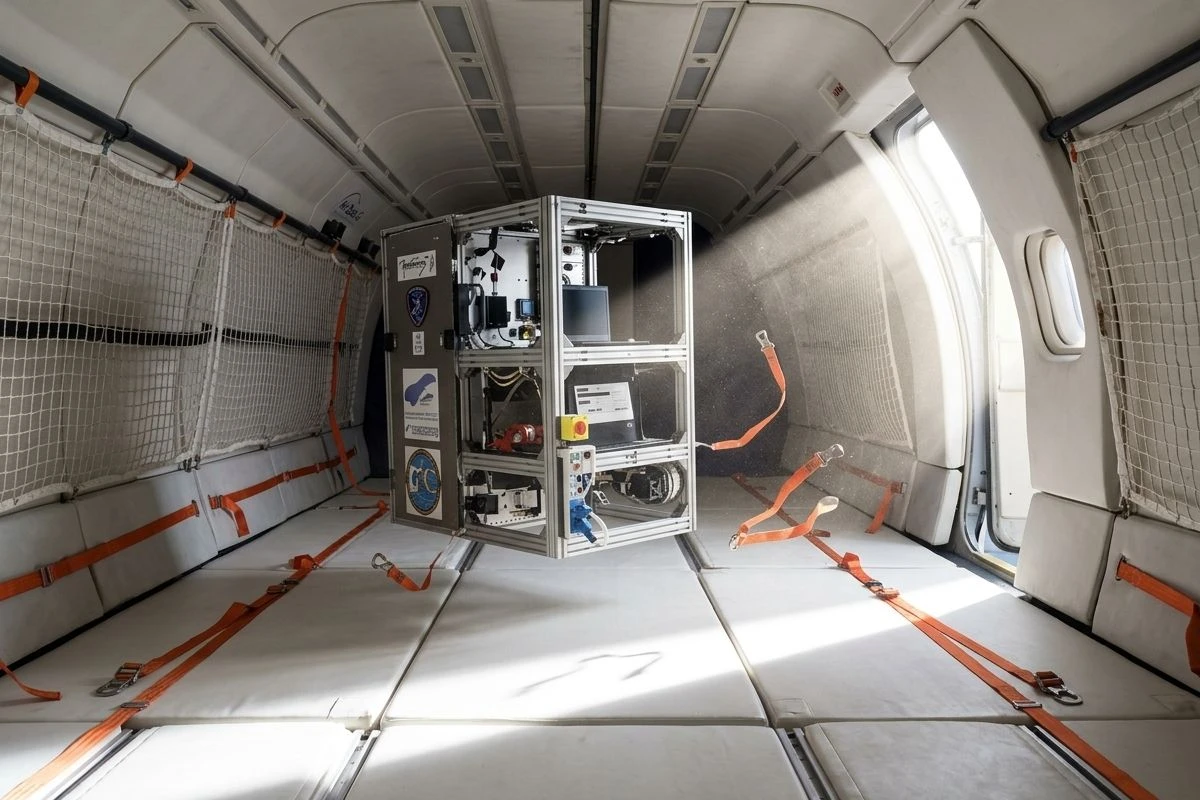
A parabola is a bell-shaped climb and dive. For about 22 seconds of weightlessness per parabola, the A310 and everything in it are in free fall, so a pump, a flame, a bubble or a human inner ear behaves as it would in orbit. CNES lists 31 parabolas on a typical three-hour sortie and a 100 m² padded cabin for experiments. The same aircraft can fly shallower arcs that mimic lunar and Martian gravity. Public AirZeroG flights use 15 parabolas.
THE A310 ZERO-G IN FIGURES
- Free-fall slice: Each science parabola gives 22 seconds of weightlessness.
- Cadence: A standard flight flies 31 parabolas in about three hours.
- Cabin: Researchers get 100 m² of padded floor for racks and crew.
- CNES rhythm: The agency runs two campaigns a year, three flights each, with about a dozen experiments on board.
That is not orbit. A protein crystal, a metal foam or a cell culture that needs days of quiet g will not finish its work between pull-up and pull-out. What the plane can do is break hardware, procedures and people cheaply, in France, with the scientists standing next to the kit. If a valve slams, a flame climbs the wrong way, or a surgeon cannot intubate in 22 seconds, the failure happens at 8,500 metres over the Bay of Biscay rather than on a capsule that will not be fished from the Atlantic for weeks.
CNES still treats the aircraft as a national lab. The 70th CNES campaign in March ran from 17 to 19 March 2026, stacked 93 parabolas, and logged a little more than 30 minutes of cumulative weightlessness. Ten to 15 experiments rode in the cabin. Researchers operated them in real time, which no free-flyer box can match.
WHAT THE MARCH CAMPAIGN FLEW
- Onboard care: Teams drilled emergency intubation and other crew-medical tasks in free fall.
- Perception: Tests looked at how the body reads motion and how space sickness starts.
- Fluids: Bubble and liquid behaviour, which gravity hides on the ground, was filmed in the cabin.
- Fire: Crews studied how flames spread when hot air no longer rises.
- Plasma: The SAFE series kept work going on plasma tools for wound healing.
- Metals: High-temperature liquid-metal tests used aerodynamic levitation in the padded bay.
DLR, Germany’s space agency, buys three campaigns every two years on the same aircraft. ESA flies its own. For a company that wants to sell orbital manufacturing, this is the filter. A customer can shake out a payload on the A310, then pay for a two-week BentoBox slot once Phoenix actually flies.
The Astronaut Who Now Sells Parabolas
Thomas Pesquet, the ESA astronaut who commanded the International Space Station and has spent close to 400 days off the planet, became Novespace’s chief executive in April 2025 after an INSEAD MBA. He already knew the jet. He has flown it as a pilot, including with a new ESA class in 2024. Thierry Gharib remains president. Jean-Francois Clervoy, the astronaut who helped start Europe’s parabolic programme, is honorary president and ambassador. Lionel Suchet, president of CNES, backed Pesquet’s appointment as a way to push the company faster.
Pesquet’s welcome to Space Cargo was warmer than a standard shareholder note, and it gave away the commercial ask.
Parabolic flight sits at the crossroads of extreme aviation and cutting-edge space research. What Novespace has achieved so far is nothing short of remarkable, establishing itself as the world leader in its field. I’m incredibly proud to be part of this team, and there is nowhere else I would rather be today except perhaps in space! We are delighted to welcome SCU as a shareholder, helping us open the door to new markets and new customers.
Thomas Pesquet, CEO of Novespace
The new markets line is the point. Agency campaigns still pay the bills. AirZeroG sells a few discovery flights. Pesquet has been running the firm as an aviation shop, down to signing off orange flight-test polos he compared to Formula 1 kit in March 2026. A commercial factory company on the cap table is a different customer: repeat payloads, private schedules, less patience for the agency calendar.
He is not chained to Merignac. France has already booked him to command a Vast private astronaut mission to the ISS no earlier than summer 2027, the same year Space Cargo now prints for its first Phoenix flight. The plane will need a bench that can sell parabolas when the chief executive is back in orbit.
Gaume Joins the Novespace Board With CNES
When Pesquet took the job, Novespace’s named shareholders were CNES Participations, Bpifrance and Elevation Capital Partners. A private fund had already bought out old bank stakes in 2018. Space Cargo now sits “alongside CNES,” in the companies’ words, which is a quiet change for a firm born as an agency subsidiary and still described that way on the CNES site.
The board seat is the control point Space Cargo actually bought. Gaume does not need to own the A310 to put BentoBox customers on it. He needs a vote on campaign planning, pricing and how much cabin time goes to paying companies rather than the spring and autumn CNES science runs. Pesquet, for his part, gets a shareholder whose whole pitch is to drag private labs into weightlessness and then up the gravity ladder.
That mix will grate. Novespace’s cabin is already full on agency weeks. A dozen experiments share 100 m² and 31 parabolas. Private slots have to fit around CNES, ESA and DLR, around Sabena Technics maintenance, and around the simple fact that there is one modified A310 in Europe. Space Cargo can promise a pathway. It cannot print a second Zero-G aircraft.
After the Station, Short Flights Fill the Gap
NASA has committed to operate the space station through 2030, then hand low Earth orbit to commercial destinations. ESA is buying end-to-end commercial missions for 2026-2029 rather than promising a European station of its own. The long-duration lab that trained a generation of European researchers is running down. The replacements (Vast’s Haven, Axiom, Starlab, Orbital Reef) are still designs, slips and press kits.
Space Cargo is selling a ladder that does not need a station: 22 seconds on the A310, then weeks in an uncrewed box, then a 1-tonne REV1 sometime around 2030. The first rung exists. The second does not, not this year.
MICROGRAVITY ACCESS COMPARED
| Platform | Weightless time | How it comes home | When it is real |
|---|---|---|---|
| A310 Zero-G (Novespace) | 22 seconds, 31 times a flight | Same afternoon, on wheels at Merignac | Flying now |
| BentoBox on ATMOS Phoenix | About two weeks (four on request) | Splashdown near the Azores | Dated 2027 on Space Cargo’s site |
| ISS | Months | Crew and cargo vehicles | Funded through 2030 |
| REV1 | Long-stay, 1-tonne class | Reusable re-entry | Introduction 2029, industrial 2030 |
The stake does not move Phoenix left. It does not add a second European Zero-G plane. It puts a Bordeaux-Luxembourg factory startup on the board of the CNES company that already holds the keys to 22 seconds of free fall, while the box that is supposed to replace the station waits for a capsule. Until that capsule flies, the product Space Cargo can actually deliver is a seat on an Airbus that has been drawing parabolas out of Merignac since 2015.


Space Cargo Buys Into France’s Zero-G Flight Company

The $399 Omni Walks Away, Then Asks for a Dock

TECNO’s 0mm Bezelless Phone Still Needs a Rim

The Ryobi Tools That Unblocked a Garage Workbench

Ripple’s 700 Million XRP Re-Lock Repeats a Yearlong Pattern

The 2026 Kawasaki Ninja ZX-10R Matches Honda’s Price

Chainlink Puts Official US Inflation and GDP Onchain

Google Pushes Gemini Daily Brief off the Chat Screen

The Crosshair A16 HX Outruns Its Own Power Brick

Cloover Turns a $350 Million Installer Book Into a Utility

Trump Iran Threat Wiped $238M Crypto Longs Then Flipped

30-Year Yield Hits 5.32% Highest Since 2007 as Debt Supply Locks In Costs

Oil Crashes Below $80 as Iran Talks Restart and Markets Split

Walter’s TWG Insists No Fraud as Insurer Probes Force Cleanup

Astute’s $1.2M bet makes B2B creator deals feed AI discovery

Strategy Parks $1.59B Cash While Bitcoin Stack Stays Flat

BlackRock Turns Cash Empire Into Stablecoin Reserve Rails

The 20% Savings Ideal Meets a 2.7% Reality Check

SpaceX Stock Rebound Tests Real Demand Before Huge Unlock

Amber’s €7M locks Mittelstand knowledge inside Europe
-
 FINANCE3 months ago
Zcash Patched a Double-Spend Bug as ZEC Climbed 5%
-
 ENTERTAINMENT3 months ago
Steam Summer Sale 2026 Locks In June 25 to July 9 Dates
-

 FINANCE2 months ago
CLARITY Act Final Text Expected This Weekend as 60-Vote Hurdle Looms
-
 NEWS4 months ago
Meta Adds AI Replies to Threads, But Users Can’t Block It
-

 NEWS3 months ago
YouTube Shorts is testing a heart in place of the thumbs-up
-

 NEWS1 month ago
Senators Force Apple Off Chinese Memory as Big Three Cash In
-

 NEWS3 months ago
NEURA Robotics’ $1.4B Series C Redraws Europe’s Physical AI Bet
-
 ENTERTAINMENT5 months ago
Extraction 3 Is Officially Coming to Netflix in 2027